Xylitol Market Size, Share Demand Report By Type (Crystalline Xylitol, Liquid Xylitol), By Application (Food & Beverages, Pharmaceuticals, Personal Care & Cosmetics, Others), Regional Insights & Segment Forecasts, 2026–2034
USD 3950
Xylitol Market Size
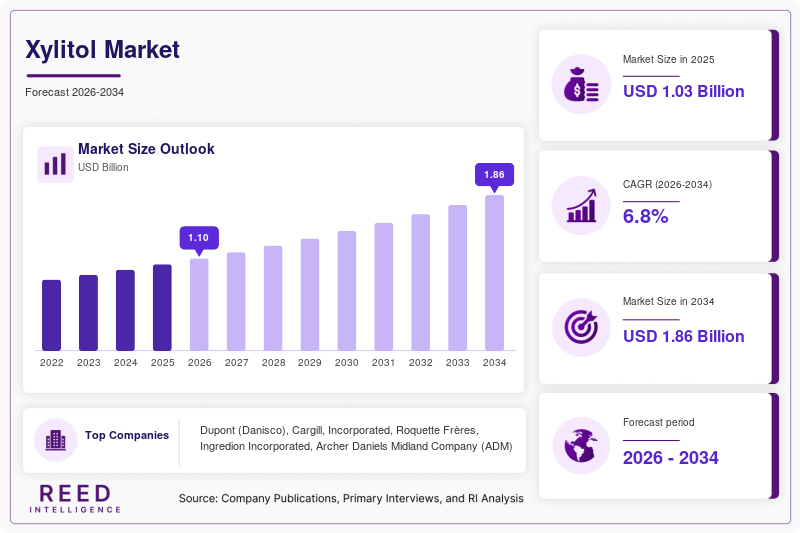
Xylitol market size is projected at USD 1.1 billion in 2026 and is expected to hit USD 1.8 billion by 2034 with a CAGR of 6.8% during the forecast period. The increasing global demand for sugar-free and low-calorie sweeteners, the growing awareness of dental health benefits, and the rising application of xylitol in food, pharmaceutical, and personal care products underpin market expansion. This report delivers a comprehensive analysis of the Xylitol market, including segmentation by type and application, competitive dynamics, and regional growth patterns, equipping stakeholders with critical intelligence. The Xylitol market continues to demonstrate robust growth potential, fueled by the global shift toward healthier lifestyles, the increasing prevalence of diabetes and obesity, and the continuous innovation in xylitol production technology.
Xylitol is a natural sugar alcohol used as a low-calorie sweetener and is known for its dental health benefits and its suitability for diabetics. It is produced from various plant sources, including birch trees and corn cobs, and is widely used in sugar-free chewing gums, mints, oral care products, and as a sugar substitute. The global market for xylitol is driven by the demand for healthier sugar alternatives. The global production volume of xylitol exceeded 280,000 metric tons in 2025, reflecting a 7% increase from 2022. Adoption patterns reveal that the crystalline xylitol segment dominates the market, accounting for 70% of total demand, followed by liquid xylitol at 30%. The Xylitol market's trajectory is closely linked to the growth of the global sugar substitute market, which is projected to reach USD 30 billion by 2028, and the increasing consumer focus on health and wellness.
Xylitol Market Trends
Growing Demand for Natural and Plant-Based Xylitol
The Xylitol market is witnessing a significant trend toward natural and plant-based xylitol, driven by consumer preference for clean-label and sustainable ingredients. The revenue from natural xylitol (derived from birch and other plant sources) grew to USD 0.4 billion in 2025, a year-on-year increase of 8%, as 30% of new product launches in 2025 featured natural xylitol. Adoption rates of plant-based xylitol in the food and beverage sector reached 25%, with this figure projected to exceed 40% by 2030. The Xylitol market's trend toward natural is reinforced by the increasing consumer awareness of food origins, the growing demand for sustainable products, and the development of cost-effective production processes from agricultural residues.
Increasing Focus on Dental and Oral Health Applications
The increasing focus on dental and oral health applications is a major trend shaping the Xylitol market, with xylitol being a key ingredient in products like chewing gum, toothpaste, and mouthwash. The market has seen a 15% increase in the demand for xylitol in oral care products since 2022, with 20% of new product launches in 2025 featuring xylitol for its dental benefits. The use of xylitol in professional dental products and preventive care has also gained traction. The Xylitol market's trend toward oral health is reinforced by the growing awareness of the link between oral health and overall health, the increasing prevalence of dental caries, and the continuous innovation in oral care formulations.
Xylitol Market Drivers
The Xylitol market's expansion is primarily driven by the increasing global demand for sugar-free and low-calorie sweeteners, with the global sugar substitute market growing at a CAGR of 6%. The growing awareness of the dental health benefits of xylitol, including its ability to reduce plaque and prevent tooth decay, has also been a major driver. The rising prevalence of diabetes and obesity has fueled the demand for low-glycemic sweeteners like xylitol. Additionally, the expanding application of xylitol in pharmaceuticals and personal care products has driven market growth. The Xylitol market's growth is further reinforced by the continuous innovation in production technology, leading to improved efficiency and reduced costs.
Xylitol Market Restraints
Despite favorable growth prospects, the Xylitol market faces significant constraints, primarily related to the higher cost of xylitol compared to other sugar substitutes, which can be a barrier for some applications. The potential for gastrointestinal discomfort with excessive consumption can also be a limitation. The Xylitol market's growth is also tempered by the competition from other sweeteners, such as stevia and erythritol.
Xylitol Market Opportunities
The Xylitol market presents significant opportunities in the rapidly expanding market for functional foods and nutraceuticals, where the global market is projected to reach USD 450 billion by 2028. The adoption of xylitol in functional food and beverage applications is expected to grow at a CAGR of 8% through 2034. Emerging opportunities also exist in the development of xylitol for new applications, such as in pharmaceuticals and nutraceuticals for its prebiotic properties. The Xylitol market's opportunity profile is further enhanced by the growing trend of sugar reduction and the increasing consumer demand for natural and healthy ingredients.
Challenges in Xylitol Market
The Xylitol market faces persistent challenges related to the management of production costs and the need for efficient manufacturing processes, as production from biomass can be complex and energy-intensive. The complexity of ensuring product purity and consistency presents a challenge. The market is also contending with the challenge of educating consumers about the benefits and proper use of xylitol. Additionally, the Xylitol market is challenged by the need for continuous innovation to improve production efficiency and develop new applications.
Xylitol Market Segmentation
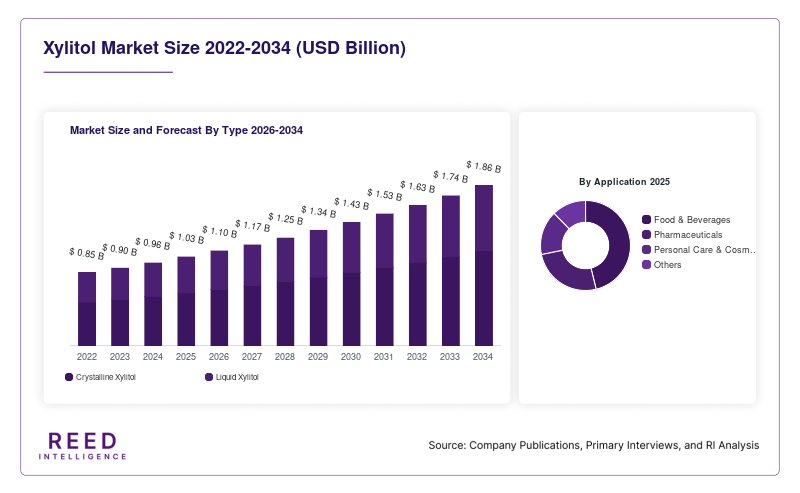
The Xylitol market is segmented by Type and Application to provide a comprehensive market perspective. By Type, Crystalline Xylitol dominates with a 70% market share, driven by its stability and ease of use. The Application segment is led by Food & Beverages, which accounts for 55% of the market, followed by Pharmaceuticals at 20%, Personal Care & Cosmetics at 15%, and Others at 10%.
By Type
Crystalline Xylitol represent the largest segment in the Xylitol market, commanding a 70% share, with production reaching 196,000 metric tons in 2025. This form is characterized by its high purity, stability, and ease of handling. Technical specifications include purity, particle size, and solubility. The Xylitol market's crystalline segment is driven by its use in food, pharmaceutical, and personal care products.
Liquid Xylitol capture a 30% share of the Xylitol market, with production of 84,000 metric tons in 2025. This form is characterized by its ease of use in liquid formulations and its convenience. Technical specifications include concentration, viscosity, and purity. The Xylitol market's liquid segment is driven by its use in liquid applications like syrups and oral care products.
By Application
Food & Beverages dominates the Xylitol market, accounting for 55% of sales, representing 154,000 metric tons in 2025. This segment includes use in sugar-free chewing gum, candies, beverages, and baked goods. Usage penetration exceeds 20% in the sugar-free confectionery sector. The Xylitol market's food segment is characterized by its focus on sweetness and health benefits.
Pharmaceuticals accounts for 20% of the Xylitol market, with a volume of 56,000 metric tons in 2025. This segment encompasses use in medicines, syrups, and nutritional supplements. The segment is growing at a steady CAGR, driven by the pharmaceutical industry. The Xylitol market's pharmaceutical segment is characterized by its focus on purity and quality.
Personal Care & Cosmetics represents 15% of the Xylitol market, with a volume of 42,000 metric tons in 2025. This segment includes use in toothpaste, mouthwash, and skincare products. The segment is growing at a steady CAGR, driven by the demand for natural ingredients. The Xylitol market's personal care segment is characterized by its focus on oral and skin health benefits.
Others comprises the remainder of the Xylitol market, accounting for 10% of total sales, with 28,000 metric tons in 2025. This segment includes use in other industrial and specialty applications. The segment is projected to grow at a steady CAGR through 2034.
Xylitol Market Regional Outlook
Asia-Pacific Xylitol Market
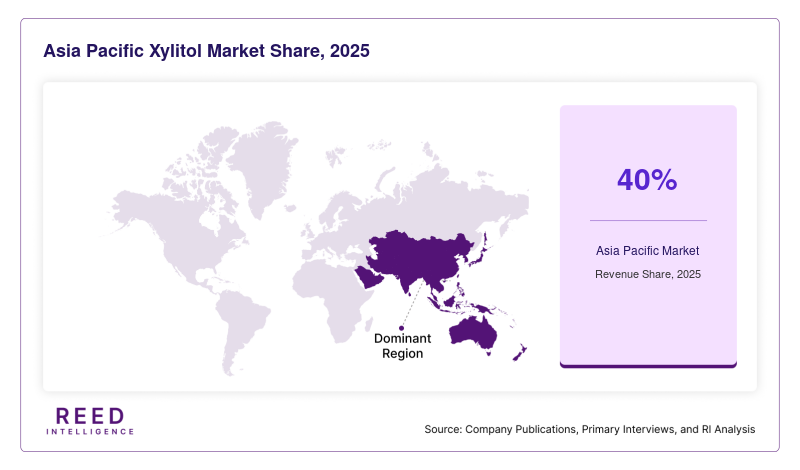
Leads the Xylitol market, commanding a 40% share, with a revenue of USD 0.44 billion in 2025. China, Japan, and India are the primary drivers, accounting for 70% of regional demand, driven by the large food and pharmaceutical industries. The Asia-Pacific Xylitol market is characterized by its high growth rate and focus on cost-effective production.
North America Xylitol Market
Represents the second-largest market, capturing a 28% share with a revenue of USD 0.31 billion in 2025. The United States dominates regional demand, accounting for 80% of consumption, driven by the strong demand for sugar-free products and oral care. The Xylitol market in North America is characterized by its focus on innovation and premium products.
Europe Xylitol Market
Accounts for 22% of the global Xylitol market, with a revenue of USD 0.24 billion in 2025. Germany, the UK, and France collectively represent 55% of the regional market, driven by the strong focus on health and wellness. The Xylitol market in Europe is characterized by its focus on quality and sustainability.
Middle East & Africa and Latin America Xylitol Market
Together account for the remaining 10% of the Xylitol market, with South Africa leading the African market and Brazil leading the Latin American market. Both regions are projected to grow at CAGRs exceeding 7%, driven by the increasing health awareness.
Top players in Xylitol Market
- Dupont (Danisco)
- Cargill, Incorporated
- Roquette Frères
- Ingredion Incorporated
- Archer Daniels Midland Company (ADM)
- Shandong Longlive Bio-Technology Co., Ltd.
- Zhejiang Huakang Pharmaceutical Co., Ltd.
- Futaste Pharmaceutical Co., Ltd.
- Mitsubishi Corporation
- Towa Chemical Industry Co., Ltd.
- Xylitol Canada Inc.
- Novagreen Inc.
- Jilin Province Xinyuan Pharmaceutical Co., Ltd.
- Hengtian Nuowei Group
- Nanjing Chemspec Chemical Co., Ltd.
Dupont (Danisco)
Dupont holds a dominant position in the Xylitol market, with an estimated 16% global market share, particularly strong in the North American and European segments. The company's portfolio of high-quality xylitol products is widely recognized for its purity and performance. Dupont's market leadership is reinforced by its significant R&D investment and its strong global presence. Dupont commands over 20% of the North American market and 14% of the European market, positioning it as a key player in the Xylitol market.
Cargill, Incorporated
Cargill is a leading player in the Xylitol market, commanding approximately 12% of the global market share through its comprehensive portfolio of sweetener solutions. The company's expertise in ingredient sourcing and processing and its strong presence in the global market have solidified its position. Cargill's focus on developing innovative and sustainable xylitol solutions has strengthened its position. The company's commitment to quality has enhanced its brand equity.
Roquette Frères holds a significant 10% market share, with particular strength in the European and Asian markets, where it commands a 12% share. The company's focus on plant-based ingredients is a key differentiator. Ingredion Incorporated is a major player in the global ingredient market, holding a 9% share.
Recent Developments in Xylitol Market
- 2025: Dupont launched a new line of organic xylitol derived from non-GMO corn, targeting the clean-label and organic food market.
- 2025: Cargill introduced a new high-purity liquid xylitol for pharmaceutical and oral care applications, offering improved solubility and stability.
Xylitol Market Segments
By Type
- Crystalline Xylitol
- Liquid Xylitol
By Application
- Food & Beverages
- Pharmaceuticals
- Personal Care & Cosmetics
- Others
By Region
- North America
- Europe
- APAC
- Middle East and Africa
- LATAM