Glucoamylase Market Size, Share & Demand Report By Type (Microbial Glucoamylase, Plant-Based Glucoamylase, Genetically Engineered Glucoamylase), By Application (Food & Beverage Processing, Bioethanol Production, Animal Feed, Pharmaceuticals), By End-Use Industry (Food & Beverage Industry, Energy & Biofuel Industry, Pharmaceutical & Biotechnology Industry, Agriculture Industry), By Region & Segment Forecasts, 2026–2034
USD 3950
Market Overview
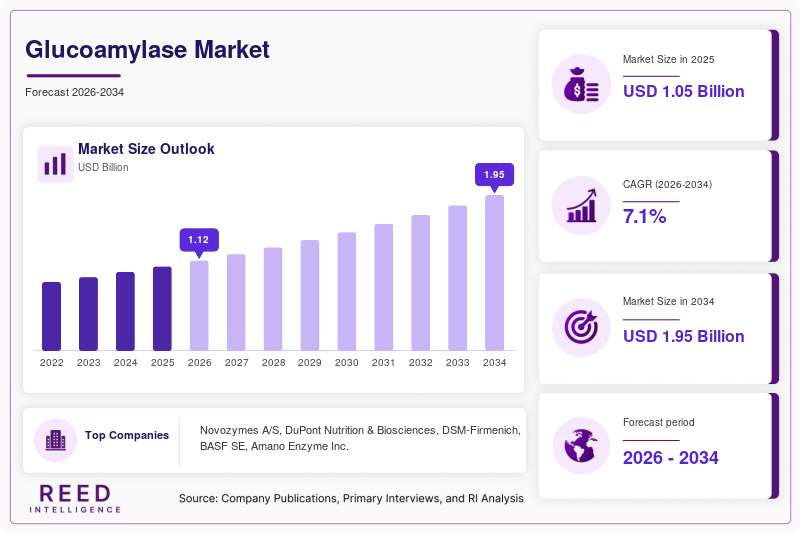
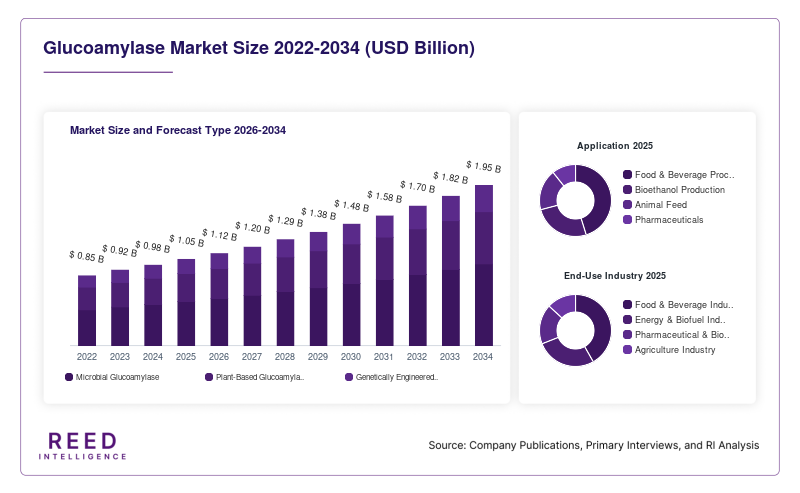
The Glucoamylase Market size was valued at approximately USD 1.05 billion in 2026 and is projected to reach USD 1.82 billion by 2034, expanding at a CAGR of 7.1% during the forecast period (2026–2034). Glucoamylase, an essential enzyme used to break down starch into glucose, plays a critical role across industries such as food & beverages, biofuel production, pharmaceuticals, and animal feed. Increasing industrial demand for efficient starch conversion processes has significantly influenced market expansion, particularly in emerging economies where industrialization and processed food consumption are growing steadily.
One of the primary global factors supporting the growth of the glucoamylase market is the rising demand for bioethanol production. Governments worldwide are promoting renewable energy sources, and bioethanol derived from starch-based feedstocks requires glucoamylase during the saccharification stage. This has led to increased enzyme consumption, especially in regions with strong biofuel mandates. Additionally, the food processing industry continues to rely on glucoamylase for producing sweeteners such as glucose syrup and high-fructose corn syrup, further contributing to market growth.
Key Highlights
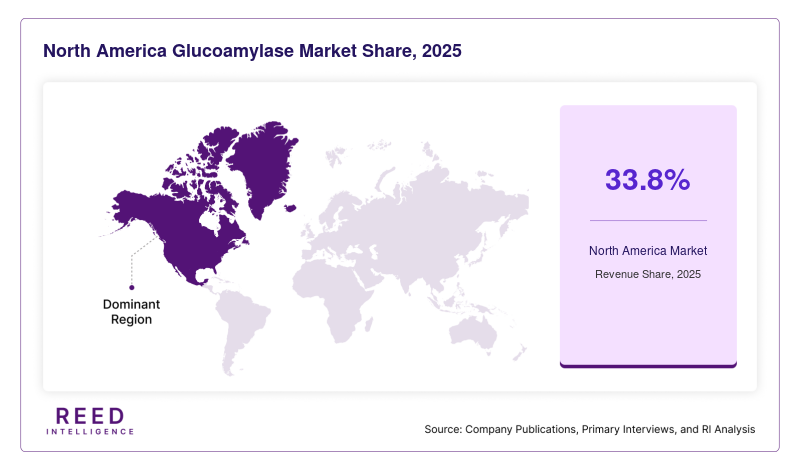
- North America dominated the market with a 33.8% share in 2025.
- Asia Pacific is expected to grow at the fastest CAGR of 8.4% during 2026–2034.
- By type, microbial glucoamylase accounted for the largest share of 61.2%, while genetically engineered variants are projected to grow at a CAGR of 9.1%.
- By application, bioethanol production led with a 42.5% share, whereas food & beverage processing is expected to expand at a CAGR of 7.8%.
- The United States remained the dominant country, with market values of USD 320 million in 2024 and USD 345 million in 2025.
Market Trends
Expansion of Enzyme Engineering Technologies
Advancements in enzyme engineering have emerged as a significant trend shaping the glucoamylase market. Companies are increasingly investing in biotechnology to enhance enzyme stability, efficiency, and substrate specificity. Genetically modified strains of microorganisms are being developed to produce glucoamylase with higher thermal stability and improved catalytic performance. This reduces production costs and improves yield in industrial processes such as starch hydrolysis and ethanol fermentation. The growing integration of synthetic biology and protein engineering techniques is enabling manufacturers to tailor enzymes for specific industrial applications, making them more versatile and cost-effective.
Moreover, the trend toward sustainable manufacturing is accelerating the adoption of engineered glucoamylase enzymes. Industries are seeking solutions that minimize energy consumption and waste generation, and optimized enzymes help achieve these goals. As regulatory bodies encourage environmentally friendly production methods, enzyme manufacturers are aligning their research efforts accordingly. This shift is expected to drive long-term innovation and create differentiation among market players.
Rising Demand for Processed and Functional Foods
The increasing consumption of processed and functional foods is another key trend influencing the glucoamylase market. Urbanization and changing lifestyles have led to higher demand for convenience foods, which often require enzymatic processing to improve texture, taste, and shelf life. Glucoamylase is widely used in the production of sweeteners, baked goods, and beverages, making it an essential component in modern food processing.
In addition, consumer awareness regarding functional ingredients is rising, leading manufacturers to incorporate enzymes that enhance nutritional profiles. Glucoamylase supports the production of glucose syrups and other derivatives used in low-fat and reduced-sugar formulations. This trend is particularly prominent in developing regions, where the food processing industry is expanding rapidly. As food manufacturers continue to innovate and diversify their product portfolios, the demand for efficient enzymatic solutions is expected to grow steadily.
Market Drivers
Growth in Bioethanol Production
The expanding bioethanol industry is a major driver for the glucoamylase market. Bioethanol production relies heavily on enzymatic conversion of starch into fermentable sugars, where glucoamylase plays a critical role. Governments across the globe are implementing policies to reduce carbon emissions and promote renewable energy sources, leading to increased investment in biofuel production facilities. This has directly boosted the demand for glucoamylase enzymes.
Furthermore, the adoption of second-generation biofuels is creating additional opportunities for enzyme manufacturers. Although these processes involve lignocellulosic materials, starch-based bioethanol remains a dominant segment, especially in countries with abundant agricultural resources. Continuous improvements in enzyme efficiency and cost reduction strategies are making bioethanol production more economically viable, thereby strengthening the demand for glucoamylase in this sector.
Increasing Applications in Food Processing Industry
The food processing industry continues to be a key growth driver for the glucoamylase market. The enzyme is widely used in the production of glucose syrup, high-fructose corn syrup, and other sweeteners that are essential ingredients in various food products. As consumer preferences shift toward ready-to-eat and packaged foods, manufacturers are increasingly relying on enzymatic processes to enhance product quality and consistency.
Additionally, the bakery and beverage sectors are witnessing strong growth, further supporting enzyme demand. Glucoamylase helps improve dough fermentation, texture, and sweetness in baked goods, while also playing a role in brewing and beverage production. The expansion of the global food industry, coupled with technological advancements in processing methods, is expected to sustain the demand for glucoamylase over the forecast period.
Market Restraint
High Production Costs and Regulatory Challenges
One of the primary restraints affecting the glucoamylase market is the high cost associated with enzyme production and regulatory compliance. Manufacturing glucoamylase involves complex fermentation processes, stringent quality control measures, and advanced purification techniques, all of which contribute to elevated production costs. Small and medium-scale manufacturers often face challenges in maintaining profitability due to these expenses.
In addition, regulatory requirements related to enzyme safety and environmental impact vary across regions, creating barriers for market entry and expansion. Companies must adhere to strict guidelines regarding the use of genetically modified organisms and enzyme residues in food products. For example, obtaining approvals for new enzyme formulations can be time-consuming and costly, delaying product launches. These factors can limit the adoption of glucoamylase in certain markets and hinder overall industry growth.
Market Opportunities
Emerging Demand in Developing Economies
Developing economies present significant opportunities for the glucoamylase market due to rapid industrialization and growing food processing sectors. Countries in Asia Pacific and Latin America are experiencing increased demand for processed foods, biofuels, and animal feed, all of which require enzymatic solutions. The expansion of manufacturing facilities and favorable government policies are encouraging investments in these regions.
Additionally, rising disposable incomes and changing dietary patterns are driving the consumption of packaged and convenience foods. This creates a favorable environment for enzyme manufacturers to expand their presence and cater to new customer segments. By establishing local production units and forming strategic partnerships, companies can capitalize on these emerging opportunities and strengthen their market position.
Innovation in Enzyme Formulations
Innovation in enzyme formulations offers another promising opportunity for market growth. Manufacturers are focusing on developing multi-functional enzymes that can perform multiple roles in industrial processes, thereby reducing the need for additional inputs. This not only enhances efficiency but also lowers operational costs for end-users.
Furthermore, advancements in biotechnology are enabling the development of customized enzyme solutions tailored to specific applications. For instance, enzymes with improved tolerance to extreme pH and temperature conditions are gaining traction in industrial settings. As research and development activities continue to evolve, the introduction of innovative glucoamylase products is expected to open new avenues for market expansion.
Segmental Analysis
By Type
Microbial glucoamylase dominated the market in 2024, accounting for approximately 61.2% of the total share. This dominance can be attributed to its high efficiency, cost-effectiveness, and widespread availability. Microbial sources such as fungi and bacteria are commonly used for enzyme production due to their ability to generate large quantities of glucoamylase through fermentation processes. Industries prefer microbial enzymes because they offer consistent performance and can be easily optimized for specific applications. The growing demand for industrial enzymes in food processing and biofuel production further supports the dominance of this segment.
Genetically engineered glucoamylase is the fastest-growing subsegment, projected to expand at a CAGR of 9.1% during the forecast period. Advances in biotechnology have enabled the development of enzymes with enhanced properties, such as improved thermal stability and higher catalytic efficiency. These engineered enzymes are particularly useful in industrial processes that require extreme operating conditions. The increasing focus on reducing production costs and improving process efficiency is driving the adoption of genetically modified enzymes, making this subsegment a key contributor to future market growth.
By Application
Bioethanol production emerged as the dominant application segment in 2024, capturing 42.5% of the market share. The enzyme plays a critical role in converting starch into fermentable sugars, which are essential for ethanol fermentation. The growing emphasis on renewable energy sources and government mandates promoting biofuel usage have significantly boosted the demand for glucoamylase in this segment. Additionally, the availability of raw materials such as corn and sugarcane in major producing countries supports the expansion of bioethanol production.
Food and beverage processing is the fastest-growing application segment, with a projected CAGR of 7.8%. The increasing consumption of processed foods and beverages is driving the demand for enzymes that enhance product quality and consistency. Glucoamylase is widely used in the production of sweeteners, baked goods, and alcoholic beverages. The growing trend of functional foods and clean-label products is further encouraging manufacturers to adopt enzyme-based solutions, contributing to the rapid growth of this segment.
By End-Use Industry
The food and beverage industry dominated the glucoamylase market in 2024, accounting for a significant share of global demand. The widespread use of glucoamylase in producing sweeteners, improving dough quality, and enhancing beverage fermentation processes has made it an essential component in this sector. The industry’s continuous expansion, driven by rising consumer demand for convenience foods, has further strengthened its position as the leading end-use segment.
The pharmaceutical and biotechnology sector is the fastest-growing end-use industry, with a CAGR of 8.6% during the forecast period. The increasing use of enzymes in drug formulation and biotechnology applications is driving demand in this segment. Glucoamylase is utilized in various biochemical processes, including the production of glucose for medical and research purposes. The growing focus on innovation and the development of advanced therapeutic solutions are expected to boost the adoption of glucoamylase in this industry.
Regional Analysis
North America
North America accounted for approximately 33.8% of the glucoamylase market share in 2025 and is expected to grow at a CAGR of 6.5% during the forecast period. The region’s strong presence in bioethanol production and advanced food processing industries has significantly contributed to its dominance. High adoption of enzyme-based technologies and continuous investment in research and development further support market growth.
The United States remains the dominant country in this region, driven by its well-established biofuel industry. Government mandates promoting ethanol blending and the availability of corn as a primary feedstock have created a robust demand for glucoamylase. Additionally, the country’s focus on sustainable manufacturing practices is encouraging the adoption of advanced enzyme solutions.
Europe
Europe held a substantial share of the glucoamylase market in 2025, supported by its strong food and beverage sector and increasing emphasis on sustainable production methods. The region is projected to grow at a CAGR of 6.8% during the forecast period, driven by technological advancements and regulatory support for eco-friendly processes.
Germany leads the European market due to its advanced industrial infrastructure and focus on innovation. The country’s commitment to reducing carbon emissions has boosted the adoption of biofuels, thereby increasing the demand for glucoamylase. Additionally, the presence of major enzyme manufacturers contributes to market growth.
Asia Pacific
Asia Pacific is the fastest-growing region in the glucoamylase market, with a projected CAGR of 8.4% from 2026 to 2034. The region’s rapid industrialization, expanding food processing sector, and increasing bioethanol production are key factors driving growth. Countries such as China and India are witnessing significant demand for enzyme-based solutions.
China dominates the regional market due to its large-scale industrial operations and growing demand for processed foods. The country’s focus on improving production efficiency and reducing environmental impact has led to increased adoption of glucoamylase. Government initiatives supporting renewable energy further contribute to market expansion.
Middle East & Africa
The Middle East & Africa region is experiencing steady growth in the glucoamylase market, with a CAGR of 6.2% during the forecast period. The region’s developing industrial base and increasing investments in food processing and biofuel production are driving demand for enzymes.
South Africa emerges as a key market in this region, supported by its growing food and beverage industry. The country’s efforts to enhance agricultural productivity and promote value-added processing are creating opportunities for enzyme manufacturers. Additionally, rising awareness about sustainable production practices is encouraging the adoption of glucoamylase.
Latin America
Latin America holds a moderate share of the glucoamylase market and is expected to grow at a CAGR of 7.0% during the forecast period. The region’s strong agricultural base and increasing focus on bioethanol production are key growth drivers. Brazil, in particular, plays a significant role in the regional market.
Brazil dominates the Latin American market due to its well-established ethanol industry. The country’s abundant sugarcane resources and supportive government policies have created a favorable environment for biofuel production. This, in turn, drives the demand for glucoamylase in starch conversion processes.
Competitive Landscape
The glucoamylase market is characterized by the presence of several established players focusing on innovation, strategic partnerships, and capacity expansion to strengthen their market position. Companies are investing in research and development to enhance enzyme efficiency and develop customized solutions for various industrial applications. The competitive landscape is moderately consolidated, with key players holding a significant share of the market.
Novozymes A/S is recognized as a leading player in the market, known for its extensive enzyme portfolio and strong focus on sustainability. The company recently introduced an advanced glucoamylase variant designed to improve bioethanol production efficiency. Other major players are also expanding their global footprint through collaborations and acquisitions, aiming to cater to the growing demand across different regions.
Key Players
- Novozymes A/S
- DuPont Nutrition & Biosciences
- DSM-Firmenich
- BASF SE
- Amano Enzyme Inc.
- AB Enzymes
- Advanced Enzyme Technologies
- Chr. Hansen Holding A/S
- Jiangsu Boli Bioproducts Co., Ltd.
- Shandong Longda Bio-Products Co., Ltd.
- Sunson Industry Group Co., Ltd.
- Verenium Corporation
- Biocatalysts Ltd.
- Enzyme Development Corporation
- Aumgene Biosciences
Recent Developments
- Novozymes A/S launched a new high-performance glucoamylase enzyme to enhance ethanol yield in industrial applications.
- DSM-Firmenich expanded its enzyme production facility to meet rising global demand for biofuel enzymes.
- Advanced Enzyme Technologies introduced a customized glucoamylase solution for the food processing industry, focusing on improved efficiency and cost reduction.
Glucoamylase Market Segments
Type
- Microbial Glucoamylase
- Plant-Based Glucoamylase
- Genetically Engineered Glucoamylase
Application
- Food & Beverage Processing
- Bioethanol Production
- Animal Feed
- Pharmaceuticals
End-Use Industry
- Food & Beverage Industry
- Energy & Biofuel Industry
- Pharmaceutical & Biotechnology Industry
- Agriculture Industry
By Region
- North America
- Europe
- APAC
- Middle East and Africa
- LATAM