Gluten-Free Tortilla Market Size, Share & Demand Report By Type (Corn-Based Tortillas, Cassava-Based Tortillas, Almond Flour-Based Tortillas, Coconut Flour-Based Tortillas, Others), By Ingredient Source (Grain-Based, Nut-Based, Legume-Based, Others), By Distribution Channel (Supermarkets & Hypermarkets, Convenience Stores, Online Retail, Specialty Stores), By End-Use (Household, Foodservice), By Region & Segment Forecasts, 2025–2034
USD 3950
Market Overview
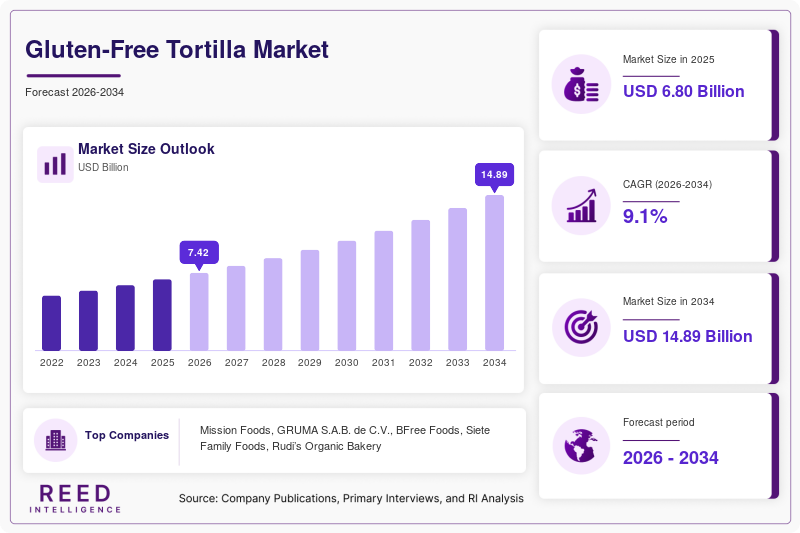
The Gluten-Free Tortilla Market size was valued at approximately USD 6.8 billion in 2025 and is projected to reach USD 14.9 billion by 2034, expanding at a CAGR of 9.1% from 2025 to 2034. The market has witnessed steady expansion due to increasing consumer awareness regarding gluten intolerance and the growing adoption of specialized diets across both developed and emerging economies.
A key global factor supporting market growth is the rising prevalence of celiac disease and gluten sensitivity, which has significantly influenced dietary patterns. Consumers are increasingly shifting toward gluten-free alternatives, not only for medical reasons but also as part of broader health and wellness trends. This shift has encouraged manufacturers to innovate with diverse ingredients such as corn, cassava, almond flour, and coconut flour to improve texture and nutritional value.
Key Highlights:
- North America dominated the market with approximately 38% share in 2025, while Asia Pacific is expected to register the fastest growth at a CAGR of 10.8%.
- By type, corn-based tortillas led the market, while cassava-based tortillas are anticipated to grow fastest at a CAGR of 11.2%.
- By distribution channel, supermarkets & hypermarkets held the largest share, whereas online retail is projected to expand at a CAGR of 12.5%.
- The United States remained the dominant country, with a market value of USD 2.1 billion in 2025 and an estimated USD 2.3 billion in 2026.
Market Trends
Expansion of Clean-Label and Plant-Based Formulations
The Gluten-Free Tortilla Market is increasingly influenced by the demand for clean-label products. Consumers prefer tortillas made from natural, minimally processed ingredients without artificial additives or preservatives. This has encouraged manufacturers to adopt plant-based and organic raw materials such as quinoa, chickpea flour, and flaxseed. Transparency in ingredient sourcing and labeling has become a critical factor shaping purchasing decisions, particularly in developed markets.
Innovation in Texture and Taste Enhancement
One of the longstanding challenges in gluten-free products has been achieving desirable texture and flavor. Recent advancements in food processing technologies have enabled manufacturers to improve product quality, making gluten-free tortillas comparable to traditional wheat-based options. Innovations such as multi-grain blends and fermentation techniques are enhancing product appeal. This trend is also expanding the consumer base beyond individuals with gluten intolerance to mainstream health-conscious consumers.
Market Drivers
Increasing Adoption of Specialized Diets
The growing popularity of gluten-free, keto, and paleo diets has significantly boosted demand in the Gluten-Free Tortilla Market. Consumers are actively seeking alternatives that align with their dietary preferences, creating a strong demand for versatile and convenient gluten-free food options. Tortillas, being a staple in many cuisines, have benefited from this shift, particularly in urban areas with higher health awareness.
Growth in Foodservice and Quick-Service Restaurants
The expansion of quick-service restaurants and fast-casual dining establishments offering gluten-free menu options has played a crucial role in market growth. Restaurants are incorporating gluten-free tortillas in wraps, tacos, and burritos to cater to diverse customer needs. This trend has increased product visibility and consumption frequency, thereby supporting overall market expansion.
Market Restraint
Higher Production Costs and Pricing Challenges
The Gluten-Free Tortilla Market faces a significant restraint in the form of higher production costs. Gluten-free ingredients such as almond flour, cassava, and specialty grains are generally more expensive than traditional wheat. Additionally, the need for dedicated manufacturing facilities to avoid cross-contamination further increases operational costs.
These cost factors translate into higher retail prices, which can limit adoption among price-sensitive consumers, particularly in developing regions. While demand is growing, affordability remains a challenge that could hinder widespread penetration. Manufacturers must balance quality, innovation, and cost-efficiency to remain competitive in the evolving market landscape.
Market Opportunities
Expansion in Emerging Economies
Emerging markets in Asia Pacific and Latin America present significant growth opportunities for the Gluten-Free Tortilla Market. Rising disposable incomes, urbanization, and increasing awareness of gluten-related health issues are driving demand. Local manufacturers are also entering the market with region-specific formulations, which is expected to enhance product acceptance and market penetration.
Product Diversification and Functional Ingredients
The incorporation of functional ingredients such as high-protein flours, fiber-rich grains, and fortified nutrients offers substantial opportunities for differentiation. Consumers are increasingly seeking products that provide additional health benefits beyond being gluten-free. This trend is encouraging companies to develop tortillas with enhanced nutritional profiles, thereby expanding their appeal to fitness-oriented and health-conscious consumers.
Segmental Analysis
By Type
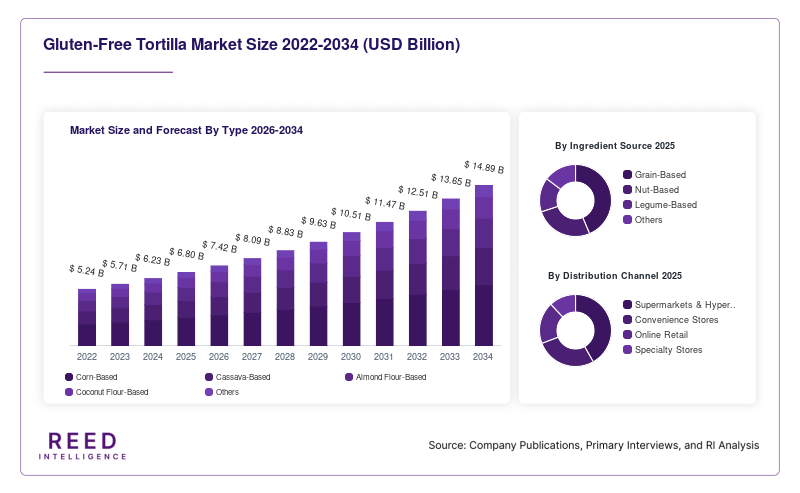
Corn-based tortillas dominated the Gluten-Free Tortilla Market in 2025, accounting for approximately 52% of the total share. Their widespread acceptance, traditional usage, and naturally gluten-free composition have made them a preferred choice among consumers. Corn tortillas also benefit from cost advantages compared to other gluten-free alternatives.
Cassava-based tortillas are expected to be the fastest-growing subsegment, registering a CAGR of 11.2% during the forecast period. The growth factor lies in cassava’s neutral flavor and superior texture, which closely resembles wheat-based tortillas. Additionally, its appeal in paleo and clean-label diets is expected to drive adoption.
By Ingredient Source
Grain-based gluten-free tortillas held the largest share of approximately 46% in 2025, driven by the use of rice, corn, and sorghum. These ingredients are widely available and offer a familiar taste profile, contributing to their dominance.
Nut-based tortillas are projected to grow at the fastest rate, with a CAGR of 10.9%. The increasing demand for high-protein and low-carb alternatives is expected to drive this growth. Almond and coconut flour-based tortillas are gaining popularity among health-conscious consumers seeking nutrient-dense options.
By Distribution Channel
Supermarkets and hypermarkets dominated the market with a share of around 55% in 2025, as they provide a wide variety of gluten-free products under one roof. The convenience of physical product inspection and immediate purchase has supported their dominance.
Online retail is anticipated to grow at the fastest CAGR of 12.5%. The key growth factor is the increasing reliance on e-commerce platforms, which offer a broader selection of products, competitive pricing, and home delivery options. Subscription-based models are also gaining traction in this segment.
By End-Use
Household consumption accounted for the largest share of approximately 60% in 2025, driven by the growing trend of home cooking and dietary control. Consumers prefer preparing meals at home to ensure ingredient transparency and quality.
The foodservice segment is expected to grow at a CAGR of 10.4%. The expansion of gluten-free menu options in restaurants and cafes is a major growth driver. Increased consumer demand for dining-out experiences that cater to dietary restrictions is expected to support this segment.
Regional Analysis
North America
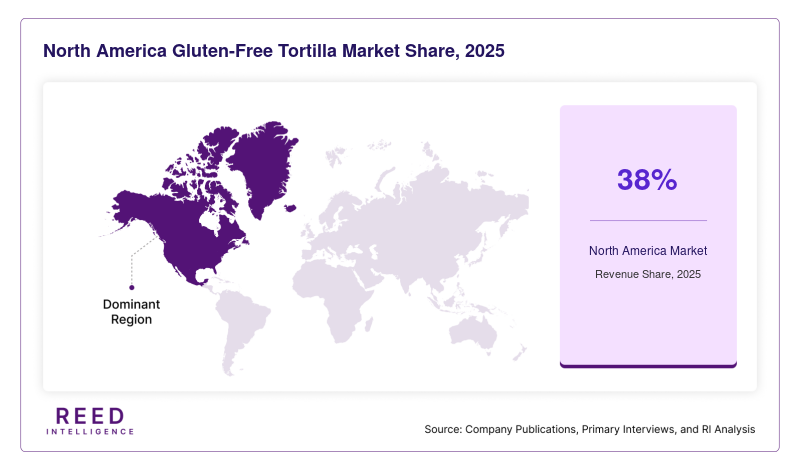
North America accounted for approximately 38% of the Gluten-Free Tortilla Market share in 2025 and is expected to grow at a CAGR of 8.5% during the forecast period. The region’s established health-conscious consumer base and strong presence of gluten-free product manufacturers have supported market expansion.
The United States dominated the regional market due to high awareness of gluten intolerance and widespread availability of gluten-free products. The growth factor in this country has been the integration of gluten-free tortillas into mainstream retail and foodservice channels, making them easily accessible to a broad consumer base.
Europe
Europe held nearly 27% share of the Gluten-Free Tortilla Market in 2025 and is projected to grow at a CAGR of 8.9%. Increasing demand for allergen-free and organic food products has driven market growth across the region.
The United Kingdom emerged as the dominant country, supported by rising demand for clean-label products. The expansion of private-label gluten-free offerings in retail chains has significantly contributed to market growth by making products more affordable and widely available.
Asia Pacific
Asia Pacific represented around 18% of the market share in 2025 and is anticipated to grow at the fastest CAGR of 10.8%. Rapid urbanization and increasing adoption of Western dietary patterns have contributed to market expansion.
China led the regional market, driven by growing health awareness and the rising influence of international cuisines. The increasing penetration of e-commerce platforms has played a key role in expanding product availability in both urban and semi-urban areas.
Middle East & Africa
The Middle East & Africa accounted for approximately 9% share in 2025 and is expected to grow at a CAGR of 7.6%. The market is gradually developing due to increasing awareness of gluten-related health conditions.
The United Arab Emirates dominated the region, supported by a strong expatriate population and growing demand for specialty food products. The expansion of premium retail outlets and health-focused stores has contributed to increased product visibility.
Latin America
Latin America held nearly 8% share of the Gluten-Free Tortilla Market in 2025 and is projected to grow at a CAGR of 9.3%. The region’s traditional consumption of tortillas provides a favorable foundation for gluten-free alternatives.
Mexico emerged as the dominant country, driven by its cultural association with tortilla consumption. The introduction of gluten-free variants using locally sourced ingredients has supported market growth by maintaining traditional taste profiles while addressing dietary needs.
Competitive Landscape
The Gluten-Free Tortilla Market is moderately fragmented, with several global and regional players competing based on product innovation, pricing, and distribution reach. Companies are focusing on expanding their product portfolios and strengthening their presence in emerging markets.
Mission Foods is a leading player in the market, benefiting from its extensive distribution network and strong brand recognition. The company has recently introduced new gluten-free variants with improved texture and extended shelf life, enhancing its competitive position.
Other key players are investing in research and development to introduce innovative formulations and cater to evolving consumer preferences. Strategic partnerships and mergers are also common strategies to expand market presence.
Key Players List
- Mission Foods
- GRUMA S.A.B. de C.V.
- BFree Foods
- Siete Family Foods
- Rudi’s Organic Bakery
- Food for Life Baking Co.
- La Tortilla Factory
- Cali’flour Foods
- Mikey’s LLC
- Old El Paso
- Toufayan Bakeries
- The Real Coconut
- Udi’s Gluten Free
- Santa Fe Tortilla Company
- Flatout Inc.
Recent Developments
- Mission Foods launched a new line of multi-grain gluten-free tortillas with enhanced fiber content.
- Siete Family Foods expanded its distribution network across Asia Pacific markets.
- BFree Foods introduced high-protein gluten-free wraps targeting fitness-focused consumers.
- La Tortilla Factory invested in sustainable packaging solutions for its gluten-free product line.
- Udi’s Gluten Free expanded its product portfolio with organic-certified tortilla variants.
Gluten-Free Tortilla Market Segments
By Type
- Corn-Based
- Cassava-Based
- Almond Flour-Based
- Coconut Flour-Based
- Others
By Ingredient Source
- Grain-Based
- Nut-Based
- Legume-Based
- Others
By Distribution Channel
- Supermarkets & Hypermarkets
- Convenience Stores
- Online Retail
- Specialty Stores
By End-Use
- Household
- Foodservice
By Region
- North America
- Europe
- APAC
- Middle East and Africa
- LATAM