Glycerol Esters Market Size, Share & Demand Report By Type (Glycerol Monostearate, Glycerol Monooleate, Polyglycerol Esters, Others), By Application (Food & Beverages, Personal Care & Cosmetics, Pharmaceuticals, Industrial), By End-Use Industry (Food Processing, Healthcare, Cosmetics, Chemical Manufacturing) By Region & Segment Forecasts, 2026–2034
USD 3950
Market Overview
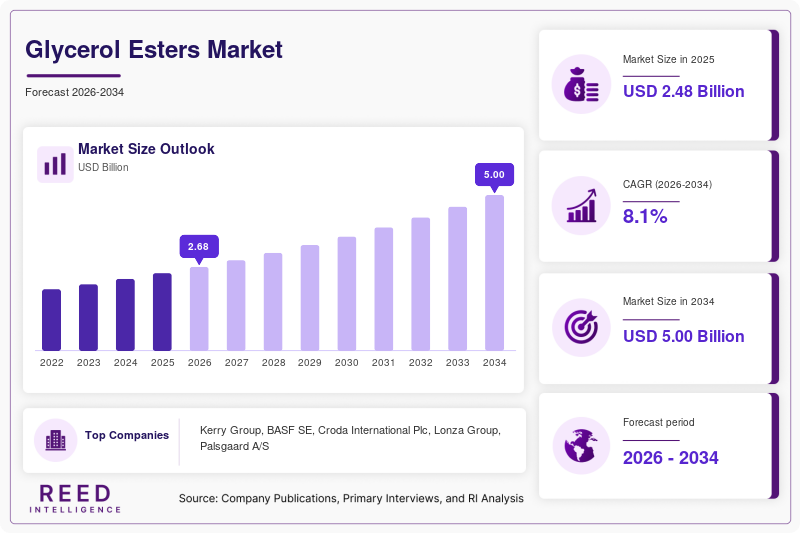
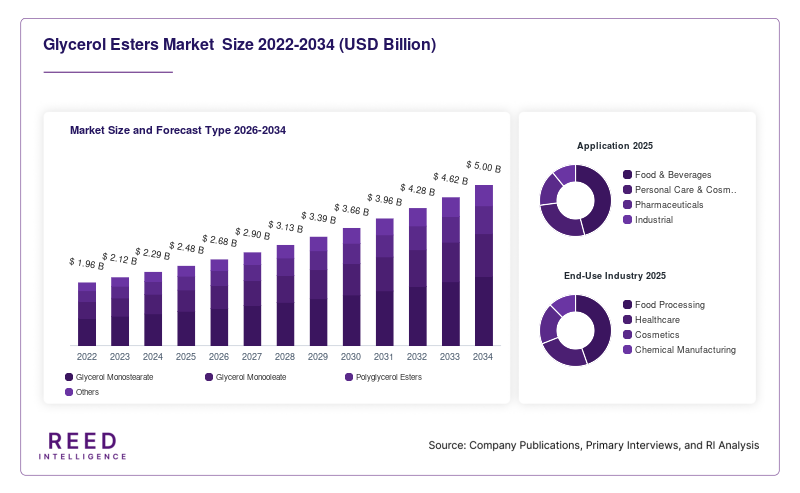
The global Glycerol Esters Market size was valued at USD 2.48 billion in 2026 and is projected to reach USD 4.61 billion by 2034, expanding at a CAGR of 8.1% during the forecast period. Glycerol esters, widely used as emulsifiers, stabilizers, and texturizing agents across food processing, pharmaceuticals, personal care, and industrial lubricants, continue to gain commercial relevance due to increasing demand for multifunctional bio-based additives. A major global factor supporting market growth is the transition toward sustainable and plant-derived ingredients in consumer and industrial formulations. Regulatory support for biodegradable additives, coupled with rising food-grade emulsifier consumption in processed foods, bakery, confectionery, and dairy sectors, has accelerated product penetration. In cosmetics and pharmaceuticals, glycerol esters are increasingly favored for their non-toxic and skin-compatible properties. The industrial sector is also adopting glycerol monostearate and related compounds for eco-friendly lubricants and polymer applications. Technological advancements in esterification efficiency and raw material optimization have improved product quality while reducing production costs, enabling broader use in developed and emerging markets. Expanding consumption of packaged foods in urban economies and increasing clean-label product launches are further strengthening industry expansion.
Key Highlights
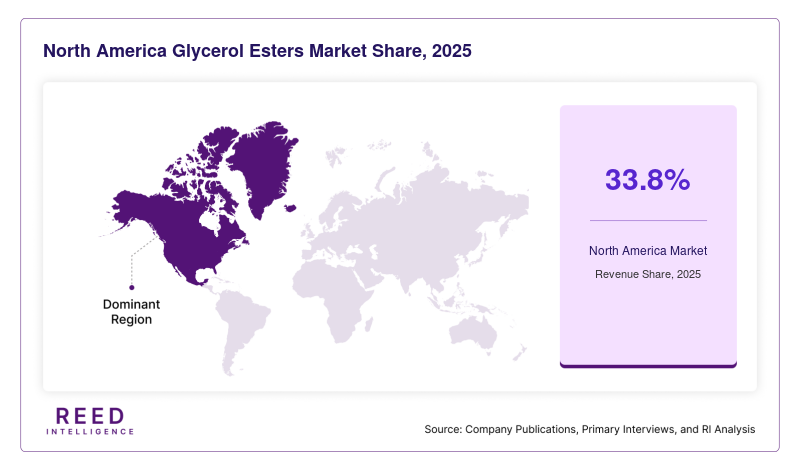
- North America dominated the market with a 33.8% share in 2025.
- Asia Pacific is expected to grow at the fastest CAGR of 9.8% during 2026–2034.
- By type, glycerol monostearate accounted for the largest share of 36.9%, while polyglycerol esters are projected to grow at a CAGR of 10.4%.
- By application, food & beverages led with a 42.6% share, whereas personal care & cosmetics is expected to expand at a CAGR of 9.9%.
- The United States remained the dominant country, with market values of USD 620 million in 2024 and USD 675 million in 2025.
Market Trends
Rising adoption of clean-label emulsifiers in processed food manufacturing
Food manufacturers are increasingly replacing synthetic emulsifiers with naturally sourced glycerol esters to align with clean-label product positioning. Consumers are actively seeking ingredient transparency, especially in bakery, dairy, infant nutrition, and confectionery products, where glycerol esters serve as stabilizers and shelf-life enhancers. This trend is encouraging producers to innovate plant-based glycerol ester formulations derived from vegetable oils. Global packaged food consumption growth, particularly in urban Asia and North America, is creating sustained demand. Manufacturers are also using glycerol esters to improve texture consistency in low-fat and sugar-reduced foods, supporting functional food expansion while maintaining regulatory compliance.
Expansion of bio-based personal care and pharmaceutical excipients
The cosmetics and pharmaceutical sectors are increasing their use of glycerol esters due to their skin-friendly, biodegradable, and multifunctional properties. In personal care, these compounds are widely used in creams, lotions, and surfactant systems because of their moisturizing and emulsifying capabilities. Pharmaceutical companies are integrating glycerol esters into topical formulations and oral drug delivery systems as stabilizing agents. Demand is rising as brands prioritize plant-derived excipients over petroleum-based alternatives. The premium skincare category, especially in Europe and Asia Pacific, is further promoting product innovation, while regulatory pressure on safer ingredients is broadening commercial opportunities.
Market Drivers
Growth in processed and convenience food industries worldwide
The rapid expansion of processed food production is a major growth driver for the Glycerol Esters Market. Glycerol esters play a critical role in improving food texture, extending shelf life, and maintaining product homogeneity in baked goods, frozen desserts, sauces, and ready meals. Rising disposable incomes, urban lifestyles, and growing demand for packaged food in emerging economies are significantly increasing usage volumes. Food manufacturers are scaling production capacities to meet consumer demand, directly boosting emulsifier requirements. Moreover, evolving dietary preferences for vegan and plant-based products are increasing the use of vegetable-derived glycerol esters in reformulated food systems.
Regulatory support for biodegradable and non-toxic industrial additives
Governments and industry regulators are increasingly promoting environmentally safer additives, creating favorable conditions for glycerol ester adoption. These compounds are biodegradable and often sourced from renewable feedstocks, making them suitable alternatives in industrial lubricants, plastics, and coatings. Industries are under pressure to reduce environmental impact and comply with stricter chemical safety frameworks, especially in Europe and North America. Glycerol esters offer lower toxicity and enhanced sustainability, making them attractive across multiple sectors. This shift is particularly visible in green manufacturing initiatives, where companies seek eco-efficient additives without sacrificing functional performance.
Market Restraint
Volatility in raw material prices and feedstock dependency
One of the primary restraints affecting the Glycerol Esters Market is fluctuating raw material costs, particularly glycerin and fatty acids derived from vegetable oils such as palm, soybean, and sunflower. Supply chain disruptions, agricultural yield variations, and geopolitical trade issues can significantly impact pricing structures. For manufacturers, this volatility affects production margins and creates uncertainty in long-term procurement strategies. For example, palm oil supply fluctuations due to environmental restrictions or export limitations can increase manufacturing expenses for glycerol monostearate. Additionally, sustainability concerns around certain feedstocks may require reformulation investments, increasing operational complexity for producers.
Market Opportunities
Rising industrial use in biodegradable lubricants and polymer additives
Glycerol esters are increasingly gaining traction beyond food and cosmetics through their application in biodegradable lubricants, anti-fogging agents, and polymer processing aids. As industrial sectors shift toward sustainable chemistry, manufacturers are investing in glycerol ester technologies for machinery lubrication and packaging materials. Their low toxicity and functional versatility create opportunities in automotive, packaging, and agricultural sectors. Demand for environmentally safer polymer additives is particularly increasing in Europe and Asia Pacific. This diversification reduces dependence on food-grade markets and creates broader revenue streams for suppliers.
Emerging demand in developing economies for fortified consumer goods
Developing markets across Asia, Latin America, and Africa are witnessing rapid growth in packaged foods, pharmaceuticals, and personal hygiene products. This creates substantial demand for glycerol esters as manufacturers localize production and improve formulation quality. Rising middle-class populations and retail modernization are enabling broader product penetration. Regional food processors are increasingly adopting advanced emulsification technologies to improve competitiveness. Additionally, government support for domestic pharmaceutical and cosmetic manufacturing in countries such as India and Brazil is expanding opportunities for glycerol ester suppliers targeting high-growth emerging sectors.
Segmental Analysis
By Type
Glycerol monostearate dominated the market in 2024, accounting for 36.9% of total revenue. Its broad usage across bakery, confectionery, dairy, plastics, and pharmaceutical formulations has positioned it as the most commercially significant type. Manufacturers prefer glycerol monostearate for its cost efficiency, emulsification performance, and multifunctional properties, including anti-caking and texturizing capabilities. In food processing, it remains essential for maintaining consistency and extending shelf life. Industrial sectors also use it in resins and lubricants, reinforcing broad demand stability across mature and developing markets.
Polyglycerol esters are expected to witness the fastest CAGR of 10.4% through 2034 due to superior emulsification strength and growing premium application use. These esters are increasingly used in specialty bakery, infant nutrition, and advanced skincare products requiring enhanced performance. Their ability to improve formulation stability while supporting clean-label trends is attracting manufacturers. Rising demand for high-value food formulations and premium personal care products is expected to accelerate adoption significantly.
By Application
Food & beverages represented the leading application segment in 2024, securing 42.6% of global share. Glycerol esters are heavily utilized in baked goods, margarine, confectionery, beverages, and dairy due to their emulsifying and shelf-life enhancement properties. Food manufacturers rely on these compounds for texture consistency, improved product stability, and formulation flexibility. The growth of convenience foods, frozen desserts, and health-focused reformulations continues to sustain strong market demand globally.
Personal care & cosmetics is projected to be the fastest-growing application segment, registering a CAGR of 9.9% through 2034. Increasing use in skincare, lotions, creams, and haircare products is driving growth. Consumers are prioritizing natural and biodegradable ingredients, encouraging brands to reformulate with plant-derived glycerol esters. Product innovation in premium beauty categories and expanding skincare markets in Asia are strengthening future opportunities.
By End-Use Industry
Food processing remained the dominant end-use industry in 2024 with a 39.4% share due to large-scale use in mass-market packaged foods. The sector’s dependence on functional additives for quality, texture, and shelf life ensures continued dominance. Industrial-scale bakery, processed snacks, and dairy sectors remain major contributors. The growth of private-label food brands and ready-to-eat products is sustaining consistent demand.
Pharmaceuticals are expected to emerge as the fastest-growing end-use segment, with a CAGR of 9.3% over the forecast period. Increasing use in oral formulations, topical creams, and excipient systems is driving demand. Growing healthcare manufacturing in emerging economies and preference for safer formulation ingredients are supporting segment expansion.
Regional Analysis
North America
North America held 33.8% of the global Glycerol Esters Market share in 2025 and is projected to grow at a CAGR of 7.4% through 2034. The region benefits from mature food processing infrastructure, high processed food consumption, and advanced pharmaceutical manufacturing. Strong demand for food emulsifiers, especially in bakery and dairy, continues to support market stability.
The United States dominated regional demand due to extensive industrial applications and strong clean-label adoption across food and cosmetics sectors. The country’s growth is supported by regulatory focus on safer additives and rising consumer preference for plant-based packaged products, encouraging domestic manufacturers to expand glycerol ester production capacities.
Europe
Europe accounted for 27.6% of the market in 2025 and is forecast to expand at a CAGR of 7.8% during the assessment period. Demand is supported by strict environmental regulations promoting biodegradable ingredients and sustainable industrial chemistry. Food safety frameworks also encourage high-quality emulsifier integration across major food categories.
Germany led the European market due to its strong industrial manufacturing base and advanced personal care sector. The country’s emphasis on sustainable ingredient innovation and bio-based chemical adoption has increased demand for glycerol esters in cosmetics, pharmaceuticals, and green polymer processing applications.
Asia Pacific
Asia Pacific represented 24.9% of the global market in 2025 and is expected to register the fastest CAGR of 9.8% through 2034. Rising urbanization, increasing packaged food consumption, and expanding cosmetics industries are major regional contributors. Cost-effective manufacturing and abundant feedstock access further enhance market attractiveness.
China dominated the regional market, supported by large-scale food manufacturing and expanding industrial production. The country’s growth is strongly linked to increasing domestic demand for processed foods and personal care products, alongside export-oriented chemical production capabilities that strengthen glycerol ester supply chains.
Middle East & Africa
Middle East & Africa captured 7.1% of the market in 2025 and is projected to grow at a CAGR of 8.4%. Growth is fueled by expanding food imports, local food processing investments, and rising personal care demand. Industrial diversification strategies are also creating moderate demand for specialty additives.
Saudi Arabia emerged as the leading country due to food security investments and increasing domestic manufacturing. Expansion of packaged food production and modernization of pharmaceutical sectors are driving glycerol ester consumption, while diversification from oil dependence supports broader industrial ingredient adoption.
Latin America
Latin America held 6.6% market share in 2025 and is anticipated to expand at a CAGR of 8.1% during the forecast period. Rising food processing activities and increasing consumer goods manufacturing are contributing to regional demand. Economic recovery in major countries is also supporting industrial ingredient investments.
Brazil led the region due to abundant agricultural feedstocks and a growing processed food industry. The country’s strength in vegetable oil production provides raw material advantages, while expanding domestic cosmetics and pharmaceutical manufacturing supports broader glycerol ester utilization.
Competitive Landscape
The Glycerol Esters Market is moderately consolidated, with leading players focusing on product innovation, sustainability, and regional expansion. Kerry Group remains a market leader due to its broad food ingredient portfolio and strong emulsifier manufacturing capabilities. In 2025, the company expanded its bio-based emulsifier production line to support clean-label food demand. BASF SE, Croda International, Lonza Group, and Palsgaard also maintain significant positions through diversified product portfolios. These companies are investing in advanced esterification technologies and expanding into high-growth Asian markets. Strategic partnerships with food processors and cosmetic manufacturers are enhancing supply chain strength, while sustainability commitments remain central to competitive positioning.
Key Players
- Kerry Group
- BASF SE
- Croda International Plc
- Lonza Group
- Palsgaard A/S
- Estelle Chemicals Pvt. Ltd.
- Stepan Company
- Corbion N.V.
- ABITEC Corporation
- Riken Vitamin Co., Ltd.
- Cargill Incorporated
- Archer Daniels Midland Company
- Oleon NV
- AAK AB
- Fine Organics Industries Ltd.
Recent Developments
- In 2025, Kerry Group expanded glycerol ester production for clean-label bakery applications.
- BASF SE introduced advanced biodegradable glycerol ester additives for polymer processing in 2024.
- Palsgaard launched new plant-based emulsifier solutions targeting premium confectionery markets in 2025.
Glycerol Esters Market Segments
Type
- Glycerol Monostearate
- Glycerol Monooleate
- Polyglycerol Esters
- Others
Application
- Food & Beverages
- Personal Care & Cosmetics
- Pharmaceuticals
- Industrial
End-Use Industry
- Food Processing
- Healthcare
- Cosmetics
- Chemical Manufacturing
By Region
- North America
- Europe
- APAC
- Middle East and Africa
- LATAM