Glyceryl Caprylate Market Size, Share & Demand Report By Source (Plant-Based, Synthetic), By Application (Personal Care & Cosmetics, Pharmaceuticals, Food & Beverages, Industrial), By Function (Emollient, Emulsifier, Preservative Booster), By End-Use Industry (Cosmetics, Healthcare, Food Industry, Chemical Industry), By Region & Segment Forecasts, 2025–2034
USD 3950
Market Overview
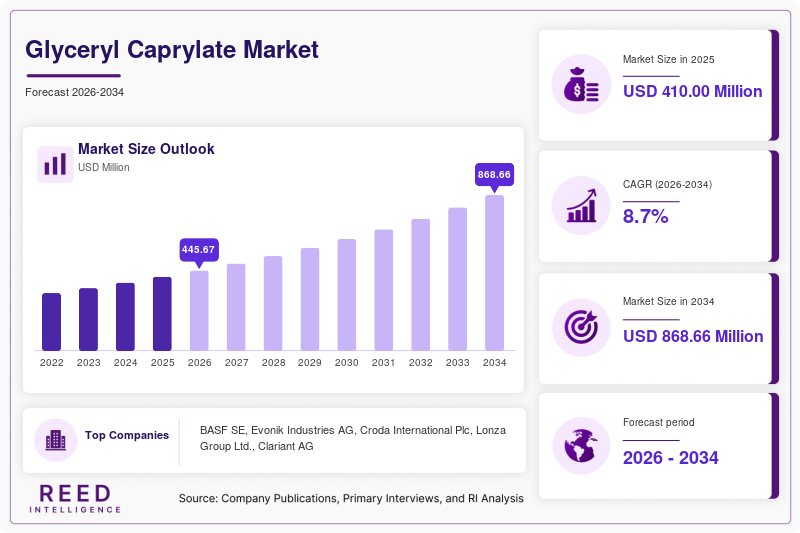
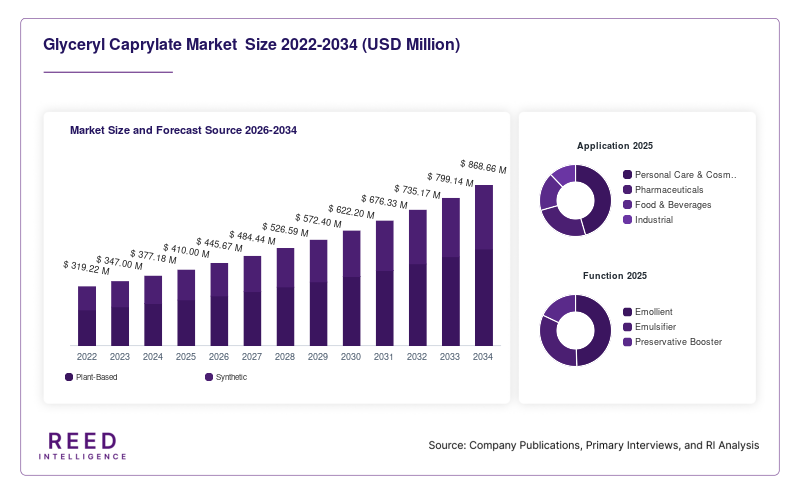
The global Glyceryl Caprylate Market size was valued at approximately USD 410 million in 2025 and is projected to reach USD 865 million by 2034, expanding at a CAGR of 8.7% during the forecast period (2025–2034). Glyceryl caprylate, a multifunctional ingredient widely used as an emollient, emulsifier, and antimicrobial agent, has witnessed steady demand growth across personal care, cosmetics, and pharmaceutical applications.
A key global factor supporting market expansion has been the rising demand for naturally derived and multifunctional cosmetic ingredients. As consumers increasingly shift toward clean-label and sustainable formulations, manufacturers are replacing synthetic preservatives with bio-based alternatives such as glyceryl caprylate. This shift has accelerated its adoption across skincare, haircare, and personal hygiene products globally.
Key Highlights
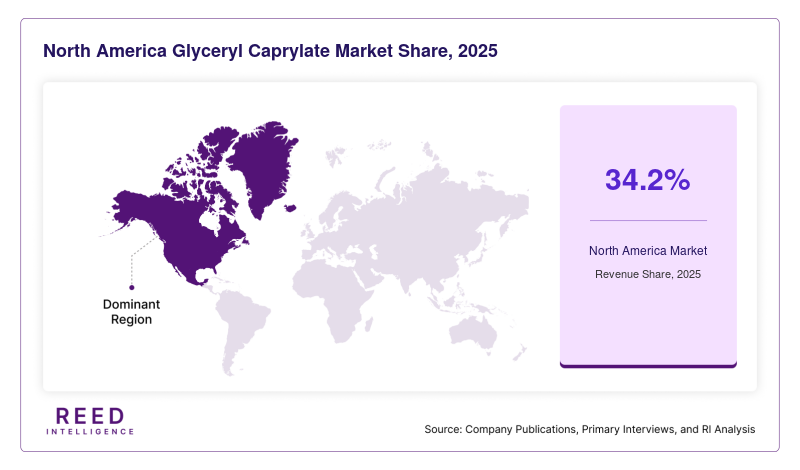
- North America dominated the market with a 34.2% share in 2025, while Asia Pacific is projected to register the fastest CAGR of 10.1% through 2034.
- By application, personal care & cosmetics led with a 52.6% share, while pharmaceuticals are expected to grow fastest at a CAGR of 9.4%.
- By source, plant-based glyceryl caprylate held the largest share (61.8%), whereas synthetic variants will witness a steady CAGR of 7.9%.
- The United States remained the dominant country with market values of USD 128 million in 2025 and USD 138 million in 2026.
Market Trends
Shift Toward Multifunctional Cosmetic Ingredients
The Glyceryl Caprylate Market is increasingly influenced by the demand for multifunctional ingredients in cosmetic formulations. Manufacturers are focusing on reducing ingredient lists while maintaining product performance. Glyceryl caprylate serves as an emollient, co-emulsifier, and preservative booster, making it a preferred choice in minimalist formulations. This trend is particularly evident in premium skincare products where efficiency and transparency are key differentiators. The shift toward multifunctionality is expected to continue shaping product development strategies.
Rising Adoption in Natural and Organic Formulations
Another notable trend is the increasing integration of glyceryl caprylate in natural and organic product lines. Consumers are becoming more conscious of ingredient sourcing, leading to higher demand for plant-derived components. Glyceryl caprylate derived from coconut or palm kernel oil aligns with this preference. Brands are leveraging this ingredient to meet certification requirements and enhance product appeal in the clean beauty segment. This trend is expected to significantly contribute to long-term market growth.
Market Drivers
Growing Demand for Clean Label Products
The rising preference for clean label and non-toxic personal care products is a major driver of the Glyceryl Caprylate Market. Consumers are increasingly scrutinizing ingredient lists and avoiding synthetic preservatives such as parabens. Glyceryl caprylate, being a mild and naturally derived alternative, is gaining traction as a safe and effective ingredient. This demand is particularly strong in developed economies, where regulatory frameworks support transparency and safety in product formulations.
Expansion of Personal Care Industry
The rapid expansion of the global personal care and cosmetics industry is another key factor driving market growth. Increasing disposable income, urbanization, and changing lifestyle patterns have led to higher spending on skincare and grooming products. Glyceryl caprylate is widely used in moisturizers, lotions, and serums, making it an essential component in this expanding industry. The continuous launch of innovative personal care products further supports its demand.
Market Restraint
Fluctuating Raw Material Prices
One of the major challenges in the Glyceryl Caprylate Market is the volatility in raw material prices. Glyceryl caprylate is commonly derived from natural oils such as coconut and palm kernel oil, which are subject to price fluctuations due to climatic conditions, supply chain disruptions, and geopolitical factors. These fluctuations impact production costs and profit margins for manufacturers.
Additionally, sustainability concerns related to palm oil sourcing have led to stricter regulations and certification requirements. Compliance with these standards can increase operational costs and limit the availability of raw materials. Small and medium-scale manufacturers may find it difficult to manage these cost pressures, potentially restricting market growth.
Market Opportunities
Growth in Pharmaceutical Applications
The increasing use of glyceryl caprylate in pharmaceutical formulations presents a significant growth opportunity. Its antimicrobial and stabilizing properties make it suitable for topical medications and drug delivery systems. As the pharmaceutical industry continues to innovate, the demand for multifunctional excipients is expected to rise, creating new avenues for market expansion.
Emerging Markets Expansion
Emerging economies in Asia Pacific, Latin America, and the Middle East & Africa offer substantial growth opportunities for the Glyceryl Caprylate Market. Rapid urbanization, rising disposable incomes, and increasing awareness of personal hygiene are driving demand for personal care products in these regions. Manufacturers are focusing on expanding their presence in these markets through strategic partnerships and localized production.
Segmental Analysis
By Source
Plant-based glyceryl caprylate dominated the Glyceryl Caprylate Market with a 61.8% share in 2025. This dominance was attributed to increasing consumer preference for natural and sustainable ingredients. Plant-derived variants are widely used in organic and clean-label products, making them a preferred choice among manufacturers.
Synthetic glyceryl caprylate is expected to grow at a CAGR of 7.9% during the forecast period. Its consistent quality, cost-effectiveness, and availability will drive its adoption in industrial applications. The ability to meet large-scale production requirements efficiently will further support its growth.
By Application
Personal care & cosmetics accounted for the largest share of 52.6% in 2025. The widespread use of glyceryl caprylate in skincare, haircare, and hygiene products contributed to this dominance. Its multifunctional properties make it an essential ingredient in various formulations.
The pharmaceutical segment is projected to grow at the fastest CAGR of 9.4%. Increasing demand for multifunctional excipients and advancements in drug formulation technologies will drive growth. Its antimicrobial properties and compatibility with active ingredients make it suitable for pharmaceutical applications.
By Function
Emollients represented the dominant subsegment with a 44.3% share in 2025. Glyceryl caprylate’s ability to improve skin texture and moisture retention made it a key component in cosmetic formulations.
Preservative boosters are expected to grow at a CAGR of 9.2% during the forecast period. The shift away from synthetic preservatives and the need for safer alternatives will drive demand. Glyceryl caprylate’s effectiveness in enhancing preservative systems will support its growth.
By End-Use Industry
The cosmetics industry held the largest share of 49.7% in 2025. The increasing demand for skincare and beauty products supported this dominance. Continuous innovation in cosmetic formulations further boosted the use of glyceryl caprylate.
The healthcare industry is expected to grow at a CAGR of 9.0%. The rising demand for topical medications and advanced drug delivery systems will drive growth. Glyceryl caprylate’s functional benefits make it suitable for various healthcare applications.
Regional Analysis
North America
North America accounted for 34.2% of the Glyceryl Caprylate Market share in 2025 and is expected to grow at a CAGR of 7.8% during the forecast period. The region’s mature personal care industry and strong consumer preference for clean-label products supported its dominant position. Regulatory frameworks emphasizing product safety and transparency further contributed to market growth.
The United States led the regional market due to its advanced cosmetics industry and high consumer awareness. The presence of major cosmetic brands and continuous product innovation played a key role in driving demand. Increasing adoption of natural ingredients in skincare formulations remained a significant growth factor in the country.
Europe
Europe held a 27.5% share of the Glyceryl Caprylate Market in 2025 and is projected to grow at a CAGR of 8.2% through 2034. The region’s stringent regulations on cosmetic ingredients encouraged the use of safer and sustainable alternatives such as glyceryl caprylate.
Germany emerged as the dominant country in Europe, driven by its strong manufacturing base and emphasis on sustainable product development. The country’s focus on eco-friendly formulations and high-quality standards supported consistent market growth.
Asia Pacific
Asia Pacific captured 23.8% of the market share in 2025 and is expected to register the fastest CAGR of 10.1% during the forecast period. Rapid urbanization and increasing disposable incomes in the region have driven demand for personal care products.
China dominated the regional market due to its large consumer base and expanding cosmetics industry. The growing middle-class population and rising awareness of skincare products significantly contributed to market growth in the country.
Middle East & Africa
The Middle East & Africa accounted for 7.1% of the Glyceryl Caprylate Market in 2025 and is projected to grow at a CAGR of 8.5%. Increasing demand for premium personal care products and rising awareness of hygiene supported market expansion.
The United Arab Emirates led the region due to its strong retail sector and high demand for luxury cosmetics. The presence of international brands and a growing beauty-conscious population contributed to market growth.
Latin America
Latin America held a 7.4% market share in 2025 and is expected to grow at a CAGR of 8.0% during the forecast period. The region’s expanding personal care industry and increasing consumer spending supported market growth.
Brazil dominated the regional market due to its large cosmetics industry and high demand for skincare products. The country’s focus on natural ingredients and local production further boosted market expansion.
Competitive Landscape
The Glyceryl Caprylate Market is moderately fragmented, with key players focusing on product innovation, sustainability, and strategic partnerships. Leading companies are investing in research and development to enhance product functionality and expand application areas.
A prominent market leader is BASF SE, which has maintained a strong presence through its extensive product portfolio and focus on sustainable solutions. The company recently introduced an advanced grade of glyceryl caprylate designed for high-performance cosmetic formulations, strengthening its market position.
Other major players are emphasizing regional expansion and collaboration with cosmetic manufacturers to increase market share. The competitive landscape is characterized by continuous innovation and efforts to meet evolving consumer preferences.
Key Players List
- BASF SE
- Evonik Industries AG
- Croda International Plc
- Lonza Group Ltd.
- Clariant AG
- Stepan Company
- IOI Oleo GmbH
- Kuala Lumpur Kepong Berhad
- Oleon NV
- Emery Oleochemicals
- Vantage Specialty Chemicals
- Galaxy Surfactants Ltd.
- Solvay SA
- Innospec Inc.
- Kao Corporation
Recent Developments
- In 2024, BASF SE expanded its production capacity for bio-based glyceryl caprylate to meet rising global demand.
- Evonik Industries introduced a new formulation targeting clean beauty applications.
- Croda International launched a sustainable sourcing initiative for plant-based raw materials.
- Clariant AG developed an advanced preservative system incorporating glyceryl caprylate.
- Galaxy Surfactants Ltd. strengthened its distribution network in Asia Pacific to expand market reach.
Glyceryl Caprylate Market Segments
Source
- Plant-Based
- Synthetic
Application
- Personal Care & Cosmetics
- Pharmaceuticals
- Food & Beverages
- Industrial
Function
- Emollient
- Emulsifier
- Preservative Booster
End-Use Industry
- Cosmetics
- Healthcare
- Food Industry
- Chemical Industry
Distribution Channel
- Direct Sales (B2B)
- Online Distribution
- Specialty Chemical Distributors
- Retail Supply Chains
By Region
- North America
- Europe
- APAC
- Middle East and Africa
- LATAM