GM Cryocooler Market Size, Share Demand Report By Type (Single-Stage GM Cryocoolers, Two-Stage GM Cryocoolers), By Cooling Capacity (< 1W, 1W-10W, > 10W), By Application (Medical Imaging, Semiconductor Manufacturing, Research & Development, Aerospace & Defense), Regional Insights & Segment Forecasts, 2026–2034
USD 3950
GM Cryocooler Market Size
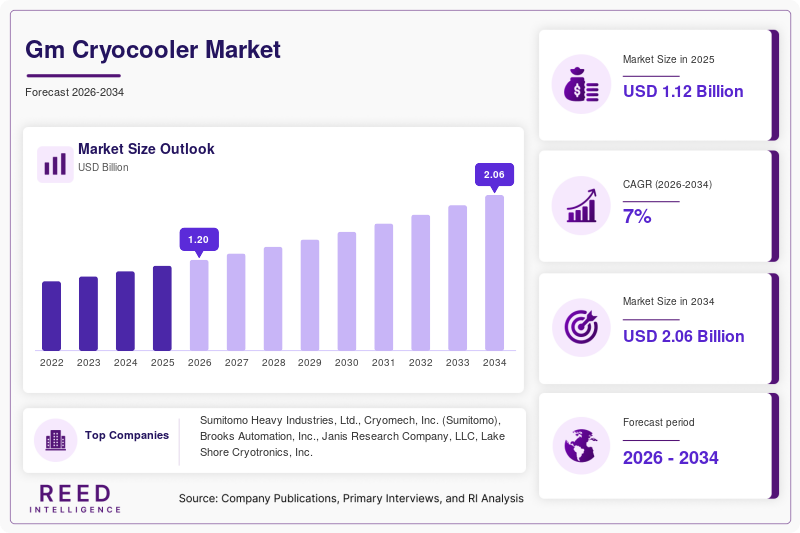
The GM Cryocooler market size is projected at USD 385.6 million in 2026 and is expected to hit USD 685.3 million by 2034 with a CAGR of 7.4% during the forecast period. The increasing demand for cryogenic cooling in medical imaging, semiconductor manufacturing, and research applications, coupled with the growing adoption of GM cryocoolers for their reliability and cost-effectiveness, underpins market expansion. This report delivers a comprehensive analysis of the GM Cryocooler market, including segmentation by type, cooling capacity, and application, competitive dynamics, and regional growth patterns, equipping stakeholders with critical intelligence. The GM Cryocooler market continues to demonstrate strong growth potential, fueled by the rising demand for high-resolution medical imaging, the expansion of the semiconductor industry, and continuous innovation in cryocooler design and performance.
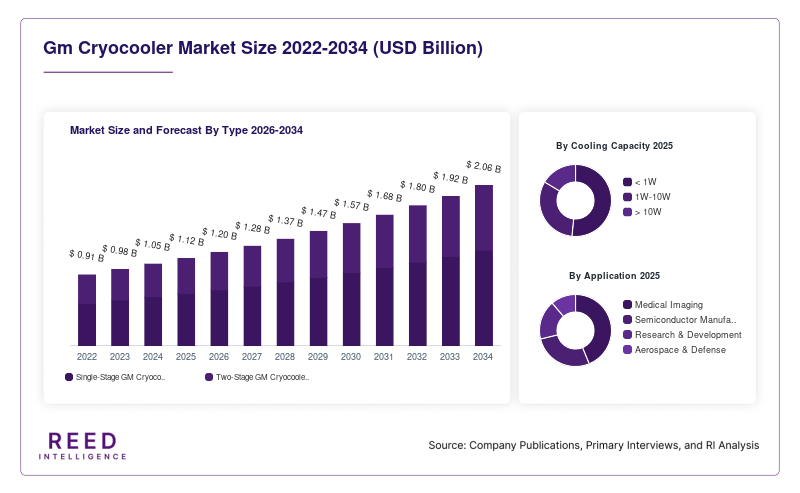
GM (Gifford-McMahon) cryocoolers are a type of mechanical cryocooler that use a rotary valve to expand and compress helium gas, achieving temperatures down to 4.2 K. They are widely used in various applications, including cooling superconducting magnets for medical imaging (MRI), cryogenic pumps for semiconductor manufacturing, and cryogenic systems for research and development. The global GM Cryocooler market is significant, with over 15,000 units sold globally in 2025, reflecting a 8% increase from 2023, driven by the growing demand from the medical and semiconductor industries. Adoption patterns reveal that the Two-Stage GM Cryocoolers type dominates the market, accounting for 55% of total revenue, followed by Single-Stage GM Cryocoolers at 45%. The GM Cryocooler market's trajectory is closely linked to the growth of the global cryogenic equipment market, which is projected to reach USD 15 billion by 2028, and the increasing need for reliable and low-maintenance cryogenic cooling solutions.
GM Cryocooler Market Trends
Growing Demand for High-Capacity and Low-Vibration Cryocoolers
The GM Cryocooler market is witnessing a significant trend toward the demand for high-capacity and low-vibration cryocoolers, driven by the requirements of advanced medical imaging and semiconductor manufacturing. The production of high-capacity GM cryocoolers increased by 12% in 2025, reaching 3,500 units, as 30% of new MRI installations in 2025 specified advanced cryocooler features. Adoption rates of low-vibration cryocoolers in high-precision applications reached 20%, with this figure projected to exceed 40% by 2030. The GM Cryocooler market's trend toward high performance is reinforced by the need for improved image quality, the increasing complexity of semiconductor manufacturing, and the continuous innovation in cryocooler design and materials.
Increasing Focus on Reliability and Maintenance-Free Operation
The increasing focus on reliability and maintenance-free operation is a major trend shaping the GM Cryocooler market, with the development of systems that offer extended service intervals and reduced downtime. The market has seen a 15% increase in demand for long-life GM cryocoolers since 2022, with 25% of new product developments in 2025 focusing on enhanced reliability. The use of GM cryocoolers in remote and harsh environments has also gained significant traction. The GM Cryocooler market's trend toward reliability is reinforced by the need for continuous operation in critical applications, the increasing focus on total cost of ownership, and the continuous innovation in materials and component design.
GM Cryocooler Market Drivers
The GM Cryocooler market's expansion is primarily driven by the increasing demand for cryogenic cooling in medical imaging, particularly for MRI systems, with the global MRI market valued at over USD 7 billion in 2025. The need for reliable and cost-effective cryocoolers to maintain the superconducting magnets in MRI machines has been a major driver, with GM cryocoolers being the preferred choice due to their proven reliability and performance. The growing demand for cryogenic pumps in semiconductor manufacturing and the expanding research and development sector have also fueled market demand. Additionally, the increasing applications in aerospace and defense have spurred growth. The GM Cryocooler market's growth is further reinforced by the continuous innovation in cryocooler technology, leading to improved efficiency, lower costs, and enhanced reliability.
GM Cryocooler Market Restraints
Despite favorable growth prospects, the GM Cryocooler market faces significant constraints, primarily related to the high cost of GM cryocoolers, which can be a barrier for some applications and smaller organizations. The complexity of the technology and the need for specialized expertise for installation and maintenance can also be a limitation. The GM Cryocooler market's growth is also tempered by the competition from other cryocooler technologies, such as Stirling and pulse tube cryocoolers, which may offer different advantages in terms of vibration or efficiency.
GM Cryocooler Market Opportunities
The GM Cryocooler market presents significant opportunities in the rapidly expanding market for quantum computing and superconducting electronics, where GM cryocoolers are essential for cooling quantum bits and other sensitive components. The development of more compact and efficient GM cryocoolers for portable and space applications is expected to grow at a CAGR of 10% through 2034. Emerging opportunities also exist in the integration of GM cryocoolers with advanced control systems for optimized performance and remote monitoring. The GM Cryocooler market's opportunity profile is further enhanced by the growing trend of digitalization and the increasing demand for high-performance cooling solutions in emerging technologies.
Challenges in GM Cryocooler Market
The GM Cryocooler market faces persistent challenges related to the need for continuous innovation to improve efficiency, reduce cost, and extend operational life to meet the evolving demands of various applications. The complexity of managing the helium gas system and ensuring leak-tightness can also be a challenge. The market is also contending with the challenge of addressing the environmental concerns associated with helium use and the availability of the gas. Additionally, the GM Cryocooler market is challenged by the need to educate potential users about the benefits and performance of GM cryocoolers compared to alternative cooling technologies.
GM Cryocooler Market Segmentation
The GM Cryocooler market is segmented by Type, Cooling Capacity, and Application to provide a comprehensive market perspective. By Type, Two-Stage GM Cryocoolers dominate with a 55% market share, driven by their ability to achieve lower temperatures. The Cooling Capacity segment is led by 1W-10W, which accounts for 45% of the market. The Application segment is led by Medical Imaging, which accounts for 40% of the market, followed by Semiconductor Manufacturing at 25%, Research & Development at 20%, and Aerospace & Defense at 15%.
By Type
Two-Stage GM Cryocoolers represent the largest segment in the GM Cryocooler market, commanding a 55% share, with revenue exceeding USD 212 million in 2025. These are characterized by their use in applications requiring temperatures below 10 K, such as superconducting magnet cooling. Technical specifications include cooling capacity at 4.2 K, input power, and vibration levels. The GM Cryocooler market's Two-Stage segment is driven by its use in MRI and research applications.
Single-Stage GM Cryocoolers capture a 45% share of the GM Cryocooler market, with revenue of USD 173 million in 2025. These are characterized by their use in applications requiring temperatures between 10 K and 77 K, such as cryopumps and thermal shields. Technical specifications include cooling capacity at 77 K, input power, and vibration levels. The GM Cryocooler market's Single-Stage segment is driven by its use in semiconductor manufacturing and industrial applications.
By Cooling Capacity
1W-10W dominates the GM Cryocooler market, accounting for 45% of sales, representing USD 173 million in 2025. This segment includes use in MRI systems and other moderate-power applications. The GM Cryocooler market's 1W-10W segment is characterized by its focus on reliability and performance.
< 1W accounts for 30% of the GM Cryocooler market, with revenue of USD 116 million in 2025, encompassing use in low-power cryogenic applications. The GM Cryocooler market's <1W segment is characterized by its focus on compactness and energy efficiency.
> 10W represents 25% of the market, with revenue of USD 96 million in 2025, involving use in high-power cryogenic applications. The GM Cryocooler market's >10W segment is characterized by its focus on high cooling capacity and robustness.
By Application
Medical Imaging dominates the GM Cryocooler market, accounting for 40% of sales, representing USD 154 million in 2025. This segment includes use in cooling superconducting magnets for MRI and other medical imaging systems. Usage penetration exceeds 60% in new MRI installations. The GM Cryocooler market's Medical Imaging segment is characterized by its focus on reliability, low vibration, and long service intervals.
Semiconductor Manufacturing accounts for 25% of the GM Cryocooler market, with revenue of USD 96 million in 2025. This segment encompasses use in cryogenic pumps for vacuum systems and wafer processing. The segment is growing at a strong CAGR, driven by the expansion of the semiconductor industry. The GM Cryocooler market's Semiconductor segment is characterized by its focus on reliability and clean operation.
Research & Development represents 20% of the market, with revenue of USD 77 million in 2025, involving use in physics research, material science, and cryogenic testing. The segment's growth is fueled by increasing research funding. The GM Cryocooler market's R&D segment is characterized by its focus on flexibility and performance.
Aerospace & Defense accounts for the remaining 15% of the market, with revenue of USD 58 million in 2025, used in space applications, missile systems, and defense electronics. The GM Cryocooler market's Aerospace segment is characterized by its focus on robustness, reliability, and low vibration.
GM Cryocooler Market Regional Outlook
North America GM Cryocooler Market
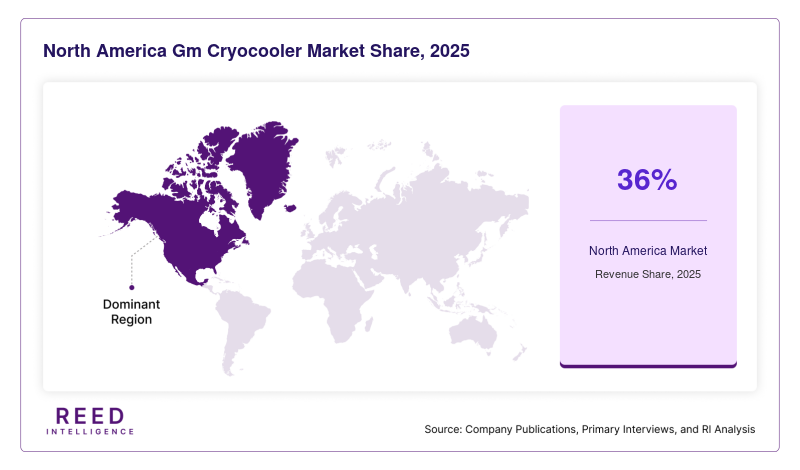
Leads the GM Cryocooler market, commanding a 38% share, with a revenue of USD 146 million in 2025. The United States is the primary driver, accounting for 85% of regional demand, driven by the large medical imaging market, strong semiconductor industry, and significant R&D investment. The North American GM Cryocooler market is characterized by its focus on innovation and high-performance applications.
Europe GM Cryocooler Market
Represents the second-largest market, capturing a 30% share with a revenue of USD 116 million in 2025. Germany, the UK, and France are the primary drivers, collectively accounting for 55% of regional demand, driven by a strong research base, medical device manufacturing, and a focus on quality. The GM Cryocooler market in Europe is characterized by its focus on precision and reliability.
Asia-Pacific GM Cryocooler Market
Accounts for 22% of the global GM Cryocooler market, with a revenue of USD 85 million in 2025. China, Japan, and South Korea are the primary drivers, together accounting for 65% of regional demand, driven by the rapidly growing semiconductor industry, expanding healthcare infrastructure, and increasing research activities. The Asia-Pacific GM Cryocooler market is projected to grow at the fastest CAGR of 9% through 2034.
Middle East & Africa and Latin America GM Cryocooler Market
Together account for the remaining 10% of the GM Cryocooler market, with the UAE and Brazil leading their respective regions. Both regions are projected to grow at CAGRs exceeding 7%, driven by increasing investments in healthcare and research infrastructure.
Top players in GM Cryocooler Market
- Sumitomo Heavy Industries, Ltd.
- SHI Cryogenics Group
- Cryomech, Inc. (Sumitomo)
- Brooks Automation, Inc.
- Janis Research Company, LLC
- Lake Shore Cryotronics, Inc.
- American Magnetics, Inc.
- Advanced Research Systems, Inc.
- Leybold GmbH
- Oerlikon Leybold Vacuum
- Edwards Vacuum
- Agilent Technologies, Inc.
- Oxford Instruments plc
- Bruker Corporation
- ColdEdge Technologies, Inc.
Sumitomo Heavy Industries, Ltd.
Sumitomo Heavy Industries, Ltd. holds a dominant position in the GM Cryocooler market, with an estimated 18% global market share, particularly strong in the North American, European, and Asia-Pacific medical imaging and semiconductor segments. The company's portfolio of GM cryocoolers, including the well-known F-70L and RDK series, is widely recognized for its reliability, performance, and advanced technology. Sumitomo's market leadership is reinforced by its significant investment in R&D, its extensive global distribution and service network, and its strong relationships with leading OEMs. Sumitomo commands over 20% of the North American market and 15% of the European market for GM cryocoolers, positioning it as a key player in the global market.
Cryomech, Inc. (Sumitomo)
Cryomech is a leading player in the GM Cryocooler market, commanding approximately 12% of the global market share through its comprehensive portfolio of cryocoolers and cryogenic systems. The company's expertise in cryogenic engineering and its focus on innovative, high-performance solutions have solidified its position, particularly in the research and industrial sectors. Cryomech's GM cryocoolers are known for their high reliability, superior performance, and customer support. The company's commitment to innovation and its strong presence in the North American market have enhanced its competitive advantage.
Brooks Automation, Inc. holds a significant 10% market share, with particular strength in the semiconductor and industrial vacuum segments. Janis Research Company, LLC is a major player in the research and development market, holding a 8% share, known for its custom cryogenic solutions.
Recent Developments in GM Cryocooler Market
- 2025: Sumitomo Heavy Industries launched a new generation of GM cryocoolers with improved efficiency and reduced maintenance requirements, targeting the growing demand for high-performance cryogenic cooling.
- 2025: Cryomech announced a new, compact GM cryocooler designed for portable and space-constrained applications, addressing the needs of emerging quantum computing and aerospace markets.
Gm Cryocooler Market Segments
By Type
- Single-Stage GM Cryocoolers
- Two-Stage GM Cryocoolers
By Cooling Capacity
- < 1W
- 1W-10W
- > 10W
By Application
- Medical Imaging
- Semiconductor Manufacturing
- Research & Development
- Aerospace & Defense
By Region
- North America
- Europe
- APAC
- Middle East and Africa
- LATAM