Gourmet Seaweed Seasoning Market Size, Share, Demand Report By Product Type (Seaweed Flakes Seasoning, Seaweed Powder Blends, Granulated Seaweed Seasoning, Liquid Seaweed Extract Seasoning), By Application (Household Cooking, Foodservice, Food Processing Industry, Packaged Snacks & Ready Meals), By Distribution Channel (Supermarkets & Hypermarkets, Online Retail / E-commerce, Specialty Organic Stores, Foodservice Distribution Channels), By Region & Segment Forecasts, 2026–2034
USD 3950
Market Overview
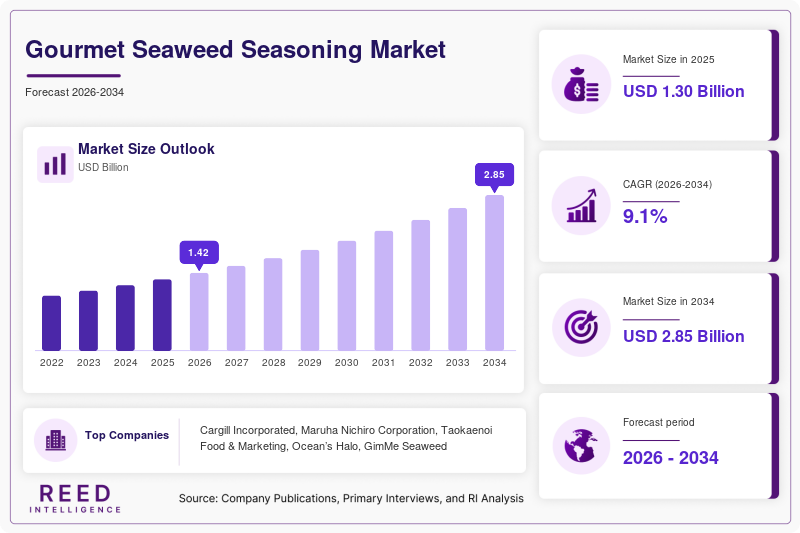
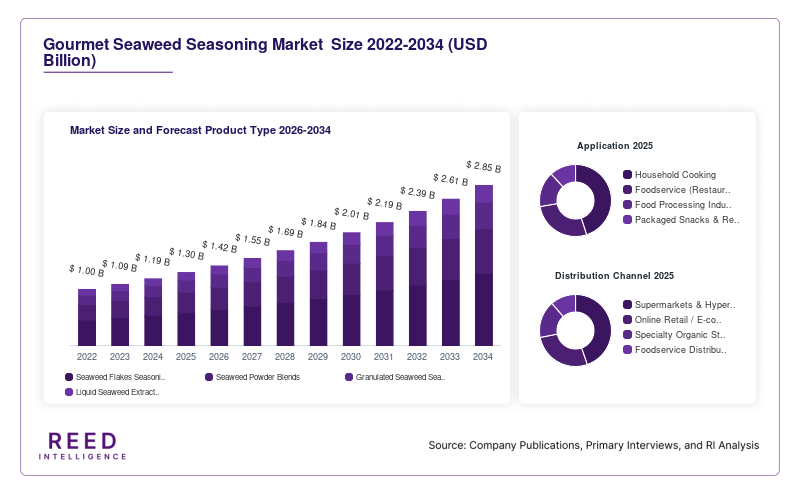
The Gourmet Seaweed Seasoning Market is projected to witness steady expansion between 2026 and 2034, driven by rising consumer preference for plant-based umami-rich flavor enhancers. In 2026, the global market size is estimated at approximately USD 1.42 billion, and it is expected to reach nearly USD 2.85 billion by 2034, registering a CAGR of 9.1% during the forecast period. Growth is strongly influenced by increasing demand for clean-label, natural seasoning alternatives in both household and foodservice applications.
A major global factor supporting market growth is the accelerated shift toward plant-based and health-conscious diets, particularly in urban populations across developed and emerging economies. Consumers are increasingly replacing artificial flavor enhancers with nutrient-rich seaweed-based seasonings that offer minerals, antioxidants, and low-calorie profiles. Additionally, globalization of Asian cuisine has significantly increased the adoption of seaweed seasoning in Western food cultures.
Key Highlights
- North America dominated the market with a 34.2% share in 2025.
- Asia Pacific is expected to grow at the fastest CAGR of 11.2% during 2026–2034.
- By product type, flake-based seaweed seasonings accounted for the largest share of 38.5%, while powder blends are projected to grow at a CAGR of 12.4%.
- By application, household cooking led with a 41.7% share, whereas foodservice applications are expected to expand at a CAGR of 11.8%.
- The United States remained the dominant country, with market values of USD 510 million in 2024 and USD 560 million in 2025.
Market Trends
Expansion of Fusion and Global Culinary Applications
One of the key trends shaping the Gourmet Seaweed Seasoning Market is the rapid expansion of fusion cuisine across global foodservice and home cooking segments. Chefs and food manufacturers are increasingly incorporating seaweed-based seasonings into non-traditional dishes such as pasta, baked snacks, gourmet chips, sauces, and ready-to-eat meals. This trend is driven by consumer demand for novel flavors that combine umami depth with nutritional benefits. Seaweed seasoning is also gaining traction in Western vegetarian and vegan food categories, where it is used to replicate savory, meat-like taste profiles. Food brands are leveraging this trend to introduce innovative product lines that cater to adventurous and health-conscious consumers, thereby expanding the application scope of gourmet seaweed seasoning beyond traditional Asian cuisine.
Rising Demand for Clean-Label and Functional Ingredients
Another significant trend in the Gourmet Seaweed Seasoning Market is the increasing adoption of clean-label and functional food ingredients. Consumers are actively avoiding artificial flavor enhancers, preservatives, and synthetic additives, pushing manufacturers to develop natural seasoning solutions derived from seaweed varieties such as nori, kelp, and wakame. These ingredients are valued for their high iodine content, trace minerals, and antioxidant properties. The trend is further reinforced by regulatory support for transparent labeling practices and growing awareness of nutritional wellness. As a result, food companies are reformulating existing seasoning products and introducing premium seaweed-based blends that align with health-focused consumption patterns, supporting sustained market expansion.
Market Drivers
Increasing Adoption of Plant-Based Diets
A primary driver of the Gourmet Seaweed Seasoning Market is the rising global adoption of plant-based diets. Consumers are shifting toward vegetarian, vegan, and flexitarian lifestyles, creating strong demand for natural umami enhancers that replace animal-derived flavor agents. Seaweed seasoning provides a rich source of natural glutamates, making it an ideal substitute for monosodium glutamate (MSG) and other artificial flavor enhancers. This shift is particularly evident in urban populations across North America, Europe, and Asia Pacific, where dietary awareness and sustainability concerns are influencing food purchasing behavior. Food manufacturers are responding by integrating seaweed seasoning into plant-based meat alternatives, snack foods, and ready meals, thereby strengthening its market penetration.
Growth in Premium and Ethnic Food Consumption
Another significant driver is the rising consumption of premium and ethnic food products worldwide. The Gourmet Seaweed Seasoning Market benefits from the global popularity of Japanese, Korean, and coastal Asian cuisines, where seaweed-based ingredients are traditionally used. Increased exposure through restaurants, food delivery platforms, and packaged ethnic food products has accelerated consumer familiarity with seaweed seasoning. Additionally, premiumization trends in the food industry are encouraging consumers to pay higher prices for gourmet and artisanal seasonings with unique flavor profiles. This has led to increased product innovation, including flavored seaweed blends infused with garlic, chili, sesame, and miso, further expanding the market’s appeal across diverse consumer segments.
Market Restraint
Limited Raw Material Availability and Supply Chain Constraints
A key restraint affecting the Gourmet Seaweed Seasoning Market is the limited and regionally concentrated availability of high-quality seaweed raw materials. Seaweed cultivation is heavily dependent on specific marine conditions, including water temperature, salinity, and ecological balance. Climate change, ocean pollution, and overharvesting have created supply inconsistencies in major producing regions such as East Asia. These challenges impact production scalability and lead to price volatility in raw materials, ultimately affecting the profitability of seasoning manufacturers. Additionally, transportation and processing constraints for perishable seaweed further complicate global supply chains. As demand increases, manufacturers may face difficulties in maintaining consistent quality and cost efficiency, limiting broader market expansion, particularly in price-sensitive regions.
Market Opportunities
Expansion in Functional Food and Nutraceutical Applications
The growing integration of seaweed into functional foods presents a significant opportunity for the Gourmet Seaweed Seasoning Market. Seaweed is rich in vitamins, minerals, and bioactive compounds that support metabolic health, immunity, and digestive wellness. As consumers become more health-conscious, food manufacturers are exploring seaweed seasoning as a functional ingredient in fortified snacks, dietary supplements, and wellness-focused meal kits. This trend is further supported by increasing scientific research on marine algae benefits, which enhances consumer trust. Companies investing in product innovation and bioactive-enriched seasoning blends are expected to gain a competitive advantage in the evolving health-food landscape.
Growth of E-commerce and Direct-to-Consumer Channels
Another strong opportunity lies in the rapid expansion of e-commerce and direct-to-consumer sales channels. The Gourmet Seaweed Seasoning Market is benefiting from digital retail platforms that allow niche and premium food brands to reach global consumers without traditional distribution barriers. Online marketplaces enable brands to educate consumers about product benefits, usage ideas, and culinary applications, thereby increasing adoption rates. Subscription-based gourmet seasoning boxes and specialty food delivery services are also gaining popularity, particularly among younger demographics seeking convenience and variety. This digital transformation is expected to significantly enhance market accessibility and brand visibility.
Segmental Analysis
By Product Type
Flake-based seasoning held the dominant share of 38.5% in 2024, making it the leading segment in the Gourmet Seaweed Seasoning Market. Its popularity is attributed to ease of use, strong flavor retention, and versatility across culinary applications. Flakes are widely used in snacks, rice dishes, and ready meals.
Powder blends are expected to grow at a CAGR of 12.4%, driven by increasing use in packaged foods, sauces, and seasoning mixes. Their solubility and consistent flavor distribution make them suitable for industrial food processing. Rising demand for customized flavor profiles is further boosting this segment.
By Application
Household cooking dominated with a 41.7% share in 2024, supported by rising home cooking trends and increased awareness of healthy seasoning alternatives. Consumers prefer seaweed seasoning for everyday meals due to its nutritional benefits and umami flavor.
Foodservice applications are projected to grow at a CAGR of 11.8%, driven by restaurant innovation and fusion cuisine trends. Chefs are increasingly experimenting with seaweed seasoning in gourmet dishes to enhance flavor complexity and differentiate menus.
By Distribution Channel
Supermarkets and hypermarkets accounted for 44.1% share in 2024, making them the primary distribution channel in the Gourmet Seaweed Seasoning Market. Their wide product availability and consumer accessibility drive strong sales performance.
Online retail is expected to grow at a CAGR of 13.1%, supported by rising digital adoption and direct-to-consumer strategies. E-commerce platforms provide greater product variety and brand visibility, accelerating market penetration.
Regional Analysis
North America
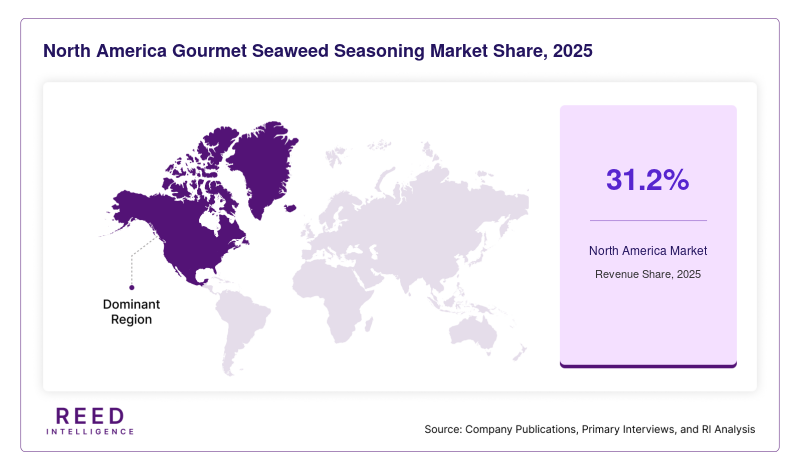
North America accounted for approximately 31.2%–34.2% of the global market share in 2025, supported by strong demand for plant-based and clean-label food products. The region is projected to grow at a CAGR of 8.5%–9.0% during the forecast period. Increasing adoption of Asian cuisine and premium gourmet ingredients continues to support market expansion.
The United States dominates the regional market due to a growing health-conscious population and increasing exposure to global cuisines. A key growth factor is the expansion of specialty organic retail chains and rising demand for functional food ingredients.
Europe
Europe held an estimated 26%–28% market share in 2025, with a projected CAGR of 8.8%–9.2%. The market is supported by clean-label regulations, sustainability initiatives, and rising vegan population trends.
Germany leads the regional market due to strong demand for organic and sustainable food products. Increasing focus on environmentally friendly consumption and marine-based nutrition is driving adoption across the region.
Asia Pacific
Asia Pacific is the largest regional market, accounting for over 43.3% share in 2025, and is expected to grow at the fastest CAGR of 10.5%–11.5% during 2026–2034. The region benefits from established seaweed farming infrastructure and long-standing culinary traditions.
China dominates the regional market due to large-scale production capabilities and widespread consumption of seaweed-based products. Investment in advanced processing technologies and export-oriented growth further strengthens the market.
Middle East & Africa
The Middle East & Africa accounted for approximately 5%–6% market share in 2025, with a projected CAGR of 7.5%–8.0%. Growth is supported by expanding tourism and increasing demand for international cuisines.
The United Arab Emirates leads the regional market, driven by a growing foodservice sector and rising demand for premium imported ingredients. Multicultural consumer preferences are also contributing to market growth.
Latin America
Latin America represented around 3%–4% market share in 2025, with an expected CAGR of 7.8%–8.3%. Growth is driven by urbanization and increasing exposure to global culinary trends.
Brazil dominates the regional market due to rising health awareness and expansion of premium food retail channels. Increasing demand for natural seasoning products is expected to drive continued growth.
Competitive Landscape
The Gourmet Seaweed Seasoning Market is moderately fragmented, with a mix of global food ingredient companies and regional specialty producers. Key players are focusing on product innovation, sustainable sourcing, and expansion of distribution networks to strengthen their market position.
Leading companies include Maruha Nichiro Corporation, Cargill Incorporated, Taokaenoi Food & Marketing, Korean Seaweed Co., and Lacroix Gourmet Foods Group. Among these, Cargill Incorporated is considered a market leader due to its extensive global supply chain and diversified food ingredient portfolio.
Recent development includes increased investment in sustainable seaweed farming partnerships and expansion of plant-based seasoning product lines targeting Western markets. Companies are also adopting advanced drying and flavor preservation technologies to improve product quality and shelf life.
Key Players
- Cargill Incorporated
- Maruha Nichiro Corporation
- Taokaenoi Food & Marketing
- Korean Seaweed Co.
- Lacroix Gourmet Foods Group
- Ocean’s Halo
- GimMe Seaweed
- Annie Chun’s
- Roland Foods
- Atlantic Sea Farms
- Kwangcheon Kim
- Seapoint Farms
- Frito-Lay (Seaweed Snack Division)
- Tata Consumer Products
- Mitsubishi Corporation Food Division
Recent Developments
- In 2025, several manufacturers expanded seaweed cultivation partnerships in Southeast Asia to ensure stable raw material supply.
- In 2026, new gourmet seasoning blends combining seaweed with spices such as truffle, chili, and sesame were introduced in premium retail markets.
- In early 2026, major players invested in sustainable packaging solutions to align with eco-friendly consumer preferences.
Gourmet Seaweed Seasoning Market Segments
Product Type
- Seaweed Flakes Seasoning
- Seaweed Powder Blends
- Granulated Seaweed Seasoning
- Liquid Seaweed Extract Seasoning
Application
- Household Cooking
- Foodservice (Restaurants & QSRs)
- Food Processing Industry
- Packaged Snacks & Ready Meals
Distribution Channel
- Supermarkets & Hypermarkets
- Online Retail / E-commerce
- Specialty Organic Stores
- Foodservice Distribution Channels
By Region
- North America
- Europe
- APAC
- Middle East and Africa
- LATAM