Governance Risk Management and Compliance (GRC) Market Size, Share Demand Report By Component (Software, Services, Solutions), By Enterprise Size (Large Enterprises, Small and Medium Enterprises, Government Organizations) By Region & Segment Forecasts, 2026–2034
USD 3950
Governance Risk Management and Compliance (GRC) Market Size
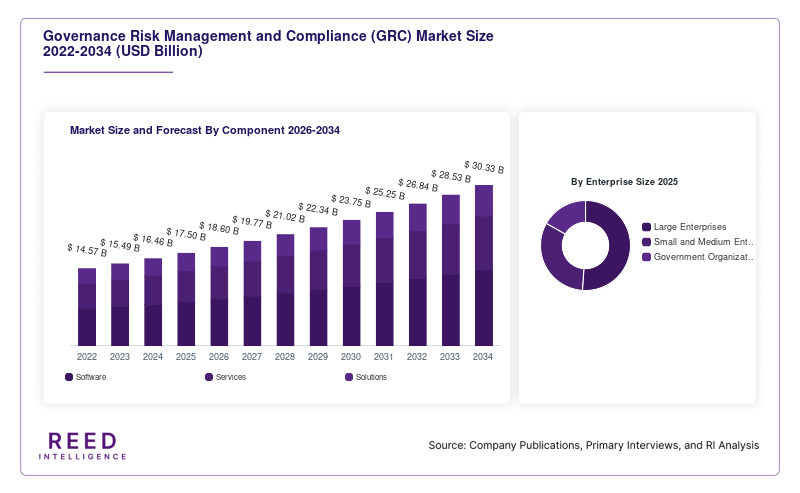
Global governance risk management and compliance (GRC) market size is projected at USD 18.6 billion in 2026 and is expected to hit USD 30.4 billion by 2034 with a CAGR of 6.3%. Increasing regulatory complexity, cybersecurity risks, third-party exposure, and demand for centralized risk visibility are accelerating GRC technology adoption. Detailed data, component-level segmentation, enterprise analysis, and competitive benchmarking are increasingly important for organizations evaluating compliance automation, risk intelligence, and integrated governance platforms.
Key takeaways
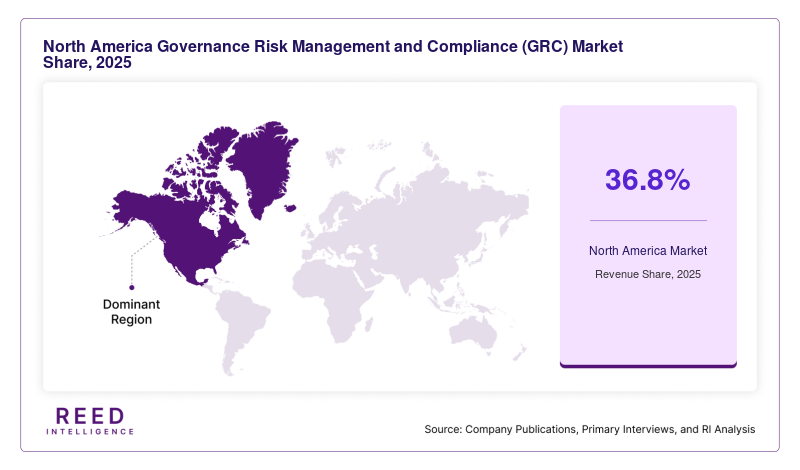
- North America dominated the global GRC market with a 36.8% share in 2026, while Asia Pacific is the fastest-growing region, projected to expand at approximately 8.1% CAGR through 2034.
- GRC Software led by component with a 51.6% share in 2026, while integrated GRC solutions are expected to record the fastest growth at approximately 7.2% CAGR.
- Large Enterprises accounted for 58.7% of global revenue in 2026 due to complex regulatory structures, extensive risk exposure, and sophisticated compliance requirements.
- SMEs represented 27.4% of revenue and are increasingly adopting cloud-based GRC platforms because of lower implementation costs and subscription-based pricing models.
- India is an emerging high-growth country, with the GRC market projected to reach approximately USD 1.46 billion by 2034 at a CAGR of 10.2%.
The Global governance risk management and compliance (GRC) market encompasses software, services, and integrated solutions used to manage organizational governance, enterprise risks, regulatory compliance, audits, policies, controls, and reporting. In 2026, approximately 92,000 enterprises and public-sector organizations globally are estimated to operate dedicated GRC platforms or integrated GRC modules. Software contributes approximately 51.6% of market revenue, Services 20.8%, and Solutions 27.6%, reflecting the increasing shift toward centralized, automated risk and compliance management.
-market-8009.png)
Governance Risk Management and Compliance (GRC) Market Trends
AI-Powered Risk Intelligence and Continuous Compliance
GRC platforms are increasingly incorporating artificial intelligence, machine learning, natural-language processing, process mining, and automated control monitoring. AI-enabled systems can identify anomalies across thousands of transactions, summarize regulatory requirements, map controls, and prioritize risk events. Cloud-native architectures, API integration, low-code workflows, and real-time dashboards are also replacing spreadsheet-based compliance processes and fragmented legacy applications.
Sector-specific demand is particularly strong in banking, insurance, healthcare, energy, telecommunications, manufacturing, and government. Financial institutions require continuous monitoring for regulatory capital, anti-money-laundering, cybersecurity, and operational risks, while healthcare organizations prioritize privacy, clinical governance, and third-party compliance. Manufacturing and energy companies increasingly use GRC platforms to coordinate environmental, occupational safety, supply-chain, and operational risk controls.
Governance Risk Management and Compliance (GRC) Market Drivers
Growing Regulatory and Risk Management Complexity
Organizations face expanding requirements covering data privacy, cybersecurity, financial reporting, environmental standards, operational resilience, and third-party risk. More than 60% of large organizations are estimated to manage multiple overlapping regulatory frameworks, increasing demand for centralized compliance repositories, automated control testing, audit trails, risk scoring, and regulatory reporting. These capabilities are strengthening enterprise-wide GRC technology investment.
Governance Risk Management and Compliance (GRC) Market Restraints
High Implementation Complexity and Integration Costs
GRC deployments often require integration with ERP, CRM, identity management, cybersecurity, finance, human resources, and operational systems. Complex implementations can involve 20–50 or more enterprise data sources and require extensive configuration of policies, controls, workflows, and reporting structures. Organizations with legacy infrastructure may therefore face implementation periods exceeding 12 months and substantial consulting and integration expenditure.
Governance Risk Management and Compliance (GRC) Market Opportunities
Expansion of Cloud GRC and Automated Compliance
Cloud-based GRC creates significant opportunities for vendors serving organizations seeking scalable compliance capabilities without large infrastructure investments. Automated evidence collection, continuous controls monitoring, AI-assisted regulatory mapping, and third-party risk intelligence can reduce manual compliance workloads by an estimated 20%–40% for selected processes. Demand is also increasing for modular GRC applications that can be deployed incrementally across business functions.
Challenges in Governance Risk Management and Compliance (GRC) Market
Data Quality, Cybersecurity, and Regulatory Fragmentation
GRC platforms depend on accurate, timely, and standardized organizational data, yet enterprises often maintain fragmented records across multiple systems. Inconsistent risk taxonomies, duplicate controls, incomplete audit evidence, and changing regulations can reduce automation effectiveness. At the same time, GRC platforms contain sensitive risk and compliance information, making access controls, encryption, identity management, and cybersecurity essential to successful deployment.
Governance Risk Management and Compliance (GRC) Market Segmentation Analysis
By component, Software dominated the market with a 51.6% share in 2026, supported by demand for centralized risk registers, compliance monitoring, policy management, audit management, and control automation. Solutions accounted for 27.6%, while Services contributed 20.8%. By enterprise size, Large Enterprises led with 58.7%, followed by SMEs at 27.4% and Government Organizations at 13.9%.
By Component
Software: GRC Software generated approximately USD 9.60 billion in 2026, representing 51.6% of global revenue. More than 54,000 organizations are estimated to use dedicated GRC software modules globally. Modern platforms support role-based access, configurable workflows, risk scoring, policy libraries, control mapping, audit trails, automated evidence collection, and API connectivity. Cloud deployments increasingly use multi-tenant architectures, encryption, automated updates, and real-time dashboards.
Services: GRC Services accounted for approximately 20.8% of revenue, equivalent to USD 3.87 billion in 2026. Around 29,000 organizations use consulting, implementation, managed compliance, training, integration, and support services. Enterprise projects can involve hundreds of controls and thousands of compliance evidence items. Services providers help configure risk frameworks, migrate legacy data, integrate GRC platforms with enterprise systems, and establish continuous monitoring processes.
Solutions: Integrated GRC Solutions represented 27.6% of the market and generated approximately USD 5.13 billion in 2026. More than 31,000 organizations are estimated to use integrated or bundled governance, risk, compliance, audit, and third-party risk capabilities. These solutions commonly connect multiple functional modules through shared data models, centralized dashboards, configurable workflows, analytics engines, and automated reporting environments.
By Enterprise Size
Large Enterprises held a 58.7% share in 2026, generating approximately USD 10.92 billion. More than 24,000 large organizations globally are estimated to use GRC technologies. These deployments may manage tens of thousands of controls, policies, risks, vendors, and audit activities across multiple jurisdictions. Banking, insurance, healthcare, technology, energy, and manufacturing organizations are major adopters because of their extensive compliance and operational risk exposure.
Small and Medium Enterprises: SMEs accounted for 27.4%, or approximately USD 5.10 billion, in 2026. An estimated 51,000 SMEs use cloud-based GRC capabilities either directly or through managed service providers. Subscription platforms with configurable templates, automated compliance evidence collection, and simplified dashboards are gaining adoption. SMEs commonly prioritize cybersecurity compliance, vendor risk, privacy, business continuity, and industry-specific regulatory requirements.
Government organizations represented 13.9% of global revenue, equivalent to approximately USD 2.59 billion in 2026. More than 17,000 government agencies and public-sector entities are estimated to use dedicated or integrated GRC capabilities. Key requirements include regulatory compliance, public procurement controls, cybersecurity, financial governance, data protection, audit management, and operational resilience across departments and geographically distributed agencies.
Governance Risk Management and Compliance (GRC) Market Regional Analysis
North America Governance Risk Management and Compliance (GRC) Market
North America accounted for 36.8% of global GRC revenue in 2026. The United States contributes approximately 84% of regional revenue, followed by Canada and Mexico. Financial services, healthcare, technology, and government are major users, collectively contributing more than 68% of regional spending. Large enterprises account for approximately 63% of adoption, while SMEs represent nearly 25%.
Europe Governance Risk Management and Compliance (GRC) Market
Europe represented approximately 29.1% of global revenue in 2026, supported by stringent privacy, cybersecurity, financial, sustainability, and corporate governance requirements. The United Kingdom, Germany, France, and the Netherlands are leading contributors, with the UK and Germany together representing approximately 42% of regional spending. Large enterprises contribute 59%, SMEs 28%, and government organizations approximately 13%.
Asia Pacific Governance Risk Management and Compliance (GRC) Market
Asia Pacific accounted for approximately 22.4% of global GRC revenue in 2026 and is projected to grow at about 8.1% CAGR through 2034. China, Japan, India, Australia, and South Korea are major contributors, with China and Japan representing approximately 46% of regional revenue. Financial services and technology lead adoption, while manufacturing, healthcare, and government are rapidly increasing GRC investments.
Latin America Governance Risk Management and Compliance (GRC) Market
Latin America represented approximately 6.5% of global revenue in 2026, with Brazil and Mexico contributing nearly 67% of regional spending. Banking, telecommunications, manufacturing, and government are important end-user sectors. Large enterprises account for approximately 55% of regional revenue, while SMEs contribute 32%, reflecting growing demand for affordable cloud-based compliance and cybersecurity risk-management platforms.
Middle East & Africa Governance Risk Management and Compliance (GRC) Market
Middle East & Africa accounted for approximately 5.2% of global revenue in 2026. The United Arab Emirates, Saudi Arabia, South Africa, and Israel are leading contributors. Government, banking, energy, and telecommunications represent more than 70% of regional demand. Cloud GRC adoption is increasing as organizations strengthen cybersecurity, regulatory compliance, third-party risk management, and operational resilience capabilities.
Top players in Governance Risk Management and Compliance (GRC) Market
- ServiceNow
- IBM Corporation
- Microsoft Corporation
- RSA Security LLC
- MetricStream Inc.
- LogicGate, Inc.
- Archer Technologies LLC
- SAI360
- OneTrust Technology Limited
- IBM OpenPages
- AuditBoard
- Riskonnect, Inc.
Recent Developments in Governance Risk Management and Compliance (GRC) Market
- January 2026: GRC technology providers expanded AI-assisted risk assessment, regulatory content analysis, policy management, and automated compliance workflows.
- March 2026: Major GRC platforms increased integration capabilities with cybersecurity, identity management, enterprise resource planning, and third-party risk systems.
- May 2026: GRC vendors expanded continuous controls monitoring and automated evidence collection to reduce manual audit and compliance workloads.
- July 2026: Cloud-based GRC providers introduced broader low-code configuration capabilities, enabling organizations to customize risk and compliance workflows with reduced development requirements.
- August 2026: Enterprise GRC providers increased focus on AI governance, model risk management, data lineage, and explainability as organizations expanded artificial intelligence adoption.
Governance Risk Management and Compliance (GRC) Market Segments
By Component
- Software
- Services
- Solutions
By Enterprise Size
- Large Enterprises
- Small and Medium Enterprises
- Government Organizations
By Region
- North America
- Europe
- APAC
- Middle East and Africa
- LATAM