GPIO Expander Market Size, Share & Demand Report By Type (I2C-based GPIO Expanders, SPI-based GPIO Expanders, Others), By Application (Consumer Electronics, Automotive, Industrial, Healthcare, Others), By End-Use (Industrial, Consumer, Automotive, Healthcare, Others) & Segment Forecasts, 2026–2034
USD 3950
Market Overview
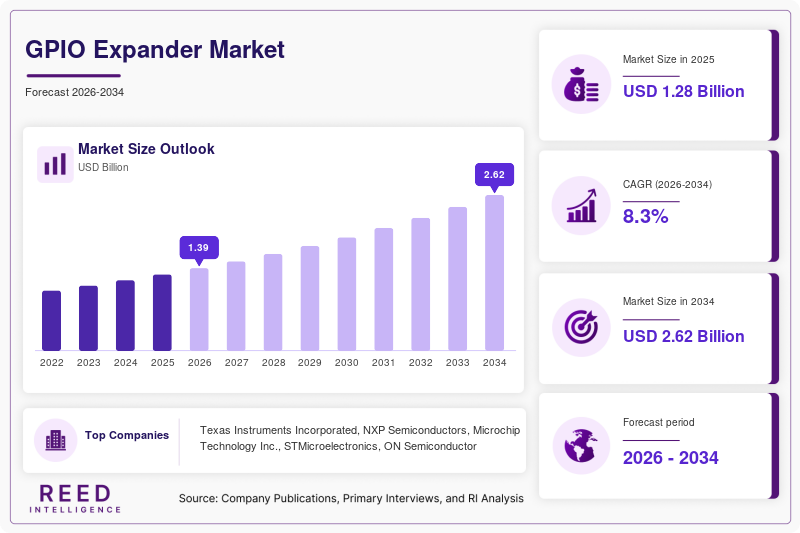
The GPIO Expander Market size was valued at approximately USD 1.28 billion in 2026 and is projected to reach USD 2.41 billion by 2034, expanding at a CAGR of 8.3% during the forecast period of 2026–2034. The market is witnessing consistent growth due to the increasing integration of microcontrollers and embedded systems across consumer electronics, automotive systems, and industrial automation. As devices become more compact and feature-rich, the demand for additional input/output (I/O) pins without increasing microcontroller complexity has accelerated the adoption of GPIO expanders.
A major global factor supporting market growth is the rapid expansion of the Internet of Things (IoT) ecosystem. IoT-enabled devices require scalable and efficient connectivity solutions, where GPIO expanders play a critical role by enabling flexible hardware configurations. These components allow designers to extend the number of controllable pins via communication protocols such as I2C and SPI, thereby optimizing system design and reducing costs.
Key Highlights
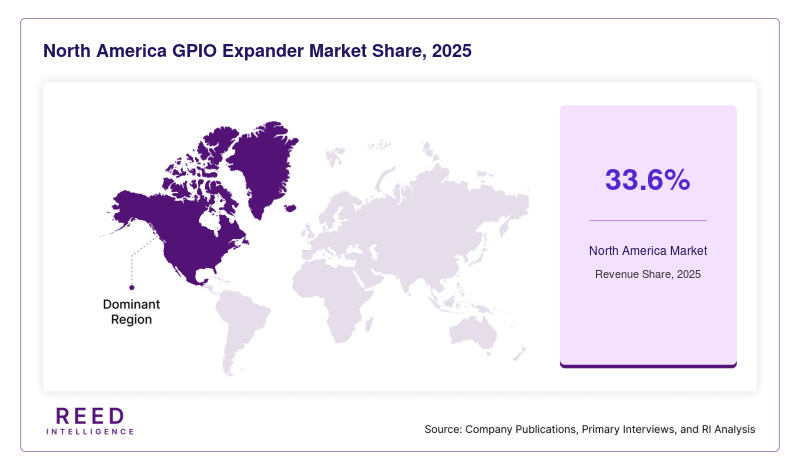
- North America dominated the market with a 33.6% share in 2025.
- Asia Pacific is expected to grow at the fastest CAGR of 9.7% during 2026–2034.
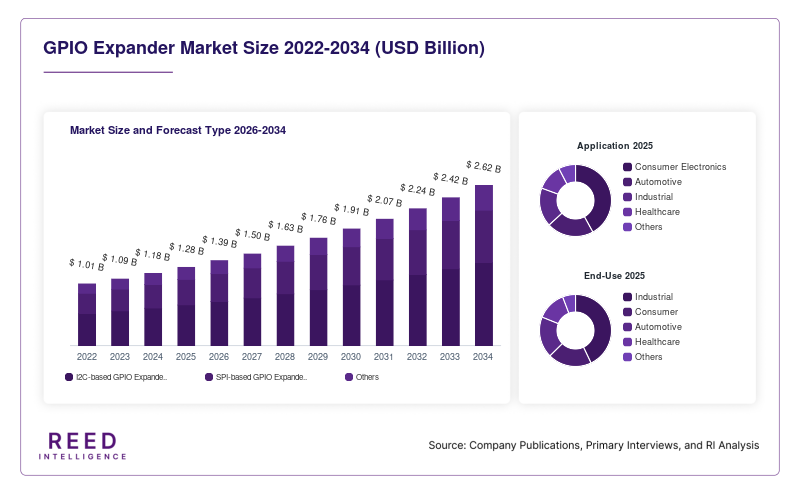
- By type, I2C-based GPIO expanders accounted for the largest share of 42.8%, while SPI-based expanders are projected to grow at a CAGR of 9.4%.
- By application, consumer electronics led with a 39.2% share, whereas automotive systems are expected to expand at a CAGR of 9.1%.
- The United States remained the dominant country, with market values of USD 420 million in 2024 and USD 455 million in 2025.
Market Trends
Increasing integration of GPIO expanders in compact and multifunctional devices
The ongoing trend toward miniaturization of electronic devices has significantly influenced the GPIO Expander Market. Manufacturers are increasingly focusing on designing compact systems without compromising functionality, which has led to a higher demand for efficient I/O expansion solutions. GPIO expanders allow system designers to add multiple input/output capabilities without increasing the size or complexity of the primary microcontroller. This is particularly relevant in wearable devices, smart home products, and portable medical equipment, where space optimization is critical.
Additionally, the rise of multifunctional devices has increased the need for flexible hardware configurations. GPIO expanders enable seamless integration of additional sensors, displays, and control interfaces, enhancing product versatility. This trend is further supported by advancements in semiconductor technology, which have improved the performance and energy efficiency of GPIO expanders. As consumer expectations for feature-rich yet compact devices continue to rise, this trend is expected to sustain long-term market growth.
Growing adoption in industrial automation and smart manufacturing
Industrial automation is becoming a major contributor to the expansion of the GPIO Expander Market. The adoption of Industry 4.0 technologies has increased the demand for intelligent control systems that require multiple input/output interfaces. GPIO expanders provide a cost-effective and scalable solution for managing these interfaces, particularly in programmable logic controllers (PLCs), robotics, and factory automation systems.
Smart manufacturing environments rely on real-time data collection and processing, which necessitates the integration of numerous sensors and actuators. GPIO expanders facilitate this integration by enabling efficient communication between devices and central control units. Furthermore, the increasing use of edge computing in industrial settings has amplified the need for localized processing capabilities, where GPIO expanders play a crucial role in managing peripheral devices. This trend is expected to accelerate as industries continue to invest in automation and digital transformation initiatives.
Market Drivers
Rising demand for IoT-enabled devices across multiple industries
The rapid proliferation of IoT-enabled devices across sectors such as healthcare, automotive, and consumer electronics is a key driver of the GPIO Expander Market. These devices require efficient connectivity solutions to manage multiple sensors, actuators, and communication modules. GPIO expanders provide a practical solution by extending the number of available I/O pins without increasing the complexity of the main processing unit.
In healthcare, for instance, wearable monitoring devices rely on GPIO expanders to integrate various sensors for tracking vital parameters. Similarly, in smart homes, devices such as lighting systems, security cameras, and thermostats utilize GPIO expanders to enhance functionality. The growing adoption of IoT technologies is also driving demand in industrial applications, where connected devices are used for predictive maintenance and process optimization. This widespread adoption is expected to sustain strong market growth over the forecast period.
Increasing complexity of embedded systems and need for scalable solutions
Modern embedded systems are becoming increasingly complex, requiring a higher number of input/output interfaces to support advanced functionalities. This complexity has created a need for scalable solutions that can accommodate additional peripherals without redesigning the entire system. GPIO expanders address this challenge by providing a flexible and modular approach to I/O expansion.
Design engineers prefer GPIO expanders as they reduce the need for larger and more expensive microcontrollers with higher pin counts. This not only lowers development costs but also simplifies system architecture. Moreover, GPIO expanders support standard communication protocols such as I2C and SPI, ensuring compatibility with a wide range of microcontrollers. As embedded systems continue to evolve, the demand for scalable and cost-effective solutions is expected to drive the growth of the GPIO Expander Market.
Market Restraint
Limited performance in high-speed and real-time applications
Despite their advantages, GPIO expanders face limitations in high-speed and real-time applications, which can restrain market growth. These devices rely on serial communication protocols such as I2C and SPI, which may introduce latency compared to direct GPIO connections on microcontrollers. In applications that require rapid signal processing or real-time responsiveness, such delays can impact system performance.
For example, in high-frequency trading systems or advanced robotics, even minor delays can lead to inefficiencies or operational issues. As a result, some manufacturers prefer using microcontrollers with higher pin counts instead of GPIO expanders, particularly in performance-critical applications. This limitation restricts the adoption of GPIO expanders in certain segments of the market. Additionally, the need for careful system design to manage communication overhead can increase development complexity, further hindering widespread adoption in high-performance environments.
Market Opportunities
Expansion of automotive electronics and electric vehicles
The growing adoption of advanced electronics in the automotive sector presents significant opportunities for the GPIO Expander Market. Modern vehicles are equipped with numerous electronic components, including infotainment systems, advanced driver assistance systems (ADAS), and battery management systems in electric vehicles. These systems require multiple input/output interfaces to function effectively, creating a strong demand for GPIO expanders.
In electric vehicles, for instance, GPIO expanders are used to manage sensors and control systems related to battery performance and safety. The increasing focus on vehicle electrification and automation is expected to drive the demand for these components. Furthermore, the integration of smart features such as connectivity and autonomous driving capabilities will further expand the use of GPIO expanders. This opportunity is expected to contribute significantly to market growth during the forecast period.
Emerging applications in smart cities and infrastructure
The development of smart cities and connected infrastructure is creating new growth opportunities for the GPIO Expander Market. Smart city initiatives involve the deployment of interconnected systems for traffic management, energy distribution, and public safety. These systems rely on a network of sensors and control devices, which require efficient I/O management solutions.
GPIO expanders enable the integration of multiple sensors and actuators in smart infrastructure projects, facilitating data collection and system control. For example, smart lighting systems use GPIO expanders to manage multiple lighting units and sensors for energy optimization. Similarly, smart traffic management systems rely on these components to control signals and monitor traffic conditions. As governments and organizations continue to invest in smart city projects, the demand for GPIO expanders is expected to increase, providing significant growth opportunities for market players.
Segmental Analysis
By Type
I2C-based GPIO expanders dominated the market, accounting for 42.8% of the share in 2024. These expanders are widely used due to their simplicity, low pin count requirements, and compatibility with a wide range of microcontrollers. I2C-based solutions are particularly popular in consumer electronics and IoT applications, where cost and efficiency are critical factors. Their ability to support multiple devices on a single bus makes them an attractive option for compact system designs.
SPI-based GPIO expanders are expected to grow at the fastest CAGR of 9.4% during the forecast period. These expanders offer higher data transfer speeds compared to I2C-based solutions, making them suitable for applications that require faster communication. The increasing demand for high-performance systems in industrial automation and automotive applications is driving the adoption of SPI-based GPIO expanders.
By Application
Consumer electronics held the largest share of 39.2% in 2024, driven by the widespread use of GPIO expanders in devices such as smartphones, tablets, and smart home products. The need for additional input/output capabilities in compact devices has made GPIO expanders an essential component in this segment.
Automotive systems are expected to grow at a CAGR of 9.1% during the forecast period. The increasing integration of electronic systems in vehicles, including infotainment and safety features, is driving the demand for GPIO expanders. The shift toward electric and autonomous vehicles is further accelerating growth in this segment.
By End-Use
The industrial sector dominated the market with a share of 36.5% in 2024. The adoption of automation technologies and smart manufacturing solutions has increased the demand for GPIO expanders in this sector. These components are used in control systems, robotics, and monitoring devices to manage multiple input/output interfaces.
The healthcare sector is expected to grow at the fastest CAGR of 8.9% during the forecast period. The increasing use of wearable devices and medical monitoring equipment is driving the demand for GPIO expanders. These devices require efficient integration of sensors and communication modules, creating significant growth opportunities in the healthcare segment.
Regional Analysis
North America
North America held a significant share of the GPIO Expander Market, accounting for 33.6% in 2025, and is expected to maintain steady growth with a CAGR of 7.9% during the forecast period. The region’s strong presence in semiconductor manufacturing and advanced technology adoption has supported market expansion. High demand for consumer electronics and industrial automation solutions further contributes to the growth of GPIO expanders in this region.
The United States dominates the North American market due to its well-established electronics and automotive industries. A unique growth factor in the country is the increasing investment in smart manufacturing and industrial IoT solutions. Companies are adopting advanced automation technologies, which require efficient I/O management systems, thereby driving the demand for GPIO expanders.
Europe
Europe accounted for approximately 24.8% of the GPIO Expander Market share in 2025 and is projected to grow at a CAGR of 7.6% during 2026–2034. The region benefits from strong demand in automotive electronics and industrial automation sectors. The presence of leading automotive manufacturers has significantly influenced the adoption of GPIO expanders.
Germany leads the European market, supported by its advanced automotive and manufacturing industries. A key growth factor is the increasing focus on electric vehicles and sustainable technologies. The integration of electronic systems in EVs requires efficient I/O expansion, driving the demand for GPIO expanders across the region.
Asia Pacific
Asia Pacific is the fastest-growing region in the GPIO Expander Market, with a CAGR of 9.7% during the forecast period and a market share of 28.5% in 2025. Rapid industrialization, coupled with the expansion of consumer electronics manufacturing, is driving market growth in the region.
China dominates the Asia Pacific market due to its large-scale electronics production and growing IoT ecosystem. A unique growth factor is the increasing government support for semiconductor manufacturing and smart infrastructure projects. These initiatives are boosting the demand for GPIO expanders across various applications.
Middle East & Africa
The Middle East & Africa region held a smaller share of 6.4% in 2025 but is expected to grow at a CAGR of 7.2% during the forecast period. The adoption of smart technologies and infrastructure development is gradually increasing the demand for GPIO expanders.
The United Arab Emirates is a key market in the region, driven by investments in smart city projects. A unique growth factor is the rapid deployment of connected infrastructure, including smart transportation and energy systems, which require efficient I/O management solutions.
Latin America
Latin America accounted for 6.7% of the GPIO Expander Market in 2025 and is projected to grow at a CAGR of 7.4% during the forecast period. The region is witnessing increased adoption of consumer electronics and industrial automation technologies.
Brazil leads the Latin American market, supported by its expanding manufacturing sector. A unique growth factor is the growing adoption of automation in industries such as food processing and automotive manufacturing, which is driving the demand for GPIO expanders.
Competitive Landscape
The GPIO Expander Market is moderately fragmented, with several global and regional players competing based on product innovation, pricing, and technological advancements. Leading companies are focusing on developing energy-efficient and high-performance GPIO expanders to meet the evolving demands of various industries.
Texas Instruments Incorporated is a key leader in the market, known for its extensive portfolio of semiconductor solutions. The company has recently introduced advanced GPIO expanders with improved power efficiency and enhanced communication capabilities. Other major players are also investing in research and development to expand their product offerings and strengthen their market presence.
Key Players
- Texas Instruments Incorporated
- NXP Semiconductors
- Microchip Technology Inc.
- STMicroelectronics
- ON Semiconductor
- Renesas Electronics Corporation
- Analog Devices, Inc.
- Maxim Integrated
- Infineon Technologies AG
- Toshiba Corporation
- ROHM Semiconductor
- Diodes Incorporated
- Silicon Labs
- Cypress Semiconductor
- Semtech Corporation
Recent Developments
- A leading semiconductor company launched a new series of low-power GPIO expanders designed for battery-operated IoT devices.
- A major market player expanded its production capacity to meet increasing demand from the automotive sector.
- Another company introduced a high-speed SPI-based GPIO expander aimed at industrial automation applications.
GPIO Expander Market Segments
Type
- I2C-based GPIO Expanders
- SPI-based GPIO Expanders
- Others
Application
- Consumer Electronics
- Automotive
- Industrial
- Healthcare
- Others
End-Use
- Industrial
- Consumer
- Automotive
- Healthcare
- Others
By Region
- North America
- Europe
- APAC
- Middle East and Africa
- LATAM