Graduated Cylinder Market Size, Share & Demand Report By Type (Standard Graduated Cylinders, Class A Precision Cylinderas), By Material (Borosilicate Glass, Soda Lime Glass), By Capacity (Up to 100 ml, 100 ml to 500 ml, Above 500 ml), By End Use (Pharmaceutical & Biotech Laboratories, Academic & Research Institutes, Hospitals & Diagnostic Laboratories), By Distribution Channel, By Region & Segment Forecasts, 2026–2034
USD 3950
Market Overview
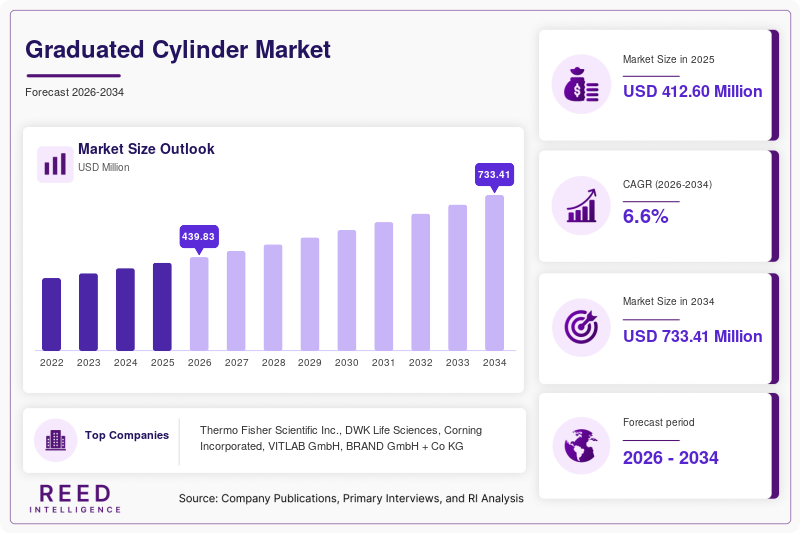
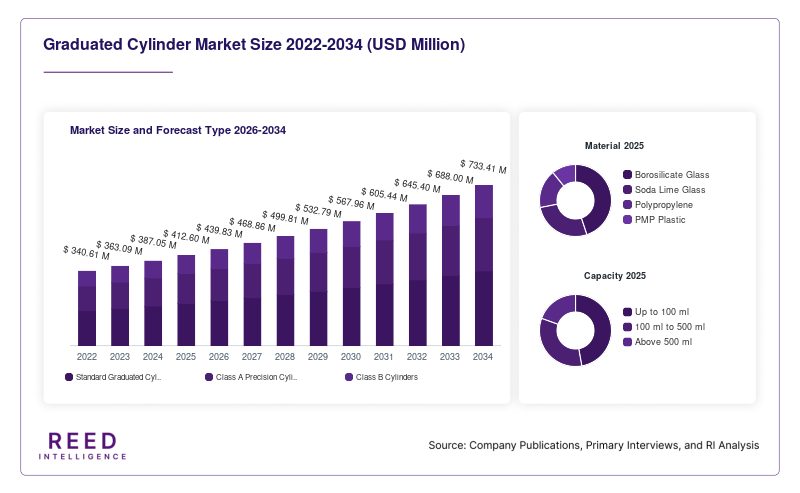
The Graduated Cylinder Market size was valued at USD 412.6 million in 2026 and is projected to reach USD 689.4 million by 2034, expanding at a CAGR of 6.6% from 2026 to 2034. The market growth is being supported by the steady expansion of laboratory infrastructure worldwide, especially in pharmaceutical manufacturing, academic research, healthcare diagnostics, food testing, and environmental monitoring. Increasing emphasis on precise volumetric measurement in quality control processes has strengthened product demand across developed and emerging economies.
Graduated cylinders remain a standard laboratory instrument due to their simplicity, repeatability, and compatibility with manual and semi-automated workflows. Demand has also benefited from rising investments in science education and the modernization of testing laboratories. In addition, replacement demand for breakage-prone glass cylinders and adoption of chemically resistant polymer alternatives continue to create recurring revenue streams for manufacturers.
Key Highlights
- Dominant region: North America held 34.2% share in 2025.
- Fastest-growing region: Asia Pacific is projected to grow at 7.9% CAGR through 2034.
- Leading Type subsegment: Standard graduated cylinders accounted for 61.8% share in 2025.
- Fastest-growing Type subsegment: Class A precision cylinders will grow at 7.4% CAGR.
- Leading Material subsegment: Borosilicate glass held 56.5% share in 2025.
- Fastest-growing Material subsegment: Polypropylene cylinders will expand at 8.1% CAGR.
- Leading End-use subsegment: Pharmaceutical and biotech laboratories held 31.6% share in 2025.
- Fastest-growing End-use subsegment: Environmental testing labs will rise at 8.3% CAGR.
- Dominant country: United States market stood at USD 103.8 million in 2024 and USD 108.9 million in 2025.
Market Trends
Shift Toward Polymer-Based Measuring Instruments
Laboratories are increasingly adopting polypropylene and PMP graduated cylinders due to their break resistance, lightweight design, and lower replacement costs. These products are gaining traction in education, field testing, and high-volume routine labs where handling efficiency matters more than premium optical clarity.
Rising Preference for Certified Accuracy and Calibration
Industrial laboratories and regulated sectors are purchasing Class A and calibration-certified cylinders to improve audit readiness and batch consistency. Demand for traceable measuring tools has increased as pharmaceutical, chemical, and food manufacturers tighten internal quality standards.
Market Drivers
Expansion of Pharmaceutical Production and Quality Testing
Global pharmaceutical output continues to rise due to chronic disease treatment demand, vaccine manufacturing, and contract development services. Each production line requires routine liquid handling, solution preparation, and validation testing, creating stable demand for graduated cylinders.
Growth in Academic and Research Laboratories
Universities, technical institutes, and private research centers are investing in STEM infrastructure. Basic laboratory glassware remains essential for chemistry, biology, and material science training, supporting steady sales volume in the Graduated Cylinder Market.
Market Restraint
Competition from Automated Liquid Measurement Systems
Advanced laboratories are shifting some workflows toward digital dispensers, pipetting robots, and volumetric automation systems. These alternatives can reduce dependence on manual measuring cylinders in precision-intensive environments.
Market Opportunities
Rising Demand from Environmental Monitoring Programs
Water quality testing, soil analysis, and wastewater treatment facilities are expanding worldwide. These applications require reliable volumetric tools, creating new growth avenues for mid-range and chemical-resistant graduated cylinders.
Private Label and E-commerce Distribution Expansion
Online procurement platforms and OEM/private-label manufacturing are opening new channels for smaller suppliers. Regional distributors can now reach educational institutions and small laboratories more efficiently.
Segmental Analysis
By Type
Standard graduated cylinders accounted for 61.8% of the Graduated Cylinder Market in 2025 due to their broad use in routine measurement tasks across schools, hospitals, and industrial labs. Their low cost and wide size availability supported volume sales.
Class A precision cylinders will grow at 7.4% CAGR through 2034. Rising procurement by regulated laboratories that require tighter tolerance and documented calibration will drive demand.
By Material
Borosilicate glass held 56.5% share in 2025 because of its chemical resistance, temperature stability, and transparency. It remained the preferred option for analytical chemistry and research applications.
Polypropylene cylinders are forecast to expand at 8.1% CAGR. Their shatter resistance and lower lifecycle cost will attract educational institutions and field laboratories.
By Capacity
100 ml to 500 ml cylinders represented 44.7% share in 2025, as these sizes fit common sample preparation and mixing needs in daily laboratory workflows.
Above 500 ml cylinders will grow at 6.9% CAGR due to rising demand in industrial chemical blending, wastewater testing, and bulk liquid handling.
By End Use
Pharmaceutical and biotech laboratories captured 31.6% share in 2025 because of recurring use in formulation support, media preparation, and quality testing.
Environmental testing laboratories are expected to rise at 8.3% CAGR through 2034 as governments expand pollution control and water monitoring programs.
By Distribution Channel
Direct institutional sales accounted for 53.2% share in 2025, driven by tenders, annual contracts, and bundled procurement from hospitals and industrial buyers.
E-commerce and digital distributors will grow at 8.5% CAGR as smaller laboratories increasingly prefer quick ordering and broader brand comparison.
Regional Analysis
North America
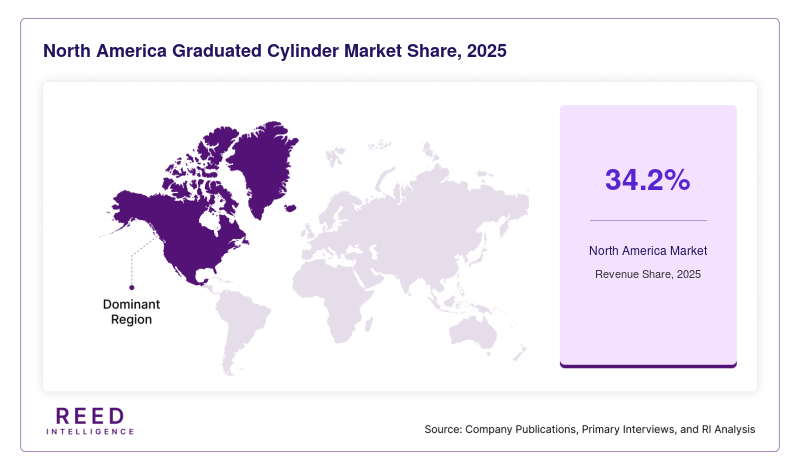
North America accounted for 34.2% of the Graduated Cylinder Market share in 2025 and will grow at a 5.8% CAGR through 2034. The United States dominated the region due to strong pharmaceutical production capacity and frequent replacement demand from research facilities. Federal support for laboratory modernization further sustained purchases.
Europe
Europe held 27.6% share in 2025 and will expand at a 5.9% CAGR during the forecast period. Germany led the regional market due to its dense network of chemical manufacturers and industrial testing laboratories. Strong preference for certified laboratory tools supported premium product sales.
Asia Pacific
Asia Pacific captured 24.8% share in 2025 and will register the fastest 7.9% CAGR through 2034. China led regional demand owing to expanding pharmaceutical exports, university laboratory construction, and increasing domestic production of laboratory consumables.
Middle East & Africa
Middle East & Africa represented 7.1% share in 2025 and will grow at a 6.4% CAGR. Saudi Arabia remained the leading country as healthcare infrastructure expansion and industrial diversification programs increased laboratory equipment procurement.
Latin America
Latin America held 6.3% share in 2025 and will advance at a 6.1% CAGR through 2034. Brazil led the region due to growth in food testing, healthcare diagnostics, and public university laboratory investments.
Competitive Landscape
The Graduated Cylinder Market remains moderately fragmented, with global laboratory supply companies competing alongside regional manufacturers. Product quality, calibration compliance, pricing, and distribution reach are the main competitive factors. Leading companies focus on durable materials, clear graduation marking, and broad product portfolios.
Thermo Fisher Scientific Inc. remained a market leader due to its strong global laboratory distribution network and diversified consumables portfolio. The company recently expanded its lab essentials catalog with upgraded polymer measuring products aimed at education and healthcare buyers.
DWK Life Sciences maintained strong positioning through premium glassware offerings and calibration-certified cylinders. Corning Incorporated continued to benefit from trusted Pyrex-branded laboratory glassware. VITLAB GmbH focused on precision plastic laboratory instruments, while BRAND GmbH + Co KG strengthened presence through quality volumetric products for regulated industries.
Many mid-sized players are using e-commerce channels and private-label partnerships to increase market share in cost-sensitive regions.
Key Players List
- Thermo Fisher Scientific Inc.
- DWK Life Sciences
- Corning Incorporated
- VITLAB GmbH
- BRAND GmbH + Co KG
- Eppendorf SE
- Kartell S.p.A.
- Hirschmann Laborgeräte GmbH
- Globe Scientific Inc.
- Heathrow Scientific
- Cole-Parmer Instrument Company
- Thomas Scientific
- SP Industries
- Fisherbrand
- Borosil Limited
Recent Developments
- Thermo Fisher Scientific introduced expanded polymer measuring ware lines for routine laboratory use in 2025.
- DWK Life Sciences increased production capacity for calibrated glass cylinders to meet European demand in 2025.
- Borosil Limited expanded laboratory glassware exports across Asia and Africa in 2024.
- Tarsons Products Ltd. launched new autoclavable polypropylene graduated cylinders for healthcare laboratories in 2025.
- Several distributors adopted digital procurement portals, improving bulk purchasing efficiency for educational and research institutions.
Graduated Cylinder Market Segments
Type
- Standard Graduated Cylinders
- Class A Precision Cylinders
- Class B Cylinders
Material
- Borosilicate Glass
- Soda Lime Glass
- Polypropylene
- PMP Plastic
Capacity
- Up to 100 ml
- 100 ml to 500 ml
- Above 500 ml
End Use
- Pharmaceutical & Biotech Laboratories
- Academic & Research Institutes
- Hospitals & Diagnostic Laboratories
- Environmental Testing Laboratories
- Industrial & Chemical Laboratories
Distribution Channel
- Direct Sales
- Distributors
- E-commerce Platforms
By Region
- North America
- Europe
- APAC
- Middle East and Africa
- LATAM