Gram Staining System Market Size, Share & Demand Report By Product Type (Automated Gram Staining Systems, Manual Gram Staining Systems, Consumables), By Application (Clinical Diagnostics, Research Laboratories, Pharmaceutical Testing), By End-Use (Hospitals & Diagnostic Laboratories, Academic & Research Institutes, Pharmaceutical & Biotechnology Companies) By Region & Segment Forecasts, 2026–2034
USD 3950
Market Overview
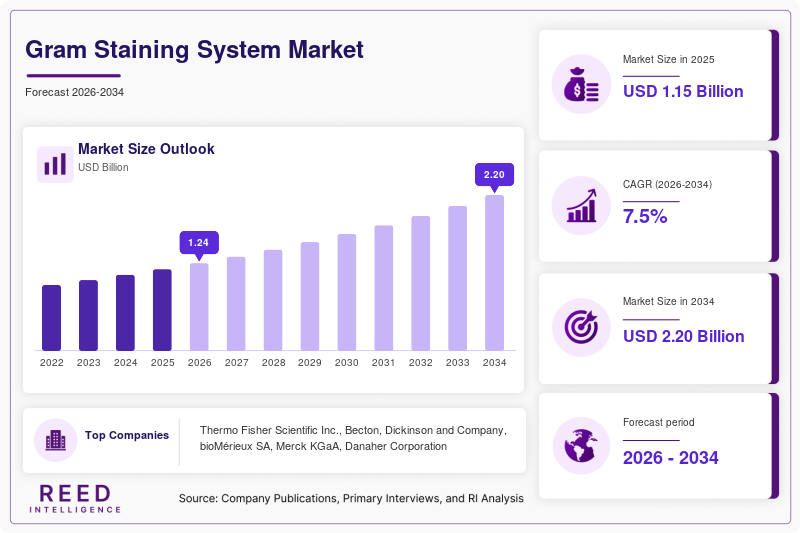
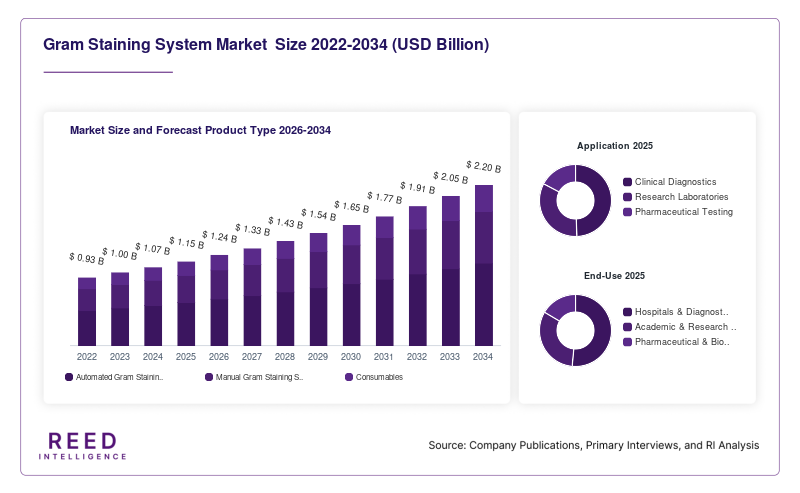
The Gram Staining System Market size was valued at approximately USD 1.15 billion in 2026 and is projected to reach USD 2.05 billion by 2034, expanding at a CAGR of 7.5% during the forecast period (2026–2034). Gram staining systems remain a critical diagnostic tool in microbiology laboratories, enabling rapid classification of bacteria into Gram-positive and Gram-negative categories. This fundamental diagnostic technique continues to support clinical decision-making, particularly in infection control, antibiotic selection, and disease surveillance.
One of the primary global factors driving market growth is the increasing burden of infectious diseases across both developed and developing regions. Rising cases of hospital-acquired infections (HAIs), antimicrobial resistance (AMR), and emerging pathogens have significantly elevated the demand for efficient and standardized diagnostic methods. Gram staining systems offer a cost-effective and rapid preliminary diagnostic solution, making them indispensable in routine laboratory workflows.
Key Highlights
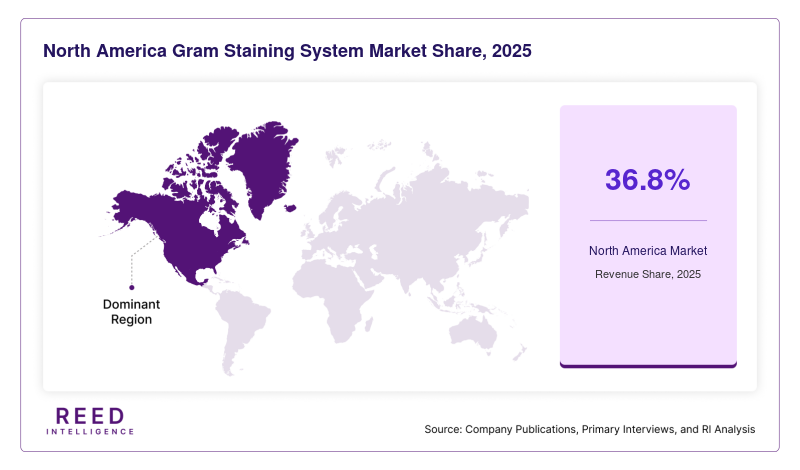
- North America dominated the market with a 36.8% share in 2025.
- Asia Pacific is expected to grow at the fastest CAGR of 9.4% during 2026–2034.
- By product type, automated Gram staining systems accounted for the largest share of 42.6%, while consumables are projected to grow at a CAGR of 8.7%.
- By application, clinical diagnostics led with a 47.9% share, whereas research laboratories are expected to expand at a CAGR of 8.9%.
- The United States remained the dominant country, with market values of USD 410 million in 2024 and USD 445 million in 2025.
Market Trends
Increasing adoption of laboratory automation in microbiology workflows
The growing shift toward automation in clinical laboratories is significantly influencing the Gram Staining System Market. Laboratories are increasingly adopting automated staining systems to improve efficiency, reduce manual intervention, and enhance consistency in results. Automated systems streamline the staining process by controlling reagent dispensing, timing, and slide handling, which minimizes variability caused by human error. This trend is particularly evident in large diagnostic centers and hospital laboratories that process high sample volumes daily.
Automation also supports faster turnaround times, which is critical in diagnosing infectious diseases and initiating appropriate treatment. Additionally, automated systems integrate seamlessly with laboratory information systems (LIS), enabling better data management and traceability. As healthcare systems continue to prioritize efficiency and accuracy, the adoption of automated Gram staining solutions is expected to increase steadily, reinforcing this trend across both developed and emerging markets.
Rising integration of digital imaging and AI-based diagnostic tools
Another notable trend shaping the market is the integration of digital imaging and artificial intelligence into Gram staining workflows. Advanced imaging systems now allow laboratories to capture high-resolution images of stained slides, which can be analyzed using AI algorithms for bacterial classification. This reduces reliance on manual microscopy and enhances diagnostic precision.
AI-powered tools can identify bacterial morphology and staining characteristics with high accuracy, supporting microbiologists in making faster and more reliable decisions. This trend is gaining traction in research institutions and advanced clinical laboratories where precision and efficiency are critical. Furthermore, digital platforms enable remote analysis and telepathology, expanding access to diagnostic expertise in underserved regions. As digital health technologies continue to evolve, their integration with Gram staining systems is expected to create new opportunities for innovation and market growth.
Market Drivers
Growing prevalence of infectious diseases and antimicrobial resistance
The increasing global burden of infectious diseases is a major driver of the Gram Staining System Market. Conditions such as sepsis, pneumonia, urinary tract infections, and tuberculosis require rapid and accurate diagnostic methods to guide treatment decisions. Gram staining remains one of the first-line diagnostic techniques used in identifying bacterial infections, making it essential in clinical settings.
Additionally, the rise of antimicrobial resistance has intensified the need for early and precise bacterial identification. Gram staining helps clinicians determine the type of bacteria involved, enabling targeted antibiotic therapy and reducing the misuse of broad-spectrum antibiotics. Governments and healthcare organizations are investing in diagnostic infrastructure to combat AMR, further supporting market growth. The continued emphasis on infection control and surveillance is expected to sustain demand for Gram staining systems in the coming years.
Expansion of healthcare infrastructure in emerging economies
The expansion of healthcare infrastructure in emerging economies is another key driver of market growth. Countries in Asia Pacific, Latin America, and the Middle East are investing heavily in improving healthcare access and diagnostic capabilities. New hospitals, diagnostic laboratories, and research centers are being established, increasing the demand for essential laboratory equipment, including Gram staining systems.
These regions are also witnessing a rise in public health initiatives aimed at controlling infectious diseases, which further boosts the adoption of diagnostic tools. Government funding and international collaborations are supporting the development of laboratory networks, particularly in rural and underserved areas. As healthcare systems in these regions continue to evolve, the demand for cost-effective and reliable diagnostic solutions such as Gram staining systems is expected to grow significantly.
Market Restraint
Limited sensitivity and dependence on skilled personnel
Despite its widespread use, Gram staining has certain limitations that restrain market growth. One of the primary challenges is its limited sensitivity compared to advanced molecular diagnostic techniques. Gram staining provides preliminary results but may not always offer definitive identification, particularly in cases involving mixed infections or atypical organisms. This limitation can lead to the need for additional confirmatory tests, increasing overall diagnostic time and cost.
Another significant constraint is the dependence on skilled laboratory personnel. Accurate interpretation of Gram-stained slides requires expertise and experience, and variations in technique can affect results. In regions with limited access to trained microbiologists, this can lead to inconsistent outcomes. While automation addresses some of these challenges, the high cost of automated systems may restrict their adoption in smaller laboratories. These factors collectively pose challenges to the widespread adoption of Gram staining systems, particularly in resource-constrained settings.
Market Opportunities
Growth potential in point-of-care diagnostics
The increasing demand for point-of-care diagnostics presents a significant opportunity for the Gram Staining System Market. Healthcare providers are seeking rapid diagnostic solutions that can be used directly at the patient’s bedside or in decentralized settings. Portable and compact Gram staining systems are being developed to meet this demand, enabling faster diagnosis and treatment initiation.
Point-of-care Gram staining can be particularly valuable in emergency departments, intensive care units, and remote healthcare facilities where timely decision-making is critical. These systems reduce the need for sample transportation and centralized laboratory processing, improving efficiency and patient outcomes. As the healthcare industry continues to move toward decentralized diagnostics, the development of portable Gram staining solutions is expected to create new growth avenues for market players.
Increasing research activities in microbiology and life sciences
The expansion of research activities in microbiology and life sciences is another promising opportunity for the market. Academic institutions, biotechnology companies, and research organizations are increasingly investing in studies related to bacterial pathogenesis, antibiotic resistance, and vaccine development. Gram staining remains a fundamental technique in these research applications, supporting the identification and characterization of bacterial species.
Funding from governments and private organizations is driving research initiatives, particularly in areas related to infectious diseases and public health. Additionally, the growing focus on personalized medicine and precision diagnostics is encouraging the use of advanced laboratory techniques, including Gram staining. As research activities continue to expand globally, the demand for reliable and high-quality staining systems is expected to rise, contributing to market growth.
Segmental Analysis
By Product Type
Automated Gram staining systems emerged as the dominant subsegment, accounting for approximately 42.6% of the market share in 2024. These systems are widely adopted in clinical laboratories due to their ability to deliver consistent and reproducible results. Automation reduces manual errors and enhances efficiency, making it suitable for high-throughput environments. Additionally, automated systems often include features such as programmable protocols and integrated quality control, further improving their reliability. The increasing demand for standardized diagnostic procedures is a key factor supporting the growth of this subsegment.
Consumables, including reagents and staining kits, are expected to be the fastest-growing subsegment, with a projected CAGR of 8.7% during the forecast period. The recurring nature of consumable usage ensures a steady demand, particularly in high-volume laboratories. Growth in this subsegment is driven by the increasing number of diagnostic tests performed globally. Additionally, the development of high-quality and ready-to-use staining kits enhances convenience and reduces preparation time. As laboratory testing volumes continue to rise, the demand for consumables is expected to grow significantly.
By Application
Clinical diagnostics dominated the application segment, accounting for approximately 47.9% of the market share in 2024. Gram staining is extensively used in hospitals and diagnostic laboratories for the rapid identification of bacterial infections. The technique provides preliminary results that guide treatment decisions, particularly in critical care settings. The increasing prevalence of infectious diseases and the need for timely diagnosis are key factors driving the growth of this subsegment.
Research laboratories are expected to be the fastest-growing application segment, with a CAGR of 8.9%. The expansion of microbiology research and the increasing focus on understanding bacterial behavior are driving demand in this segment. Research institutions require reliable staining systems for various studies, including antibiotic resistance and pathogen characterization. The availability of funding and the growing number of research initiatives are further supporting the growth of this subsegment.
By End-Use
Hospitals and diagnostic laboratories represented the largest end-use segment, accounting for approximately 52.3% of the market share in 2024. These facilities rely heavily on Gram staining systems for routine diagnostic procedures. The high patient volume and the need for rapid diagnosis contribute to the dominance of this segment. Additionally, the adoption of automated systems in hospitals enhances efficiency and reduces turnaround time.
Academic and research institutes are projected to be the fastest-growing end-use segment, with a CAGR of 8.5%. The increasing number of research projects and collaborations is driving demand for Gram staining systems in this segment. These institutes require advanced laboratory equipment to support their research activities. The growing emphasis on scientific research and innovation is expected to further boost the adoption of Gram staining systems in academic settings.
Regional Analysis
North America
North America accounted for the largest share of the Gram Staining System Market in 2025, contributing approximately 36.8% of the global revenue. The region is expected to grow at a steady CAGR of 6.9% during the forecast period. The presence of advanced healthcare infrastructure, well-established diagnostic laboratories, and high adoption of automated systems are key factors supporting market growth. Additionally, strong investment in research and development further enhances the region’s market position.
The United States remains the dominant country in North America, driven by its robust healthcare system and high prevalence of infectious diseases. A unique growth factor in this region is the strong focus on antimicrobial resistance surveillance programs. Government initiatives aimed at improving diagnostic capabilities and infection control measures are significantly boosting the demand for Gram staining systems.
Europe
Europe held a significant share of the global market in 2025, accounting for approximately 27.4% of total revenue. The region is projected to grow at a CAGR of 6.7% over the forecast period. The presence of well-established healthcare systems and increasing awareness about infection control contribute to market growth. Additionally, the adoption of advanced laboratory technologies supports the demand for automated Gram staining systems.
Germany is the leading country in the European market, supported by its strong healthcare infrastructure and emphasis on research and innovation. A unique growth factor in this region is the increasing implementation of quality standards and regulations in diagnostic laboratories. These standards encourage the adoption of standardized and automated staining systems, driving market expansion.
Asia Pacific
Asia Pacific is expected to be the fastest-growing region in the Gram Staining System Market, with a projected CAGR of 9.4% during 2026–2034. The region accounted for approximately 21.6% of the global market in 2025. Rapid urbanization, increasing healthcare investments, and rising awareness about infectious diseases are key factors driving growth in this region.
China dominates the Asia Pacific market due to its large population and expanding healthcare infrastructure. A unique growth factor is the increasing government focus on strengthening public health systems and laboratory networks. Investments in diagnostic facilities and the growing number of hospitals are significantly boosting demand for Gram staining systems across the region.
Middle East & Africa
The Middle East & Africa region accounted for around 7.1% of the global market share in 2025 and is expected to grow at a CAGR of 7.2%. The region is witnessing gradual improvements in healthcare infrastructure and increasing investments in diagnostic capabilities. The rising burden of infectious diseases also contributes to market growth.
Saudi Arabia is the dominant country in this region, driven by its investments in healthcare modernization. A unique growth factor is the increasing focus on medical tourism and the development of advanced healthcare facilities. These initiatives are encouraging the adoption of modern diagnostic technologies, including Gram staining systems.
Latin America
Latin America held approximately 7.1% of the global market share in 2025 and is projected to grow at a CAGR of 7.0%. The region’s growth is supported by improving healthcare access and increasing government initiatives to control infectious diseases. The expansion of diagnostic laboratories also contributes to market development.
Brazil leads the Latin American market due to its large healthcare network and growing demand for diagnostic services. A unique growth factor is the increasing focus on public health programs aimed at disease prevention and early diagnosis. These initiatives are driving the adoption of Gram staining systems across the region.
Competitive Landscape
The Gram Staining System Market is characterized by the presence of several established players focusing on product innovation, strategic partnerships, and geographic expansion. Companies are investing in research and development to enhance automation, improve staining quality, and integrate digital technologies into their systems. The competitive landscape is moderately fragmented, with key players competing based on product quality, pricing, and technological advancements.
One of the leading companies in the market is Thermo Fisher Scientific, known for its comprehensive range of laboratory solutions and strong global presence. The company has recently introduced advanced automated staining systems designed to improve efficiency and accuracy in microbiology laboratories. Other major players are also focusing on expanding their product portfolios and strengthening their distribution networks to gain a competitive edge.
Collaborations with research institutions and healthcare providers are common strategies adopted by market participants. These partnerships enable companies to develop innovative solutions tailored to specific customer needs. As the market continues to evolve, competition is expected to intensify, with companies focusing on technological advancements and customer-centric approaches.
Key Players
- Thermo Fisher Scientific Inc.
- Becton, Dickinson and Company
- bioMérieux SA
- Merck KGaA
- Danaher Corporation
- Hardy Diagnostics
- HiMedia Laboratories
- Agilent Technologies
- Carl Zeiss AG
- Leica Microsystems
- Biocare Medical
- ELITechGroup
- Atom Scientific Ltd
- RAL Diagnostics
- Pro-Lab Diagnostics
Recent Developments
- A leading diagnostics company launched a fully automated Gram staining system with integrated imaging capabilities to improve workflow efficiency in high-volume laboratories.
- A major market player expanded its product portfolio by introducing eco-friendly staining reagents designed to reduce environmental impact and enhance safety.
- A global healthcare company entered into a strategic partnership with research institutions to develop AI-based analysis tools for Gram-stained slides, aiming to improve diagnostic accuracy and speed.
Gram Staining System Market Segments
Product Type
- Automated Gram Staining Systems
- Manual Gram Staining Systems
- Consumables
Application
- Clinical Diagnostics
- Research Laboratories
- Pharmaceutical Testing
End-Use
- Hospitals & Diagnostic Laboratories
- Academic & Research Institutes
- Pharmaceutical & Biotechnology Companies
By Region
- North America
- Europe
- APAC
- Middle East and Africa
- LATAM