Gray Foam Glass Market Size, Share & Demand Report By Product Type (Foam Glass Gravel, Foam Glass Panels, Foam Glass Blocks), By Application (Building Insulation, Industrial Insulation, Infrastructure Construction), By End-Use Industry (Construction, Energy & Utilities, Industrial Manufacturing) By Region & Segment Forecasts, 2025–2034
USD 3950
Market Overview
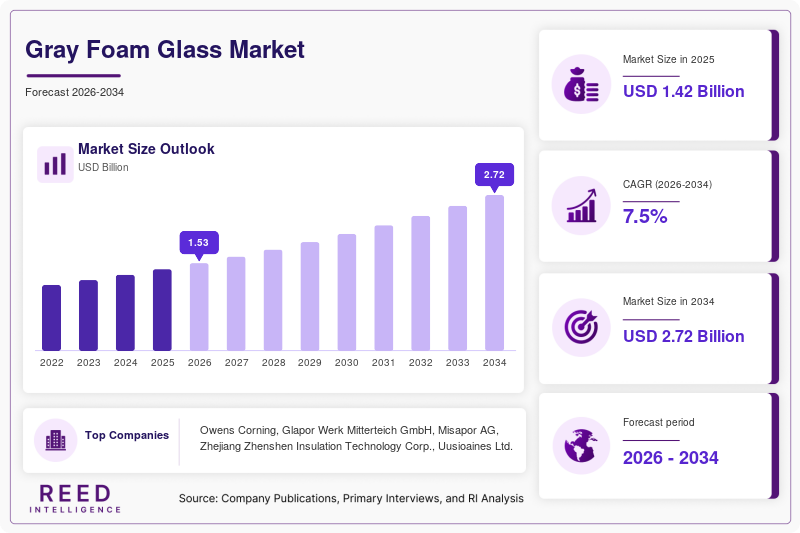
The Gray Foam Glass Market size was valued at approximately USD 1.42 billion in 2025 and is projected to reach USD 2.73 billion by 2034, expanding at a compound annual growth rate (CAGR) of 7.5% from 2025 to 2034. Gray foam glass is a lightweight, porous material produced primarily from recycled glass. It offers strong thermal insulation, high compressive strength, moisture resistance, and durability. These characteristics have positioned gray foam glass as a suitable solution for insulation and structural applications across construction, industrial infrastructure, and cryogenic systems.
One global factor supporting the growth of the Gray Foam Glass Market is the increasing emphasis on sustainable construction materials. Governments and industry stakeholders are encouraging the use of recycled raw materials and low-carbon building products. Gray foam glass meets these objectives by using waste glass while delivering long service life and thermal performance. As a result, construction firms and infrastructure developers are incorporating foam glass insulation into foundations, roof insulation, and underground pipeline systems.
Key Highlights
- Europe accounted for approximately 36% of the global Gray Foam Glass Market share in 2025, while Asia Pacific is expected to grow at a CAGR of 8.6% through 2034.
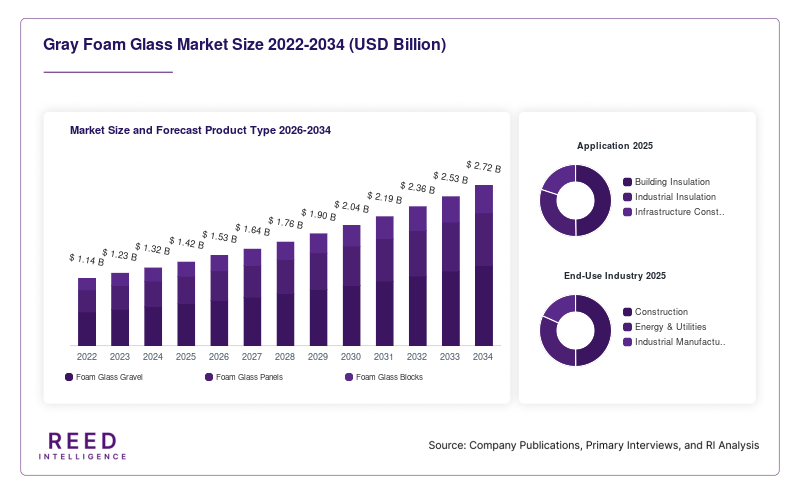
- By product type, foam glass gravel dominated with 48% share, while foam glass panels are projected to grow fastest at 8.2% CAGR.
- By application, building insulation held the largest share at 44%, while industrial insulation will expand at a CAGR of 8.4%.
- Germany remained the dominant country, with the market valued at USD 185 million in 2025 and projected to reach USD 198 million in 2026.
Market Trends
Expansion of Circular Economy Materials in Construction
A significant trend shaping the Gray Foam Glass Market is the increasing adoption of circular economy construction materials. Foam glass production relies heavily on recycled glass, which reduces landfill waste and lowers raw material consumption. Builders and infrastructure developers are integrating such materials into modern construction practices to comply with sustainability guidelines. Gray foam glass is being used in road embankments, foundation insulation, and green roofing systems because it provides both insulation and structural stability. As environmental regulations become more structured in several economies, recycled construction materials are gaining broader acceptance across public infrastructure projects.
Integration of Foam Glass in Energy Infrastructure Insulation
Another important trend in the Gray Foam Glass Market involves the growing use of foam glass insulation in energy and industrial infrastructure. Industrial pipelines, LNG facilities, and district heating systems require insulation materials that resist moisture, temperature fluctuations, and chemical exposure. Gray foam glass performs effectively under such conditions due to its non-combustible structure and closed-cell composition. Energy companies and industrial plant operators are therefore integrating foam glass insulation into new facilities and modernization projects. This trend is contributing to stable demand growth as industrial infrastructure expands globally.
Market Drivers
Increasing Demand for Durable Insulation Materials
The growing need for durable insulation materials in construction and industrial sectors has supported the expansion of the Gray Foam Glass Market. Foam glass offers long service life, compressive strength, and resistance to water absorption. These characteristics allow it to maintain performance under heavy loads and harsh environmental conditions. As building standards emphasize durability and lifecycle cost reduction, developers are adopting foam glass solutions for underground insulation, roof insulation, and structural backfill applications. The demand for materials capable of maintaining consistent insulation performance is therefore reinforcing the market outlook.
Growth in Infrastructure Development Projects
Infrastructure development has also been a major driver for the Gray Foam Glass Market. Large-scale projects such as transportation corridors, tunnels, and district heating systems require lightweight yet strong insulation materials. Gray foam glass is suitable for such applications because it combines structural stability with thermal insulation. Governments in multiple regions are investing in modern infrastructure systems that improve energy efficiency and long-term durability. These investments are generating demand for foam glass products used in road construction, foundation insulation, and underground utility systems.
Market Restraints
High Manufacturing Costs Compared with Conventional Insulation
One significant restraint affecting the Gray Foam Glass Market is the relatively high manufacturing cost of foam glass products. Production involves specialized kilns, high-temperature processing, and energy-intensive manufacturing steps. These requirements increase operational costs compared with conventional insulation materials such as mineral wool or expanded polystyrene.
The higher price point can influence purchasing decisions in cost-sensitive construction projects. Contractors and developers sometimes prioritize lower-cost insulation solutions, especially in residential or small-scale commercial projects. While foam glass provides durability and sustainability benefits, the upfront cost difference can limit adoption in certain markets.
Additionally, the availability of alternative insulation products that offer acceptable thermal performance at lower prices creates competitive pressure within the industry. These factors may slow adoption in regions where construction budgets remain constrained. As a result, manufacturers in the Gray Foam Glass Market continue to explore process optimization and recycling efficiency improvements to lower production costs and expand market accessibility.
Market Opportunities
Expansion of Green Building Certification Programs
The growth of green building certification frameworks presents an emerging opportunity for the Gray Foam Glass Market. Programs that evaluate building sustainability often prioritize recycled materials, energy efficiency, and long-lasting insulation systems. Foam glass aligns with these criteria due to its recycled glass composition and stable insulation performance. As commercial buildings increasingly pursue sustainability certifications, demand for eco-friendly construction materials is expected to increase.
Manufacturers are responding by introducing foam glass products designed for environmentally focused building projects. This trend may create additional opportunities in commercial real estate, institutional buildings, and public infrastructure developments.
Development of Advanced Foam Glass Products
Another opportunity lies in the development of advanced foam glass formulations with improved strength-to-weight ratios and enhanced thermal insulation properties. Research activities are focusing on refining pore structure and manufacturing techniques to achieve higher performance materials. These innovations may expand the range of applications across transportation infrastructure, cold storage facilities, and industrial insulation systems.
Advanced products can enable foam glass to compete more effectively with traditional insulation materials, opening new segments within the global Gray Foam Glass Market.
Segmental Analysis
By Product Type
Foam glass gravel represented the dominant subsegment in the Gray Foam Glass Market, accounting for approximately 48% of the total share in 2025. Foam glass gravel is widely used as a lightweight aggregate in construction projects. Its porous structure provides thermal insulation while maintaining structural stability, making it suitable for foundation insulation and road embankment applications. Construction companies have incorporated foam glass gravel into infrastructure projects that require both load-bearing capacity and insulation performance.
The foam glass panels subsegment is projected to grow at the fastest CAGR of 8.2% between 2025 and 2034. These panels offer consistent thickness and controlled insulation properties, which make them suitable for building insulation systems. Manufacturers are expected to develop panels with improved dimensional stability and installation flexibility. This innovation will expand their adoption in commercial building insulation and industrial facilities.
By Application
Building insulation accounted for the largest share of the Gray Foam Glass Market, representing around 44% of total demand in 2025. Foam glass insulation materials are used in roofs, foundations, and walls to enhance thermal efficiency and moisture protection. The closed-cell structure prevents water absorption while maintaining insulation performance, making it suitable for long-term building applications.
The industrial insulation segment will likely grow at the fastest CAGR of 8.4% through 2034. Industrial facilities require insulation materials capable of withstanding temperature fluctuations and exposure to chemicals. Foam glass insulation meets these requirements due to its non-combustible and moisture-resistant properties. The expansion of industrial infrastructure projects is expected to support the growth of this subsegment.
By End-Use Industry
The construction industry dominated the Gray Foam Glass Market in 2025, accounting for approximately 52% of total market share. Construction companies have integrated foam glass insulation into building foundations, underground structures, and roof insulation systems. The material’s durability and thermal performance support its widespread use in infrastructure and commercial construction projects.
The energy and utilities sector is projected to grow at the fastest CAGR of 8.1% during the forecast period. Energy infrastructure requires insulation materials that maintain performance under extreme environmental conditions. Foam glass products provide moisture resistance and structural stability, making them suitable for pipeline insulation and energy facility construction. The expansion of energy distribution infrastructure will support the growth of this segment.
Regional Analysis
North America
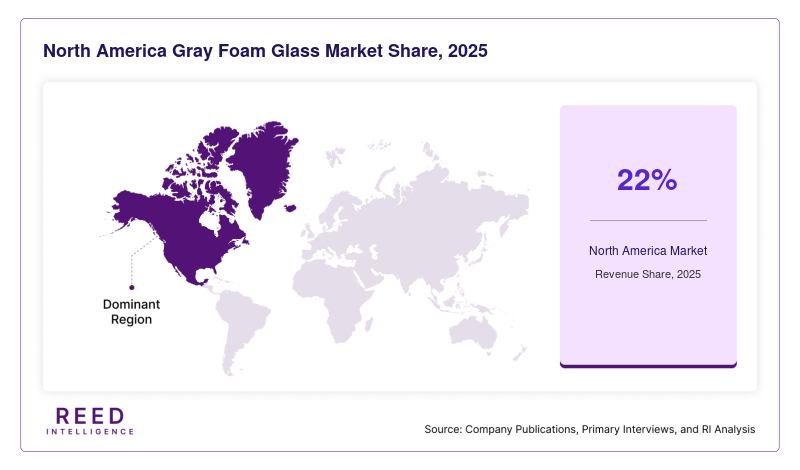
North America accounted for approximately 22% of the global Gray Foam Glass Market share in 2025. The regional market is expected to grow at a CAGR of 7.1% between 2025 and 2034. The region’s construction industry has shown increasing interest in insulation materials that offer durability and moisture resistance. Infrastructure modernization and energy-efficient building retrofits are contributing to steady demand for foam glass products. The United States and Canada continue to incorporate high-performance insulation materials in infrastructure development projects, which is expected to support market expansion during the forecast period.
The United States represented the dominant country in the North American Gray Foam Glass Market. The country’s construction sector has increasingly adopted foam glass insulation for foundation systems and underground infrastructure. Industrial projects including chemical processing facilities and pipeline insulation installations have also utilized foam glass due to its resistance to water and chemical exposure. These factors have positioned the United States as the leading contributor to regional revenue growth.
Europe
Europe held the largest share of the global Gray Foam Glass Market at around 36% in 2025. The market across the region will likely grow at a CAGR of 6.9% through 2034. European countries have established construction standards that prioritize energy-efficient building materials and durable insulation systems. Foam glass products are widely used in roof insulation, foundation insulation, and civil engineering applications.
Germany dominated the regional market due to its established manufacturing base and advanced building standards. The country has a strong network of foam glass manufacturers and suppliers that support domestic and international demand. Infrastructure projects, including underground transit systems and energy-efficient buildings, have integrated foam glass insulation to enhance structural stability and thermal efficiency. This consistent demand has supported Germany’s leading role in the European market.
Asia Pacific
Asia Pacific represented approximately 24% of the global Gray Foam Glass Market share in 2025 and is projected to grow at the fastest CAGR of 8.6% from 2025 to 2034. Rapid urbanization and expanding construction activities across several economies are contributing to the growth of the market. Infrastructure development in urban transportation systems, industrial parks, and commercial buildings is increasing the use of insulation materials that provide both durability and structural support.
China remained the dominant country in the Asia Pacific Gray Foam Glass Market. The country’s large-scale construction sector and extensive infrastructure investments have supported the demand for foam glass insulation materials. Construction companies in China are utilizing foam glass in underground infrastructure, road construction, and commercial building insulation systems. These applications have strengthened the country’s role in driving regional market expansion.
Middle East & Africa
The Middle East & Africa accounted for around 10% of the global Gray Foam Glass Market share in 2025 and is expected to grow at a CAGR of 7.4% through 2034. The region has experienced steady infrastructure development, particularly in urban transportation networks and industrial facilities. Foam glass insulation materials are being adopted in projects that require moisture-resistant and non-combustible insulation.
The United Arab Emirates emerged as the dominant country within the regional market. Large-scale commercial construction projects and urban infrastructure developments have integrated advanced insulation materials to ensure structural durability. Foam glass is used in underground construction and roof insulation systems due to its moisture resistance and long service life. These factors have contributed to the country’s leadership in the regional market.
Latin America
Latin America represented approximately 8% of the global Gray Foam Glass Market share in 2025 and will likely grow at a CAGR of 6.8% during the forecast period. The construction sector across the region has gradually adopted modern insulation materials to improve building efficiency and durability. Infrastructure upgrades and urban development projects are contributing to the steady expansion of the market.
Brazil dominated the Latin American Gray Foam Glass Market. The country’s infrastructure sector includes transportation corridors, industrial facilities, and commercial construction projects that require reliable insulation systems. Foam glass products are being used in foundation insulation and underground infrastructure applications. These developments have supported Brazil’s position as the leading market within the region.
Competitive Landscape
The competitive landscape of the Gray Foam Glass Market consists of a mix of established insulation manufacturers and specialized foam glass producers. Companies compete through product innovation, manufacturing capacity expansion, and distribution partnerships. Market participants focus on developing foam glass materials with improved thermal performance and structural strength to address evolving construction requirements.
Owens Corning is recognized as one of the leading companies in the market due to its diversified insulation portfolio and global distribution network. The company has recently expanded its sustainable materials strategy by incorporating recycled raw materials into insulation product development.
Other manufacturers continue to focus on regional expansion and new product launches designed for infrastructure and industrial insulation applications. Competitive dynamics remain moderate as companies seek to strengthen supply chains and increase production capacity to meet growing global demand.
Key Players List
- Owens Corning
- Glapor Werk Mitterteich GmbH
- Misapor AG
- Zhejiang Zhenshen Insulation Technology Corp.
- Uusioaines Ltd.
- Refaglass s.r.o.
- Polydros S.A.
- Geocell Schaumglas GmbH
- Earthstone International LLC
- Stikloporas UAB
- AeroAggregates LLC
- Liaver GmbH & Co. KG
- Nordic Foam Glass AS
- Veriso GmbH
- Poraver GmbH
Recent Developments
- Several foam glass manufacturers have introduced recycled glass processing technologies to improve production efficiency and material consistency.
- Construction companies have increased the use of foam glass gravel in road embankment projects, supporting lightweight infrastructure development.
- Manufacturers have expanded foam glass panel product lines designed for commercial building insulation systems.
- Industrial insulation providers have incorporated foam glass materials in pipeline insulation solutions for energy infrastructure projects.
- Research institutions have explored advanced pore-structure engineering to improve the thermal performance of foam glass insulation products.
Gray Foam Glass Market Segments
Product Type
- Foam Glass Gravel
- Foam Glass Panels
- Foam Glass Blocks
Application
- Building Insulation
- Industrial Insulation
- Infrastructure Construction
End-Use Industry
- Construction
- Energy & Utilities
- Industrial Manufacturing
By Region
- North America
- Europe
- APAC
- Middle East and Africa
- LATAM