Green Building Market Size, Share & Demand Report By Building Type (Commercial Buildings, Residential Buildings, Industrial Buildings), By Material Type (Energy-Efficient Insulation Materials, Recycled Construction Materials, Low-Emission Glass, Sustainable Roofing Materials), By Application (Energy Management Systems, Water Efficiency Systems, Indoor Environmental Quality Systems, Renewable Energy Integration), By Region & Segment Forecasts, 2026–2034
USD 3950
Market Overview
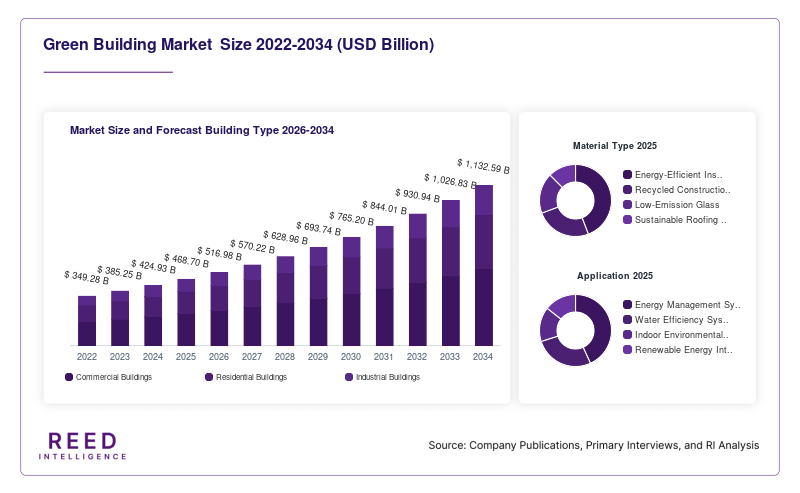
The global Green Building Market size was valued at USD 468.7 billion in 2026 and is projected to reach USD 1,028.4 billion by 2034, expanding at a CAGR of 10.3% during the forecast period from 2026 to 2034. The market continues to gain momentum as governments, developers, and institutional investors prioritize sustainable construction practices to reduce carbon emissions and operational energy costs. Green buildings incorporate energy-efficient systems, low-emission materials, water conservation technologies, and smart infrastructure solutions that improve environmental performance across residential, commercial, and industrial properties. Rising urbanization and stricter environmental regulations are accelerating the adoption of green construction standards in both developed and emerging economies.
One major global factor supporting market expansion is the rapid implementation of carbon neutrality targets across the construction industry. Several countries have introduced mandatory building efficiency regulations, tax benefits, and green certification frameworks that encourage sustainable construction. Public infrastructure investments and growing corporate commitments toward ESG goals are also contributing to long-term demand. In addition, rising consumer awareness regarding indoor air quality, energy savings, and climate resilience is increasing the adoption of eco-friendly residential projects. Technological developments in smart energy management systems, renewable integration, and recyclable construction materials are further strengthening industry growth.
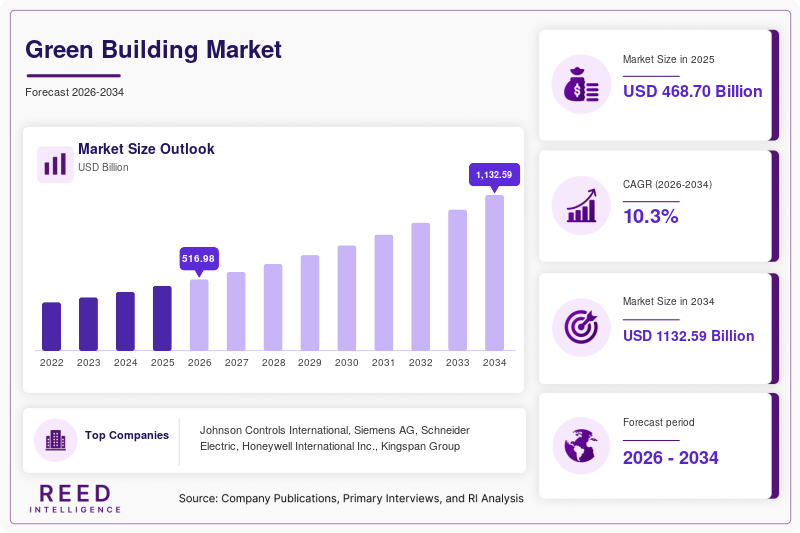
Key Highlights
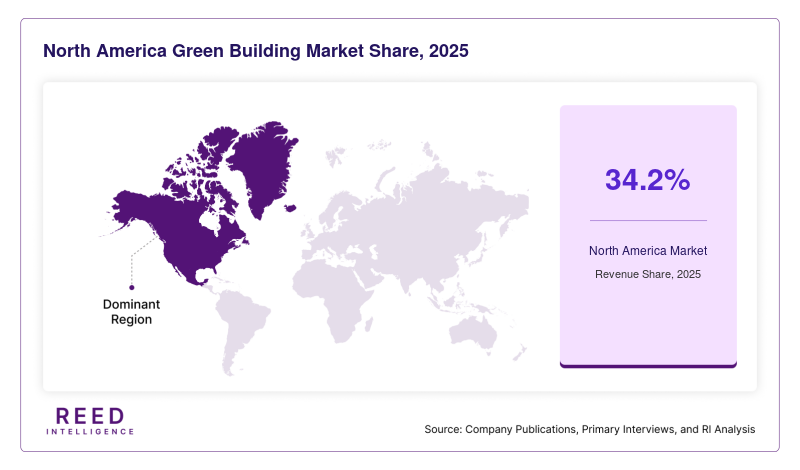
- North America dominated the market with a 34.2% share in 2025, while Asia Pacific is expected to grow at the fastest CAGR of 11.8% during 2026–2034.
- By building type, commercial buildings accounted for the largest share of 46.5%, while residential buildings are projected to grow at a CAGR of 12.1%.
- By material type, energy-efficient insulation materials led with a 29.4% share, whereas recycled construction materials are expected to expand at a CAGR of 11.7%.
- By application, energy management systems held the largest share of 37.9%, while water efficiency systems are projected to grow at a CAGR of 12.5%.
- The United States remained the dominant country, with market values of USD 121.5 billion in 2024 and USD 132.8 billion in 2025.
Market Trends
Integration of Smart Technologies in Sustainable Buildings
The adoption of smart technologies within sustainable infrastructure projects has emerged as a major trend influencing the Green Building Market. Developers are increasingly integrating artificial intelligence, IoT-enabled monitoring systems, automated lighting controls, and predictive energy management platforms into green buildings to optimize operational efficiency. Smart HVAC systems and occupancy-based automation tools help reduce electricity consumption while improving occupant comfort. Commercial property owners are also deploying cloud-based building analytics systems that provide real-time insights into energy use and maintenance requirements. This trend is particularly visible in urban office complexes, healthcare facilities, and smart residential communities where energy optimization remains a key investment priority. The increasing convergence of green construction with digital building management technologies is expected to enhance long-term market expansion across developed economies.
Rising Adoption of Net-Zero and Carbon-Neutral Construction
The growing focus on net-zero construction projects is reshaping investment strategies across the global Green Building Market. Governments and private developers are increasingly prioritizing carbon-neutral infrastructure to meet climate action commitments and sustainability targets. Builders are adopting renewable energy integration, passive architectural designs, advanced insulation systems, and sustainable materials to reduce the environmental footprint of buildings. Demand for solar-integrated roofing systems and energy-positive commercial buildings has increased significantly in metropolitan regions. Financial institutions and real estate investment firms are also favoring environmentally certified projects due to rising ESG investment standards. This trend is encouraging construction companies to redesign project planning models around lifecycle emissions reduction and long-term environmental performance, creating new opportunities for green technology providers and sustainable material manufacturers.
Market Drivers
Government Regulations and Green Certification Programs
Supportive government regulations and green certification frameworks continue to drive the expansion of the Green Building Market globally. Regulatory bodies across North America, Europe, and Asia Pacific are introducing stricter energy efficiency standards and sustainable construction mandates for residential and commercial projects. Programs such as LEED, BREEAM, and Green Star certifications are encouraging builders to adopt environmentally responsible construction practices. Governments are also providing tax rebates, low-interest financing, and subsidies for energy-efficient building projects. Public sector investments in sustainable transportation hubs, educational facilities, and healthcare infrastructure are further supporting industry demand. These initiatives are helping developers offset initial construction costs while improving long-term operational savings. The regulatory push toward low-carbon construction is expected to remain one of the most influential growth drivers during the forecast period.
Increasing Demand for Energy-Efficient Infrastructure
The growing need for energy-efficient infrastructure is significantly contributing to the growth of the Green Building Market. Rising electricity prices and concerns regarding energy security are encouraging property owners to invest in buildings with lower operational costs. Green buildings reduce energy consumption through efficient insulation, renewable power systems, high-performance windows, and advanced ventilation technologies. Commercial enterprises are increasingly adopting sustainable office spaces to reduce utility expenses and improve corporate sustainability ratings. In the residential sector, homeowners are prioritizing properties equipped with solar systems, rainwater harvesting solutions, and energy-efficient appliances. Rapid urban population growth is also increasing the need for sustainable housing and infrastructure in emerging economies. The long-term financial benefits associated with lower maintenance and energy expenses continue to strengthen market demand worldwide.
Market Restraint
High Initial Investment and Complex Implementation Challenges
The high upfront investment associated with sustainable construction projects remains a key restraint for the Green Building Market. Green buildings often require advanced insulation systems, renewable energy technologies, water recycling equipment, and smart monitoring platforms that increase initial project costs compared to conventional construction. Small-scale developers and budget-sensitive residential buyers frequently face financial limitations when adopting sustainable building practices. In developing economies, limited awareness regarding long-term cost savings also restricts investment in green infrastructure. Complex certification procedures and compliance requirements can further extend project timelines and increase administrative expenses. For example, large commercial projects seeking international green certifications often require specialized consultants, performance testing, and material validation processes, which raise development costs. These financial and operational barriers continue to limit market penetration in price-sensitive regions despite growing sustainability awareness.
Market Opportunities
Expansion of Sustainable Urban Infrastructure Projects
Rapid urbanization and increasing government investments in sustainable cities are creating major opportunities for the Green Building Market. Several countries are implementing smart city initiatives focused on environmentally efficient transportation systems, sustainable housing, and energy-efficient public infrastructure. Urban planners are increasingly integrating green roofs, solar-powered utilities, and water conservation technologies into large-scale development projects. Emerging economies in Asia Pacific and the Middle East are investing heavily in eco-friendly urban expansion to manage population growth and reduce environmental impact. Public-private partnerships are also accelerating investments in sustainable airports, educational campuses, and healthcare facilities. These infrastructure modernization programs are expected to create substantial demand for green construction materials, smart energy systems, and environmentally compliant building solutions over the coming years.
Growth of Green Retrofitting and Renovation Activities
The increasing focus on retrofitting existing buildings with sustainable technologies presents a strong growth opportunity for the Green Building Market. Many commercial and residential buildings constructed decades ago fail to meet modern energy efficiency standards, creating demand for renovation projects that improve environmental performance. Building owners are upgrading lighting systems, insulation materials, HVAC equipment, and water management infrastructure to reduce operating costs and comply with sustainability regulations. The commercial office sector is witnessing strong retrofitting activity as corporations aim to improve workplace sustainability and employee well-being. Government incentive programs for energy-efficient renovations are further supporting market expansion. The growing preference for upgrading existing infrastructure instead of complete redevelopment is expected to create continuous demand for green construction services and sustainable material suppliers.
Segmental Analysis
By Building Type
Commercial buildings accounted for the largest share of the Green Building Market in 2024, representing 46.5% of total revenue. The dominance of this segment is primarily linked to the rapid adoption of sustainable office spaces, retail complexes, healthcare facilities, and educational institutions. Large corporations and institutional investors are increasingly prioritizing green-certified commercial properties to improve operational efficiency and strengthen sustainability commitments. Smart lighting systems, advanced HVAC technologies, and renewable energy integration are widely implemented across commercial projects to reduce long-term energy expenses. Growing demand for environmentally responsible workplaces and increasing employee wellness initiatives are also supporting segment expansion. In addition, governments across developed economies continue to encourage sustainable commercial infrastructure through tax incentives and energy efficiency mandates.
Residential buildings are projected to witness the fastest growth, expanding at a CAGR of 12.1% during the forecast period. Rising urban population growth and increasing consumer awareness regarding energy-efficient housing are major factors supporting demand. Homebuyers are increasingly seeking properties equipped with solar energy systems, smart home automation, water conservation technologies, and eco-friendly construction materials. Government-supported affordable housing initiatives focused on sustainability are also contributing to market expansion. Emerging economies are experiencing rapid growth in green residential construction due to rising electricity costs and environmental concerns. Developers are increasingly adopting modular construction methods and low-emission materials to improve sustainability performance while reducing construction timelines and operational expenses in modern residential projects.
By Material Type
Energy-efficient insulation materials held the dominant share of the Green Building Market in 2024, accounting for 29.4% of total revenue. These materials are widely used across residential, commercial, and industrial projects to reduce heating and cooling energy consumption. Demand for advanced insulation products such as mineral wool, polyurethane foam, and cellulose-based materials has increased significantly due to stringent energy efficiency standards. Builders are increasingly focusing on thermal performance optimization to lower operational costs and improve environmental sustainability. The growing adoption of passive building designs and net-zero construction practices is also contributing to segment growth. In addition, technological advancements in recyclable and low-emission insulation products are enhancing product performance and supporting long-term industry adoption.
Recycled construction materials are expected to register the fastest CAGR of 11.7% during the forecast period. Rising environmental concerns and stricter waste management regulations are encouraging the use of recycled steel, reclaimed wood, recycled concrete, and sustainable composite materials in construction projects. Builders are increasingly adopting circular economy principles to reduce material waste and lower carbon emissions associated with infrastructure development. Governments and environmental agencies are also promoting sustainable procurement policies that support the adoption of recycled construction materials. The segment is gaining traction across commercial and residential sectors due to growing awareness regarding resource conservation and sustainable building lifecycle management. Increasing investments in green manufacturing technologies are expected to further accelerate segment growth globally.
By Application
Energy management systems represented the largest application segment within the Green Building Market in 2024, capturing 37.9% of total market revenue. These systems enable property owners to monitor and optimize electricity consumption through automated controls, smart sensors, and real-time analytics platforms. Commercial office complexes, industrial facilities, and institutional buildings are increasingly implementing intelligent energy management solutions to reduce operational expenses and improve sustainability performance. Rising electricity prices and growing corporate focus on carbon reduction are major factors supporting segment dominance. Integration of artificial intelligence and cloud-based building management technologies is also improving system efficiency and predictive maintenance capabilities. The growing adoption of smart infrastructure across urban development projects continues to strengthen demand for advanced energy management applications.
Water efficiency systems are anticipated to expand at the fastest CAGR of 12.5% during the forecast period. Increasing water scarcity concerns and stricter environmental regulations are driving investments in rainwater harvesting systems, greywater recycling technologies, and low-flow plumbing infrastructure. Governments and municipal authorities are encouraging sustainable water management practices across residential, commercial, and industrial projects. Developers are integrating intelligent water monitoring technologies into modern buildings to reduce utility consumption and improve environmental compliance. Hospitality facilities, healthcare institutions, and large residential complexes are particularly increasing investments in water conservation systems due to rising operational costs. Continuous advancements in smart water analytics and automated leak detection technologies are expected to support strong segment growth over the coming years.
Regional Analysis
North America
North America accounted for the largest share of the Green Building Market in 2025, representing 34.2% of global revenue. The region is projected to expand at a CAGR of 9.4% during the forecast period due to strong regulatory frameworks and high adoption of sustainable construction standards. The United States and Canada continue to witness rising investments in energy-efficient commercial infrastructure, green residential communities, and low-carbon industrial facilities. Demand for smart building technologies and renewable energy integration remains particularly strong across urban centers and technology-driven business districts.
The United States dominated the regional market due to the widespread adoption of LEED-certified projects and federal support for energy-efficient infrastructure. Rising investments in data centers, healthcare facilities, and institutional buildings are contributing to long-term market growth. The increasing adoption of ESG-focused real estate development strategies among large commercial property owners is also supporting demand. Additionally, growing investments in retrofitting aging infrastructure with sustainable technologies continue to strengthen the country’s position within the regional market.
Europe
Europe represented a significant share of the Green Building Market in 2025 and is expected to maintain stable growth throughout the forecast period with a CAGR of 9.8%. Strict carbon reduction targets established by the European Union are encouraging the adoption of energy-efficient construction practices across residential and commercial sectors. Countries within the region are implementing green financing policies, renewable energy integration standards, and sustainable urban development programs that support industry expansion. Demand for environmentally certified buildings remains high among institutional investors and commercial developers.
Germany emerged as the dominant country within the European market due to strong investments in sustainable industrial infrastructure and eco-friendly residential construction. The country continues to promote low-energy building standards and renewable heating systems through supportive regulatory initiatives. Rising modernization projects involving old commercial buildings are also contributing to demand for sustainable construction materials and energy-efficient technologies. In addition, the increasing deployment of prefabricated green construction methods is improving project efficiency and reducing environmental impact across the German construction industry.
Asia Pacific
Asia Pacific is projected to register the fastest growth in the Green Building Market, expanding at a CAGR of 11.8% from 2026 to 2034. Rapid urbanization, population growth, and rising environmental concerns are driving demand for sustainable infrastructure across emerging economies. Governments in China, India, Japan, and Southeast Asia are increasing investments in green housing, smart transportation systems, and energy-efficient commercial complexes. The region is also witnessing growing adoption of renewable energy integration technologies and sustainable construction materials in large-scale infrastructure projects.
China dominated the Asia Pacific market due to extensive investments in environmentally sustainable urban development and industrial modernization programs. The country continues to implement stringent building efficiency regulations aimed at reducing carbon emissions from the construction sector. Rapid growth in smart city projects and public infrastructure modernization is further increasing demand for green building technologies. In addition, rising awareness regarding indoor air quality and energy savings among urban consumers is accelerating the adoption of eco-friendly residential construction across major Chinese metropolitan areas.
Middle East & Africa
The Middle East & Africa region is experiencing gradual growth in the Green Building Market and is expected to expand at a CAGR of 8.7% during the forecast period. Increasing investments in sustainable tourism infrastructure, commercial real estate, and smart city projects are supporting regional demand. Governments across the Gulf countries are introducing green building regulations and energy efficiency programs to reduce dependence on conventional energy resources. The adoption of solar-integrated infrastructure and water conservation technologies is becoming increasingly important due to environmental and climate-related concerns.
The United Arab Emirates led the regional market owing to strong investments in sustainable urban development and environmentally efficient commercial projects. Major cities such as Dubai and Abu Dhabi are focusing on energy-efficient skyscrapers, eco-friendly hospitality projects, and smart infrastructure systems. The country’s commitment toward carbon reduction and renewable energy adoption is encouraging developers to integrate advanced sustainability technologies into new construction projects. Increasing international tourism and large-scale infrastructure expansion are also contributing to the growing demand for green buildings in the region.
Latin America
Latin America accounted for a moderate share of the Green Building Market in 2025 and is projected to grow at a CAGR of 8.9% through 2034. The region is witnessing rising awareness regarding sustainable construction and energy conservation across urban areas. Governments are increasingly supporting environmentally efficient housing programs and public infrastructure modernization initiatives. Commercial developers are also adopting green certification standards to attract international investors and reduce operational expenses. Demand for sustainable building materials and renewable energy systems is gradually increasing across major metropolitan regions.
Brazil remained the dominant country in the Latin American market due to expanding urban infrastructure projects and increasing adoption of sustainable residential construction. Government programs focused on affordable green housing and renewable energy integration are contributing to market growth. The country is also witnessing increased investments in environmentally efficient commercial properties and industrial facilities. Rising concerns regarding electricity costs and environmental sustainability are encouraging property developers to incorporate energy-saving technologies and water management systems into modern building designs.
Competitive Landscape
The Green Building Market is moderately fragmented, with global construction companies, material manufacturers, and technology providers competing through sustainability innovation, strategic partnerships, and regional expansion initiatives. Major participants are focusing on environmentally efficient construction technologies, smart building systems, and recyclable materials to strengthen their market positions. Companies are also investing in research and development activities aimed at improving energy efficiency and reducing lifecycle emissions across construction projects. Strategic collaborations with government agencies and infrastructure developers remain a common growth strategy within the industry.
Johnson Controls International emerged as one of the leading companies in the market due to its strong portfolio of smart energy management systems and sustainable infrastructure solutions. The company recently expanded its AI-based building optimization platform to improve energy monitoring capabilities across commercial facilities. Other key participants are increasing investments in low-carbon construction materials, renewable energy integration systems, and green retrofit services to address rising global demand for sustainable infrastructure solutions.
Key Players
- Johnson Controls International
- Siemens AG
- Schneider Electric
- Honeywell International Inc.
- Kingspan Group
- Saint-Gobain
- LafargeHolcim
- Skanska AB
- AECOM
- Carrier Global Corporation
- Daikin Industries Ltd.
- Interface Inc.
- Trane Technologies
- ABB Ltd.
- Bosch Building Technologies
Recent Developments
- In February 2026, Schneider Electric launched an advanced AI-enabled building automation platform designed to improve energy efficiency in commercial facilities.
- In September 2025, Saint-Gobain expanded its sustainable insulation manufacturing capacity in Europe to address rising demand for low-emission building materials.
- In January 2026, Johnson Controls International partnered with a global infrastructure developer to deploy smart energy management systems across large-scale mixed-use urban projects.
- In November 2025, Siemens AG introduced a next-generation digital twin platform for sustainable commercial building operations and predictive maintenance.
Green Building Market Segments
Building Type
- Commercial Buildings
- Residential Buildings
- Industrial Buildings
Material Type
- Energy-Efficient Insulation Materials
- Recycled Construction Materials
- Low-Emission Glass
- Sustainable Roofing Materials
Application
- Energy Management Systems
- Water Efficiency Systems
- Indoor Environmental Quality Systems
- Renewable Energy Integration
By Region
- North America
- Europe
- APAC
- Middle East and Africa
- LATAM