Green Chelates Natural Chelating Agent Market Size, Share & Demand Report By Type (Biodegradable Organic Acid Chelates, Amino Acid-Based Chelates, Lignosulfonate Chelates, Polymeric Natural Chelates), By Application (Agriculture, Water Treatment, Household Cleaning, Industrial Cleaning, Food Processing, Personal Care), By End Use (Industrial Manufacturing, Agriculture Industry, Municipal Utilities, Household Consumers, Commercial Facilities) By Region & Segment Forecasts, 2026–2034
USD 3950
Market Overview
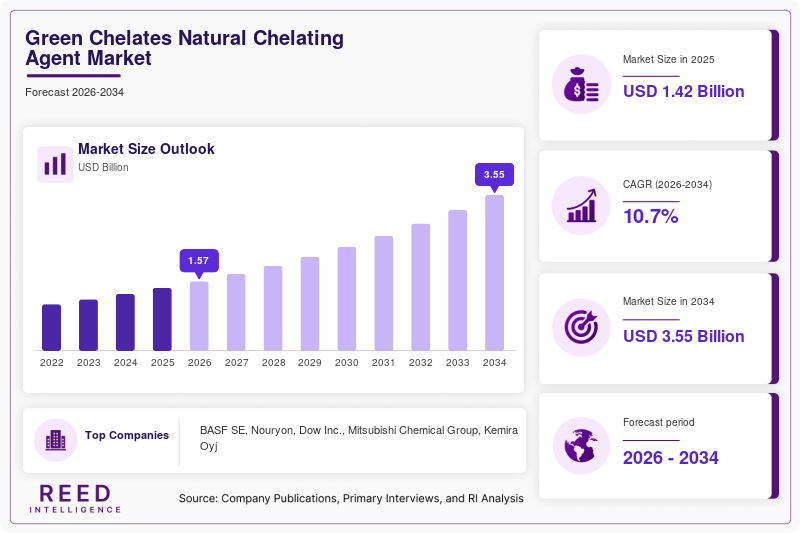
The global Green Chelates Natural Chelating Agent Market size was valued at USD 1.42 billion in 2026 and is projected to reach USD 3.21 billion by 2034, expanding at a CAGR of 10.7% during the forecast period. The market is gaining steady traction as industries adopt biodegradable and plant-based chelating agents to replace conventional synthetic alternatives. Green chelates are widely used in agriculture, detergents, water treatment, food processing, personal care, and industrial cleaning applications because they offer improved environmental compatibility and lower toxicity levels. Rising environmental regulations regarding phosphates and non-biodegradable chemicals have accelerated demand for sustainable formulations across developed and emerging economies.
The increasing focus on sustainable industrial processing has become a major factor supporting market growth. Governments and manufacturing industries are promoting circular economy practices and reducing reliance on petrochemical-derived additives. Natural chelating agents derived from organic acids, amino acids, and bio-based compounds are witnessing increasing integration into industrial cleaning formulations, micronutrient fertilizers, and eco-friendly household products. Growing investment in green chemistry research has also improved production efficiency and expanded commercial availability of biodegradable chelates.
Key Highlights
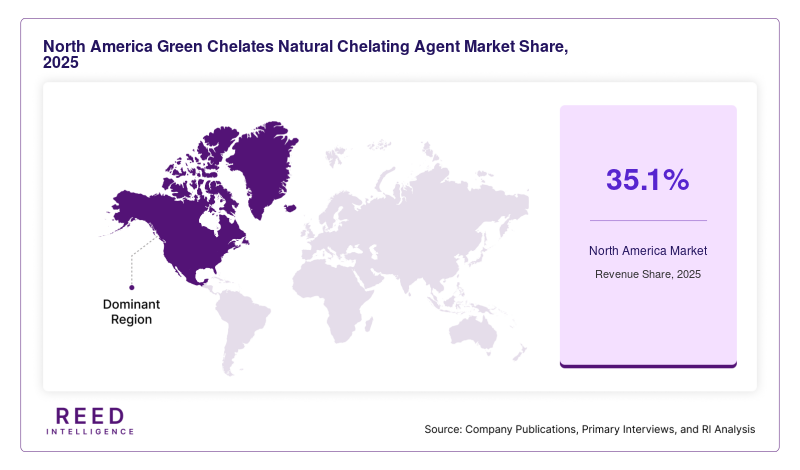
- North America dominated the market with a 35.1% share in 2025.
- Asia Pacific is expected to grow at the fastest CAGR of 11.8% during 2026–2034.
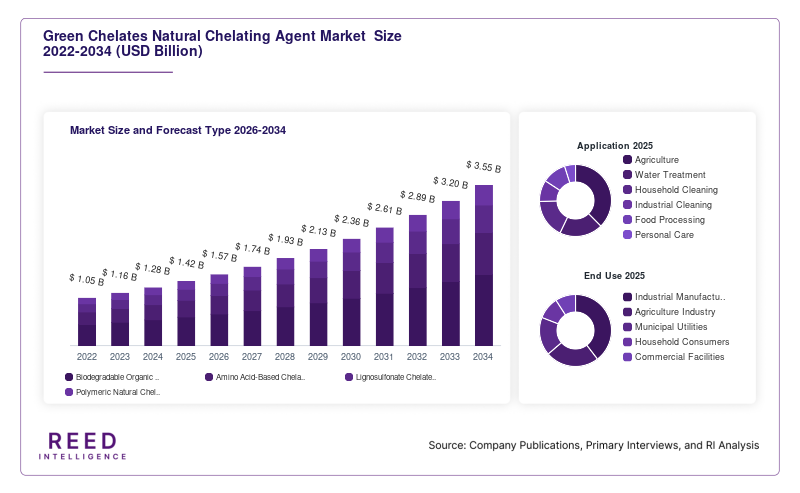
- By type, biodegradable organic acid chelates accounted for the largest share of 39.4%.
- while amino acid-based chelates are projected to grow at a CAGR of 12.3%.
- By application, agriculture led with a 36.8% share.
- whereas water treatment is expected to expand at a CAGR of 11.9%.
- By end use, industrial manufacturing accounted for the highest share of 33.6%.
- while household cleaning products are anticipated to grow at a CAGR of 12.1%.
- The United States remained the dominant country, with market values of USD 420 million in 2024 and USD 468 million in 2025.
Market Trends
Expansion of Bio-Based Cleaning Formulations
The increasing transition toward bio-based cleaning formulations has emerged as a significant trend in the Green Chelates Natural Chelating Agent Market. Industrial cleaning companies and household detergent manufacturers are replacing traditional phosphates and EDTA-based compounds with biodegradable chelating agents to comply with environmental standards and improve product sustainability profiles. Green chelates are being integrated into dishwashing liquids, laundry detergents, industrial degreasers, and institutional cleaning products because they improve metal ion control without generating persistent environmental residues. Demand for sustainable cleaning products has increased among commercial facilities, healthcare institutions, and hospitality operators seeking environmentally responsible procurement practices. Product manufacturers are also promoting low-toxicity formulations to attract environmentally conscious consumers. This trend is encouraging investments in natural raw material sourcing and advanced formulation technologies.
Rising Adoption in Sustainable Agriculture
The growing adoption of sustainable agricultural practices is reshaping demand patterns within the Green Chelates Natural Chelating Agent Market. Farmers and fertilizer manufacturers are increasingly using natural chelating agents to improve micronutrient delivery efficiency and enhance crop productivity while minimizing soil degradation. Bio-based chelates improve nutrient stability and absorption in crops under varying soil conditions, making them suitable for precision farming systems. Demand is particularly strong in organic farming and high-value horticulture segments where environmental compliance and soil health management are important priorities. Agricultural cooperatives and food producers are also focusing on reducing chemical residue levels throughout the cultivation cycle. In addition, governments in several countries are supporting sustainable fertilizer programs and promoting eco-friendly agricultural inputs, which is creating favorable conditions for long-term market expansion.
Market Drivers
Increasing Environmental Regulations on Synthetic Chemicals
The growing implementation of environmental regulations regarding synthetic chemicals is a major driver supporting the Green Chelates Natural Chelating Agent Market. Regulatory authorities in North America and Europe are introducing stricter limits on phosphate discharge and persistent chemical compounds in industrial and consumer products. Conventional chelating agents such as EDTA and phosphonates face increasing scrutiny because they remain in aquatic ecosystems for extended periods and contribute to environmental pollution. As a result, manufacturers are shifting toward biodegradable alternatives derived from natural acids and renewable feedstocks. Industries including detergents, water treatment, agriculture, and personal care are actively reformulating products to align with sustainability targets and environmental certification requirements. This regulatory transition is encouraging continuous product development and increasing commercial adoption of green chelates across multiple end-use sectors.
Growth of Sustainable Industrial Manufacturing Practices
The expansion of sustainable industrial manufacturing practices is further accelerating demand for green chelates across global markets. Industrial facilities are increasingly integrating environmentally compatible additives into production processes to reduce hazardous waste generation and improve compliance with corporate sustainability frameworks. Green chelating agents are being adopted in textile processing, pulp and paper manufacturing, food processing, and metal treatment applications because they support efficient metal ion control while lowering environmental impact. Companies are also incorporating bio-based ingredients into supply chains to meet investor expectations regarding environmental performance and responsible sourcing. In addition, advancements in biotechnology and fermentation-based production methods are reducing manufacturing costs and improving scalability for natural chelating agents. These developments are strengthening market accessibility and encouraging wider industrial adoption during the forecast period.
Market Restraint
Higher Production Costs Compared with Synthetic Alternatives
Higher production costs associated with natural chelating agents remain a key challenge for the Green Chelates Natural Chelating Agent Market. Manufacturing bio-based chelates often requires specialized raw materials, fermentation technologies, and purification processes that increase operational expenses compared with traditional synthetic chelating agents. Small and medium-sized manufacturers may face difficulties in achieving economies of scale, particularly in price-sensitive markets where conventional additives remain widely available at lower costs. Agricultural producers and industrial buyers in developing regions often prioritize product affordability over sustainability considerations, limiting the adoption rate of premium bio-based formulations.
The cost challenge also affects supply chain stability because natural raw material availability can fluctuate due to climate conditions and agricultural production cycles. In addition, some end users remain concerned about performance consistency when transitioning from synthetic chelates to biodegradable alternatives. These factors can delay product substitution in industrial applications that require stable processing efficiency. Although technological advancements are gradually improving production efficiency, pricing pressure continues to influence purchasing decisions across several industries. Market participants are therefore investing in process optimization, strategic partnerships, and regional manufacturing expansion to improve cost competitiveness and strengthen long-term commercial viability.
Market Opportunities
Increasing Demand for Organic and Specialty Crops
The rising cultivation of organic and specialty crops is creating substantial growth opportunities for the Green Chelates Natural Chelating Agent Market. Farmers producing fruits, vegetables, herbs, and export-oriented crops are increasingly adopting bio-based nutrient management solutions to meet international quality standards and certification requirements. Natural chelates improve micronutrient uptake and support crop productivity without leaving harmful chemical residues in soil or water systems. Demand is particularly increasing in greenhouse farming, hydroponics, and precision agriculture operations where nutrient efficiency is critical for maintaining crop quality and yield consistency. Food retailers and consumers are also placing greater emphasis on sustainably produced agricultural products, encouraging farmers to integrate eco-friendly inputs throughout cultivation cycles. This expanding preference for sustainable farming systems is expected to create long-term revenue opportunities for market participants.
Expansion of Green Water Treatment Infrastructure
The growing development of environmentally sustainable water treatment infrastructure is generating new opportunities across the global market. Municipalities and industrial facilities are increasingly investing in advanced wastewater treatment systems that reduce environmental discharge and improve recycling efficiency. Green chelating agents are being incorporated into treatment formulations because they effectively bind metal ions while maintaining biodegradability and lower toxicity profiles. Industrial sectors including mining, food processing, chemicals, and energy production are focusing on water reuse initiatives to reduce freshwater consumption and comply with discharge regulations. Governments are also increasing funding for sustainable water management projects in urban and industrial regions. These developments are encouraging manufacturers to introduce specialized chelate formulations for wastewater treatment, desalination systems, and industrial process water applications, thereby supporting market expansion during the forecast period.
Segmental Analysis
By Type
Biodegradable organic acid chelates accounted for the largest share of 39.4% in 2024 within the Green Chelates Natural Chelating Agent Market. These chelates are widely used across agriculture, cleaning products, and industrial processing applications because they provide effective metal ion stabilization while maintaining strong biodegradability characteristics. Citric acid-based and gluconic acid-based chelates are among the most commonly utilized formulations due to their compatibility with water treatment systems and household cleaning products. Industrial users prefer organic acid chelates because they support regulatory compliance and reduce environmental discharge concerns. The segment has also benefited from increasing consumer preference for environmentally compatible detergents and institutional cleaning solutions. Manufacturers are investing in production capacity expansion and process optimization to improve supply availability and strengthen commercial adoption across developed and emerging markets.
Amino acid-based chelates are projected to expand at the fastest CAGR of 12.3% during the forecast period due to rising adoption in precision agriculture and specialty crop cultivation. These chelates improve nutrient absorption efficiency and enhance crop productivity under varying soil conditions. Agricultural producers are increasingly using amino acid formulations in foliar sprays, hydroponic systems, and micronutrient fertilizers because they support sustainable farming practices and reduce nutrient losses. The segment is also witnessing increased interest from greenhouse farming operators and high-value horticulture producers seeking improved crop quality. Advancements in biotechnology and fermentation methods are improving production scalability and reducing manufacturing costs. Growing awareness regarding soil health management and environmentally responsible fertilizer programs is expected to support continued segment growth.
By Application
Agriculture represented the largest application segment and accounted for 36.8% of market revenue in 2024. Green chelates are extensively used in agricultural formulations to enhance micronutrient availability, improve nutrient absorption, and support higher crop yields. Farmers and fertilizer manufacturers are increasingly adopting biodegradable chelating agents to reduce environmental contamination and improve soil sustainability. The segment has experienced strong growth due to the expansion of precision farming practices and increasing demand for sustainable crop management solutions. Natural chelates are commonly integrated into foliar fertilizers, drip irrigation systems, and specialty crop nutrition programs. Rising demand for organic farming inputs and export-quality agricultural products is also encouraging greater adoption across commercial farming operations. Government support for environmentally responsible agricultural practices continues to strengthen long-term market demand.
Water treatment is anticipated to register the fastest CAGR of 11.9% through 2034 due to increasing investment in wastewater recycling and industrial water management infrastructure. Municipal treatment facilities and industrial operators are focusing on sustainable chemical formulations that improve metal ion control while reducing environmental discharge. Green chelating agents are increasingly used in wastewater treatment, cooling systems, and desalination plants because they provide biodegradability advantages compared with conventional synthetic alternatives. Industrial sectors such as mining, chemicals, food processing, and energy production are expanding water reuse programs to improve operational sustainability and comply with environmental regulations. Governments are also increasing investment in urban wastewater treatment systems, particularly in rapidly industrializing regions. These developments are expected to create substantial growth opportunities for green chelate manufacturers.
By End Use
Industrial manufacturing accounted for the largest share of 33.6% in 2024 within the Green Chelates Natural Chelating Agent Market. Manufacturers across textile processing, pulp and paper, food production, and industrial cleaning sectors are increasingly integrating biodegradable chelates into processing operations to reduce environmental impact and improve compliance with sustainability standards. Industrial users prefer green chelates because they help control metal ions, stabilize formulations, and enhance cleaning efficiency while supporting environmentally responsible operations. The segment has benefited from increasing corporate sustainability initiatives and stricter environmental regulations regarding wastewater discharge. Demand is particularly strong in industries with high water usage and chemical processing requirements. In addition, global manufacturing companies are prioritizing green procurement strategies, encouraging suppliers to provide bio-based processing chemicals and environmentally compatible additives.
Household cleaning products are expected to witness the fastest CAGR of 12.1% during the forecast period because consumers are increasingly purchasing eco-friendly detergents and surface cleaners. Growing awareness regarding chemical toxicity and environmental pollution is encouraging detergent manufacturers to replace traditional chelating agents with biodegradable alternatives. Green chelates are being incorporated into laundry detergents, dishwashing liquids, and multipurpose cleaning products to improve formulation sustainability and meet environmental certification requirements. Retailers are also expanding shelf space for environmentally responsible household products, supporting higher market visibility and consumer adoption. Product innovation focused on plant-derived ingredients and low-toxicity cleaning formulations is further accelerating growth. Rising urbanization and increasing disposable income levels in emerging economies are expected to support long-term demand expansion within the segment.
Regional Analysis
North America
North America accounted for 35.1% of the global Green Chelates Natural Chelating Agent Market in 2025 and is expected to maintain steady growth at a CAGR of 9.8% through 2034. The region benefits from strong environmental regulations, advanced industrial infrastructure, and increasing demand for sustainable chemical formulations across multiple industries. Industrial cleaning manufacturers and agricultural input companies are expanding the use of biodegradable chelating agents to reduce environmental impact and comply with federal and state sustainability standards. Demand is also increasing in institutional cleaning applications, wastewater treatment facilities, and food processing industries where environmental compliance has become a major operational priority.
The United States remained the leading country within North America due to strong adoption of green chemistry technologies and extensive investment in sustainable manufacturing practices. The country recorded market values of USD 420 million in 2024 and USD 468 million in 2025. One unique growth factor supporting the U.S. market is the increasing use of biodegradable agricultural micronutrient formulations across precision farming systems. Agricultural producers are integrating natural chelates into fertilizer programs to improve nutrient efficiency and reduce groundwater contamination risks. Growing investment in sustainable household cleaning products is also supporting long-term demand across consumer markets.
Europe
Europe represented 28.4% of the global market in 2025 and is projected to expand at a CAGR of 10.1% during the forecast period. The regional market is supported by stringent environmental legislation regarding wastewater discharge, phosphate usage, and biodegradable chemical standards. Countries across the region are encouraging industrial manufacturers to replace persistent synthetic additives with renewable and environmentally compatible alternatives. Demand for green chelates is particularly strong within industrial cleaning, detergents, food processing, and textile manufacturing sectors. European consumers also demonstrate high awareness regarding environmentally responsible products, which supports the adoption of bio-based household and personal care formulations.
Germany dominated the European market because of its advanced chemical manufacturing sector and strong sustainability initiatives within industrial production systems. A major growth factor in the German market is the increasing integration of bio-based ingredients into industrial processing applications. Manufacturers are investing in green chemistry research to improve process efficiency and reduce industrial emissions. In addition, partnerships between chemical companies and agricultural technology providers are supporting innovation in sustainable micronutrient formulations. The expansion of environmentally certified cleaning products throughout retail channels is also contributing to rising market penetration across the region.
Asia Pacific
Asia Pacific held a significant share of the Green Chelates Natural Chelating Agent Market in 2025 and is anticipated to register the fastest CAGR of 11.8% through 2034. Rapid industrialization, agricultural modernization, and rising environmental awareness are contributing to strong market growth throughout the region. Governments in several countries are introducing sustainability policies that encourage reduced chemical pollution and promote eco-friendly industrial inputs. Demand for biodegradable chelates is increasing across agriculture, industrial cleaning, textile processing, and water treatment sectors. The expansion of manufacturing activities and urban infrastructure projects is also creating favorable conditions for water management and wastewater treatment applications.
China remained the dominant country in the Asia Pacific region due to large-scale agricultural production and increasing investment in sustainable industrial infrastructure. One unique growth factor driving the Chinese market is the expansion of environmentally regulated industrial parks that require sustainable wastewater treatment technologies. Industrial manufacturers are increasingly incorporating green chelating agents into process water treatment systems to improve compliance with environmental standards. Rising domestic demand for organic food production and eco-friendly consumer products is also supporting adoption across agricultural and household cleaning applications.
Middle East & Africa
The Middle East & Africa market accounted for a moderate share of global revenue in 2025 and is projected to grow at a CAGR of 9.3% during the forecast period. Demand is increasing due to rising investment in industrial water treatment, sustainable agriculture, and urban wastewater management systems. Countries across the region are focusing on water conservation and resource efficiency because of increasing pressure on freshwater availability. Green chelating agents are being adopted in desalination systems, industrial treatment facilities, and agricultural irrigation programs to support environmentally sustainable operations. Industrial diversification initiatives are also contributing to growing adoption within manufacturing and processing sectors.
Saudi Arabia emerged as the dominant country within the region because of ongoing investment in water infrastructure and industrial sustainability programs. A unique growth factor supporting the Saudi Arabian market is the rapid expansion of desalination and industrial water reuse projects. The country is focusing on reducing environmental discharge while improving long-term water security for industrial and urban applications. Green chelates are increasingly incorporated into treatment chemicals used in desalination plants and industrial facilities. Rising greenhouse agriculture activities and government-supported food security programs are also supporting demand for sustainable agricultural nutrient solutions.
Latin America
Latin America represented a developing but steadily expanding market in 2025 and is expected to register a CAGR of 10.4% through 2034. The regional market is benefiting from increasing awareness regarding sustainable agriculture and environmentally compatible industrial inputs. Agricultural production remains a major economic activity throughout the region, encouraging the adoption of biodegradable chelating agents for micronutrient management and soil improvement. Demand is also increasing within food processing, mining, and municipal water treatment applications. Regulatory efforts related to wastewater management and industrial discharge reduction are gradually supporting broader adoption of green chemistry products.
Brazil dominated the Latin American market because of its extensive agricultural industry and expanding focus on sustainable crop management practices. One unique growth factor supporting the Brazilian market is the growing adoption of bio-based micronutrient fertilizers in large-scale soybean and sugarcane cultivation. Farmers are increasingly using natural chelates to improve nutrient absorption and maintain soil productivity under intensive farming conditions. In addition, export-oriented agricultural producers are adopting environmentally responsible inputs to meet international sustainability requirements. Increasing investment in industrial wastewater treatment infrastructure is also contributing to long-term market expansion.
Competitive Landscape
The Green Chelates Natural Chelating Agent Market is moderately fragmented, with global chemical manufacturers and specialized bio-based ingredient companies competing through product innovation, strategic partnerships, and regional expansion initiatives. Market participants are focusing on biodegradable formulations, cost optimization, and sustainable raw material sourcing to strengthen competitive positioning. Companies are also investing in research and development activities to improve product performance and expand applications across agriculture, water treatment, and industrial cleaning industries.
BASF SE remained one of the leading companies in the market due to its broad sustainable chemical portfolio and strong global distribution network. The company recently expanded its biodegradable chelating solutions portfolio for industrial cleaning and agricultural applications. Other major participants are emphasizing acquisitions, production capacity expansion, and collaboration with agricultural technology firms to strengthen market penetration. Competitive activity is also increasing in Asia Pacific as regional manufacturers invest in bio-based chemical production capabilities. Product differentiation based on biodegradability, efficiency, and regulatory compliance continues to influence purchasing decisions across end-use industries.
Key Players
- BASF SE
- Nouryon
- Dow Inc.
- Mitsubishi Chemical Group
- Kemira Oyj
- Innospec Inc.
- Lanxess AG
- Jungbunzlauer Suisse AG
- NIPPON SHOKUBAI CO., LTD.
- Valagro S.p.A.
- Shandong IRO Chelating Chemical Co., Ltd.
- Akzo Nobel N.V.
- Tata Chemicals Ltd.
- Aries Agro Limited
- Adob Fertilizers
Recent Developments
- BASF SE expanded its biodegradable chelating agent production capacity in Europe during 2025 to support rising demand from industrial cleaning and agricultural sectors.
- Nouryon introduced a new plant-derived chelating formulation for water treatment applications in 2024, focusing on improved biodegradability and lower environmental impact.
- Kemira Oyj partnered with regional wastewater treatment operators in 2025 to develop sustainable chemical programs for industrial recycling facilities.
- Lanxess AG launched an advanced amino acid-based chelate portfolio for precision agriculture applications in 2024 to improve micronutrient absorption efficiency.
- Dow Inc. increased investment in bio-based specialty chemical research during 2025 to expand sustainable formulation offerings across cleaning and industrial processing applications.
Green Chelates Natural Chelating Agent Market Segments
Type
- Biodegradable Organic Acid Chelates
- Amino Acid-Based Chelates
- Lignosulfonate Chelates
- Polymeric Natural Chelates
Application
- Agriculture
- Water Treatment
- Household Cleaning
- Industrial Cleaning
- Food Processing
- Personal Care
End Use
- Industrial Manufacturing
- Agriculture Industry
- Municipal Utilities
- Household Consumers
- Commercial Facilities
By Region
- North America
- Europe
- APAC
- Middle East and Africa
- LATAM