Green Fluorescent Protein Market Size, Share & Demand Report By Type (Wild-Type GFP, Enhanced GFP (eGFP), Other Variants), By Application (Cell Imaging, Gene Expression Studies, Drug Discovery, Others), By End-Use (Academic & Research Institutes, Pharmaceutical & Biotechnology Companies, Contract Research Organizations), By Region & Segment Forecasts, 2025–2034
USD 3950
Market Overview
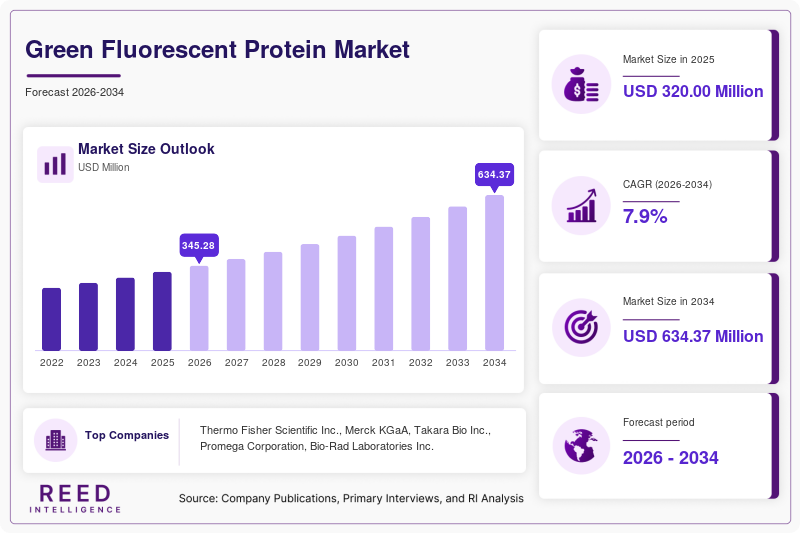
The Green Fluorescent Protein Market size is estimated at USD 320 million and is projected to reach approximately USD 345 million in 2026. Looking ahead, the market is expected to grow to around USD 680 million by 2034, registering a compound annual growth rate (CAGR) of 7.9% during the forecast period (2025–2034). This growth trajectory reflects increasing investments in life sciences research, advancements in genetic engineering technologies, and expanding use of fluorescent markers in diagnostics.
One of the primary growth factors is the increasing adoption of fluorescence-based techniques in academic and industrial laboratories. Researchers are leveraging green fluorescent protein (GFP) as a reliable biomarker for gene expression and protein localization studies. Additionally, the rising prevalence of chronic diseases such as cancer and neurological disorders has intensified the need for advanced imaging techniques, further boosting demand for GFP-based solutions.
Key Highlights
- Market size is estimated at USD 320 million in 2025, reflecting steady adoption across research and laboratory applications. The demand is supported by increased funding and expansion of life sciences infrastructure globally.
- The market is expected to reach USD 680 million by 2034, indicating sustained long-term growth. This rise is driven by broader use of fluorescent proteins in advanced biomedical and clinical research.
- The CAGR is projected at 7.9% from 2025 to 2034, highlighting consistent expansion. Growth is supported by technological advancements and increasing research activities worldwide.
- There is strong demand from biotechnology and pharmaceutical sectors, where GFP is widely used in drug discovery and molecular studies. These industries continue to invest in innovative research tools to improve efficiency.
Market Trends
Rising Adoption of Advanced Imaging Technologies
The integration of green fluorescent protein into advanced imaging technologies represents a key trend shaping the market. Modern microscopy techniques, such as confocal and super-resolution microscopy, rely heavily on fluorescent markers like GFP to achieve high-resolution visualization of cellular processes. Researchers are increasingly using GFP-tagged proteins to study dynamic biological events in real time, which enhances understanding of disease mechanisms. This trend is further supported by improvements in imaging software and hardware, enabling more precise data analysis. As laboratories adopt automated imaging platforms, the demand for GFP reagents continues to grow, reinforcing its importance in cutting-edge research.
Development of Engineered GFP Variants
Another notable trend is the ongoing development of engineered GFP variants with enhanced properties. Scientists are focusing on creating proteins with improved fluorescence intensity, thermal stability, and resistance to photobleaching. These innovations expand the usability of GFP in complex experimental conditions, including long-term live-cell imaging. Additionally, multi-color fluorescent protein systems are being developed, allowing simultaneous tracking of multiple cellular targets. This trend supports broader applications in synthetic biology and systems biology. The availability of customized GFP variants is also encouraging adoption in industrial research, where specific performance characteristics are required.
Market Drivers
Increasing Research Activities in Life Sciences
The expansion of research activities in life sciences is a major driver for the Green Fluorescent Protein Market. Academic institutions, research organizations, and biotechnology companies are investing heavily in molecular and cellular biology studies. GFP serves as a fundamental tool for visualizing gene expression, protein interactions, and cellular pathways. The rise in government and private funding for biomedical research further accelerates the adoption of GFP-based technologies. Moreover, collaborative research initiatives across countries are fostering innovation and increasing demand for advanced research tools, including fluorescent proteins.
Growing Demand for Drug Discovery and Development Tools
The growing need for efficient drug discovery processes is another critical driver. Pharmaceutical companies are increasingly using GFP in high-throughput screening assays to identify potential drug candidates. GFP-based assays enable rapid and accurate measurement of cellular responses, improving the efficiency of drug development pipelines. Additionally, the use of GFP in toxicity testing and biomarker identification enhances the reliability of preclinical studies. As the pharmaceutical industry continues to expand, particularly in emerging markets, the demand for GFP is expected to rise significantly.
Market Restraint
Technical Limitations and Photobleaching Issues
Despite its widespread use, the Green Fluorescent Protein Market faces challenges related to technical limitations, particularly photobleaching and signal instability. GFP can lose fluorescence intensity when exposed to prolonged illumination, which affects the accuracy of long-term imaging studies. This limitation restricts its use in certain applications that require continuous observation. Additionally, variations in protein expression levels can lead to inconsistent results, complicating data interpretation. For example, in live-cell imaging experiments, photobleaching may reduce signal clarity over time, requiring researchers to use alternative fluorescent markers or advanced imaging techniques. These challenges can increase operational costs and limit adoption in resource-constrained settings, thereby restraining overall market growth.
Market Opportunities
Expansion in Gene Therapy and Regenerative Medicine
The increasing focus on gene therapy and regenerative medicine presents significant growth opportunities for the Green Fluorescent Protein Market. GFP is widely used as a reporter gene to monitor the success of gene delivery and expression in therapeutic applications. As gene editing technologies such as CRISPR gain traction, the need for reliable markers like GFP is expected to increase. Additionally, GFP plays a crucial role in stem cell research by enabling visualization of cell differentiation and migration. The expansion of clinical trials in gene therapy is likely to drive demand for GFP-based tools, creating new revenue streams for market players.
Growth in Emerging Markets
Emerging economies in Asia Pacific, Latin America, and the Middle East are offering lucrative opportunities for market expansion. These regions are witnessing increased investments in healthcare infrastructure and research facilities. Governments are promoting biotechnology research through funding programs and policy support. As a result, academic institutions and research laboratories in these regions are adopting advanced research tools, including GFP. The growing number of contract research organizations (CROs) in emerging markets also contributes to demand. Companies that focus on expanding their presence in these regions are likely to benefit from untapped market potential.
Segmental Analysis
By Type
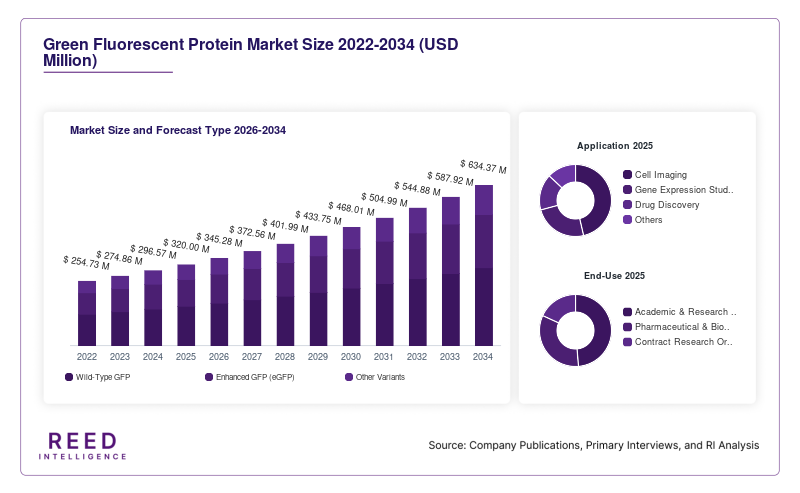
The wild-type GFP segment dominated the market in 2024, accounting for approximately 55% of the total share. This dominance is attributed to its widespread use in basic research applications due to its reliability and ease of use. Researchers prefer wild-type GFP for standard imaging and gene expression studies because of its established performance and cost-effectiveness. Additionally, the availability of well-documented protocols and compatibility with various experimental systems further strengthens its position in the market. Academic institutions and research laboratories continue to rely heavily on wild-type GFP for routine experiments.
The enhanced GFP (eGFP) segment is expected to be the fastest-growing, registering a CAGR of 8.6% during the forecast period. The growth of this segment is driven by its improved fluorescence intensity and stability compared to wild-type GFP. eGFP is increasingly used in advanced imaging applications and long-term studies where signal consistency is critical. The demand for high-performance fluorescent proteins in pharmaceutical research and drug discovery further supports the growth of this segment. Continuous advancements in protein engineering are also contributing to the development of more efficient GFP variants.
By Application
The cell imaging segment held the largest market share in 2024, accounting for around 48%. GFP is extensively used in cell imaging due to its ability to provide real-time visualization of cellular processes. Researchers use GFP-tagged proteins to study cell structure, function, and interactions. The increasing adoption of advanced microscopy techniques further drives the demand for GFP in this segment. Additionally, the growing focus on understanding disease mechanisms at the cellular level supports the widespread use of GFP in imaging applications.
The drug discovery segment is projected to be the fastest-growing, with a CAGR of 9.0% during the forecast period. The use of GFP in high-throughput screening and assay development is a key factor driving growth. Pharmaceutical companies rely on GFP-based assays to evaluate drug efficacy and toxicity. The increasing need for efficient and cost-effective drug development processes further boosts demand. Moreover, advancements in automation and screening technologies are enhancing the efficiency of GFP-based applications in drug discovery.
By End-Use
The academic and research institutes segment dominated the market in 2024, holding approximately 52% of the total share. This dominance is driven by the extensive use of GFP in basic and applied research. Universities and research institutions are major consumers of GFP products due to their focus on molecular biology, genetics, and cell biology studies. The availability of research funding and the presence of skilled professionals further support the growth of this segment.
The pharmaceutical and biotechnology companies segment is expected to grow at the fastest rate, with a CAGR of 8.8% during the forecast period. The increasing use of GFP in drug development, biomarker identification, and clinical research drives this growth. Companies are investing in advanced research tools to enhance productivity and reduce development timelines. The expansion of the biotechnology sector and the growing emphasis on personalized medicine further contribute to the rapid growth of this segment.
Regional Analysis
North America
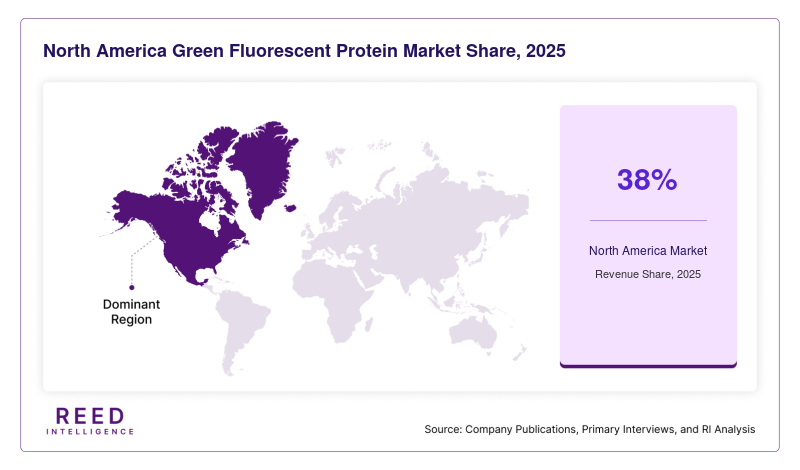
North America held the largest share of the Green Fluorescent Protein Market in 2025, accounting for approximately 38% of the global market. The region is expected to maintain steady growth with a CAGR of around 7.2% during the forecast period. The strong presence of biotechnology companies and advanced research infrastructure supports market expansion. High funding for biomedical research and the adoption of advanced imaging technologies further contribute to the region’s dominance.
The United States remains the dominant country in North America, driven by extensive research activities and strong government support. A key growth factor is the increasing number of clinical trials involving gene therapy and cell-based treatments. The presence of leading pharmaceutical companies and academic institutions fosters innovation, making the country a central hub for GFP-based research applications.
Europe
Europe accounted for nearly 26% of the global market share in 2025 and is projected to grow at a CAGR of 6.8% through 2034. The region benefits from a well-established research ecosystem and strong collaboration between academic institutions and industry players. Increasing investments in life sciences research and the adoption of advanced laboratory technologies support market growth.
Germany is the leading country in Europe, driven by its strong biotechnology sector and research capabilities. A unique growth factor is the region’s focus on sustainable and ethical research practices, which encourages the use of advanced tools like GFP. Government funding programs and partnerships with research organizations further enhance market development.
Asia Pacific
Asia Pacific held a market share of approximately 22% in 2025 and is expected to register the fastest CAGR of 9.1% during the forecast period. Rapid economic growth and increasing investments in healthcare infrastructure are key factors driving the market. The expansion of pharmaceutical and biotechnology industries in the region supports demand for GFP-based products.
China dominates the Asia Pacific market due to its growing research capabilities and government initiatives. A significant growth factor is the increasing number of research institutions and laboratories focusing on molecular biology and genetic engineering. The country’s emphasis on innovation and technological advancement further accelerates market growth.
Middle East & Africa
The Middle East & Africa region accounted for around 7% of the global market share in 2025 and is expected to grow at a CAGR of 6.5% during the forecast period. The market is gradually expanding due to improvements in healthcare infrastructure and increasing investments in research. The adoption of advanced laboratory technologies is still in the early stages but shows promising potential.
Saudi Arabia leads the market in this region, supported by government initiatives to develop the healthcare and biotechnology sectors. A unique growth factor is the increasing focus on diversifying the economy through investments in scientific research. The establishment of research centers and collaborations with international institutions is expected to drive demand for GFP.
Latin America
Latin America captured approximately 7% of the global market share in 2025 and is projected to grow at a CAGR of 6.9% through 2034. The region is experiencing gradual growth due to increasing awareness of advanced research techniques and expanding healthcare infrastructure. Government support for scientific research also contributes to market development.
Brazil is the dominant country in Latin America, driven by its growing biotechnology sector. A key growth factor is the increasing number of academic and research institutions adopting modern laboratory tools. The expansion of pharmaceutical research activities in the country further supports the demand for GFP-based solutions.
Competitive Landscape
The Green Fluorescent Protein Market is characterized by the presence of several established players and emerging companies focusing on innovation and product development. Leading companies are investing in research to develop advanced GFP variants with improved performance characteristics. Strategic collaborations, mergers, and acquisitions are common strategies used to strengthen market presence.
Thermo Fisher Scientific is considered a leading player in the market, owing to its extensive product portfolio and strong global presence. The company has recently introduced advanced fluorescent protein solutions designed for high-resolution imaging applications. Other key players are focusing on expanding their product offerings and enhancing distribution networks to capture a larger market share.
The competitive environment is moderately fragmented, with companies competing based on product quality, innovation, and pricing. Continuous advancements in biotechnology and increasing demand for research tools are expected to intensify competition in the coming years.
Key Players
- Thermo Fisher Scientific Inc.
- Merck KGaA
- Takara Bio Inc.
- Promega Corporation
- Bio-Rad Laboratories Inc.
- Agilent Technologies Inc.
- New England Biolabs
- Clontech Laboratories Inc.
- Abcam plc
- PerkinElmer Inc.
- GenScript Biotech Corporation
- Lonza Group AG
- Enzo Life Sciences Inc.
- Creative Biogene
- OriGene Technologies Inc.
Recent Developments
- A leading biotechnology company launched a new enhanced GFP variant with improved brightness and reduced photobleaching, targeting advanced imaging applications.
- A major life sciences firm expanded its production capacity for fluorescent proteins to meet growing global demand.
- A strategic collaboration between a research institute and a biotech company focused on developing GFP-based tools for gene therapy applications.
Green Fluorescent Protein Market Segments
Type
- Wild-Type GFP
- Enhanced GFP (eGFP)
- Other Variants
Application
- Cell Imaging
- Gene Expression Studies
- Drug Discovery
- Others
End-Use
- Academic & Research Institutes
- Pharmaceutical & Biotechnology Companies
- Contract Research Organizations
By Region
- North America
- Europe
- APAC
- Middle East and Africa
- LATAM