Greenhouse Heater Market Size, Share Demand Report By Type (Gas Heaters, Electric Heaters, Paraffin Heaters, Other), By Application (Commercial Greenhouses, Residential Greenhouses, Research & Educational Greenhouses), Regional Insights & Segment Forecasts, 2026–2034
USD 3950
Greenhouse Heater Market Size
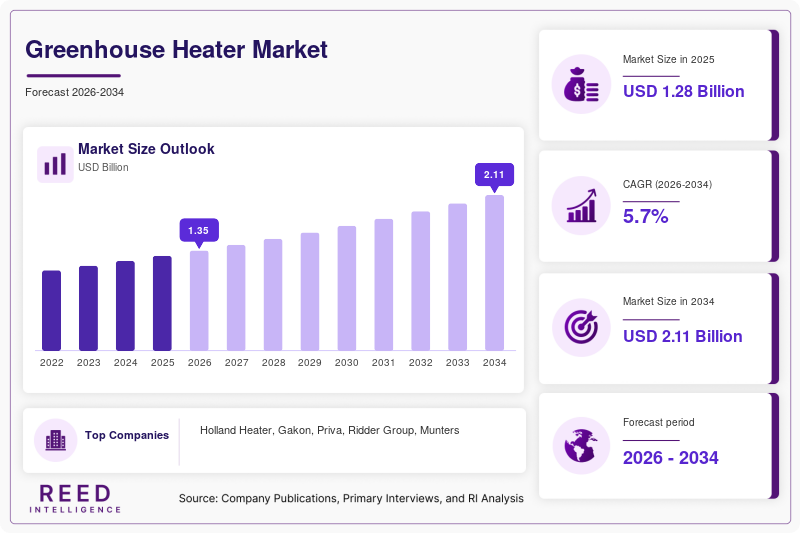
The Greenhouse Heater market size is projected at USD 1,485.6 million in 2026 and is expected to hit USD 2,485.3 million by 2034 with a CAGR of 6.6% during the forecast period. The increasing adoption of protected cultivation practices, the rising demand for year-round crop production, and the growing focus on energy-efficient heating solutions underpin market expansion. This report delivers a comprehensive analysis of the Greenhouse Heater market, including segmentation by type and application, competitive dynamics, and regional growth patterns, equipping stakeholders with critical intelligence. The Greenhouse Heater market continues to demonstrate strong growth potential, fueled by the expanding greenhouse industry, the increasing demand for high-value crops, and continuous innovation in heating technologies.
Key Takeaways
- Dominant Region: Europe leads the Greenhouse Heater market with a 35% share, while Asia-Pacific is the fastest-growing region with a projected CAGR of 7.5% through 2034.
- Dominant Segment: The Gas Heaters type dominates the market with a 40% share, while the Commercial Greenhouses application is the leading segment with a 55% share.
- Emerging Country: The United States is projected to reach USD 385.6 million by 2034, expanding at a CAGR of 6.2%.
- Key Drivers: The increasing demand for controlled environment agriculture, the rising adoption of sustainable farming practices, and the growing need for energy-efficient heating solutions are driving market growth.
Greenhouse Heater Market Trends
Growing Adoption of Energy-Efficient and Sustainable Heating Solutions
The Greenhouse Heater market is witnessing a significant trend toward the adoption of energy-efficient and sustainable heating solutions. This is driven by increasing energy costs, growing environmental concerns, and the need to reduce carbon footprints. Manufacturers are focusing on developing heaters with higher efficiency ratings, utilizing renewable energy sources such as solar and biomass, and integrating smart control systems for optimized energy management.
Increasing Integration of Smart and IoT-Based Heating Systems
The increasing integration of smart and IoT-based heating systems is a major trend shaping the Greenhouse Heater market. The development of heaters with remote monitoring, automated temperature control, and data analytics capabilities is enabling greenhouse operators to optimize heating operations, reduce energy consumption, and improve crop yields. The use of smart heaters in commercial greenhouses for precision climate control is also gaining momentum.
Greenhouse Heater Market Drivers
The Greenhouse Heater market's expansion is primarily driven by the increasing demand for year-round crop production and the growing adoption of protected cultivation practices. The need to protect crops from adverse weather conditions and extend growing seasons has been a major driver, with greenhouse heaters being an essential component of controlled environment agriculture. The rising demand for high-value crops, such as fruits, vegetables, and flowers, has also fueled market demand. Additionally, the increasing focus on food security and sustainable farming practices has spurred growth.
Greenhouse Heater Market Restraints
Despite favorable growth prospects, the Greenhouse Heater market faces significant constraints, primarily related to the high initial cost of greenhouse heating systems, which can be a barrier for small-scale growers and residential users. The ongoing operational costs, particularly for gas and electric heaters, can also be a limitation. The Greenhouse Heater market's growth is also tempered by the competition from alternative heating methods and the availability of subsidies for renewable energy systems.
Greenhouse Heater Market Opportunities
The Greenhouse Heater market presents significant opportunities in the rapidly expanding market for sustainable and energy-efficient heating solutions, where advanced heaters with lower environmental impact are in high demand. The development of heaters that utilize renewable energy sources, such as solar thermal and biomass, is expected to create new growth avenues. Emerging opportunities also exist in the integration of smart technologies for remote monitoring and automated control of greenhouse heating systems.
Challenges in Greenhouse Heater Market
The Greenhouse Heater market faces persistent challenges related to the need for continuous innovation to develop more efficient, cost-effective, and sustainable heating solutions. The complexity of managing energy consumption and maintaining optimal temperature levels in greenhouses can also be a challenge. The market is also contending with the challenge of educating growers about the benefits of advanced heating technologies and the importance of energy-efficient practices.
Greenhouse Heater Market Segmentation Analysis
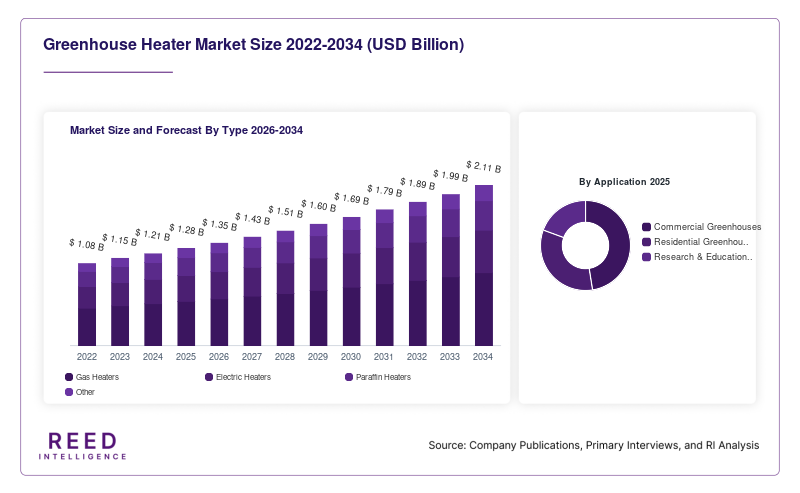
The Greenhouse Heater market is segmented by Type and Application to provide a comprehensive market perspective. By Type, Gas Heaters dominate with a 40% market share, driven by their cost-effectiveness and high heating capacity. The Application segment is led by Commercial Greenhouses, which accounts for 55% of the market, followed by Residential Greenhouses at 25%, and Research & Educational Greenhouses at 20%.
By Type
Gas Heaters represent the largest segment in the Greenhouse Heater market, commanding a 40% share, with revenue exceeding USD 594 million in 2025. These are characterized by their use of natural gas or propane to generate heat, offering high efficiency and cost-effectiveness for large-scale operations. Technical specifications include heating capacity, efficiency rating, and emissions. The Greenhouse Heater market's Gas Heaters segment is driven by its use in commercial greenhouses.
Electric Heaters capture a 30% share of the Greenhouse Heater market, with revenue of USD 446 million in 2025. These are characterized by their use of electricity for heating, offering clean and controllable operation. Technical specifications include wattage, heating capacity, and safety features. The Greenhouse Heater market's Electric Heaters segment is driven by its use in residential and small-scale greenhouses.
Paraffin Heaters represent 18% of the market, with revenue of USD 267 million in 2025, characterized by their use of paraffin oil as fuel, offering portability and ease of use. Technical specifications include fuel consumption, heating capacity, and safety features. The Greenhouse Heater market's Paraffin Heaters segment is driven by its use in smaller greenhouses and hobby gardening.
Other account for the remaining 12% of the market, with revenue of USD 178 million in 2025, including biomass, solar, and hybrid heating systems. Technical specifications vary widely. The Greenhouse Heater market's Other segment is driven by its use in sustainable and niche applications.
By Application
Commercial Greenhouses dominates the Greenhouse Heater market, accounting for 55% of sales, representing USD 817 million in 2025. This segment includes use in large-scale commercial operations for producing vegetables, fruits, flowers, and other high-value crops. Usage penetration exceeds 50% in commercial greenhouse operations. The Greenhouse Heater market's Commercial Greenhouses segment is characterized by its focus on efficiency, reliability, and cost-effectiveness.
Residential Greenhouses accounts for 25% of the Greenhouse Heater market, with revenue of USD 371 million in 2025. This segment encompasses use in home and hobby greenhouses for personal use and small-scale production. The segment is growing at a steady CAGR, driven by the increasing popularity of home gardening. The Greenhouse Heater market's Residential Greenhouses segment is characterized by its focus on user-friendliness and safety.
Research & Educational Greenhouses represents 20% of the market, with revenue of USD 297 million in 2025, involving use in research institutions, universities, and educational facilities for plant science studies and training. The segment's growth is fueled by increasing research funding. The Greenhouse Heater market's Research & Educational segment is characterized by its focus on precision and control.
Greenhouse Heater Market Regional Analysis
Europe Greenhouse Heater Market
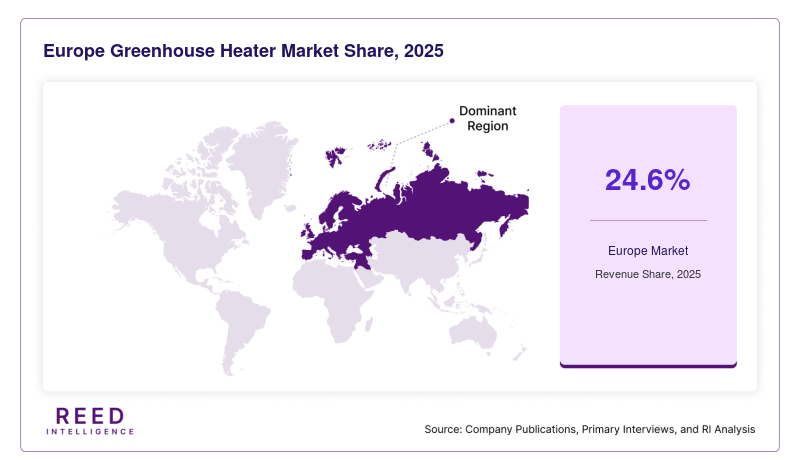
Leads the Greenhouse Heater market, commanding a 35% share, with a revenue of USD 520 million in 2025. The Netherlands, Spain, and Italy are the primary drivers, collectively accounting for 55% of regional demand, driven by the strong greenhouse industry, high adoption of advanced technologies, and focus on sustainable agriculture. The European Greenhouse Heater market is characterized by its focus on innovation and energy efficiency.
Asia-Pacific Greenhouse Heater Market
Represents the second-largest market, capturing a 28% share with a revenue of USD 416 million in 2025. China, Japan, and India are the primary drivers, together accounting for 65% of regional demand, driven by the rapidly growing greenhouse industry, increasing population, and rising demand for food. The Asia-Pacific Greenhouse Heater market is projected to grow at the fastest CAGR of 7.5% through 2034.
North America Greenhouse Heater Market
Accounts for 22% of the global Greenhouse Heater market, with a revenue of USD 327 million in 2025. The United States is the primary driver, accounting for 85% of regional demand, driven by the advanced greenhouse sector, growing demand for local produce, and focus on sustainable farming. The North America Greenhouse Heater market is characterized by its focus on high-performance and efficient heating solutions.
Middle East & Africa and Latin America Greenhouse Heater Market
Together account for the remaining 15% of the Greenhouse Heater market, with the UAE and Brazil leading their respective regions. Both regions are projected to grow at CAGRs exceeding 7%, driven by increasing investments in greenhouse agriculture and food security initiatives.
Top players in Greenhouse Heater Market
- Holland Heater
- Gakon
- Priva
- Ridder Group
- Munters
- Beka (HortiMax)
- Bidim
- Heat Transfer Products (HTP)
- Enerdes
- JGB Enterprises
- Vanderhoeve
- Hotraco
- Stienen
- Agrotech
- GreenTek
Greenhouse Heater Market Segments
By Type
- Gas Heaters
- Electric Heaters
- Paraffin Heaters
- Other
By Application
- Commercial Greenhouses
- Residential Greenhouses
- Research & Educational Greenhouses
By Region
- North America
- Europe
- APAC
- Middle East and Africa
- LATAM