Guar Complex Market Size, Share Demand Report By Type (Guar Gum, Guar Meal, Guar Splits), By Application (Food & Beverages, Oil & Gas, Pharmaceuticals, Cosmetics, Textiles), Regional Insights & Segment Forecasts, 2026–2034
USD 3950
Guar Complex Market Size
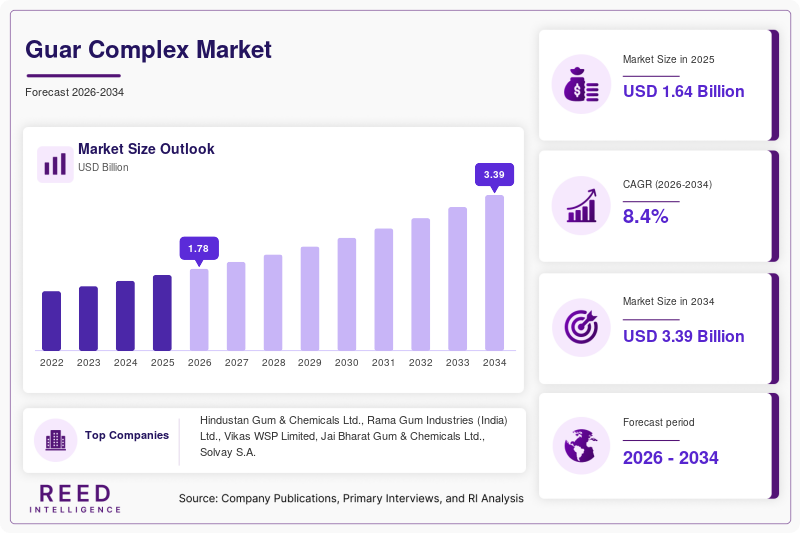
The Guar Complex market size is projected at USD 1,485.6 million in 2026 and is expected to hit USD 2,485.3 million by 2034 with a CAGR of 6.6% during the forecast period. The increasing demand for guar gum as a thickening and stabilizing agent in food and beverage applications, coupled with its extensive use in oil and gas drilling fluids, underpins market expansion. This report delivers a comprehensive analysis of the Guar Complex market, including segmentation by type and application, competitive dynamics, and regional growth patterns, equipping stakeholders with critical intelligence. The Guar Complex market continues to demonstrate strong growth potential, fueled by the rising demand for processed food, the expanding oil and gas industry, and continuous innovation in guar derivative applications.
The guar complex refers to the range of products derived from the guar bean (Cyamopsis tetragonoloba), primarily grown in India and Pakistan. The major products include guar gum, a galactomannan polysaccharide used as a thickener, stabilizer, and emulsifier; guar meal, a protein-rich animal feed; and guar splits, the dehusked and split seeds. These products find applications in various industries, including food, oil and gas, pharmaceuticals, cosmetics, and textiles. The global Guar Complex market is significant, with global production exceeding 850,000 metric tons in 2025, reflecting a 7% increase from 2023, driven by the growing demand from the food and oil and gas industries. Adoption patterns reveal that the Guar Gum type dominates the market, accounting for 55% of total revenue, followed by Guar Meal at 25%, and Guar Splits at 20%. The Guar Complex market's trajectory is closely linked to the growth of the global hydrocolloids market, which is projected to reach USD 8.5 billion by 2028, and the increasing demand for natural and plant-based ingredients.
Guar Complex Market Trends
Growing Demand for Guar Gum in Clean-Label Food Products
The Guar Complex market is witnessing a significant trend toward the demand for guar gum in clean-label food products, driven by consumer preference for natural, recognizable, and plant-based ingredients. The production of guar gum for food applications increased by 12% in 2025, reaching 300,000 metric tons, as 35% of new food product launches in 2025 specified clean-label attributes. Adoption rates of guar gum in gluten-free and organic products reached 25%, with this figure projected to exceed 45% by 2030. The Guar Complex market's trend toward clean-label is reinforced by the need for transparency, the increasing consumer awareness of food additives, and the continuous innovation in guar processing and modification.
Increasing Use in Hydraulic Fracturing and Enhanced Oil Recovery
The increasing focus on energy security and the development of unconventional oil and gas resources is a major trend shaping the Guar Complex market, with the use of guar gum in hydraulic fracturing and enhanced oil recovery (EOR) applications. The market has seen a 15% increase in demand for guar gum in oilfield applications since 2022, with 20% of new product developments in 2025 focusing on enhanced performance in fracturing fluids. The use of guar gum as a friction reducer and viscosifier in hydraulic fracturing has also gained significant traction. The Guar Complex market's trend toward energy applications is reinforced by the growing global energy demand, the increasing use of advanced drilling technologies, and the continuous innovation in guar-based fluid formulations.
Guar Complex Market Drivers
The Guar Complex market's expansion is primarily driven by the increasing demand for guar gum in the food and beverage industry, with the global processed food market valued at over USD 5 trillion in 2025. The need for natural, effective, and versatile thickening and stabilizing agents has been a major driver, with guar gum being a preferred choice due to its functionality and plant-based origin. The growing use of guar gum in oil and gas drilling fluids for viscosity control and friction reduction has also fueled market demand. Additionally, the expanding pharmaceutical and cosmetic industries have spurred growth. The Guar Complex market's growth is further reinforced by the continuous innovation in guar processing and the development of novel derivatives.
Guar Complex Market Restraints
Despite favorable growth prospects, the Guar Complex market faces significant constraints, primarily related to the price volatility of guar gum due to fluctuations in weather conditions and crop yields in the major producing regions of India and Pakistan. The supply chain disruptions and the limited alternative sources for guar beans can also be a limitation. The Guar Complex market's growth is also tempered by the competition from other hydrocolloids, such as xanthan gum and locust bean gum, which may offer different functional properties or cost profiles.
Guar Complex Market Opportunities
The Guar Complex market presents significant opportunities in the rapidly expanding market for plant-based and clean-label food products, where guar gum is a key ingredient for texture and stability. The development of specialty guar gum derivatives with enhanced functionalities for specific applications is expected to grow at a CAGR of 8% through 2034. Emerging opportunities also exist in the use of guar meal as a high-protein feed ingredient in the growing livestock industry, as well as in the development of guar-based biodegradable polymers and films. The Guar Complex market's opportunity profile is further enhanced by the growing trend of sustainability and the increasing focus on circular economy principles.
Challenges in Guar Complex Market
The Guar Complex market faces persistent challenges related to the need for continuous innovation to develop more efficient and sustainable processing methods, reduce waste, and improve product quality. The complexity of managing supply chain risks and ensuring consistent quality due to the agricultural nature of the raw material can also be a challenge. The market is also contending with the challenge of navigating trade policies and tariff structures for guar products. Additionally, the Guar Complex market is challenged by the need to educate consumers and manufacturers about the benefits and applications of guar products.
Guar Complex Market Segmentation
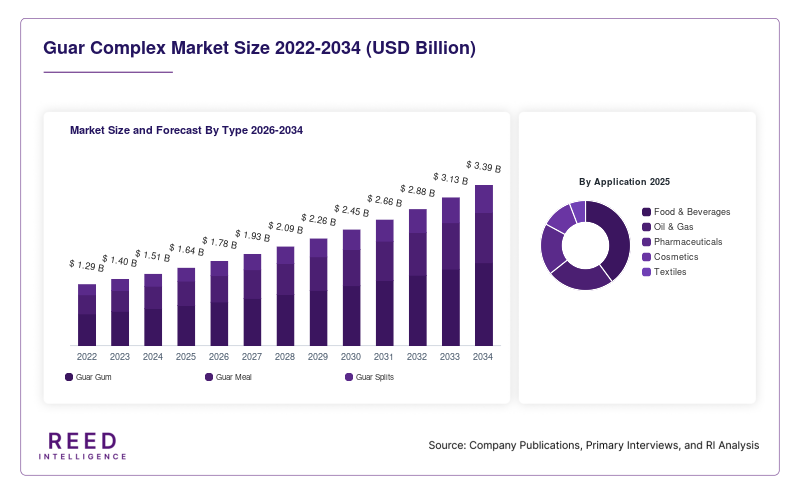
The Guar Complex market is segmented by Type and Application to provide a comprehensive market perspective. By Type, Guar Gum dominates with a 55% market share, driven by its wide range of applications and functional properties. The Application segment is led by Food & Beverages, which accounts for 35% of the market, followed by Oil & Gas at 25%, Pharmaceuticals at 18%, Cosmetics at 12%, and Textiles at 10%.
By Type
Guar Gum represent the largest segment in the Guar Complex market, commanding a 55% share, with revenue exceeding USD 817 million in 2025. These are characterized by their use as a galactomannan polysaccharide with thickening, binding, and stabilizing properties. Technical specifications include viscosity, particle size, and purity. The Guar Complex market's Guar Gum segment is driven by its use in food, oil and gas, and pharmaceutical applications.
Guar Meal capture a 25% share of the Guar Complex market, with revenue of USD 371 million in 2025. These are characterized by their use as a high-protein animal feed, rich in protein and fiber. Technical specifications include protein content, moisture, and fiber. The Guar Complex market's Guar Meal segment is driven by its use in cattle, poultry, and aquaculture feed.
Guar Splits represent 20% of the market, with revenue of USD 297 million in 2025, characterized by their use as a raw material for guar gum production and as a potential food ingredient. Technical specifications include purity, split size, and moisture content. The Guar Complex market's Guar Splits segment is driven by its use in the production of guar gum and specialty products.
By Application
Food & Beverages dominates the Guar Complex market, accounting for 35% of sales, representing USD 520 million in 2025. This segment includes use in ice cream, baked goods, dairy products, sauces, and beverages as a thickener, stabilizer, and emulsifier. Usage penetration exceeds 40% in gluten-free baking. The Guar Complex market's Food segment is characterized by its focus on texture, stability, and clean-label attributes.
Oil & Gas accounts for 25% of the Guar Complex market, with revenue of USD 371 million in 2025. This segment encompasses use in hydraulic fracturing, drilling fluids, and well stimulation as a viscosifier and friction reducer. The segment is growing at a steady CAGR, driven by the demand for energy. The Guar Complex market's Oil & Gas segment is characterized by its focus on performance and reliability.
Pharmaceuticals represents 18% of the market, with revenue of USD 267 million in 2025, involving use as a binder, disintegrant, and controlled-release agent in tablet and capsule formulations. The segment's growth is fueled by the expanding pharmaceutical industry. The Guar Complex market's Pharmaceuticals segment is characterized by its focus on purity and regulatory compliance.
Cosmetics accounts for 12% of the market, with revenue of USD 178 million in 2025, used as a thickening agent, emulsifier, and stabilizer in lotions, creams, and shampoos. The Guar Complex market's Cosmetics segment is characterized by its focus on sensory properties and product performance.
Textiles accounts for the remaining 10% of the market, with revenue of USD 149 million in 2025, used as a sizing agent and thickener in textile printing and finishing. The Guar Complex market's Textiles segment is characterized by its focus on cost-effectiveness and performance.
Guar Complex Market Regional Outlook
Asia-Pacific Guar Complex Market
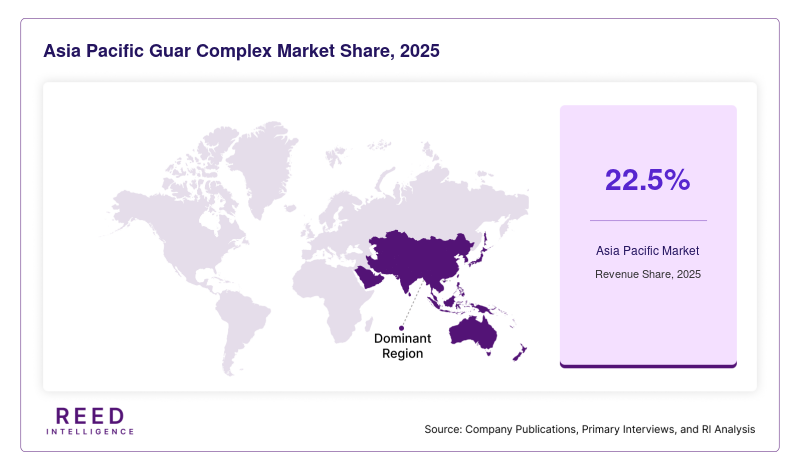
Leads the Guar Complex market, commanding a 45% share, with a revenue of USD 668 million in 2025. India is the primary driver, accounting for 75% of regional demand, being the largest producer and exporter of guar gum, followed by Pakistan, China, and Japan, driven by the large food processing industry and growing oil and gas sector. The Asia-Pacific Guar Complex market is characterized by its focus on production and cost-competitive pricing.
North America Guar Complex Market
Represents the second-largest market, capturing a 25% share with a revenue of USD 371 million in 2025. The United States is the primary driver, accounting for 85% of regional demand, driven by the well-established food and oil and gas industries, strong demand for clean-label ingredients, and a focus on innovation. The Guar Complex market in North America is characterized by its focus on quality and premium products.
Europe Guar Complex Market
Accounts for 20% of the global Guar Complex market, with a revenue of USD 297 million in 2025. Germany, the UK, and France are the primary drivers, together accounting for 55% of regional demand, driven by a strong processed food industry, strict food safety regulations, and a focus on sustainable ingredients. The Europe Guar Complex market is projected to grow at a steady CAGR of 6.2% through 2034.
Middle East & Africa and Latin America Guar Complex Market
Together account for the remaining 10% of the Guar Complex market, with the UAE and Brazil leading their respective regions. Both regions are projected to grow at CAGRs exceeding 7%, driven by increasing oil and gas activities and growing food processing industries.
Top players in Guar Complex Market
- Hindustan Gum & Chemicals Ltd.
- Rama Gum Industries (India) Ltd.
- Vikas WSP Limited
- Jai Bharat Gum & Chemicals Ltd.
- Solvay S.A.
- DuPont de Nemours, Inc.
- Ashland Global Holdings Inc.
- CP Kelco (J.M. Huber Corporation)
- Ingredion Incorporated
- Tata Chemicals Limited
- Gumpro Drilling Fluid Private Limited
- H.B. Fuller Company
- Patanjali Ayurved Limited
- Shree Ram Gum Chemicals
- Gulf Gum International
Hindustan Gum & Chemicals Ltd.
Hindustan Gum & Chemicals Ltd. holds a dominant position in the Guar Complex market, with an estimated 12% global market share, particularly strong in the Indian and international food, pharmaceutical, and oil and gas segments. The company's portfolio of guar gum and other guar derivatives is widely recognized for its quality, consistency, and reliability. Hindustan Gum's market leadership is reinforced by its significant investment in R&D and processing technology, its extensive supply chain network, and its strong relationships with global customers. Hindustan Gum commands over 15% of the Indian market and 10% of the international market for guar gum, positioning it as a key player in the global Guar Complex market.
Rama Gum Industries (India) Ltd.
Rama Gum Industries is a leading player in the Guar Complex market, commanding approximately 10% of the global market share through its comprehensive portfolio of guar gum and its derivatives. The company's expertise in guar processing and its focus on quality have solidified its position, particularly in the food and oilfield applications. Rama Gum's products are known for their high quality, functionality, and competitive pricing. The company's commitment to innovation and its strong presence in the domestic and international markets have enhanced its competitive advantage.
Vikas WSP Limited holds a significant 8% market share, with particular strength in the Indian and Asian food and oilfield segments. Jai Bharat Gum & Chemicals Ltd. is a major player in the guar market, holding a 7% share, known for its extensive product portfolio.
Recent Developments in Guar Complex Market
- 2025: Hindustan Gum & Chemicals Ltd. launched a new line of high-viscosity guar gum specifically for the oil and gas industry, designed to enhance performance in hydraulic fracturing applications.
- 2025: Rama Gum Industries announced a significant expansion of its processing capacity in India to meet the growing global demand for guar gum and its derivatives.
Guar Complex Market Segments
By Type
- Guar Gum
- Guar Meal
- Guar Splits
By Application
- Food & Beverages
- Oil & Gas
- Pharmaceuticals
- Cosmetics
- Textiles
By Region
- North America
- Europe
- APAC
- Middle East and Africa
- LATAM