Guitar Bridges Market Size, Share & Demand Report By Product Type (Fixed Bridges, Tremolo Bridges, Locking Tremolo Bridges, Roller Bridges, Wraparound Bridges), By Material (Metal, Wood, Composite, Hybrid Materials), By End User (Professional Musicians, Hobbyist and Beginner Users, Music Schools and Institutions, Guitar Manufacturers, Repair and Customization Workshops), By Region & Segment Forecasts, 2026–2034
USD 3950
Market Overview
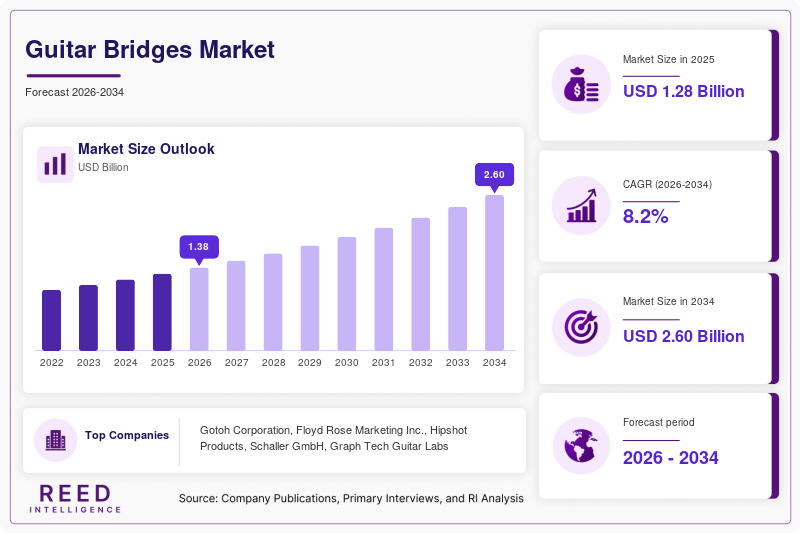
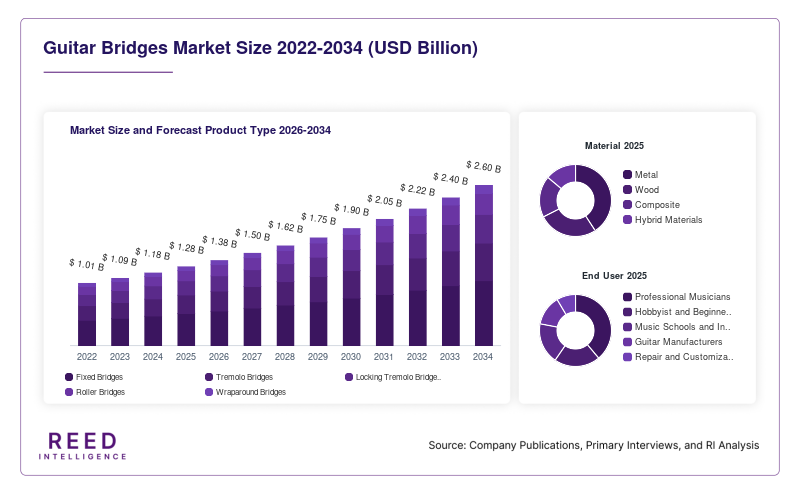
The Guitar Bridges Market size was valued at USD 1.28 billion in 2026 and is projected to reach USD 2.41 billion by 2034, expanding at a CAGR of 8.2% during the forecast period from 2026 to 2034. The market continues to evolve alongside growing global interest in musical instruments, live performances, home-based music production, and customized guitar manufacturing. Guitar bridges remain one of the most important hardware components in acoustic, electric, and bass guitars because they directly influence sustain, tuning stability, resonance, and overall sound quality.
A major factor supporting market growth is the continued expansion of the global music industry and increasing participation in music education programs. Rising enrollment in music schools, online guitar learning platforms, and independent artist communities has increased demand for both entry-level and premium guitars. This trend has encouraged manufacturers to invest in advanced bridge technologies that improve playability, tonal consistency, and durability.
Key Highlights
- North America dominated the market with a 34.8% share in 2025, while Asia Pacific is expected to grow at the fastest CAGR of 10.6% during 2026–2034.
- By product type, fixed bridges accounted for the largest share of 46.3%, while locking tremolo bridges are projected to grow at a CAGR of 10.9%.
- By material, metal bridges led with a 58.7% share, whereas composite bridges are expected to expand at a CAGR of 11.3%.
- By end user, professional musicians held a 42.6% share, while hobbyist and beginner users are projected to grow at a CAGR of 10.1%.
- The United States remained the dominant country, with market values of USD 338 million in 2024 and USD 369 million in 2025.
Market Trends
Growing Demand for Premium and Custom Guitar Components
The market is witnessing increasing demand for premium guitar hardware among professional musicians and serious enthusiasts. Consumers are increasingly seeking bridge systems that enhance sustain, improve tonal response, and provide superior tuning stability. This has encouraged manufacturers to introduce precision-engineered bridges made from advanced alloys, brass, titanium, and specialized composite materials. Custom guitar builders are also incorporating high-performance bridge systems into boutique instruments to differentiate their products. As social media and digital content platforms expose consumers to advanced guitar modifications, demand for aftermarket bridge upgrades continues to expand. This trend is particularly visible in electric guitar categories where players frequently modify instruments to achieve personalized tonal characteristics and performance capabilities.
Expansion of Online Musical Instrument Retail Channels
Online retailing has become an important growth driver for the Guitar Bridges Market. E-commerce platforms provide consumers with access to a broader range of bridge designs, materials, and price points than traditional music stores. Product comparison tools, demonstration videos, and customer reviews help buyers make informed purchasing decisions. Manufacturers are increasingly leveraging direct-to-consumer strategies through branded websites and digital marketplaces. The rise of international shipping and improved logistics networks has enabled smaller manufacturers to reach global customer bases. Furthermore, online communities focused on guitar maintenance and customization continue to educate consumers about bridge replacement benefits, creating sustained demand for specialized bridge products across multiple regions.
Market Drivers
Rising Popularity of Electric Guitar-Based Music Genres
The growing influence of rock, metal, blues, indie, and alternative music genres continues to support demand for advanced guitar hardware. Electric guitars remain central instruments in these musical styles, creating a consistent requirement for durable and performance-oriented bridge systems. Musicians increasingly prioritize tuning stability during live performances and studio recordings, leading to higher adoption of upgraded bridge technologies. The increasing number of independent artists producing music through digital platforms has further expanded the user base. Manufacturers are responding with innovative bridge designs that improve sustain, intonation, and vibrato functionality. As music creation becomes more accessible worldwide, the demand for reliable guitar components is expected to increase steadily throughout the forecast period.
Growth of Music Education and Recreational Learning
Music education programs are expanding across developed and emerging economies, creating favorable conditions for market growth. Educational institutions, private academies, and online learning platforms have significantly increased access to guitar training. This trend is generating demand for beginner and intermediate instruments equipped with quality bridge systems. Many students eventually upgrade their instruments and components as their skills improve, supporting aftermarket sales. Government initiatives promoting arts education and growing awareness regarding the cognitive benefits of music learning have further strengthened participation rates. The increasing affordability of learning resources and digital tutorials is encouraging more consumers to purchase guitars, indirectly driving demand for bridge replacements and upgrades.
Market Restraint
Price Sensitivity and Availability of Low-Cost Alternatives
One of the primary challenges affecting the Guitar Bridges Market is intense price competition from low-cost manufacturers. Entry-level consumers often prioritize affordability over performance, resulting in widespread adoption of inexpensive bridge systems that offer limited durability and functionality. This trend can reduce revenue opportunities for premium bridge manufacturers and create pressure on profit margins. Additionally, counterfeit and unbranded products available through online channels often compete aggressively on price. The presence of these alternatives can slow adoption of advanced bridge technologies despite their superior performance characteristics. Smaller manufacturers may also face challenges associated with fluctuating raw material costs, particularly for high-grade metals and specialty composites. These factors collectively create barriers to premium product penetration and may limit growth in price-sensitive regions where consumer purchasing power remains constrained.
Market Opportunities
Increasing Adoption of Aftermarket Guitar Upgrades
The growing culture of instrument customization presents substantial opportunities for market participants. Guitar players increasingly view bridge replacement as an effective method of enhancing performance without purchasing a new instrument. This trend has created a thriving aftermarket ecosystem focused on premium hardware upgrades. Consumers are investing in components that improve sustain, tuning accuracy, and tonal versatility. Professional repair technicians and guitar modification specialists are also contributing to market expansion by recommending upgraded bridge systems. As educational content related to guitar maintenance becomes more accessible online, awareness regarding bridge replacement benefits continues to increase. Manufacturers that offer compatibility across multiple guitar models are expected to benefit significantly from this expanding aftermarket demand.
Emergence of Sustainable and Advanced Material Technologies
Sustainability initiatives are creating new growth opportunities within the market. Manufacturers are increasingly exploring environmentally responsible materials and production methods while maintaining performance standards. Recycled metals, engineered composites, and responsibly sourced wood components are gaining attention among environmentally conscious consumers. At the same time, advancements in material science are enabling the development of lightweight bridges with improved resonance and durability characteristics. These innovations appeal to musicians seeking enhanced performance while supporting sustainability goals. As regulatory expectations and consumer awareness continue to evolve, companies investing in eco-friendly manufacturing practices and advanced material technologies are likely to strengthen their competitive positioning and attract new customer segments.
Segmental Analysis
By Product Type
Fixed bridges represented the dominant subsegment and accounted for 46.3% of the global market share in 2024. These bridge systems remain widely used because of their simplicity, tuning stability, durability, and cost efficiency. Fixed bridges are commonly installed on acoustic guitars, many electric guitar models, and bass guitars. Their ability to maintain accurate intonation while requiring minimal maintenance makes them attractive to both beginners and professional musicians. Manufacturers continue to enhance fixed bridge performance through improved materials and precision engineering. Demand remains particularly strong among players seeking reliable hardware for recording sessions and live performances. The widespread availability of fixed bridge designs across multiple guitar categories continues to support their leadership position within the market.
Locking tremolo bridges are projected to register the fastest CAGR of 10.9% through 2034. These systems are increasingly favored by musicians who require advanced vibrato techniques while maintaining tuning stability. Modern locking mechanisms reduce string slippage and improve performance during aggressive playing styles. The popularity of rock and metal music genres continues to drive adoption of locking tremolo systems. Manufacturers are introducing lighter and more durable versions that enhance sustain and responsiveness. Growing awareness of premium guitar modifications and increasing demand for professional-grade hardware are expected to support continued expansion of this segment throughout the forecast period.
By Material
Metal bridges accounted for the largest share of 58.7% in 2024. Their dominance is attributed to superior durability, structural strength, and tonal consistency. Materials such as steel, brass, aluminum, and titanium are widely used across electric and bass guitar applications. Metal bridges provide excellent sustain and resistance to wear, making them suitable for frequent performance use. Manufacturers continue to develop specialized alloys that improve resonance while reducing overall weight. The versatility of metal bridges across various instrument categories supports their extensive adoption. Furthermore, advancements in precision machining technologies have enabled manufacturers to produce highly accurate bridge components that meet the performance requirements of professional musicians.
Composite bridges are expected to expand at the fastest CAGR of 11.3% during the forecast period. These products combine lightweight construction with improved durability and acoustic characteristics. Manufacturers are increasingly investing in engineered materials that offer enhanced vibration transfer and environmental resistance. Composite bridges are gaining popularity among consumers seeking alternatives to traditional metal and wooden designs. Sustainability considerations are also encouraging adoption of advanced composite materials. The ability to customize material properties for specific tonal outcomes creates additional opportunities within this segment. Continued innovation in composite engineering is expected to accelerate growth and expand application potential across multiple guitar categories.
By End User
Professional musicians emerged as the dominant end-user segment, accounting for 42.6% of market revenue in 2024. This group places significant emphasis on sound quality, tuning stability, and long-term reliability. Professional performers and recording artists frequently invest in premium bridge systems to optimize instrument performance. Demand within this segment is supported by live concerts, studio recording activities, and instrument customization trends. Manufacturers often target professional users through premium product lines featuring advanced materials and precision-engineered designs. The willingness of professionals to invest in high-performance hardware contributes substantially to overall market revenue and supports ongoing innovation across the industry.
Hobbyist and beginner users are projected to grow at the fastest CAGR of 10.1% through 2034. Increased accessibility of guitar education, online tutorials, and affordable instruments has expanded participation among new players. As skill levels improve, many hobbyists seek upgraded bridge systems to enhance performance and playability. Social media platforms showcasing guitar modifications have further increased awareness of aftermarket upgrades. Manufacturers are responding by offering affordable yet feature-rich bridge products designed specifically for this growing consumer group. Rising interest in recreational music activities is expected to sustain demand and support long-term market expansion.
Regional Analysis
North America
North America accounted for 34.8% of the Guitar Bridges Market share in 2025, making it the largest regional market. The region is projected to expand at a CAGR of 7.8% through 2034. Strong demand for electric guitars, widespread music education programs, and a mature musical instrument industry continue to support growth. The presence of established guitar manufacturers and aftermarket component suppliers further strengthens regional demand. High consumer spending on premium instruments and accessories contributes significantly to market expansion.
The United States remains the dominant country in the region. A key growth factor is the strong culture of guitar customization among enthusiasts and professional musicians. Consumers frequently upgrade bridge systems to improve tonal performance and tuning stability. The increasing popularity of home recording studios and independent music production has further boosted demand for high-quality guitar hardware. Continuous innovation by domestic manufacturers also supports sustained market growth.
Europe
Europe represented 27.1% of the global market in 2025 and is expected to grow at a CAGR of 7.5% during the forecast period. The region benefits from a strong tradition of music education and active participation in live music events. Demand for premium guitars and replacement components remains robust across major economies. Consumers increasingly prefer durable bridge systems that offer enhanced performance and longevity, supporting sales of advanced hardware products.
Germany leads the European market due to its established musical instrument manufacturing sector and strong consumer interest in guitar-based music. A unique growth factor is the increasing popularity of boutique guitar brands that emphasize craftsmanship and component quality. These manufacturers frequently integrate premium bridge systems into their instruments. Growing demand for custom-built guitars among professional musicians continues to support market development throughout the country.
Asia Pacific
Asia Pacific held 22.4% of the market share in 2025 and is forecast to register the fastest CAGR of 10.6% through 2034. Rising disposable income, expanding music education programs, and increasing adoption of western musical instruments are driving demand. The region has become an important manufacturing hub for guitars and related components, creating favorable conditions for market expansion. Growth in online retail channels is also improving product accessibility.
China remains the dominant country within the region. A major growth factor is the rapid expansion of domestic guitar manufacturing and export activities. Local manufacturers are increasingly producing mid-range and premium instruments equipped with advanced bridge systems. Rising participation among younger consumers in music-related activities and digital content creation further contributes to growing demand. Continued investments in manufacturing capabilities are expected to strengthen regional competitiveness.
Middle East & Africa
The Middle East & Africa accounted for 7.2% of global market revenue in 2025 and is expected to grow at a CAGR of 8.1% during the forecast period. Although relatively smaller than other regions, demand is increasing due to growing interest in contemporary music and expanding access to musical instruments. Educational initiatives and cultural events promoting music participation are supporting gradual market development across several countries.
South Africa represents the largest national market in the region. One distinctive growth factor is the increasing number of music festivals and performance venues that encourage instrument ownership. Rising urbanization and improving access to international musical instrument brands have expanded consumer choice. The growing influence of digital learning platforms is also helping new musicians acquire guitar skills, creating demand for instruments and replacement hardware components.
Latin America
Latin America captured 8.5% of the Guitar Bridges Market share in 2025 and is anticipated to grow at a CAGR of 8.4% through 2034. The region benefits from a strong musical culture and increasing participation in guitar-centered genres. Growing accessibility of affordable instruments and expanding online retail networks are supporting demand for bridge systems. Manufacturers are increasingly targeting regional consumers through localized product offerings and distribution partnerships.
Brazil dominates the Latin American market due to its large population of musicians and vibrant music industry. A unique growth factor is the increasing popularity of independent music production and social media-based performance content. Consumers are investing in upgraded hardware to improve instrument quality and reliability. The expanding presence of music schools and training programs further supports demand for guitars and associated components across the country.

Competitive Landscape
The Guitar Bridges Market is moderately fragmented, with established hardware manufacturers competing alongside specialized boutique component producers. Companies focus on product innovation, precision engineering, material development, and strategic partnerships with guitar manufacturers. Competitive differentiation is often based on tuning stability, tonal performance, durability, and compatibility with a wide range of guitar models.
Gotoh remains one of the leading market participants due to its extensive portfolio of bridge systems and strong relationships with guitar manufacturers worldwide. The company continues to invest in precision manufacturing technologies and premium hardware solutions. Other prominent participants actively pursue product upgrades and international distribution expansion to strengthen market presence.
Recent industry activity includes the introduction of lightweight alloy bridge systems, enhanced locking mechanisms, and environmentally responsible manufacturing processes. Companies are also increasing direct-to-consumer sales through digital channels. Strategic collaborations with boutique guitar builders and custom instrument workshops are becoming increasingly common. These initiatives enable manufacturers to expand customer reach while addressing evolving performance requirements among professional and recreational musicians.
Key Players
- Gotoh Corporation
- Floyd Rose Marketing Inc.
- Hipshot Products
- Schaller GmbH
- Babicz Guitars
- Graph Tech Guitar Labs
- Wilkinson Hardware
- TonePros Sound Labs
- ABM Guitar Parts
- Kahler International
- Allparts Music Corporation
- Sung-il Musical Instrument Co.
- Fender Musical Instruments Corporation
- Gibson Brands Inc.
- PRS Guitars
Recent Developments
- In 2025, Gotoh Corporation introduced a new lightweight titanium guitar bridge series designed to improve sustain, tuning stability, and tonal clarity for premium electric guitar applications.
- In 2025, Floyd Rose Marketing Inc. expanded its locking tremolo bridge portfolio with enhanced fine-tuning mechanisms aimed at professional touring musicians and recording artists.
- In 2024, Graph Tech Guitar Labs launched an advanced composite bridge platform engineered to improve resonance transfer while supporting sustainable material initiatives.
- In 2024, Schaller GmbH upgraded its precision-machined bridge systems with improved intonation adjustment technology to meet the evolving performance requirements of modern guitar players.
- In 2025, Hipshot Products expanded its global distribution network and increased production capacity for premium bridge assemblies to address rising demand from aftermarket customization and boutique guitar manufacturers.
Guitar Bridges Market Segments
Product Type
- Fixed Bridges
- Tremolo Bridges
- Locking Tremolo Bridges
- Roller Bridges
- Wraparound Bridges
Material
- Metal
- Wood
- Composite
- Hybrid Materials
End User
- Professional Musicians
- Hobbyist and Beginner Users
- Music Schools and Institutions
- Guitar Manufacturers
- Repair and Customization Workshops
By Region
- North America
- Europe
- APAC
- Middle East and Africa
- LATAM