Gulf Cooperation Council Activated Carbon Market Size, Share, Demand Report by Type (Powdered Activated Carbon, Granular Activated Carbon, Extruded Activated Carbon), By Raw Material (Coal-Based, Coconut Shell-Based, Wood-Based), By Application (Water Treatment, Air Purification, Industrial Processing, Food & Beverage), By End-Use Industry (Industrial, Municipal, Commercial, Residential) & Regional Forecasts, 2026–2034
USD 3950
Market Overview
The Gulf Cooperation Council Activated Carbon Market size is estimated at USD 320.4 million, and it is anticipated to reach USD 560.8 million by 2034, registering a CAGR of 7.3% throughout the forecast period.
A key global factor supporting the growth of the Gulf Cooperation Council Activated Carbon Market is the tightening of environmental regulations focused on water safety, industrial emissions control, and sustainable waste management. These regulatory frameworks have accelerated adoption of high-efficiency adsorption materials such as activated carbon across both municipal and industrial sectors.
The market is also benefitting from rapid infrastructure development in water desalination and petrochemical industries within GCC countries, where activated carbon plays a critical role in purification and contaminant removal processes.
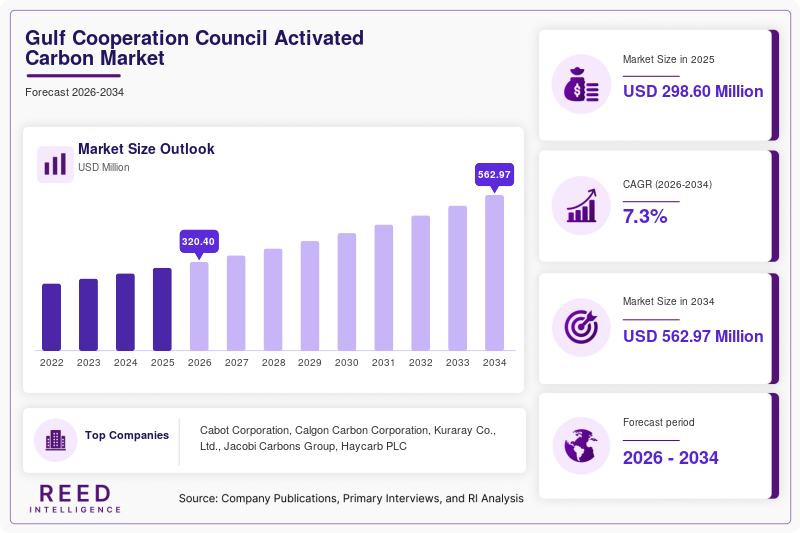
Key Highlights
- Dominant region share (2025): Saudi Arabia accounted for 38.6% share of the GCC market
- Fastest-growing region CAGR (2026–2034): United Arab Emirates at 7.9% CAGR
- Leading subsegment (Type): Powdered Activated Carbon held 44.2% share in 2025
- Fastest-growing subsegment (Type): Granular Activated Carbon at 7.8% CAGR
- Dominant country: Saudi Arabia market value was USD 118.5 million in 2024 and USD 126.3 million in 2025
Market Trends
Expansion of Water Desalination Infrastructure
The GCC region is heavily investing in desalination plants to address freshwater scarcity. This has significantly boosted the demand for activated carbon used in pre-treatment and post-treatment filtration stages. The Gulf Cooperation Council Activated Carbon Market is increasingly aligned with large-scale water security initiatives, particularly in Saudi Arabia and the UAE.
Shift Toward High-Performance Air Filtration Systems
Industrialization and urbanization have intensified air quality concerns across GCC cities. As a result, activated carbon-based air purification systems are witnessing rising adoption in commercial buildings, healthcare facilities, and industrial plants. This trend is further reinforced by stricter emission standards across oil refining and petrochemical sectors.
Market Drivers
Increasing Industrial Water Treatment Demand
One of the primary drivers of the Gulf Cooperation Council Activated Carbon Market is the rising need for advanced water treatment systems in oil & gas, chemical processing, and municipal utilities. Activated carbon is widely used for removing organic contaminants, chlorine, and volatile compounds, ensuring compliance with water quality standards.
Growth of Oil & Gas Refining Activities
The GCC region remains a global hub for petroleum refining and petrochemical production. Activated carbon is extensively used in refining processes for purification, gas separation, and contaminant adsorption. Expansion of downstream petrochemical capacity continues to support market growth.
Market Restraint
High Regeneration and Disposal Costs
Despite strong demand, the Gulf Cooperation Council Activated Carbon Market faces challenges due to high regeneration and disposal costs associated with spent activated carbon. The regeneration process requires specialized infrastructure and energy-intensive operations, limiting adoption among small and medium-scale industries.
Market Opportunities
Expansion of Municipal Water Projects
Large-scale government investments in municipal water treatment infrastructure across GCC countries present a significant opportunity. Increasing urban population and water scarcity concerns are driving demand for advanced adsorption technologies.
Adoption of Sustainable Activated Carbon Alternatives
There is growing interest in bio-based and coconut shell-derived activated carbon products. These sustainable alternatives are gaining traction due to lower environmental impact and improved lifecycle efficiency, opening new growth avenues in the Gulf Cooperation Council Activated Carbon Market.
Segmental Analysis
The Gulf Cooperation Council Activated Carbon Market is segmented based on type, raw material, application, and end-use industry. Each segment plays a critical role in defining market structure and growth trajectory.
By Type Analysis
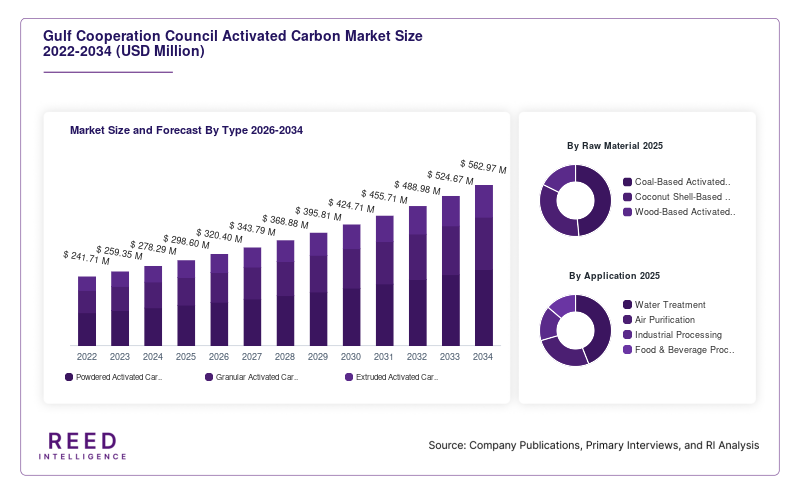
Powdered Activated Carbon (PAC) dominated the market in 2025, holding 44.2% share. Its dominance is attributed to widespread use in water treatment facilities, where rapid adsorption of contaminants is required. PAC is extensively used in municipal water purification systems across GCC countries due to its cost-effectiveness and high surface area efficiency.
Granular Activated Carbon (GAC) is the fastest-growing subsegment, expected to register a 7.8% CAGR during 2026–2034. Its growth is driven by increasing adoption in industrial gas treatment, air purification systems, and liquid-phase adsorption processes. GAC offers longer lifecycle performance and regeneration capability, making it suitable for large-scale industrial applications in the Gulf Cooperation Council Activated Carbon Market.
By Raw Material Analysis
Coal-based activated carbon held the dominant share of 41.5% in 2025 due to its availability and cost efficiency. It is widely used in industrial filtration applications across petrochemical plants in Saudi Arabia and Kuwait.
Coconut shell-based activated carbon is the fastest-growing segment, projected at a 8.1% CAGR. The shift toward sustainable raw materials and eco-friendly production processes is driving its adoption. Coconut shell-based carbon offers higher hardness and better adsorption efficiency, making it suitable for premium filtration applications.
By Application Analysis
Water treatment remained the dominant application segment with 48.3% share in 2025. The expansion of desalination plants and municipal wastewater treatment facilities across GCC countries continues to drive demand.
Air purification is the fastest-growing application, projected at a 7.9% CAGR, driven by rising air quality concerns in urban centers such as Dubai, Riyadh, and Doha. Industrial emission control systems are increasingly integrating activated carbon filters.
By End-Use Industry Analysis
The industrial sector dominated the Gulf Cooperation Council Activated Carbon Market with 52.6% share in 2025, primarily due to extensive use in oil & gas refining, petrochemicals, and chemical processing industries.
The municipal sector is the fastest-growing end-use segment at a 7.6% CAGR, driven by government investments in water infrastructure and urban sustainability programs.
Regional Analysis
North America
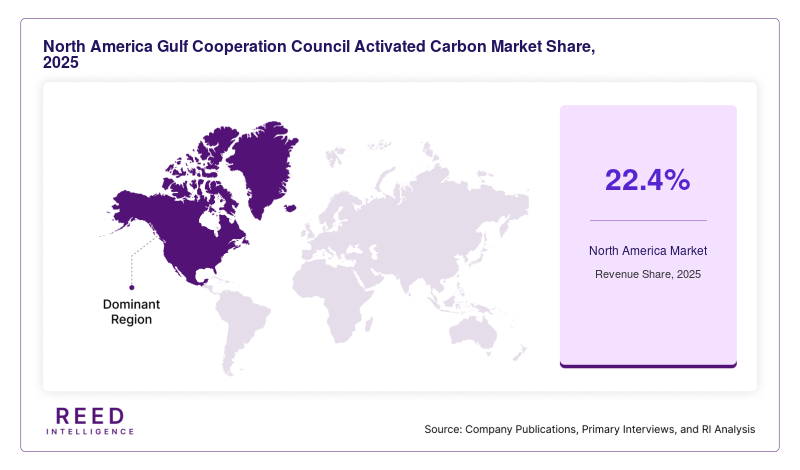
North America held approximately 22.4% share in 2025, driven by advanced industrial filtration systems and strict EPA regulations. The region is expected to register a 6.5% CAGR (2026–2034) due to increasing adoption in pharmaceutical and chemical industries.
Europe
Europe accounted for 19.7% share in 2025, supported by strong environmental policies and water recycling initiatives. The region is projected to grow at a 6.2% CAGR, driven by sustainable filtration technologies and circular economy practices.
Asia Pacific
Asia Pacific dominated globally with 28.9% share in 2025 and is expected to expand at a 7.8% CAGR (2026–2034). Rapid industrialization in China and India, along with growing wastewater treatment demand, is driving growth.
Middle East & Africa
The Middle East & Africa region, including the Gulf Cooperation Council Activated Carbon Market, held 18.6% share in 2025 and is expected to grow at a 7.4% CAGR. Saudi Arabia leads the region due to desalination expansion and oil refining capacity upgrades.
Latin America
Latin America accounted for 10.4% share in 2025 and is projected to grow at a 6.7% CAGR. Growth is supported by mining activities and municipal water treatment expansion in Brazil and Chile.
Competitive Landscape
The Gulf Cooperation Council Activated Carbon Market is moderately consolidated with global and regional players focusing on capacity expansion, sustainability, and product innovation. Leading companies are investing in high-efficiency adsorption technologies and sustainable raw materials to strengthen their regional presence.
Cabot Corporation remains a key global leader with strong activated carbon solutions for industrial purification. Calgon Carbon continues to expand its water treatment portfolio across the Middle East region. Kuraray Co., Ltd. focuses on high-performance carbon materials for environmental applications. Jacobi Carbons is strengthening its supply chain in GCC markets. Haycarb PLC is expanding coconut shell-based carbon production to meet sustainable demand.
Key Players List
- Cabot Corporation
- Calgon Carbon
- Kuraray Co., Ltd.
- Jacobi Carbons
- Haycarb PLC
- Donau Carbon GmbH
- Osaka Gas Chemicals Co., Ltd.
- Evoqua Water Technologies LLC
- ADA-ES, Inc.
- Carbon Activated Corporation
- Boyce Carbon
- CPL Carbon Link
- Activated Carbon Technologies Pty Ltd
- Carbon Resources LLC
- Fujian Yuanli Active Carbon Co., Ltd.
Recent Developments
- Expansion of activated carbon production facilities in Saudi Arabia to support desalination projects.
- Strategic partnerships between regional distributors and global suppliers to strengthen GCC supply chains.
- Increasing R&D investments in bio-based activated carbon derived from agricultural waste.
- Deployment of advanced air filtration systems in Dubai’s commercial infrastructure projects.
- Capacity enhancement initiatives by manufacturers targeting petrochemical purification applications.
Gulf Cooperation Council Activated Carbon Market Segments
By Type
- Powdered Activated Carbon
- Granular Activated Carbon
- Extruded Activated Carbon
By Raw Material
- Coal-Based Activated Carbon
- Coconut Shell-Based Activated Carbon
- Wood-Based Activated Carbon
By Application
- Water Treatment
- Air Purification
- Industrial Processing
- Food & Beverage Processing
By End-Use Industry
- Industrial Sector
- Municipal Sector
- Commercial Sector
- Residential Sector
By Region
- North America
- Europe
- APAC
- Middle East and Africa
- LATAM