Gym Management Software Market Size, Share & Trends Analysis Report By Type (Cloud-Based, On-Premises, Hybrid), By Application (Gyms & Health Clubs, Fitness Studios, Personal Trainers, Others) and By Region (North America, Europe, Asia Pacific, Latin America, Middle East & Africa) Forecasts, 2026–2034
USD 3950
Gym Management Software Market Size
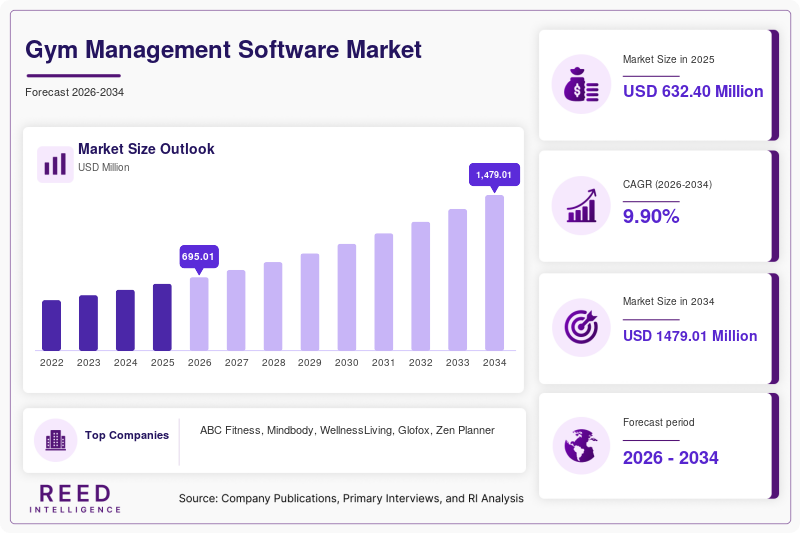
The global gym management software market size was valued at USD 632.40 million in 2025 and is projected to grow from USD 694.99 million in 2026 to USD 1,479.01 million by 2034, registering a CAGR of 9.90% during the forecast period from 2026 to 2034.
The gym management software market is developing around the operational digitization of fitness businesses. Operators increasingly require software that connects membership management with scheduling, payments, lead management, customer communications, reporting and facility access. The value proposition therefore extends from administrative efficiency to the management of member acquisition, retention and recurring revenue.
Cloud deployment is becoming particularly relevant because gyms and fitness franchises need centralized access to information across locations. Multi-location operators can use a common platform to standardize membership rules, pricing, reporting and customer experiences while allowing individual facilities to manage day-to-day activities.
Gym Management Software Market Drivers
AI Automation Is Expanding the Role of Gym Management Platforms
Gym software is increasingly being used to automate activities that previously required front-desk employees, sales teams or managers. AI can handle lead qualification, missed-call follow-up, appointment and class scheduling, customer questions and recurring communications, allowing software to participate directly in revenue-generating workflows.
ABC Fitness acquired Replify in July 2026 to add agentic AI capabilities covering voice, text, email and chat communications, including lead capture, qualification, tour booking and missed-call follow-up.
This changes the purchasing rationale for gym software. Operators can evaluate platforms based not only on administrative functionality but also on how much repetitive customer interaction can be automated. The counterbalance is that AI adoption requires reliable customer data, suitable workflows and appropriate oversight for sensitive membership and payment interactions.
Multi-Location Fitness Businesses Require Centralized Operations
Franchise networks and multi-location fitness operators need centralized software to maintain consistent pricing, membership rules, reporting, scheduling and customer engagement. As fitness brands expand geographically, decentralized spreadsheets and standalone applications become increasingly difficult to manage.
ABC Fitness's April 2026 partnership with Body Fit Training demonstrates this requirement. BFT selected ABC Glofox to support operations across its expanding franchise network, with the platform intended to standardize operations and member engagement across locations.
The mechanism creates recurring demand for cloud-based management systems capable of supporting multiple facilities from one operating environment. Franchise-oriented functionality such as centralized reporting, role-based permissions, standardized workflows and location-level controls therefore becomes an important competitive factor.
Integration With Payments, Access and Fitness Technology
Gym-management software increasingly functions as the central layer connecting multiple technologies used by fitness facilities. Scheduling, payments, access control, fitness equipment, customer applications and marketing platforms can be integrated into one ecosystem.
WellnessLiving's integration network includes Google booking, ClassPass, Wellhub, Zoom and Brivo access control, illustrating how gym software is extending beyond conventional membership administration.
Integration creates switching costs because the management platform becomes embedded in multiple operational workflows. However, fragmented APIs, legacy systems and inconsistent data structures can increase implementation complexity for operators with existing technology stacks.
Gym Management Software Market Restraints
Subscription and Implementation Costs for Smaller Gyms
Small independent gyms often operate with limited administrative resources and relatively narrow technology budgets. Moving from spreadsheets or basic membership systems to an integrated software platform can introduce subscription, implementation, training and migration expenses.
The financial burden is particularly relevant when a facility does not require advanced automation or complex reporting. Vendors therefore need to demonstrate value through measurable reductions in administrative work, improved payment collection, stronger member engagement or better lead conversion.
Cloud-based subscription models can lower upfront infrastructure expenditure, but recurring software fees remain an ongoing operating cost. This can encourage smaller facilities to adopt modular packages rather than comprehensive enterprise platforms.
Data Migration and Integration Complexity
Gym operators frequently use multiple systems for payments, access control, scheduling, customer communications and fitness equipment. Replacing one core platform can therefore require historical data migration and integration with systems that the operator cannot immediately replace.
This creates operational risk during implementation. Incorrect membership records, billing information or access permissions can directly affect customer experience. Vendors increasingly address this issue through APIs, integration marketplaces and implementation services, but the complexity remains higher for multi-location businesses with heterogeneous legacy systems.
Gym Management Software Market Opportunities
Agentic AI for Sales, Retention and Front-Desk Operations
AI-enabled automation provides an opportunity to convert gym-management software from a passive database into an active operating system. Agents can respond to inquiries, qualify prospects, schedule tours, manage bookings and initiate retention-related communications without requiring staff intervention for every interaction.
WellnessLiving's July 2026 CAASI launch illustrates this development. Its AI chat and phone agents can answer questions, complete bookings, process purchases, handle cancellations and manage customer inquiries continuously.
The commercial opportunity extends across independent gyms and larger fitness chains. Smaller operators can obtain automated front-desk capabilities without maintaining a large administrative team, while larger operators can use automation to standardize customer interactions across locations.
Integrated Platforms for Franchise and Multi-Brand Fitness Networks
Fitness businesses are increasingly expanding through franchises, specialized studios and multi-brand platforms. This creates demand for software capable of supporting different facility concepts while retaining centralized administrative control.
In August 2026, Fitura Brands selected ABC Fitness to provide a unified software environment across Padel SWT, Core Precinct and ContrasTheory, including booking functionality and franchise-oriented operational support.
The opportunity extends beyond traditional gyms into Pilates, racket sports, recovery, strength training and hybrid wellness facilities. Vendors capable of adapting a common platform to different membership structures, booking models and facility formats can address a broader portion of the fitness-services ecosystem.
Segmental Analysis
By Type
Cloud-Based Is the Largest Segment
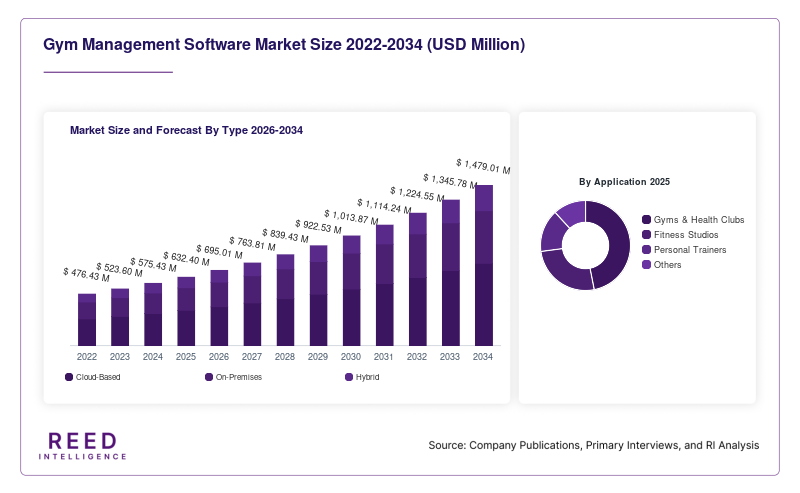
Cloud-based gym management software accounts for approximately 58.0% market share, making it the dominant deployment type. Its position is supported by lower infrastructure requirements, remote accessibility, automatic software updates and suitability for multi-location operations.
Cloud platforms allow gym owners and managers to access membership, scheduling, payment and reporting information from different locations while maintaining centralized databases. This is particularly valuable for franchise organizations where headquarters need visibility into individual facility performance.
Cloud deployment also facilitates third-party integrations. Platforms can connect payment providers, access-control systems, marketing applications, consumer marketplaces and fitness technologies without requiring each gym to maintain separate infrastructure.
The principal limitation is dependence on internet connectivity and vendor-managed infrastructure. Data-security requirements and concerns about vendor lock-in can also affect purchasing decisions among larger organizations.
Hybrid Deployment Is Expanding Faster Because Operators Need Flexibility
Hybrid deployment is projected to record the fastest growth among major deployment types, with a 11.1% CAGR during 2026–2034. Hybrid systems allow fitness businesses to retain selected local infrastructure while using cloud services for analytics, customer applications, integrations and centralized management.
This approach can be relevant for established health clubs with legacy systems that cannot be immediately replaced. It enables gradual modernization without requiring complete migration in a single implementation cycle.
On-premises software represents approximately 18.0% market share and is projected to grow at a 5.8% CAGR, primarily among organizations with specific infrastructure-control requirements. Cloud-based platforms account for the remaining dominant share and are projected to grow at a 9.8% CAGR.
By Application
Gyms & Health Clubs Are the Largest Application
Gyms & Health Clubs account for approximately 49.0% market share. These facilities typically require broad functionality covering membership contracts, recurring payments, class scheduling, attendance, access control, staff management and customer communication.
The breadth of operational requirements makes integrated management software particularly relevant. Larger facilities can also benefit from centralized reporting and automated workflows that allow managers to monitor member activity and financial performance across multiple departments or locations.
Fitness Studios Are Expanding Faster Because Specialized Workflows Require Integrated Scheduling
Fitness Studios are projected to record the fastest growth among application segments, with a 11.4% CAGR during 2026–2034. Studios often operate around scheduled classes, instructor availability, recurring memberships and capacity-constrained sessions, making automated booking and customer communication highly relevant.
The expansion of boutique fitness concepts and specialized formats such as Pilates, strength training and recovery services further increases the need for configurable scheduling and membership systems.
Gyms & Health Clubs account for approximately 49.0% share with a 9.1% CAGR, while Personal Trainers represent approximately 18.0% share and are projected to grow at a 10.3% CAGR. Other applications represent approximately 11.0% share, with a 7.5% CAGR.
Gym Management Software Market Regional Analysis
North America Gym Management Software Market
North America represents the dominant regional market with approximately 35.0% market share. The region benefits from high software adoption among gyms and health clubs, established fitness chains, mature cloud infrastructure and a large ecosystem of specialized fitness-technology providers.
The United States is the principal regional market, with software increasingly embedded across membership management, billing, marketing, access control and customer engagement. ABC Fitness states that its software is used by 40% of U.S. clubs, demonstrating the established role of specialized technology providers in the regional fitness ecosystem.
AI is becoming an important source of product differentiation. ABC Fitness expanded its AI infrastructure in March 2026, while Mindbody's current gym software includes AI Concierge functionality designed to respond to inquiries and support bookings.
The region's mature competitive environment creates pressure for vendors to demonstrate measurable operational value. At the same time, the presence of large fitness chains and franchise networks supports demand for centralized management, analytics and integration capabilities.
Europe Gym Management Software Market
Europe is projected to record an 8.9% CAGR during 2026–2034. The region contains established gym and health-club markets alongside rapidly expanding boutique fitness and wellness concepts.
Software adoption is supported by the need to manage memberships, payments, scheduling and customer engagement across geographically distributed facilities. European fitness businesses also increasingly require integrations with consumer booking platforms and digital payment infrastructure.
ABC Fitness's partnership ecosystem includes technologies designed to connect fitness operators with broader consumer and fitness services, while WellnessLiving supports integrations with platforms such as ClassPass, Wellhub and Google booking.
Data protection and payment-security requirements remain important purchasing considerations. Vendors serving European operators therefore need to demonstrate compliance, secure data handling and transparent integration practices.
Asia Pacific Gym Management Software Market
Asia Pacific is projected to be the fastest-growing region, recording a 12.0% CAGR through 2034. Growth is supported by expanding organized fitness businesses, rising digital adoption, new boutique fitness formats and the increasing professionalization of gym operations.
China, Japan, South Korea, India and Australia represent important regional markets, while Southeast Asia provides additional expansion opportunities as fitness businesses adopt digital membership and booking systems.
The region's growth mechanism is strongly connected to mobile-first customer engagement. Members increasingly expect mobile booking, digital payments, automated communications and self-service access, encouraging operators to adopt integrated software rather than standalone desktop systems.
The principal constraints include fragmented markets, differences in payment infrastructure and varying levels of technology maturity among independent operators. Vendors that offer localized interfaces, flexible pricing and integrations with regional payment and booking systems can address these differences.
Middle East and Africa Gym Management Software Market
The Middle East and Africa region is projected to grow at a 10.6% CAGR during 2026–2034. The expansion of organized fitness facilities, premium health clubs and franchise-based fitness concepts is increasing demand for digital operational infrastructure.
The Gulf markets provide an important center for premium fitness facilities, where operators require membership management, mobile engagement, booking and access-control capabilities. Software that connects these functions can reduce manual administration and provide centralized visibility for multi-location operators.
Africa presents a more fragmented opportunity, with adoption influenced by connectivity, pricing and the availability of local implementation support. Cloud deployment can reduce infrastructure requirements, although operators remain sensitive to recurring subscription costs.
Latin America Gym Management Software Market
Latin America is projected to register a 10.1% CAGR. Brazil and Mexico represent important regional markets, supported by large urban fitness populations and the expansion of organized gym and studio formats.
Cloud-based systems can be particularly relevant because they allow operators to access software without maintaining extensive local IT infrastructure. Mobile booking, recurring payments and automated customer communications are also becoming more important as fitness businesses seek to professionalize operations.
The region remains exposed to currency volatility and differences in digital-payment adoption. Vendors can address these issues through localized payment integrations, flexible subscription structures and scalable packages designed for smaller operators.

Competitive Landscape
The gym management software market is characterized by specialized fitness-technology companies competing alongside broader wellness-management platforms. Competition is increasingly centered on integrated functionality, AI automation, ecosystem connectivity, franchise capabilities and member-facing digital experiences.
ABC Fitness has positioned its platform around a broad operating ecosystem covering member management, payments, engagement, coaching and AI-enabled workflows. Its acquisition of Replify in July 2026 expanded its ability to automate communications, lead qualification and booking workflows.
Key Market Players
- ABC Fitness
- Mindbody
- WellnessLiving
- Glofox
- Zen Planner
- GymMaster
- PushPress
- Virtuagym
- TeamUp
- Gymdesk
- Exercise.com
- ClubReady
Gym Management Software Market Recent Market Developments
July 2026- ABC Fitness acquired Replify, an agentic AI platform designed for fitness-business communications. The acquisition adds AI capabilities covering voice, text, email and chat, including lead capture, qualification, tour booking, class-scheduling support and missed-call follow-up. The transaction strengthens ABC Fitness's ability to embed AI directly into gym-management workflows.
July 2026- WellnessLiving announced the general availability of CAASI Chat Agent and CAASI Phone Agent. The AI front-desk system can answer customer questions, complete bookings, process purchases, manage cancellations and handle inquiries without continuous staff intervention. The development expands automation from back-office management into direct member and prospect interactions.
Gym Management Software Market Segments
By Type
- Cloud-Based
- On-Premises
- Hybrid
By Application
- Gyms & Health Clubs
- Fitness Studios
- Personal Trainers
- Others
By Region
- North America
- Europe
- APAC
- Middle East and Africa
- LATAM