Gymnastic Equipment Market Size, Share & Demand Report By Product Type (Mats and Landing Systems, Balance Beams, Uneven Bars and Parallel Bars), By Application (Training Institutes and Sports Academies, Schools and Universities), By Distribution Channel (Specialty Sports Stores, Online Retail, Direct Sales), By End User (Educational Institutions, Sports Clubs, Professional Athletes) By Region & Segment Forecasts, 2026–2034
USD 3950
Market Overview
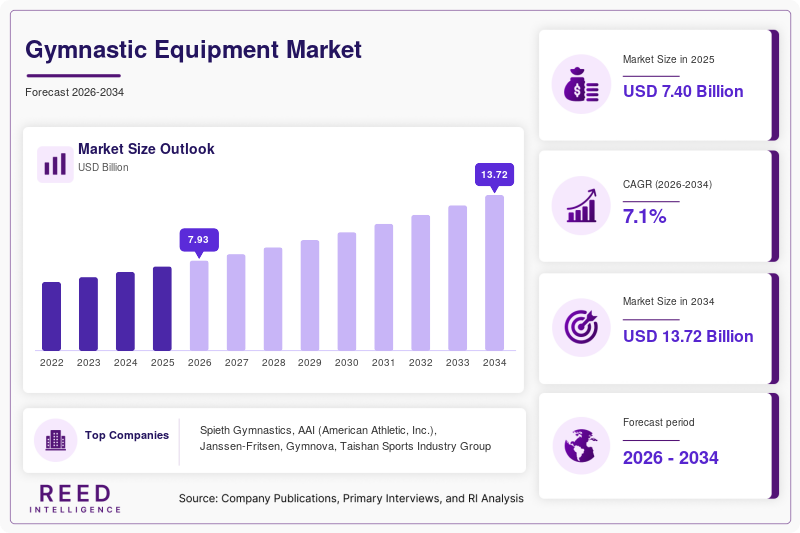
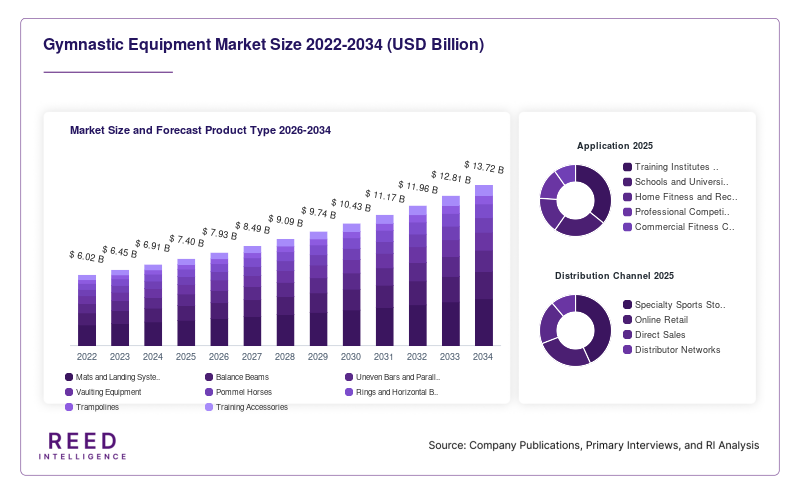
The Gymnastic Equipment Market size was valued at USD 7.4 billion in 2026 and is projected to reach USD 12.8 billion by 2034, expanding at a CAGR of 7.1% during the forecast period from 2026 to 2034. The global Gymnastic Equipment Market growth was supported by rising investments in sports infrastructure development across schools, training academies, universities, and recreational fitness centers. Increasing awareness regarding physical fitness, youth athletic participation, and professional gymnastics competitions contributed to the demand for advanced gymnastic equipment worldwide.
Government-backed sports promotion initiatives and international sporting events also accelerated the adoption of high-performance gymnastic apparatus in both developed and emerging economies. The growing popularity of gymnastics as a competitive and recreational activity encouraged sports clubs and educational institutions to upgrade training facilities with safer and technologically advanced equipment. Manufacturers increasingly focused on durable materials, lightweight construction, and shock-absorbing features to improve athlete safety and training efficiency.
Key Highlights
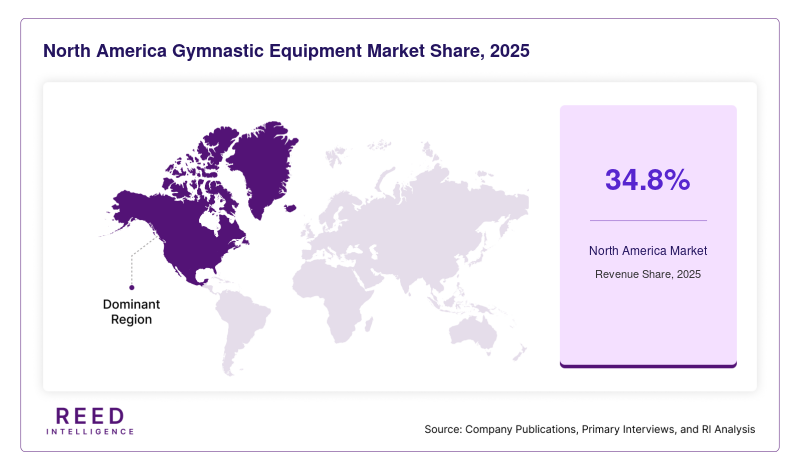
- North America accounted for 34.8% of the global Gymnastic Equipment Market share in 2025, while Asia Pacific is projected to register the fastest CAGR of 8.3% during 2026–2034.
- By product type, mats and landing systems held the largest market share of 28.4% in 2025, whereas balance beams are projected to grow at a CAGR of 8.1% during the forecast period.
- By application, training institutes and sports academies dominated with a 39.6% share in 2025, while home fitness and recreational usage is anticipated to expand at a CAGR of 8.5%.
- By distribution channel, specialty sports stores accounted for 41.2% of the market share in 2025, whereas online retail channels are forecast to grow at a CAGR of 9.1%.
- The U.S. Gymnastic Equipment Market was valued at USD 1.68 billion in 2024 and reached USD 1.79 billion in 2025.
Market Trends
Integration of Smart Training Technologies
The Gymnastic Equipment Market is witnessing increasing adoption of smart training technologies integrated into professional gymnastic apparatus. Sensors, motion analysis systems, and performance tracking tools are being incorporated into training equipment to help coaches monitor athlete movements and improve performance accuracy. Training facilities increasingly use data-driven feedback systems to reduce injury risks and optimize athlete conditioning. This trend is encouraging manufacturers to develop connected gymnastic equipment compatible with digital coaching platforms.
Growing Demand for Portable and Modular Equipment
Portable and modular gymnastic equipment solutions are gaining popularity among schools, home users, and temporary sports facilities. Consumers prefer lightweight and foldable equipment that can be easily stored and transported. Multi-functional systems designed for compact indoor environments are becoming increasingly common. Manufacturers are introducing adjustable training systems that can accommodate different age groups and skill levels, supporting broader participation in gymnastics and fitness training.
Market Drivers
Expansion of Youth Sports Participation Programs
The increasing number of youth sports participation programs globally is driving the Gymnastic Equipment Market growth. Educational institutions and local sports organizations are investing in gymnastics infrastructure to encourage physical development and athletic training among children and teenagers. Public and private funding for youth sports programs continues to support the installation of modern gymnastic equipment in schools and community sports centers.
Rising Commercial Fitness Center Investments
Commercial fitness operators are increasingly incorporating gymnastics-based functional fitness programs into their service offerings. Training formats that combine flexibility, balance, and bodyweight exercises are becoming more popular among consumers seeking alternative fitness routines. This trend is driving demand for training bars, mats, rings, and vaulting equipment in fitness clubs and sports rehabilitation centers.
Market Restraint
High Installation and Maintenance Costs
The high cost associated with professional-grade gymnastic equipment installation and maintenance remains a major restraint for the Gymnastic Equipment Market. Advanced apparatus often require specialized flooring systems, safety padding, and periodic inspections, which increase operational expenses for schools and smaller training facilities. Budget constraints in developing regions may limit widespread adoption of premium equipment solutions.
Market Opportunities
Growth of Home-Based Athletic Training
The increasing popularity of home fitness and personalized athletic training is creating new opportunities for the Gymnastic Equipment Market. Consumers are investing in compact gymnastic bars, mats, and flexibility training systems suitable for residential use. Manufacturers are introducing beginner-friendly and child-safe equipment designed for home environments, expanding the addressable consumer base.
Emergence of Sports Tourism and Competitive Events
The expansion of international gymnastics tournaments and regional sports tourism activities is expected to create growth opportunities for equipment suppliers. New sports complexes and training venues require modern gymnastic infrastructure to host competitive events and athlete training camps. Countries investing in international sporting events are expected to increase procurement of certified gymnastic equipment during the forecast period.
Segmental Analysis
By Product Type
Mats and Landing Systems
Mats and landing systems accounted for the largest share of 28.4% in the Gymnastic Equipment Market in 2025. Their dominance was attributed to mandatory safety requirements across gymnastics training and competition environments. High demand from schools, sports academies, and recreational fitness centers supported consistent sales of protective mats and cushioning systems.
Balance Beams
Balance beams are projected to register the fastest CAGR of 8.1% during 2026–2034. The segment growth will be supported by increasing female participation in artistic gymnastics and rising investments in competitive gymnastics programs. Manufacturers are expected to develop adjustable and portable balance beam systems designed for beginner and professional training applications.
By Application
Training Institutes and Sports Academies
Training institutes and sports academies dominated the Gymnastic Equipment Market with a 39.6% share in 2025. The segment benefited from increasing enrollment in structured gymnastics training programs and professional coaching facilities. Demand for competition-grade apparatus remained high across established training centers.
Home Fitness and Recreational Usage
Home fitness and recreational usage is expected to witness the fastest CAGR of 8.5% during the forecast period. Rising consumer interest in indoor physical activities and child-friendly fitness products will support segment growth. Compact and foldable gymnastic training systems are anticipated to gain popularity among residential users.
By Distribution Channel
Specialty Sports Stores
Specialty sports stores held the largest market share of 41.2% in 2025. Consumers preferred these retail channels due to access to expert guidance, equipment demonstrations, and customized product recommendations. Professional athletes and institutions relied on specialty retailers for certified gymnastic equipment purchases.
Online Retail
Online retail channels are projected to expand at the fastest CAGR of 9.1% during 2026–2034. E-commerce platforms will benefit from wider product availability, competitive pricing, and home delivery convenience. Digital marketing strategies and virtual product demonstrations are expected to strengthen online sales growth.
By End User
Educational Institutions
Educational institutions accounted for the largest share of the Gymnastic Equipment Market in 2025. Schools and universities increasingly incorporated gymnastics into physical education and athletic training programs. Government-supported sports education initiatives contributed to equipment procurement growth.
Commercial Fitness Centers
Commercial fitness centers are anticipated to grow at a CAGR of 7.9% during the forecast period. The segment expansion will be driven by growing demand for functional training and bodyweight exercise programs. Fitness operators are expected to increase investments in gymnastics-inspired training equipment to diversify service offerings.
Regional Analysis
North America
North America held 34.8% of the global Gymnastic Equipment Market share in 2025 and is expected to grow at a CAGR of 6.7% during 2026–2034. The regional market benefited from established sports infrastructure and strong participation in school athletics and professional gymnastics competitions. The United States dominated the regional market due to increasing investments in collegiate athletic programs and private gymnastics training facilities. Rising consumer spending on recreational sports equipment also contributed to regional market growth.
Europe
Europe accounted for 27.1% of the Gymnastic Equipment Market share in 2025 and is projected to expand at a CAGR of 6.5% through 2034. The market growth was supported by structured sports education systems and strong government support for physical activity programs. Germany represented the leading country in the region due to its extensive sports club network and growing demand for advanced training equipment in professional gymnastics centers. Equipment modernization initiatives across public sports facilities further supported market expansion.
Asia Pacific
Asia Pacific represented 23.4% of the global Gymnastic Equipment Market share in 2025 and is forecast to register the fastest CAGR of 8.3% during the forecast period. The region experienced rising participation in school sports and increasing investments in sports infrastructure development. China dominated the regional market due to expanding gymnastics training academies and increasing government support for Olympic sports programs. Rapid urbanization and rising disposable income also supported recreational sports equipment demand.
Middle East & Africa
Middle East & Africa accounted for 7.2% of the Gymnastic Equipment Market share in 2025 and is expected to grow at a CAGR of 6.1% during 2026–2034. The region benefited from increasing investments in indoor sports facilities and youth fitness programs. The United Arab Emirates emerged as the dominant country due to growing sports tourism initiatives and the development of international-standard training complexes. Demand for imported gymnastic equipment increased as sports participation levels continued to rise.
Latin America
Latin America held 7.5% of the Gymnastic Equipment Market share in 2025 and is projected to expand at a CAGR of 6.4% during the forecast period. Brazil dominated the regional market due to increasing public investments in athletic development programs and community sports centers. Rising awareness regarding youth fitness and school sports participation supported demand for training mats, bars, and vaulting systems across the region.
Competitive Landscape
The Gymnastic Equipment Market remains moderately fragmented with the presence of established sports equipment manufacturers and specialized gymnastics apparatus suppliers. Companies compete based on product durability, safety compliance, customization capabilities, and distribution networks. Market participants increasingly focus on lightweight materials, modular designs, and digital training integration to strengthen competitive positioning.
Key Players List
- Spieth Gymnastics
- AAI (American Athletic, Inc.)
- Janssen-Fritsen
- Gymnova
- Taishan Sports Industry Group
- Norbert’s Athletic Products
- Tumbl Trak
- Reisport
- Z Athletic Mats
- MatsMatsMats.com
- Palmer Spring Company
- Eurotramp
- Mancino Manufacturing Co.
- Gym Gear
- Wesing Sports
Recent Developments
- In 2025, Spieth Gymnastics launched a new series of lightweight FIG-certified apparatus designed for international competitions.
- In 2024, Gymnova expanded its manufacturing capacity to support increasing demand from European sports academies.
- In 2025, Tumbl Trak introduced foldable home gymnastics training systems targeting residential consumers.
- In 2024, Taishan Sports Industry Group supplied advanced gymnastics equipment for newly constructed sports facilities in Asia.
- In 2025, AAI partnered with collegiate athletic programs in North America to develop customized training equipment solutions.
- In 2024, Eurotramp introduced upgraded trampoline systems with improved impact absorption technology.
- In 2025, Janssen-Fritsen launched modular gymnastics training stations for youth athletic development programs.
Gymnastic Equipment Market Segments
Product Type
- Mats and Landing Systems
- Balance Beams
- Uneven Bars and Parallel Bars
- Vaulting Equipment
- Pommel Horses
- Rings and Horizontal Bars
- Trampolines
- Training Accessories
Application
- Training Institutes and Sports Academies
- Schools and Universities
- Home Fitness and Recreational Usage
- Professional Competitions
- Commercial Fitness Centers
Distribution Channel
- Specialty Sports Stores
- Online Retail
- Direct Sales
- Distributor Networks
End User
- Educational Institutions
- Sports Clubs
- Professional Athletes
- Commercial Fitness Facilities
- Residential Users
By Region
- North America
- Europe
- APAC
- Middle East and Africa
- LATAM