Gypsum Free Lactic Acid Market Size, Share & Demand Report By Grade (Food Grade, Pharmaceutical Grade, Industrial Grade, Polymer Grade), By Production Method (Fermentation, Chemical Synthesis, Membrane Separation), By Application (Food & Beverages, Pharmaceuticals, Personal Care, Bioplastics, Industrial Applications), By End-Use Industry (Food Industry, Healthcare, Packaging, Cosmetics, Chemical Industry), By Region & Segment Forecasts, 2025–2034
USD 3950
Market Overview
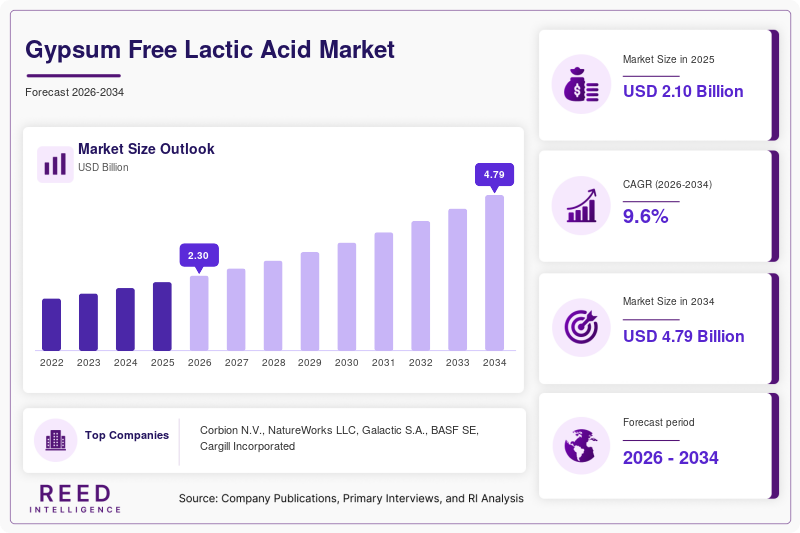
The global Gypsum Free Lactic Acid Market size was valued at approximately USD 2.1 billion in 2025 and is projected to reach USD 4.8 billion by 2034, expanding at a CAGR of 9.6% during the forecast period (2025–2034). The market is experiencing steady expansion due to increasing demand for environmentally sustainable production processes across food, pharmaceutical, and biodegradable polymer industries. Gypsum-free lactic acid production, which eliminates calcium sulfate waste, has gained traction as industries shift toward cleaner and circular manufacturing practices.
A key global factor supporting market growth is the rising emphasis on green chemistry and waste minimization. Governments and environmental bodies are encouraging manufacturers to adopt cleaner production technologies, thereby boosting the adoption of gypsum-free fermentation processes. This shift has particularly influenced producers of polylactic acid (PLA), where sustainable sourcing of lactic acid is becoming a critical requirement.
Key Highlights
- Asia Pacific dominated the market with a 38% share in 2025 and is projected to grow at a CAGR of 10.8%
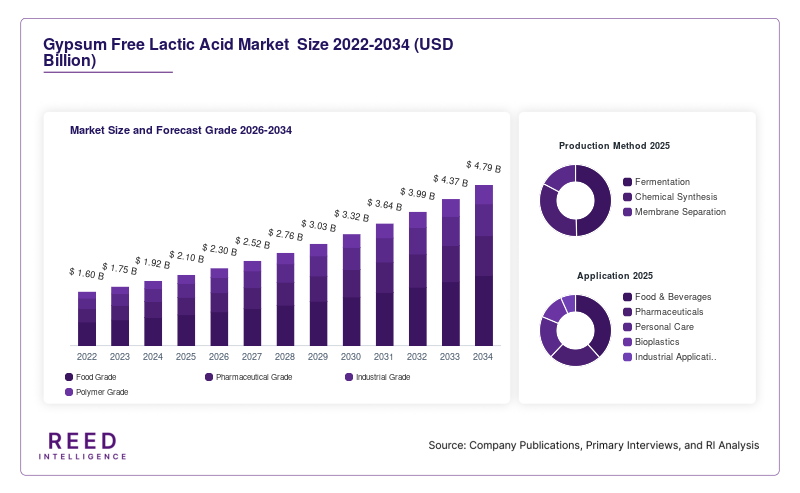
- Food-grade lactic acid was the leading subsegment with a 44% share, while polymer-grade is expected to grow fastest at a CAGR of 11.2%
- Fermentation-based production dominated with a 71% share; membrane separation technology is projected to be the fastest-growing at a CAGR of 10.5%
- China remained the dominant country, with market values of USD 620 million in 2025 and USD 680 million in 2026
Market Trends
Adoption of Sustainable Production Technologies
Manufacturers are increasingly adopting gypsum-free production processes to eliminate solid waste generation associated with conventional lactic acid production. Technologies such as membrane filtration, ion exchange, and direct fermentation have gained prominence. These innovations reduce environmental impact while improving production efficiency, making them attractive for large-scale industrial adoption.
Growing Demand from Bioplastics Industry
The increasing demand for biodegradable plastics, particularly polylactic acid (PLA), is shaping the market. Gypsum-free lactic acid is preferred for PLA production due to its purity and sustainability profile. As global regulations tighten around single-use plastics, industries are transitioning toward eco-friendly alternatives, driving demand for high-quality lactic acid derived from cleaner processes.
Market Drivers
Rising Demand for Eco-Friendly Chemicals
The global push toward sustainability has significantly increased demand for environmentally friendly chemicals. Gypsum-free lactic acid production eliminates hazardous waste, making it a preferred option for industries aiming to reduce their environmental footprint. Regulatory support and corporate sustainability goals are further accelerating this transition.
Expansion of Food and Beverage Industry
Lactic acid is widely used as an acidulant, preservative, and flavoring agent in food and beverages. With increasing consumption of processed and packaged foods, the demand for high-purity lactic acid is rising. Gypsum-free production methods ensure better quality and compliance with stringent food safety standards, further driving adoption.
Market Restraint
High Initial Capital Investment
The adoption of gypsum-free lactic acid production technologies requires significant capital investment in advanced equipment such as membrane filtration systems and bioreactors. Small and medium-scale manufacturers often face financial constraints in upgrading existing facilities. Additionally, operational complexities and the need for skilled personnel further increase the overall cost burden. These factors may limit widespread adoption, particularly in developing regions where cost sensitivity remains high.
Market Opportunities
Growth in Biodegradable Plastics
The increasing use of biodegradable plastics presents a significant opportunity for gypsum-free lactic acid producers. As industries move toward sustainable packaging solutions, the demand for PLA is expected to rise, thereby driving the need for high-quality lactic acid produced through eco-friendly processes.
Technological Advancements in Fermentation
Continuous innovations in microbial fermentation and downstream processing technologies are creating opportunities for cost reduction and efficiency improvement. Advanced strains and optimized production processes can enhance yield and reduce production costs, making gypsum-free lactic acid more accessible to a broader range of industries.
Segmental Analysis
By Grade
Food-grade lactic acid dominated the market in 2025, accounting for 44% of the total share. This dominance was attributed to its extensive use in food preservation, flavor enhancement, and pH regulation across processed food products.
Polymer-grade lactic acid will be the fastest-growing segment, with a projected CAGR of 11.2%. Its growth will be driven by increasing demand for PLA in packaging and textiles. The shift toward biodegradable materials will significantly boost this segment.
By Production Method
Fermentation-based production held the largest share of 71% in 2025 due to its widespread adoption and cost-effectiveness. This method allows for large-scale production with relatively high yields.
Membrane separation technology will grow at the fastest CAGR of 10.5% as it offers improved efficiency and eliminates gypsum waste. The ability to produce high-purity lactic acid with minimal environmental impact will drive its adoption.
By Application
The food & beverages segment dominated with a 39% share in 2025, driven by the extensive use of lactic acid as an acidulant and preservative.
Bioplastics will be the fastest-growing application segment, with a CAGR of 11.8%. Increasing environmental concerns and regulatory restrictions on plastic use will drive demand for biodegradable alternatives.
By End-Use Industry
The food industry accounted for the largest share in 2025 due to consistent demand for lactic acid in various applications.
The packaging industry will grow at the fastest rate, supported by rising demand for sustainable packaging solutions. The shift toward eco-friendly materials will significantly influence this segment.
Regional Analysis
North America
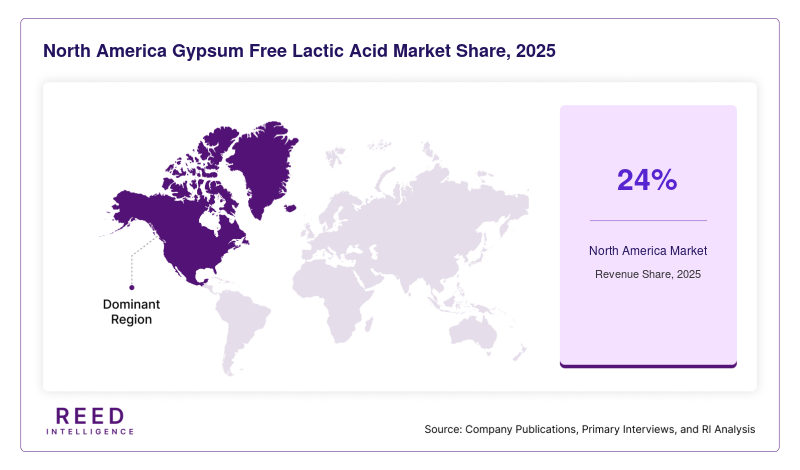
North America accounted for approximately 24% of the global market share in 2025 and will grow at a CAGR of 8.7% during the forecast period. The region’s growth will be driven by stringent environmental regulations and increasing demand for sustainable chemicals.
The United States dominated the regional market due to strong demand from the food and biodegradable plastics sectors. The country’s focus on reducing industrial waste and promoting green chemistry has supported the adoption of gypsum-free production technologies.
Europe
Europe held a 22% market share in 2025 and is projected to grow at a CAGR of 9.1% through 2034. The region will experience growth due to strict environmental policies and strong demand for bio-based products.
Germany emerged as the dominant country, supported by its advanced chemical manufacturing sector. The country’s emphasis on sustainable production and circular economy initiatives has driven the adoption of gypsum-free lactic acid.
Asia Pacific
Asia Pacific led the global market with a 38% share in 2025 and is expected to grow at a CAGR of 10.8%. Rapid industrialization and increasing demand for biodegradable plastics will fuel market expansion.
China dominated the region due to large-scale production capabilities and growing demand from packaging and food industries. Government support for eco-friendly manufacturing practices has further accelerated market growth.
Middle East & Africa
The Middle East & Africa accounted for 8% of the market share in 2025 and will grow at a CAGR of 8.3%. The region’s growth will be supported by increasing investments in sustainable chemical production.
Saudi Arabia led the region, driven by diversification efforts in the chemical sector. The country’s focus on reducing dependence on conventional petrochemicals has encouraged the adoption of bio-based alternatives.
Latin America
Latin America held an 8% share in 2025 and is projected to grow at a CAGR of 8.9%. Growing awareness of sustainable products and increasing industrial activities will support market growth.
Brazil dominated the region due to its strong agricultural base, which provides raw materials for lactic acid production. The availability of feedstock and rising demand for biodegradable materials have driven market expansion.
Competitive Landscape
The Gypsum Free Lactic Acid Market is moderately fragmented, with key players focusing on technological advancements and capacity expansion. The market leader, Corbion N.V., has strengthened its position through investments in sustainable production technologies and strategic partnerships. The company recently expanded its PLA production capacity to meet rising demand.
Other major players are actively investing in research and development to enhance production efficiency and reduce costs. Companies are also focusing on expanding their global presence through mergers and acquisitions, as well as collaborations with end-use industries.
Key Players
- Corbion N.V.
- NatureWorks LLC
- Galactic S.A.
- BASF SE
- Cargill Incorporated
- Henan Jindan Lactic Acid Technology Co. Ltd.
- Jungbunzlauer Suisse AG
- Musashino Chemical Laboratory Ltd.
- Sulzer Ltd.
- Danimer Scientific
- Futerro S.A.
- Shenzhen Esun Industrial Co. Ltd.
- Vaishnavi Bio Tech International Ltd.
- Foodchem International Corporation
- Vigon International Inc.
Recent Developments
- Corbion expanded its lactic acid production facility to increase capacity for PLA applications
- NatureWorks announced a new plant focused on sustainable lactic acid production
- BASF invested in bio-based chemical research to enhance product sustainability
- Cargill partnered with biotechnology firms to improve fermentation efficiency
- Galactic introduced advanced purification technology for gypsum-free lactic acid production
Gypsum Free Lactic Acid Market Segments
Grade
- Food Grade
- Pharmaceutical Grade
- Industrial Grade
- Polymer Grade
Production Method
- Fermentation
- Chemical Synthesis
- Membrane Separation
Application
- Food & Beverages
- Pharmaceuticals
- Personal Care
- Bioplastics
- Industrial Applications
End-Use Industry
- Food Industry
- Healthcare
- Packaging
- Cosmetics
- Chemical Industry
By Region
- North America
- Europe
- APAC
- Middle East and Africa
- LATAM