Hacksaw Blade Market Size, Share & Demand Report By Type (High Carbon Steel, Bi-Metal, Carbide-Tipped), By Application (Metal Cutting, Wood Cutting, Plastic Cutting), By End-Use (Industrial, Commercial, Residential) & Segment Forecasts, 2025–2034
USD 3950
Market Overview
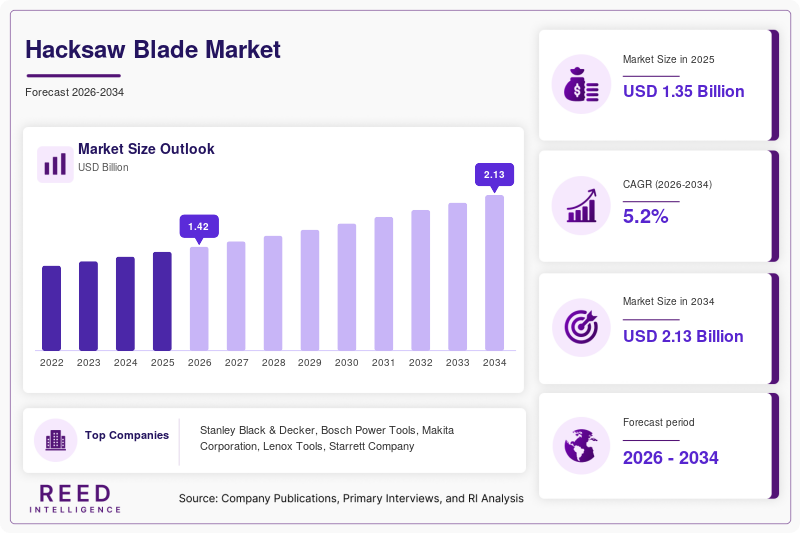
The Hacksaw Blade Market size is witnessing steady expansion driven by increasing industrial activity, construction growth, and rising demand for precision cutting tools across manufacturing sectors. In 2025, the global hacksaw blade market size is estimated at USD 1.35 billion, and it is projected to reach approximately USD 1.42 billion in 2026. Over the forecast period from 2025 to 2034, the market is expected to grow at a compound annual growth rate (CAGR) of 5.2%, reaching around USD 2.10 billion by 2034.
Hacksaw blades are essential cutting tools used in metalworking, woodworking, plumbing, and construction applications. The market is supported by consistent demand from both professional industries and DIY consumers. Growth is largely influenced by the expansion of infrastructure projects and the increasing adoption of durable and high-performance blade materials such as bi-metal and carbide-tipped variants.
Key Highlights
- Market size valued at USD 1.35 billion in 2025
- Expected to reach USD 2.10 billion by 2034
- CAGR of 5.2% from 2025 to 2034
- Construction and automotive sectors are major demand drivers
- Increasing adoption of bi-metal and carbide blades
Market Trends
Increasing Adoption of Bi-Metal and Advanced Material Blades
The hacksaw blade market is experiencing a shift toward advanced materials such as bi-metal and carbide-tipped blades. These blades offer enhanced durability, flexibility, and cutting efficiency compared to traditional high-carbon steel blades. Industries are increasingly adopting these advanced blades to reduce operational downtime and improve productivity. Bi-metal blades, which combine a flexible backing with hardened teeth, are particularly preferred in metalworking and industrial fabrication. This trend is further supported by advancements in manufacturing technologies, enabling precise tooth configurations and improved heat resistance. As a result, end users are willing to invest in higher-cost blades that deliver longer service life and consistent performance.
Growing Demand from DIY and Home Improvement Segment
The rise in DIY culture and home improvement activities is contributing to steady demand for hacksaw blades in the consumer segment. Increased awareness through digital platforms and online tutorials has encouraged individuals to undertake small repair and construction projects independently. Retail and e-commerce channels have made hacksaw tools and replacement blades more accessible, driving sales among non-professional users. Manufacturers are responding by offering user-friendly, multi-purpose blades designed for versatility and ease of use. This trend is especially visible in urban regions where homeowners prefer cost-effective maintenance solutions, thereby expanding the market beyond traditional industrial applications.
Market Drivers
Expansion of Construction and Infrastructure Projects
The global expansion of construction activities is a key driver for the hacksaw blade market. Governments and private investors are heavily investing in infrastructure projects such as roads, bridges, residential buildings, and industrial facilities. These projects require extensive use of metal and plastic cutting tools, where hacksaw blades play a critical role. The increasing need for precise and efficient cutting solutions in construction operations supports consistent demand. Additionally, renovation and remodeling activities in developed regions further contribute to blade consumption. The continuous growth of smart cities and urban infrastructure projects ensures sustained demand across multiple application areas.
Growth of Automotive and Metal Fabrication Industries
The automotive and metal fabrication sectors are major contributors to the hacksaw blade market. These industries require precise cutting tools for shaping, trimming, and assembling components. Hacksaw blades are widely used in workshops and manufacturing units for cutting metals such as steel, aluminum, and alloys. The increasing production of vehicles and machinery globally is driving the demand for high-performance cutting tools. Furthermore, the shift toward lightweight materials in automotive manufacturing requires specialized blades capable of handling diverse materials. This ongoing industrial expansion supports long-term market growth.
Market Restraint
Competition from Power Tools and Automated Cutting Solutions
One of the key restraints affecting the hacksaw blade market is the increasing adoption of power tools and automated cutting technologies. Electric saws, band saws, and CNC cutting machines offer faster and more precise cutting capabilities compared to manual hacksaw blades. These tools are widely used in large-scale industrial applications, reducing reliance on traditional hand tools. As industries focus on efficiency and productivity, the preference for automated solutions continues to grow.
This shift poses a challenge for hacksaw blade manufacturers, particularly in developed regions where automation adoption is high. For example, metal fabrication plants are increasingly replacing manual cutting processes with high-speed machinery, limiting the use of hacksaw blades to minor or specialized tasks. However, the impact is partially mitigated by the continued demand in small workshops, remote construction sites, and DIY applications where power tools may not be practical. Despite this, the growing penetration of affordable power tools remains a limiting factor for market expansion.
Market Opportunities
Growth in Emerging Economies
Emerging economies present significant growth opportunities for the hacksaw blade market. Rapid industrialization, urbanization, and infrastructure development in countries across Asia, Africa, and Latin America are driving demand for construction tools. Small and medium enterprises in these regions rely heavily on cost-effective manual tools, including hacksaw blades. Additionally, government initiatives supporting manufacturing and infrastructure development are creating favorable market conditions. The increasing availability of affordable tools through local distributors and online platforms further enhances market penetration. Manufacturers focusing on low-cost yet durable products can capitalize on this growing demand.
Product Innovation and Customization
Continuous product innovation offers substantial growth potential in the hacksaw blade market. Manufacturers are investing in research and development to enhance blade performance, including improved tooth design, coating technologies, and material composition. Customization options tailored to specific applications, such as cutting stainless steel or composite materials, are gaining traction. These innovations help address diverse customer needs and improve operational efficiency. Additionally, eco-friendly manufacturing processes and recyclable materials are emerging as important considerations, providing opportunities for companies to differentiate their offerings and attract environmentally conscious consumers.
Segmental Analysis
By Type
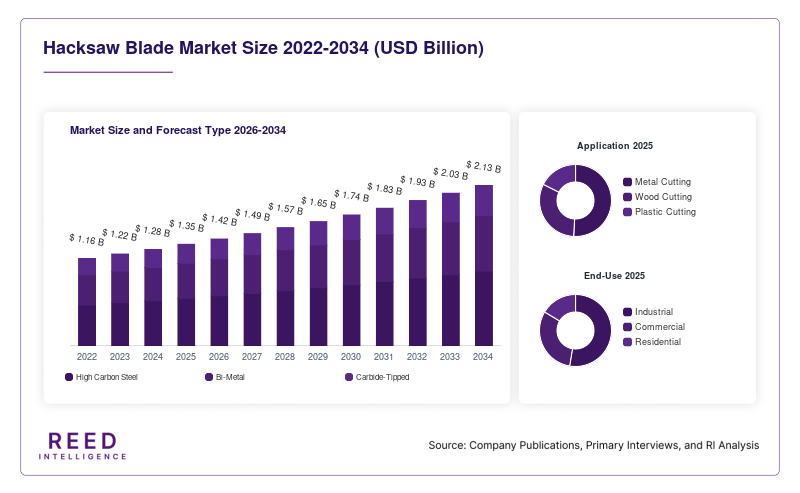
The bi-metal hacksaw blade segment dominated the market in 2024, accounting for approximately 48% of the total share. These blades are widely preferred due to their superior flexibility, durability, and resistance to wear. Bi-metal blades combine high-speed steel teeth with a flexible backing, making them suitable for cutting a variety of materials. Their longer lifespan reduces replacement frequency, which appeals to industrial users seeking cost efficiency.
The carbide-tipped blade segment is expected to be the fastest-growing, with a CAGR of 6.8% during the forecast period. These blades offer exceptional hardness and are suitable for cutting tough materials such as stainless steel and alloys. Increasing demand for high-performance tools in industrial applications is driving growth in this segment.
By Application
The metal cutting segment held the largest share in 2024, accounting for around 55% of the market. Hacksaw blades are extensively used in metalworking applications, including fabrication, maintenance, and repair. The demand is driven by the need for precise and efficient cutting solutions in industrial operations.
The plastic cutting segment is projected to grow at the fastest rate, with a CAGR of 5.9%. The increasing use of plastic materials in construction and manufacturing is driving demand for specialized blades designed for clean and accurate cuts. This growth is supported by advancements in blade design and material technology.
By End-Use
The industrial segment dominated the market in 2024, contributing approximately 60% of the total share. Industries such as construction, automotive, and manufacturing rely heavily on hacksaw blades for various cutting applications. The demand is driven by large-scale operations and the need for reliable tools.
The residential segment is expected to grow at the fastest CAGR of 5.5%. The increasing popularity of DIY activities and home improvement projects is driving demand for hacksaw blades among individual consumers. Easy availability through retail and online channels further supports growth in this segment.
Regional Analysis
North America
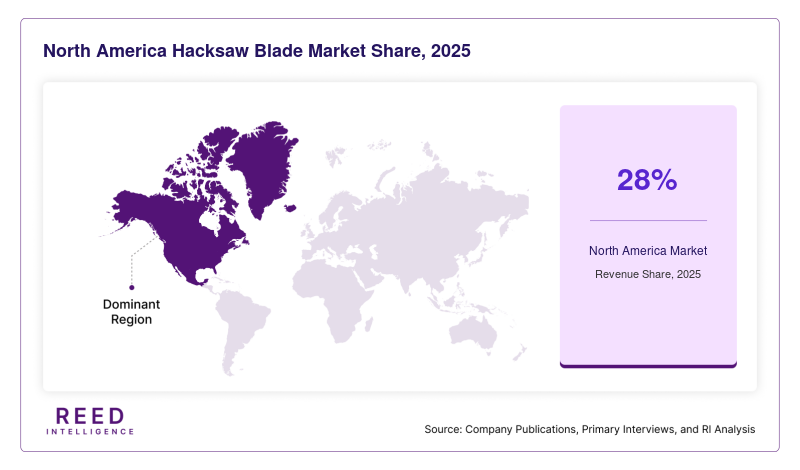
North America accounted for a significant share of the hacksaw blade market in 2025, contributing approximately 28% of the global revenue. The region is expected to grow at a CAGR of 4.6% during the forecast period. Demand is driven by established industrial sectors, including automotive, aerospace, and construction. The presence of advanced manufacturing facilities and a strong focus on quality tools support steady market growth.
The United States dominates the regional market due to its robust industrial base and high demand for precision tools. A unique growth factor in this region is the increasing adoption of high-performance blades in maintenance and repair operations. Industries prioritize durable tools to reduce downtime, which drives the demand for advanced hacksaw blade variants.
Europe
Europe held around 24% market share in 2025 and is projected to grow at a CAGR of 4.4% through 2034. The region’s market is supported by strong manufacturing and engineering industries. Countries in Western Europe emphasize quality standards and precision tools, which contributes to steady demand for hacksaw blades.
Germany is the dominant country in the European market, driven by its advanced manufacturing sector. A unique growth factor is the focus on sustainability and eco-friendly tool production. Manufacturers are adopting environmentally responsible processes, which is influencing purchasing decisions and shaping market trends.
Asia Pacific
Asia Pacific is the fastest-growing region, accounting for approximately 32% of the global market share in 2025 and expected to grow at a CAGR of 6.5%. Rapid industrialization, urbanization, and infrastructure development are key drivers in this region. The growing manufacturing sector further boosts demand for cutting tools.
China leads the Asia Pacific market due to its large-scale industrial production. A unique growth factor is the expansion of small and medium enterprises, which rely heavily on cost-effective manual tools. This widespread usage supports strong demand for hacksaw blades across various applications.
Middle East & Africa
The Middle East & Africa region accounted for around 8% of the market share in 2025 and is projected to grow at a CAGR of 5.0%. Infrastructure development and construction activities are key contributors to market growth. The demand for durable and efficient cutting tools is increasing in line with regional development projects.
Saudi Arabia is a leading market in this region, driven by large-scale infrastructure investments. A unique growth factor is the expansion of oil and gas projects, which require specialized cutting tools for maintenance and installation, thereby supporting demand for hacksaw blades.
Latin America
Latin America held approximately 8% market share in 2025 and is expected to grow at a CAGR of 4.8%. The market is supported by construction and industrial activities across the region. Economic development and urbanization are contributing to steady demand for cutting tools.
Brazil dominates the Latin American market due to its large construction sector. A unique growth factor is the increasing focus on local manufacturing, which drives demand for affordable and reliable tools, including hacksaw blades.
Competitive Landscape
The hacksaw blade market is moderately fragmented, with several global and regional players competing based on product quality, pricing, and innovation. Key companies are focusing on expanding their product portfolios and improving blade performance through advanced materials and manufacturing techniques.
A leading player in the market is Stanley Black & Decker, known for its wide range of cutting tools and strong distribution network. The company continues to invest in research and development to enhance product durability and efficiency. Other major players are adopting strategies such as mergers, acquisitions, and partnerships to strengthen their market position.
Recent developments include the introduction of coated blades with improved wear resistance and the expansion of product lines targeting specific applications. Companies are also leveraging e-commerce platforms to reach a broader customer base and improve accessibility.
Key Players List
- Stanley Black & Decker
- Bosch Power Tools
- Makita Corporation
- Lenox Tools
- Starrett Company
- Bahco
- DeWalt
- Irwin Tools
- Milwaukee Tool
- Eclipse Tools
- Olson Saw Company
- Klein Tools
- Disston Tools
- Tajima Tool Corporation
- Wiha Tools
Recent Developments
-
Introduction of bi-metal blades with enhanced tooth geometry for improved cutting efficiency
-
Expansion of distribution networks through online platforms by major manufacturers
-
Development of eco-friendly blade coatings to reduce environmental impact
Hacksaw Blade Market Segments
Type
- High Carbon Steel
- Bi-Metal
- Carbide-Tipped
Application
- Metal Cutting
- Wood Cutting
- Plastic Cutting
End-Use
- Industrial
- Commercial
- Residential
By Region
- North America
- Europe
- APAC
- Middle East and Africa
- LATAM