Hadron Therapy Market Size, Share & Demand Report By Type (Proton Therapy, Carbon Ion Therapy), By Application (Cancer Treatment, Non-Cancer Applications), By End-Use (Hospitals, Specialty Cancer Centers, Research Institutions), By Region & Segment Forecasts, 2025–2034
USD 3950
Market Overview
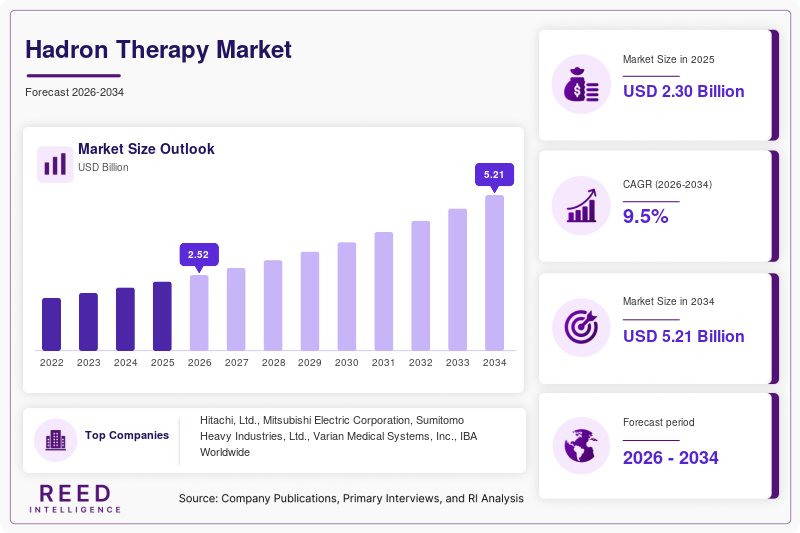
The Hadron Therapy Market size is estimated at approximately USD 2.3 billion, with projections indicating growth to USD 2.6 billion in 2026. By 2034, the market is forecasted to reach around USD 5.9 billion, expanding at a compound annual growth rate (CAGR) of 9.5% during the forecast period (2025–2034). This growth reflects increasing adoption of precision-based cancer treatment modalities and rising investments in oncology infrastructure worldwide.
Hadron therapy, including proton and carbon ion therapy, offers highly targeted radiation delivery with minimal damage to surrounding tissues. This characteristic is especially beneficial for treating pediatric cancers, tumors near critical organs, and radioresistant malignancies. The growing global cancer burden is a major factor supporting demand, as healthcare providers seek effective and less invasive treatment options. In addition, favorable clinical outcomes and reduced side effects compared to conventional radiation therapy are encouraging wider adoption.
Key Highlights
- Market size is projected to grow from USD 2.3 billion in 2025 to USD 5.9 billion by 2034, reflecting strong expansion driven by increasing adoption of advanced cancer treatment technologies and improved healthcare infrastructure globally.
- The market is expected to register a CAGR of 9.5% during the forecast period (2025–2034), supported by continuous technological advancements and rising demand for precise and effective radiation therapy solutions.
- Rising demand for precision oncology treatments is significantly driving market growth, as healthcare providers increasingly prefer targeted therapies that minimize damage to healthy tissues and improve patient outcomes.
- Increasing investments in advanced radiation therapy infrastructure are enabling the establishment of new treatment centers, particularly in developing regions, thereby enhancing accessibility to hadron therapy services.
Market Trends
Increasing Adoption of Proton Therapy Systems
Proton therapy is emerging as a dominant trend within the Hadron Therapy Market due to its precise dose distribution and reduced toxicity profile. Healthcare providers are increasingly adopting proton therapy systems to treat cancers located near sensitive organs such as the brain, spinal cord, and eyes. The trend is further supported by advancements in compact proton therapy systems, which require less space and lower capital investment compared to traditional installations. As a result, more mid-sized hospitals are entering the market, expanding access to this technology. In addition, favorable reimbursement policies in developed regions are contributing to higher patient volumes and encouraging facility expansion.
Integration of AI and Imaging Technologies
Another key trend shaping the Hadron Therapy Market is the integration of artificial intelligence and advanced imaging technologies into treatment planning and delivery. AI-driven systems are improving tumor targeting accuracy by analyzing imaging data and optimizing radiation dose distribution. This integration enhances treatment precision and reduces human error, leading to better clinical outcomes. Furthermore, real-time imaging technologies are enabling adaptive therapy, where treatment plans are adjusted based on patient response. This trend is expected to improve treatment efficiency and reduce overall therapy time, making hadron therapy more viable for a broader patient population.
Market Drivers
Rising Global Cancer Incidence
The increasing prevalence of cancer worldwide is a primary driver of the Hadron Therapy Market. As the number of cancer cases continues to rise, there is a growing demand for advanced treatment options that offer higher success rates and fewer side effects. Hadron therapy provides superior targeting capabilities compared to conventional radiation therapy, making it suitable for complex and hard-to-treat tumors. This advantage is particularly important in pediatric oncology, where minimizing long-term side effects is critical. Healthcare systems are responding to this demand by investing in advanced oncology facilities, thereby boosting market growth.
Technological Advancements in Radiation Therapy
Continuous innovation in radiation therapy technologies is another key factor driving market expansion. Developments in particle accelerators, beam delivery systems, and imaging technologies are improving the efficiency and effectiveness of hadron therapy. Modern systems are designed to be more compact and cost-efficient, reducing installation and operational costs. These advancements are enabling more healthcare institutions to adopt hadron therapy, thereby increasing market penetration. Additionally, improved treatment planning software is enhancing precision and reducing treatment times, further supporting the adoption of this technology across various healthcare settings.
Market Restraint
High Capital Investment and Operational Costs
One of the major restraints in the Hadron Therapy Market is the high cost associated with establishing and maintaining treatment facilities. The installation of proton or carbon ion therapy systems requires significant capital investment, often exceeding USD 100 million per facility. In addition to initial setup costs, ongoing maintenance, staffing, and operational expenses further increase the financial burden. This limits adoption to large hospitals and specialized cancer centers, particularly in developed regions. For example, smaller healthcare institutions in developing countries often lack the financial resources to invest in such advanced technologies. As a result, market growth is constrained by limited accessibility and affordability, especially in low- and middle-income regions.
Market Opportunities
Expansion in Emerging Markets
Emerging economies present significant growth opportunities for the Hadron Therapy Market. Countries in Asia Pacific, Latin America, and the Middle East are investing heavily in healthcare infrastructure to address the rising burden of cancer. Governments and private investors are collaborating to establish advanced cancer treatment centers equipped with hadron therapy systems. These initiatives are supported by increasing healthcare spending and growing awareness of advanced treatment options. As infrastructure improves, these regions are expected to witness higher adoption rates, contributing to overall market expansion.
Development of Compact and Cost-Effective Systems
The development of compact and cost-effective hadron therapy systems is creating new opportunities for market growth. Manufacturers are focusing on reducing the size and complexity of equipment, making it more accessible to a wider range of healthcare facilities. These innovations are lowering the entry barriers for hospitals and enabling the adoption of hadron therapy in smaller settings. Additionally, modular system designs allow for scalable installations, providing flexibility for healthcare providers. This trend is expected to drive market growth by expanding the potential customer base and increasing global accessibility.
Segmental Analysis
By Type
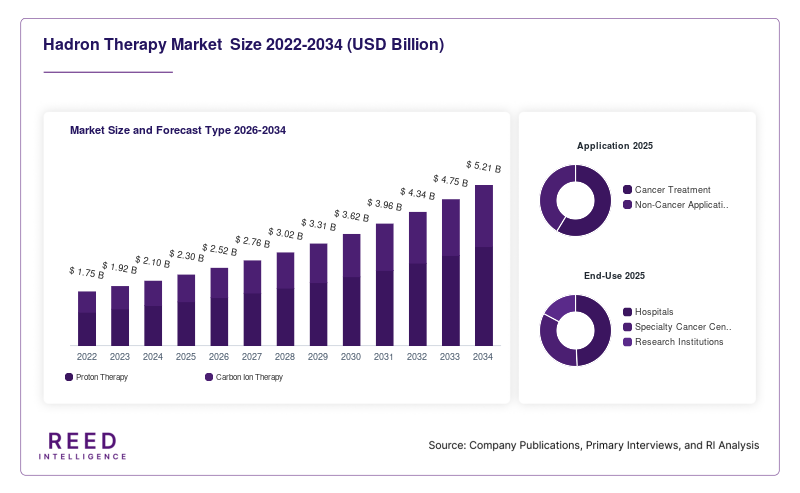
The proton therapy segment dominated the Hadron Therapy Market in 2024, accounting for approximately 68% of the total market share. This dominance is attributed to its widespread adoption and proven clinical effectiveness in treating various types of cancer. Proton therapy offers precise dose delivery with minimal damage to surrounding tissues, making it suitable for sensitive cases such as pediatric tumors. The availability of established treatment centers and favorable reimbursement policies further support its leading position in the market. Additionally, continuous technological advancements are improving the efficiency and accessibility of proton therapy systems.
The carbon ion therapy segment is expected to be the fastest-growing subsegment, with a CAGR of 11.5% during the forecast period. This growth is driven by its superior biological effectiveness in treating radioresistant tumors. Carbon ion therapy provides higher energy transfer, resulting in increased tumor cell destruction. The growing number of research studies and clinical trials demonstrating its effectiveness is encouraging adoption. Additionally, increasing investments in carbon ion therapy facilities, particularly in Asia Pacific and Europe, are supporting the growth of this segment.
By Application
The cancer treatment segment dominated the market in 2024, holding a share of approximately 85%. This dominance is due to the primary use of hadron therapy in oncology, particularly for complex and hard-to-treat tumors. The increasing global cancer burden is driving demand for advanced treatment options. Hadron therapy’s ability to deliver precise radiation doses while minimizing side effects makes it a preferred choice for many healthcare providers. The segment is further supported by ongoing research and development efforts aimed at expanding its applications in cancer treatment.
The non-cancer applications segment is expected to grow at the fastest rate, with a CAGR of 10.8%. This growth is driven by increasing research into the use of hadron therapy for other medical conditions, such as neurological disorders. Emerging studies are exploring its potential in treating conditions that require precise radiation targeting. Additionally, advancements in technology are enabling the development of new applications, expanding the scope of hadron therapy beyond oncology.
By End-Use
Hospitals accounted for the largest share of the Hadron Therapy Market in 2024, with approximately 54% of the total market. This dominance is attributed to the availability of advanced infrastructure and skilled professionals required for hadron therapy. Hospitals are the primary providers of cancer treatment services, making them the main adopters of this technology. The increasing number of hospital-based cancer centers and investments in advanced treatment systems are supporting the growth of this segment.
Specialty cancer centers are expected to be the fastest-growing end-use segment, with a CAGR of 10.6%. These centers focus exclusively on cancer treatment and are increasingly adopting advanced technologies such as hadron therapy. A key growth factor is the rising preference for specialized care, which offers better treatment outcomes and patient experience. Additionally, the establishment of new cancer centers in emerging markets is contributing to the growth of this segment.
Regional Analysis
North America
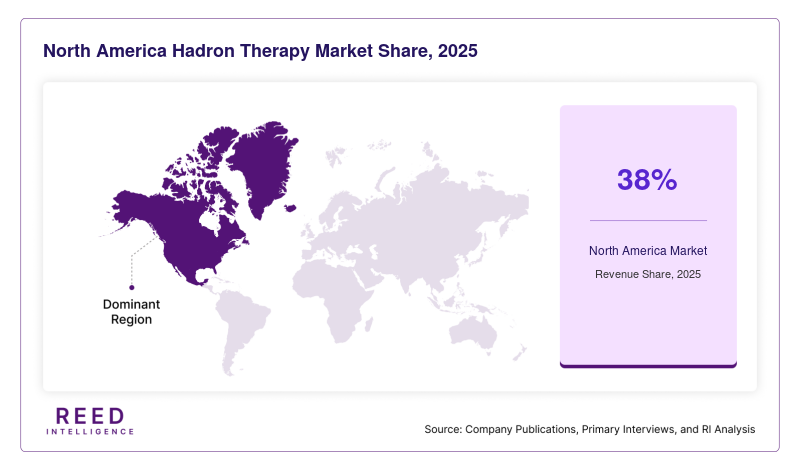
North America held the largest share of the Hadron Therapy Market in 2025, accounting for approximately 38% of global revenue. The region is expected to maintain its dominance, with a CAGR of around 8.7% during the forecast period. This growth is driven by advanced healthcare infrastructure, high adoption of innovative technologies, and strong investment in cancer research. The presence of well-established treatment centers and favorable reimbursement policies further support market expansion in this region.
The United States dominates the North American market due to its extensive network of proton therapy centers and ongoing research initiatives. A key growth factor is the increasing collaboration between academic institutions and healthcare providers to develop advanced treatment protocols. These partnerships are enhancing clinical outcomes and driving the adoption of hadron therapy across the country.
Europe
Europe accounted for approximately 27% of the global Hadron Therapy Market in 2025 and is projected to grow at a CAGR of 9.1%. The region benefits from strong government support and well-established healthcare systems. Investments in research and development, along with increasing awareness of advanced cancer treatments, are contributing to market growth. Several countries are expanding their proton and carbon ion therapy facilities to meet rising demand.
Germany is a leading market in Europe, driven by its advanced medical infrastructure and focus on innovation. A unique growth factor is the integration of hadron therapy into national healthcare systems, supported by government funding. This approach ensures wider access to treatment and promotes the adoption of advanced technologies across the region.
Asia Pacific
Asia Pacific is expected to witness the fastest growth in the Hadron Therapy Market, with a CAGR of 11.2% during the forecast period. The region accounted for approximately 22% of the market share in 2025. Rapid economic development, increasing healthcare expenditure, and rising cancer incidence are key factors driving growth. Governments are actively investing in advanced oncology facilities to improve patient outcomes.
Japan dominates the Asia Pacific market, with a strong presence of carbon ion therapy centers. A unique growth factor is the country’s focus on technological innovation and research in radiation therapy. This emphasis has led to the development of advanced treatment systems and increased adoption across healthcare institutions.
Middle East & Africa
The Middle East & Africa region held a smaller share of around 7% in 2025 but is expected to grow at a CAGR of 10.3%. The market is driven by increasing healthcare investments and efforts to improve cancer treatment infrastructure. Governments are focusing on establishing advanced medical facilities to address the growing burden of cancer in the region.
The United Arab Emirates is a key market in this region, driven by its focus on healthcare modernization. A unique growth factor is the increasing number of public-private partnerships aimed at developing advanced oncology centers. These collaborations are enhancing access to hadron therapy and supporting market growth.
Latin America
Latin America accounted for approximately 6% of the Hadron Therapy Market in 2025 and is projected to grow at a CAGR of 9.8%. The region is witnessing gradual improvements in healthcare infrastructure and increasing awareness of advanced cancer treatments. Investments in medical technology are supporting the development of new treatment facilities.
Brazil is the dominant market in Latin America, supported by its large population and growing healthcare sector. A unique growth factor is the increasing government focus on improving cancer care services. This includes investments in advanced treatment technologies, which are expected to drive market growth in the region.
Competitive Landscape
The Hadron Therapy Market is characterized by a limited number of players due to the high entry barriers and significant capital requirements. Leading companies are focusing on technological innovation, strategic partnerships, and geographic expansion to strengthen their market position. The market is moderately consolidated, with a few key players dominating global operations.
A leading company in the market is Hitachi, Ltd., known for its advanced proton therapy systems and global presence. The company has been actively involved in developing compact and efficient systems to improve accessibility. A recent development includes the launch of a next-generation proton therapy system designed to reduce installation costs and enhance treatment precision. Other major players are also investing in research and development to introduce innovative solutions and expand their product portfolios.
Key Players
- Hitachi, Ltd.
- Mitsubishi Electric Corporation
- Sumitomo Heavy Industries, Ltd.
- Varian Medical Systems, Inc.
- IBA Worldwide
- Mevion Medical Systems
- ProTom International
- Toshiba Energy Systems & Solutions Corporation
- Siemens Healthineers AG
- General Electric Company
- Danfysik A/S
- Advanced Oncotherapy plc
- Ion Beam Applications SA
- Optivus Proton Therapy, Inc.
- Shinva Medical Instrument Co., Ltd.
Recent Developments
- In 2025, a major healthcare provider announced the opening of a new proton therapy center equipped with advanced imaging systems to improve treatment precision.
- In 2026, a leading manufacturer introduced a compact proton therapy system designed for mid-sized hospitals, reducing installation costs significantly.
- In 2025, a collaboration between a research institute and a technology company led to the development of an AI-driven treatment planning system for hadron therapy.
Hadron Therapy Market Segments
Type
- Proton Therapy
- Carbon Ion Therapy
Application
- Cancer Treatment
- Non-Cancer Applications
End-Use
- Hospitals
- Specialty Cancer Centers
- Research Institutions
By Region
- North America
- Europe
- APAC
- Middle East and Africa
- LATAM