Haematococcus Pluvialis Market Size, Share & Demand Report By Form (Powder, Liquid Extract, Oil Suspension), By Application (Nutraceuticals, Cosmetics, Pharmaceuticals, Food & Beverages), By Cultivation Method (Open Pond, Closed Photobioreactor), By End-Use Industry (Dietary Supplements, Aquaculture, Personal Care, Food Industry), By Region & Segment Forecasts, 2025–2034
USD 3950
Market Overview
The Haematococcus Pluvialis Market size was valued at USD 780 million in 2025 and is projected to reach approximately USD 1.68 billion by 2034, expanding at a CAGR of 8.9% during the forecast period (2025–2034). The market growth has been supported by the rising global demand for natural antioxidants, particularly astaxanthin derived from Haematococcus pluvialis, across nutraceutical, cosmetic, and pharmaceutical industries. Increased consumer awareness regarding preventive healthcare and the shift toward plant-based bioactive compounds have further contributed to market expansion.
A key global factor supporting the Haematococcus Pluvialis Market growth has been the transition from synthetic to natural ingredients in dietary supplements and functional foods. Regulatory support for natural carotenoids, combined with growing investments in microalgae cultivation technologies, has strengthened production capabilities and improved supply chain efficiency.
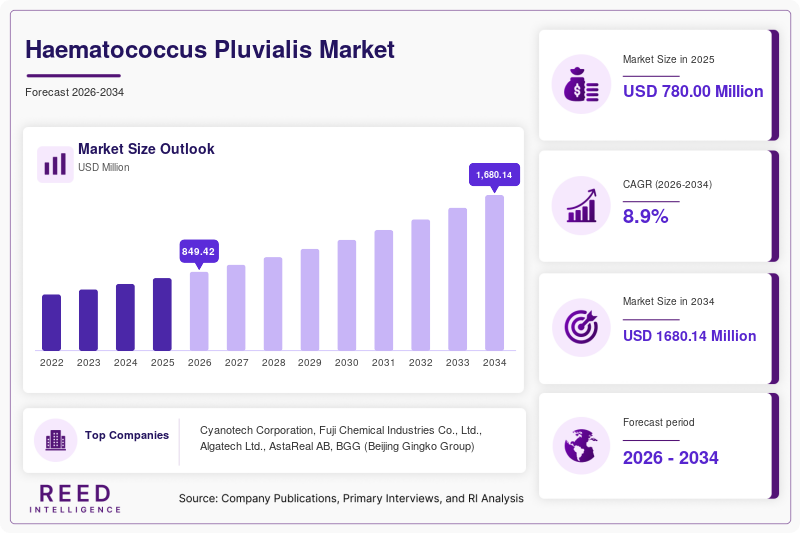
Key Highlights
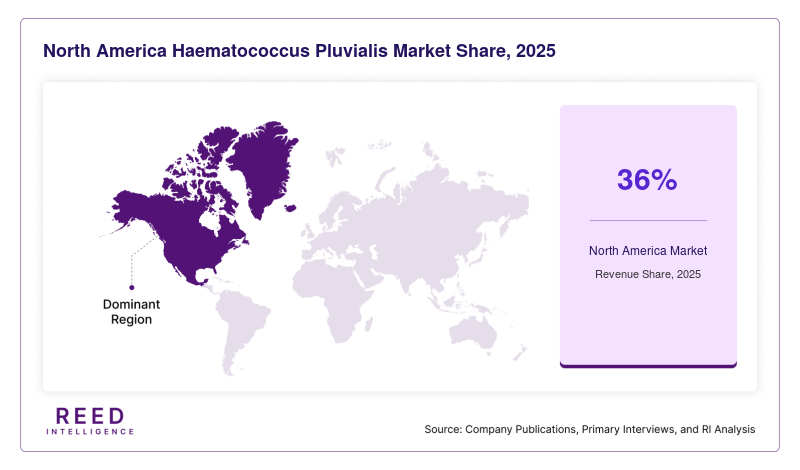
- North America dominated the market with a 36% share in 2025, while Asia Pacific is projected to grow at the fastest CAGR of 10.6%.
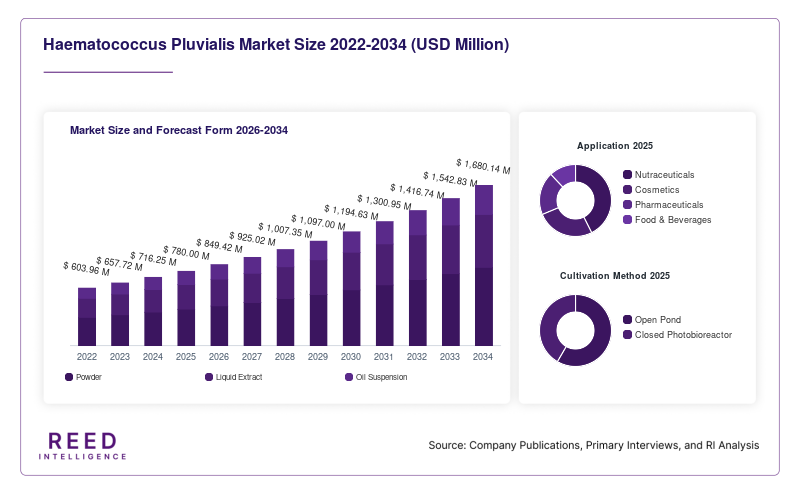
- By application, nutraceuticals led with a 42% share, while cosmetics is expected to register the fastest CAGR of 9.8%.
- By form, powder dominated with 48% share, whereas liquid extract is projected to grow at a CAGR of 9.5%.
- The United States accounted for USD 210 million in 2025 and is estimated to reach USD 228 million in 2026.
Market Trends
Rising Adoption of Natural Astaxanthin in Functional Nutrition
The increasing use of Haematococcus pluvialis as a primary source of natural astaxanthin in functional foods and dietary supplements has been a defining trend in the market. Consumers are actively seeking products that support immunity, eye health, and skin wellness, driving demand for high-purity algae-derived ingredients. Manufacturers are incorporating astaxanthin into beverages, capsules, and fortified foods, expanding product portfolios.
Technological Advancements in Algae Cultivation
Advancements in photobioreactor systems and closed-loop cultivation techniques have significantly improved biomass yield and product quality. These technologies enable controlled environmental conditions, reducing contamination risks and enhancing astaxanthin concentration. As production becomes more efficient, companies are able to scale operations while maintaining cost competitiveness, which positively influences the Haematococcus Pluvialis Market outlook.
Market Drivers
Increasing Demand for Natural Antioxidants
The growing preference for natural antioxidants over synthetic alternatives has driven the demand for Haematococcus pluvialis. Astaxanthin, known for its high antioxidant potency, is widely used in supplements and functional products. Rising health awareness and the prevalence of lifestyle-related disorders have encouraged consumers to adopt preventive healthcare solutions, boosting market growth.
Expanding Applications in Personal Care Industry
The cosmetics industry has increasingly adopted Haematococcus pluvialis extracts due to their anti-aging and skin-protective properties. The demand for clean-label beauty products has encouraged brands to incorporate algae-derived ingredients into skincare formulations. This expansion into high-value cosmetic applications has strengthened revenue streams within the Haematococcus Pluvialis Market.
Market Restraint
High Production Costs and Complex Cultivation Processes
One of the primary challenges in the Haematococcus Pluvialis Market is the high cost associated with cultivation and extraction. Producing high-quality astaxanthin requires controlled environments, specialized equipment, and significant energy input. Open pond systems are prone to contamination, while closed photobioreactors demand high capital investment.
Additionally, the multi-stage cultivation process, including stress induction for astaxanthin accumulation, adds complexity and operational costs. These factors limit market entry for smaller players and can affect product pricing, making it less competitive compared to synthetic alternatives. As a result, cost optimization remains a key challenge for manufacturers.
Market Opportunities
Growth in Plant-Based and Vegan Products
The increasing popularity of plant-based diets has created significant opportunities for algae-derived ingredients. Haematococcus pluvialis fits well into vegan formulations, offering a sustainable and natural source of nutrients. Companies are developing innovative plant-based supplements and functional foods, expanding the application scope of the Haematococcus Pluvialis Market.
Emerging Demand in Aquaculture Feed
The aquaculture industry presents a growing opportunity for Haematococcus pluvialis, particularly as a feed additive to enhance pigmentation and health of fish and shrimp. Natural astaxanthin is preferred over synthetic variants due to its superior bioavailability and safety profile. As global seafood consumption increases, demand for high-quality feed ingredients is expected to rise, creating new growth avenues.
Segmental Analysis
By Form
The powder segment dominated the Haematococcus Pluvialis Market, accounting for 48% share in 2025. Powder form has been widely preferred due to its stability, longer shelf life, and ease of incorporation into capsules, tablets, and functional foods.
The liquid extract segment is expected to grow at the fastest CAGR of 9.5%, driven by its increasing use in beverages and cosmetics. Its higher bioavailability and ease of absorption make it suitable for innovative formulations.
By Application
Nutraceuticals held the largest share at 42% in 2025, supported by the rising consumption of dietary supplements. Astaxanthin derived from Haematococcus pluvialis is widely used for its antioxidant and anti-inflammatory properties.
The cosmetics segment is projected to grow at a CAGR of 9.8%, driven by increasing demand for natural skincare products. Its anti-aging benefits and UV protection properties are expected to boost adoption in premium cosmetic formulations.
By Cultivation Method
Closed photobioreactor systems dominated with a 55% share in 2025, as they offer controlled conditions and higher yield efficiency. These systems have been preferred for producing high-quality astaxanthin.
Open pond cultivation is expected to grow at a CAGR of 8.7%, due to its lower operational costs. Improvements in contamination control techniques are expected to enhance its adoption in large-scale production.
By End-Use Industry
The dietary supplements segment accounted for 40% share in 2025, driven by increasing health consciousness and preventive healthcare practices.
The aquaculture segment is anticipated to grow at a CAGR of 9.2%, supported by the rising demand for natural feed additives that enhance fish pigmentation and health.
Regional Analysis
North America
North America held a 36% share of the Haematococcus Pluvialis Market in 2025 and is expected to grow at a CAGR of 8.2% during the forecast period. The region’s established nutraceutical industry and strong consumer awareness regarding dietary supplements supported its dominant position.
The United States emerged as the leading country, driven by high consumption of functional foods and supplements. The presence of advanced biotechnology infrastructure and strong distribution networks has enabled companies to expand product availability and maintain consistent demand.
Europe
Europe accounted for 28% of the market share in 2025 and is projected to grow at a CAGR of 7.9%. Regulatory support for natural ingredients and increasing demand for clean-label products contributed to regional growth.
Germany led the European market due to its well-developed pharmaceutical and cosmetic industries. The country’s focus on sustainable sourcing and eco-friendly production practices has encouraged the adoption of microalgae-based ingredients.
Asia Pacific
Asia Pacific held 22% of the Haematococcus Pluvialis Market share in 2025 and is expected to register the fastest CAGR of 10.6%. Rapid urbanization, rising disposable income, and growing health awareness have fueled market expansion.
China dominated the region, supported by large-scale algae cultivation facilities and increasing exports of astaxanthin products. Government initiatives promoting biotechnology and aquaculture industries have further strengthened market growth.
Middle East & Africa
The Middle East & Africa accounted for 8% of the market share in 2025 and is anticipated to grow at a CAGR of 7.4%. Increasing demand for dietary supplements and gradual development of the healthcare sector have supported growth.
The United Arab Emirates emerged as a key country, driven by rising consumer interest in wellness products and premium skincare solutions. The expanding retail sector has also facilitated product accessibility.
Latin America
Latin America held 6% of the market share in 2025 and is projected to grow at a CAGR of 7.7%. Growing awareness of natural health products and expanding aquaculture activities have contributed to market growth.
Brazil led the region, supported by increasing demand for functional foods and dietary supplements. The country’s strong agricultural base has enabled the integration of algae-based products into various industries.
Competitive Landscape
The Haematococcus Pluvialis Market is moderately fragmented, with key players focusing on product innovation, strategic partnerships, and capacity expansion. Leading companies are investing in advanced cultivation technologies to improve yield and reduce costs.
A major market leader, Cyanotech Corporation, has strengthened its position by expanding its natural astaxanthin production capacity and introducing new formulations targeting the nutraceutical segment. Other players are focusing on geographic expansion and sustainable production practices to gain competitive advantage.
Key Players
- Cyanotech Corporation
- Fuji Chemical Industries Co., Ltd.
- Algatech Ltd.
- AstaReal AB
- BGG (Beijing Gingko Group)
- Cardax Inc.
- AlgaTechnologies Ltd.
- MicroA AS
- Parry Nutraceuticals
- Jingzhou Natural Astaxanthin Inc.
- Fenchem Biotek Ltd.
- Igene Biotechnology Inc.
- Yunnan Alphy Biotech Co., Ltd.
- Algamo s.r.o.
- Divi’s Laboratories Ltd.
Recent Developments
- In 2024, Cyanotech Corporation expanded its production facility to enhance astaxanthin output capacity.
- In 2023, AstaReal AB launched a new high-purity astaxanthin formulation for clinical nutrition applications.
- In 2024, Fuji Chemical Industries introduced a sustainable algae cultivation initiative to reduce environmental impact.
- In 2023, Algatech Ltd. partnered with global cosmetic brands to develop algae-based skincare solutions.
- In 2024, Parry Nutraceuticals increased its export capabilities to meet growing international demand.
Haematococcus Pluvialis Market Segments
Form
- Powder
- Liquid Extract
- Oil Suspension
Application
- Nutraceuticals
- Cosmetics
- Pharmaceuticals
- Food & Beverages
Cultivation Method
- Open Pond
- Closed Photobioreactor
End-Use Industry
- Dietary Supplements
- Aquaculture
- Personal Care
- Food Industry
By Region
- North America
- Europe
- APAC
- Middle East and Africa
- LATAM