Halogenated Butyl Rubber Market Size, Share, Demand Report by Type (Bromobutyl Rubber, Chlorobutyl Rubber), By Application (Tire Inner Liners, Pharmaceutical Closures, Industrial Products, Adhesives & Sealants, Protective Equipment), By End-Use Industry (Automotive, Healthcare & Pharmaceuticals, Industrial Manufacturing, Construction, Consumer Goods) & Regional Forecasts, 2026–2034
USD 3950
Market Overview
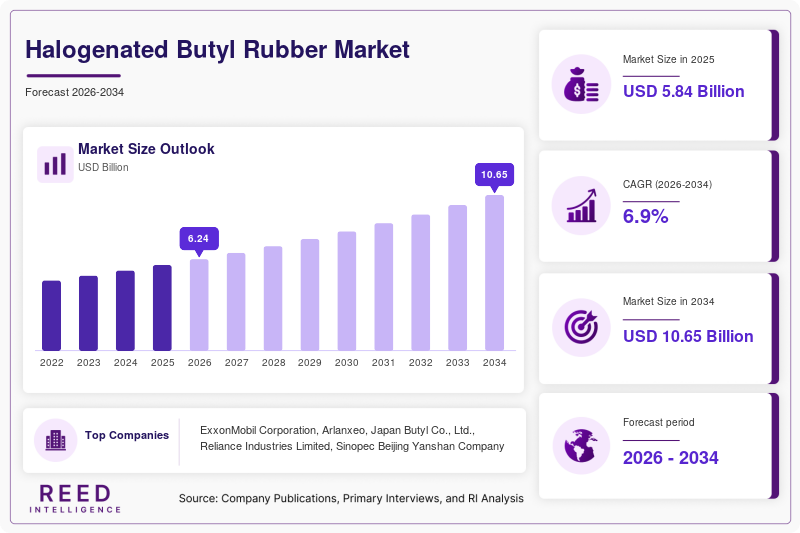
The global Halogenated Butyl Rubber Market size was valued at approximately USD 5.84 billion in 2026 and is projected to reach USD 9.97 billion by 2034, expanding at a CAGR of 6.9% during 2026–2034. Halogenated butyl rubber, including bromobutyl rubber and chlorobutyl rubber, remains a critical material across tire manufacturing, pharmaceutical closures, industrial products, and specialty elastomer applications due to its superior air retention, heat resistance, chemical stability, and sealing performance. Growing demand for durable and high-performance materials in transportation and healthcare sectors continues to support market expansion across both developed and emerging economies.
A major global factor contributing to market growth is the steady increase in vehicle production and replacement tire demand. Modern tire manufacturers increasingly utilize halogenated butyl rubber in inner liners because of its excellent impermeability and resistance to aging. The global transition toward electric vehicles has further strengthened demand, as EV manufacturers seek advanced tire materials capable of supporting higher torque loads, enhanced durability, and reduced rolling resistance. Simultaneously, healthcare applications are expanding due to rising pharmaceutical production and increasing requirements for contamination-resistant packaging solutions.
Key Highlights
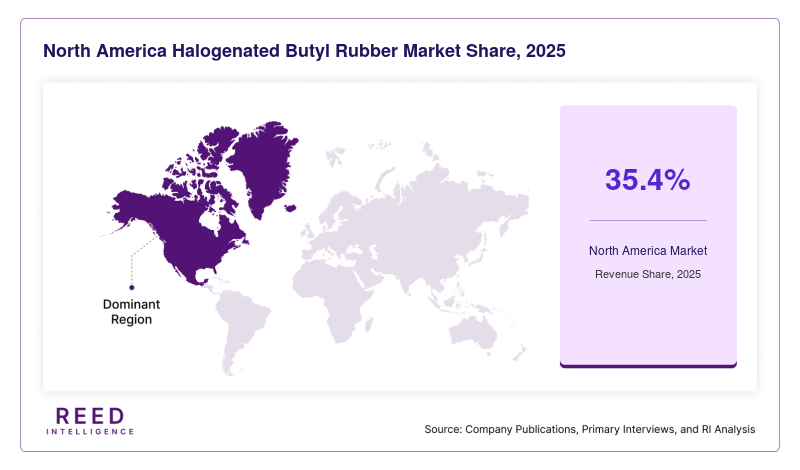
- North America dominated the market with a 35.4% share in 2025, while Asia Pacific is expected to grow at the fastest CAGR of 8.3% during 2026–2034.
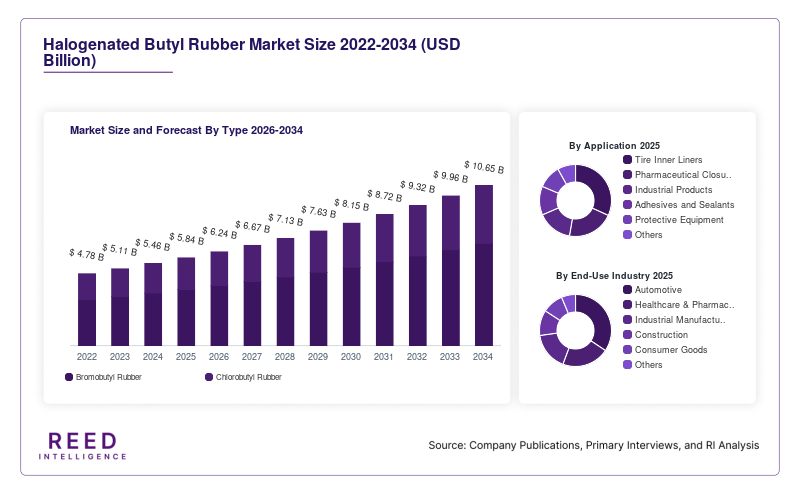
- By Type, Bromobutyl Rubber accounted for the largest share of 63.8%, while Chlorobutyl Rubber is projected to grow at a CAGR of 7.5%.
- By Application, Tire Inner Liners led with a 58.6% share, whereas Pharmaceutical Closures are expected to expand at a CAGR of 8.1%.
- By End-Use Industry, Automotive held the largest share of 61.9%, while Healthcare & Pharmaceuticals is projected to grow at a CAGR of 8.6%.
- The United States remained the dominant country, with market values of USD 1.56 billion in 2024 and USD 1.67 billion in 2025.
Market Trends
Rising Adoption of Electric Vehicle Tire Technologies
The growing adoption of electric vehicles is influencing material selection throughout the automotive supply chain, creating favorable conditions for the Halogenated Butyl Rubber Market. Electric vehicles require specialized tire designs capable of supporting heavier battery systems and delivering improved efficiency. Tire manufacturers increasingly utilize halogenated butyl rubber because of its superior air retention capabilities, which help maintain tire pressure over extended periods. Stable tire pressure contributes to energy efficiency and enhanced driving range, making the material particularly valuable for EV applications. Manufacturers are also incorporating advanced formulations that improve durability and heat resistance, helping address the performance requirements of next-generation mobility solutions. As EV production expands globally, demand for premium elastomer materials is expected to increase steadily.
Expansion of Pharmaceutical Packaging Applications
Another important trend shaping the Halogenated Butyl Rubber Market is the increasing use of high-performance rubber closures in pharmaceutical packaging. Regulatory agencies and healthcare manufacturers continue to prioritize contamination prevention, drug stability, and long-term storage performance. Halogenated butyl rubber offers low permeability, chemical resistance, and excellent sealing characteristics, making it suitable for vaccine vials, injectable medicines, and sensitive biologic products. Pharmaceutical companies are increasingly investing in advanced packaging systems that improve product safety and shelf life. Growth in biotechnology research, vaccine production, and injectable drug manufacturing is further strengthening demand. As healthcare infrastructure expands across emerging economies, pharmaceutical packaging applications are expected to become an increasingly important revenue contributor for market participants.
Market Drivers
Growth in Global Tire Manufacturing Activities
The expansion of global tire manufacturing remains a major growth driver for the Halogenated Butyl Rubber Market. Tire inner liners represent one of the largest applications for halogenated butyl rubber due to the material’s exceptional resistance to air permeability. Automotive manufacturers and tire producers continue to focus on improving fuel efficiency, safety, and durability, all of which depend heavily on maintaining optimal tire pressure. The growth of passenger vehicles, commercial transportation fleets, and replacement tire demand is creating consistent consumption patterns across major regions. Furthermore, stricter vehicle performance standards encourage the adoption of advanced materials capable of supporting long-term operational reliability. These factors collectively strengthen the demand outlook for halogenated butyl rubber products throughout the forecast period.
Increasing Demand from Healthcare and Pharmaceutical Industries
Healthcare and pharmaceutical industries are emerging as significant demand generators within the Halogenated Butyl Rubber Market. The material is widely used in pharmaceutical stoppers, vial closures, and medical packaging systems because of its ability to prevent contamination and maintain product integrity. Rising healthcare expenditures, expanding vaccine production, and growing pharmaceutical manufacturing capacities are creating favorable conditions for market growth. Biopharmaceutical products often require highly specialized packaging materials that can withstand sterilization processes while preserving drug stability. As healthcare providers and regulatory bodies continue to emphasize patient safety and quality assurance, the use of premium elastomer materials is expected to increase. This trend is particularly noticeable in emerging economies where pharmaceutical production investments continue to accelerate.
Market Restraint
Volatility in Raw Material Prices and Supply Chain Pressures
Fluctuations in raw material prices represent a significant challenge for the Halogenated Butyl Rubber Market. The production of halogenated butyl rubber depends on petrochemical feedstocks, which are highly sensitive to changes in crude oil prices, geopolitical developments, transportation costs, and supply-demand imbalances. Sudden increases in feedstock prices can reduce manufacturer profit margins and create uncertainty across procurement strategies. Additionally, supply chain disruptions can affect production schedules, inventory management, and contract fulfillment obligations. Smaller manufacturers often face greater difficulties managing these fluctuations compared to large integrated producers. For example, periods of elevated energy costs and logistics constraints have historically increased production expenses across the synthetic rubber industry. These pressures can limit investment activity and slow market expansion, particularly in regions where cost sensitivity remains high among end users.
Market Opportunities
Development of Sustainable and Recyclable Rubber Solutions
Sustainability initiatives are creating new opportunities within the Halogenated Butyl Rubber Market. Governments, automotive manufacturers, and industrial users are increasingly seeking environmentally responsible materials that support circular economy objectives. Producers are investing in research programs focused on improving recyclability, reducing manufacturing emissions, and enhancing resource efficiency. Advanced recycling technologies are enabling the recovery and reuse of valuable rubber materials while maintaining performance characteristics. As environmental regulations become more stringent, demand for sustainable elastomer solutions is expected to rise. Companies capable of developing low-emission production methods and eco-friendly product formulations may gain competitive advantages. This transition toward sustainability is likely to generate new growth avenues across transportation, industrial manufacturing, and healthcare applications.
Industrial Expansion Across Emerging Economies
Rapid industrialization in emerging markets presents another important opportunity for the Halogenated Butyl Rubber Market. Countries across Asia, Latin America, and parts of the Middle East are investing heavily in infrastructure development, manufacturing facilities, healthcare systems, and transportation networks. These investments support growing demand for industrial rubber products, adhesives, sealants, protective equipment, and automotive components. Rising disposable incomes and urbanization are also contributing to increased vehicle ownership and replacement tire consumption. Local manufacturing expansion encourages domestic sourcing of specialty materials, creating opportunities for both global and regional suppliers. As emerging economies continue to strengthen industrial capabilities and attract foreign investment, demand for high-performance elastomers is expected to experience sustained growth throughout the forecast period.
Segmental Analysis
By Type
Bromobutyl rubber represented the dominant type segment, accounting for approximately 63.8% of market revenue in 2024. Its leadership position is primarily attributed to superior processing characteristics, excellent compatibility with other elastomers, and strong adhesion properties. Tire manufacturers widely prefer bromobutyl rubber for inner liner applications because it provides effective air retention while supporting high-performance tire designs. The material is also used extensively in pharmaceutical closures, industrial products, and specialty rubber goods. Growing automotive production, increasing demand for replacement tires, and ongoing advancements in tire technology continue to strengthen the market position of bromobutyl rubber. Manufacturers are increasingly developing customized formulations to meet application-specific requirements, further reinforcing the segment’s dominance across multiple industries.
Chlorobutyl rubber is expected to emerge as the fastest-growing type segment, registering a CAGR of 7.5% through 2034. Growth is driven by increasing demand for specialized applications requiring enhanced heat resistance, chemical stability, and sterilization compatibility. Pharmaceutical packaging manufacturers frequently utilize chlorobutyl rubber in medical closures and vial stoppers due to its low permeability characteristics. The segment is also benefiting from expanding healthcare investments and increasing biologics production. Continuous product innovation and improvements in manufacturing technologies are enabling broader adoption across industrial and medical sectors. As pharmaceutical quality standards become more stringent, chlorobutyl rubber is expected to experience stronger demand from manufacturers seeking reliable and contamination-resistant packaging solutions.
By Application
Tire inner liners accounted for the largest application segment, contributing approximately 58.6% of total market revenue in 2024. The segment's dominance reflects the critical role of halogenated butyl rubber in maintaining tire pressure and improving overall vehicle performance. Air retention remains a key performance requirement in modern tire design, particularly for passenger vehicles, commercial fleets, and electric vehicles. Tire manufacturers rely on halogenated butyl rubber to enhance durability, reduce maintenance requirements, and support fuel efficiency objectives. Growth in vehicle production and replacement tire demand continues to generate substantial consumption volumes. Furthermore, advancements in tire engineering are increasing the use of premium elastomer materials capable of delivering improved safety and operational reliability.
Pharmaceutical closures are projected to register the fastest CAGR of 8.1% during the forecast period. Rising demand for injectable drugs, vaccines, and biologic therapies is driving significant expansion within this segment. Pharmaceutical companies increasingly require packaging materials capable of maintaining sterility and preventing contamination throughout product lifecycles. Halogenated butyl rubber provides excellent sealing properties and chemical resistance, making it suitable for high-value pharmaceutical applications. Expanding healthcare infrastructure, increasing vaccination programs, and growing investments in biotechnology research are further supporting market growth. As regulatory standards continue evolving, manufacturers are expected to increase adoption of advanced closure systems utilizing high-performance elastomer materials.
By End-Use Industry
The automotive industry dominated the end-use landscape with a market share of approximately 61.9% in 2024. Strong demand for passenger vehicles, commercial transportation, and replacement tires continues to drive consumption of halogenated butyl rubber products. Automotive manufacturers prioritize materials that enhance durability, safety, and operational efficiency. Tire inner liners remain the largest application area within this sector, supported by increasing production volumes and growing adoption of advanced tire technologies. Electric vehicle expansion is creating additional opportunities as manufacturers seek materials capable of supporting specialized performance requirements. Ongoing investments in vehicle manufacturing capacity and transportation infrastructure continue to strengthen the automotive segment's leadership position.
Healthcare and pharmaceuticals are anticipated to record the fastest CAGR of 8.6% through 2034. Increasing production of injectable medicines, vaccines, and biologic therapies is generating substantial demand for high-quality closure systems and packaging materials. Healthcare providers and regulatory agencies emphasize product safety, contamination prevention, and long-term stability, creating favorable conditions for premium elastomer adoption. The segment is also benefiting from rising healthcare expenditures, aging populations, and expanding pharmaceutical manufacturing activities across emerging economies. Continuous innovation in drug delivery systems and pharmaceutical packaging technologies is expected to further accelerate growth. These factors position healthcare and pharmaceuticals as one of the most attractive end-use segments within the market.
Regional Analysis
North America
North America accounted for approximately 35.4% of the global Halogenated Butyl Rubber Market in 2025 and continues to represent the largest regional market. The region is projected to expand at a CAGR of 6.2% through 2034, supported by advanced automotive manufacturing capabilities, established pharmaceutical industries, and strong research activities. Demand remains particularly robust within premium tire manufacturing applications, where producers prioritize air retention performance and durability. Continuous investments in electric vehicle production are also supporting long-term market growth.
The United States remains the dominant country within North America. A key growth factor is the country's extensive electric vehicle ecosystem, which drives demand for advanced tire materials and specialty elastomers. Major tire manufacturers continue investing in production modernization and product innovation. In addition, the presence of leading pharmaceutical manufacturers contributes to sustained consumption of halogenated butyl rubber for vial stoppers, injectable drug packaging, and medical closures.
Europe
Europe represented approximately 27.1% of global market revenue in 2025 and is anticipated to grow at a CAGR of 6.4% during the forecast period. The region benefits from a mature automotive industry, strong regulatory standards, and increasing adoption of sustainable manufacturing practices. Demand for high-performance synthetic rubber products remains stable across Germany, France, Italy, and the United Kingdom. Growing investments in environmentally responsible tire production are further supporting market development.
Germany leads the European market due to its strong automotive manufacturing base and advanced industrial infrastructure. A unique growth factor is the region’s emphasis on sustainable mobility solutions and premium vehicle production. Automotive suppliers increasingly incorporate advanced elastomer materials to meet evolving efficiency and performance requirements. Furthermore, European pharmaceutical companies continue investing in specialized packaging solutions, creating additional demand for high-quality halogenated butyl rubber products.
Asia Pacific
Asia Pacific held approximately 24.8% of the global Halogenated Butyl Rubber Market in 2025 and is expected to register the fastest CAGR of 8.3% through 2034. Rapid industrialization, expanding automotive production, and rising healthcare investments are driving regional growth. Countries throughout the region are increasing manufacturing output while improving domestic supply chains for specialty materials. Growing vehicle ownership rates and replacement tire demand provide a strong foundation for long-term market expansion.
China dominates the Asia Pacific market due to its large-scale automotive manufacturing industry and significant industrial production capacity. One unique growth factor is the country's substantial investment in electric vehicle production and battery manufacturing infrastructure. As vehicle output increases, demand for advanced tire materials continues to rise. Additionally, expanding pharmaceutical manufacturing activities and healthcare modernization programs are creating new opportunities for halogenated butyl rubber suppliers.
Middle East & Africa
The Middle East & Africa region accounted for approximately 6.8% of global market revenue in 2025 and is forecast to grow at a CAGR of 6.7% during 2026–2034. Although smaller than other regions, the market benefits from increasing industrial diversification and infrastructure development initiatives. Governments across the region are encouraging domestic manufacturing capabilities and reducing dependence on imports. Industrial applications, construction activities, and transportation projects contribute to growing demand for specialty elastomer products.
Saudi Arabia remains the dominant country within the region. A key growth factor is the ongoing expansion of petrochemical and industrial manufacturing facilities. These investments support demand for rubber-based components used in industrial equipment, sealing systems, and automotive products. The country's strategic focus on economic diversification is also encouraging investments in downstream industries that consume high-performance synthetic rubber materials.
Latin America
Latin America captured approximately 5.9% of the global Halogenated Butyl Rubber Market in 2025 and is projected to expand at a CAGR of 6.5% through 2034. Market growth is supported by recovering automotive production, infrastructure development, and increasing industrial activity. Manufacturers are gradually modernizing production facilities and improving operational efficiency. Demand for replacement tires and industrial rubber products continues to create stable consumption patterns across several countries in the region.
Brazil leads the Latin American market due to its sizeable automotive sector and growing industrial base. A unique growth factor is the country's expanding agricultural machinery industry, which requires durable tires and rubber components capable of operating in demanding environments. Investments in transportation infrastructure and manufacturing modernization are also contributing to increased demand for halogenated butyl rubber across multiple end-use sectors.
Competitive Landscape
The Halogenated Butyl Rubber Market is moderately consolidated, with global manufacturers competing through product quality, technological innovation, production capacity expansion, and strategic partnerships. Leading companies focus on enhancing polymer performance, improving manufacturing efficiency, and developing sustainable solutions to strengthen market positioning. Investments in research and development remain a key competitive strategy as end users increasingly seek specialized formulations tailored to automotive, healthcare, and industrial applications.
ExxonMobil continues to maintain a leadership position due to its extensive production capabilities, global distribution network, and diversified synthetic rubber portfolio. The company recently expanded efforts toward advanced elastomer technologies designed to improve tire performance and sustainability outcomes. Other major participants are also increasing investments in production modernization and regional expansion initiatives to capture emerging opportunities.
Competition is expected to intensify as demand rises across electric vehicle manufacturing, pharmaceutical packaging, and industrial applications. Companies with strong technical expertise, integrated supply chains, and customer-focused product development capabilities are likely to strengthen their market presence over the forecast period.
Key Players
- ExxonMobil Corporation
- Arlanxeo
- Japan Butyl Co., Ltd.
- Reliance Industries Limited
- Sinopec Beijing Yanshan Company
- PJSC Nizhnekamskneftekhim
- JSR Corporation
- Sibur Holding
- Kumho Petrochemical Co., Ltd.
- LG Chem Ltd.
- Versalis S.p.A.
- China Petrochemical Corporation
- Lanxess AG
- Zeon Corporation
- PetroChina Company Limited
Recent Developments
- In 2025, a major synthetic rubber producer expanded bromobutyl rubber production capacity to support rising global demand from tire manufacturers.
- In 2025, a leading elastomer manufacturer introduced an advanced halogenated butyl rubber grade designed for high-performance electric vehicle tire applications.
- In 2024, a pharmaceutical packaging supplier adopted next-generation chlorobutyl rubber closure technology to improve sterility and product stability.
- In 2024, several rubber manufacturers increased investments in sustainable production technologies aimed at reducing emissions and improving resource efficiency.
Halogenated Butyl Rubber Market Segments
By Type
- Bromobutyl Rubber
- Chlorobutyl Rubber
By Application
- Tire Inner Liners
- Pharmaceutical Closures
- Industrial Products
- Adhesives and Sealants
- Protective Equipment
- Others
By End-Use Industry
- Automotive
- Healthcare & Pharmaceuticals
- Industrial Manufacturing
- Construction
- Consumer Goods
- Others
By Region
- North America
- Europe
- APAC
- Middle East and Africa
- LATAM