Hammer Crusher Market Size, Share & Demand Report By Type (Reversible Hammer Crushers, Non-Reversible Hammer Crushers), By Application (Mining, Cement Manufacturing, Construction Materials), By Capacity (Low-Capacity Hammer Crushers, Medium-Capacity Hammer Crushers), By End-Use Industry (Construction Industry, Mining Industry, Cement Industry) & Regional Forecasts, 2026–2034
USD 3950
Market Overview
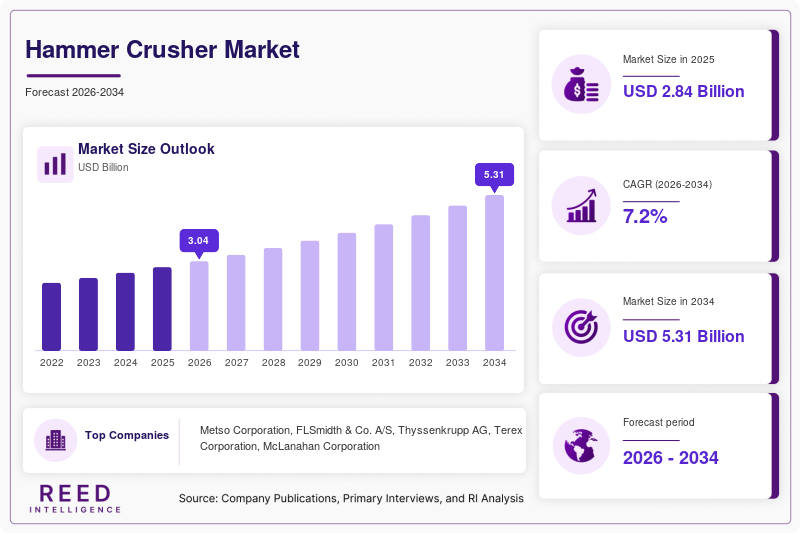
The Hammer Crusher Market was valued at approximately USD 2.84 billion in 2026 and is projected to reach USD 4.97 billion by 2034, expanding at a CAGR of 7.2% during 2026–2034. The market is experiencing stable growth due to increasing mining activities, rapid infrastructure development, and growing demand for efficient crushing equipment across construction, cement, metallurgy, and industrial processing applications. Hammer crushers are widely used for crushing limestone, coal, gypsum, shale, and other medium-hard materials because they offer high crushing efficiency, operational simplicity, and lower maintenance requirements.
One of the major global factors supporting the growth of the Hammer Crusher Market is the ongoing expansion of infrastructure and urban construction projects worldwide. Governments across emerging and developed economies are increasing investments in transportation infrastructure, residential construction, industrial facilities, and energy projects. These activities are significantly increasing demand for aggregates, cement, and processed minerals, thereby supporting the adoption of hammer crushers in mining and construction operations.
Key Highlights
- Asia Pacific dominated the Hammer Crusher Market with a market share of 39.4% in 2025.
- Middle East & Africa is expected to register the fastest growth with a projected CAGR of 8.1% during 2026–2034.
- By type, reversible hammer crushers held the dominant share of 44.8% in 2025.
- By type, ring hammer crushers are projected to grow at a 8.4% CAGR during the forecast period.
- By application, the mining segment accounted for the largest market share in 2025.
- By application, the recycling and waste processing segment is forecast to expand at a 8.6% CAGR through 2034.
- China remained the dominant country with market values of approximately USD 412 million in 2024 and USD 458 million in 2025.
Market Trends
Adoption of Energy-Efficient Crushing Equipment
The increasing demand for energy-efficient industrial equipment is a major trend shaping the Hammer Crusher Market. Mining companies and construction material manufacturers are increasingly focusing on reducing energy consumption and operational costs during crushing operations. Modern hammer crushers are being designed with optimized rotor systems, improved wear-resistant components, and automated feed control systems to improve crushing efficiency.
Manufacturers are introducing variable-speed drive systems and intelligent monitoring technologies that help optimize machine performance while reducing power consumption. These advancements are supporting wider adoption of energy-efficient hammer crushers across mining and industrial applications.
Growing Integration of Automation and Smart Monitoring
Industrial automation is becoming increasingly important in material processing industries, leading to rising integration of smart technologies in crushing equipment. Hammer crusher manufacturers are introducing advanced monitoring systems capable of tracking machine vibration, temperature, output efficiency, and maintenance schedules in real time.
Smart crushing systems help operators improve productivity and reduce unexpected equipment failures. Remote monitoring and predictive maintenance technologies are expected to play a growing role in large-scale mining and aggregate production facilities during the forecast period.
Market Drivers
Expansion of Mining and Quarrying Activities
The continued growth of mining and quarrying industries is a major driver supporting the expansion of the Hammer Crusher Market. Rising global demand for minerals, aggregates, coal, and industrial raw materials is increasing the need for efficient crushing equipment capable of handling high-volume material processing operations.
Hammer crushers are widely used in mining applications because they provide high reduction ratios and reliable performance in processing medium-hard materials. Expanding mineral extraction projects and growing investment in mining infrastructure continue to create favorable conditions for market growth.
Rising Demand from Cement Manufacturing Industry
The increasing production of cement worldwide is significantly contributing to the growth of the Hammer Crusher Market. Cement manufacturers rely on crushing equipment for processing limestone, clinker, and other raw materials used in cement production.
Rapid urbanization and infrastructure development activities are increasing cement demand across developing economies. Hammer crushers offer efficient raw material processing capabilities and lower operational complexity, making them suitable for cement manufacturing operations.
Market Restraint
High Wear and Maintenance Requirements
One of the key restraints affecting the Hammer Crusher Market is the high wear rate of crushing components during continuous operation. Hammer heads, liners, and rotors are subjected to constant impact and abrasion, particularly when processing hard or abrasive materials. Frequent maintenance and replacement of wear parts can increase operational costs and reduce equipment uptime for industrial operators.
Market Opportunities
Growth of Construction and Demolition Waste Recycling
The increasing focus on sustainable construction practices is creating new opportunities for the Hammer Crusher Market. Construction and demolition waste recycling facilities are increasingly adopting hammer crushers for processing concrete, bricks, asphalt, and other recyclable materials.
The ability of hammer crushers to efficiently reduce material size and support resource recovery processes is expected to drive future demand within recycling applications.
Expansion of Infrastructure Projects in Emerging Economies
Emerging economies across Asia, Africa, and Latin America are investing heavily in transportation, industrial, and urban infrastructure projects. These projects require large quantities of aggregates and processed construction materials, creating substantial demand for crushing equipment.
Hammer crusher manufacturers are expected to benefit from rising equipment procurement activities associated with infrastructure expansion and industrial development projects.
Segmental Analysis
By Type
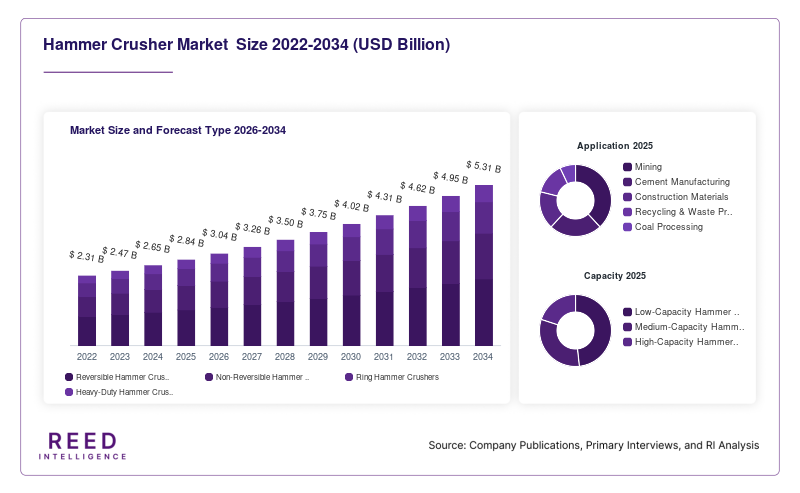
Reversible hammer crushers dominated the Hammer Crusher Market with a market share of 44.8% in 2025. These crushers gained strong adoption because they provide improved operational efficiency, longer service life, and better material reduction capabilities.
Ring hammer crushers are projected to witness the fastest CAGR of 8.4% during 2026–2034. Increasing demand for coal crushing and fine material processing applications is expected to support segment growth. Their compact structure and efficient crushing performance are contributing to wider industrial adoption.
By Application
The mining segment accounted for the largest share of 37.5% in 2025 within the Hammer Crusher Market. Extensive use of crushing equipment for mineral extraction and aggregate production significantly contributed to segment dominance.
The recycling and waste processing segment is expected to expand at a 8.6% CAGR through 2034 due to increasing focus on sustainable construction practices and material recovery initiatives.
By Capacity
Medium-capacity hammer crushers held the dominant market share of 41.2% in 2025 because of their broad applicability across construction material processing and industrial manufacturing facilities.
High-capacity hammer crushers are anticipated to register the fastest CAGR of 8.0% during the forecast period due to rising demand for large-scale mining and aggregate processing operations.
By End-Use Industry
The construction industry represented the dominant segment with a market share of 33.8% in 2025 in the Hammer Crusher Market. Growing demand for aggregates, sand, and crushed stone significantly contributed to segment expansion.
The recycling industry is projected to grow at a 8.5% CAGR during 2026–2034 as governments and industrial operators increasingly focus on waste reduction and circular economy initiatives.
Regional Analysis
North America
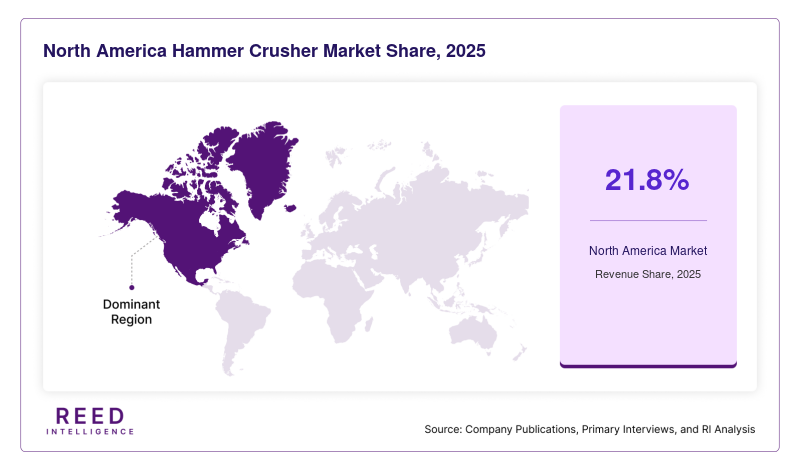
North America accounted for approximately 21.8% of the Hammer Crusher Market in 2025 and is projected to grow at a 6.4% CAGR during 2026–2034. The United States dominated the regional market due to strong mining activities and increasing investment in aggregate production facilities.
The region also benefits from growing adoption of automated material processing equipment and increasing replacement of aging crushing systems across industrial operations.
Europe
Europe held a market share of 24.7% in 2025 and is expected to expand at a 6.6% CAGR through 2034. Germany remained the dominant country because of its advanced industrial manufacturing sector and strong construction equipment demand.
The region is witnessing increasing adoption of energy-efficient crushing technologies and sustainable material processing systems across cement and recycling industries.
Asia Pacific
Asia Pacific represented 39.4% of the global Hammer Crusher Market in 2025 and is anticipated to register a 7.9% CAGR during 2026–2034. China dominated the regional market due to rapid infrastructure expansion, strong mining activities, and large-scale cement production capacity.
The region continues to experience rising demand for aggregates and industrial raw materials associated with urbanization and industrial development activities.
Middle East & Africa
The Middle East & Africa accounted for 8.1% of the Hammer Crusher Market in 2025 and is projected to grow at the fastest 8.1% CAGR during the forecast period. Saudi Arabia remained the dominant country because of increasing mining investments and major infrastructure development projects.
The expansion of construction activities and mineral extraction projects is expected to support growing demand for crushing equipment across the region.
Latin America
Latin America held approximately 6.0% market share in 2025 and is expected to expand at a 6.8% CAGR through 2034. Brazil dominated the regional market due to increasing mining operations and rising infrastructure construction activities.
Growing investment in quarrying and cement manufacturing facilities continues to create opportunities for hammer crusher manufacturers across the region.
Competitive Landscape
The Hammer Crusher Market remains moderately competitive, with manufacturers focusing on product durability, automation capabilities, and energy-efficient crushing technologies.
Metso Corporation emerged as a major market leader due to its broad crushing equipment portfolio and strong global mining industry presence. The company recently introduced upgraded hammer crushing systems integrated with predictive maintenance technologies and energy-efficient drive systems.
FLSmidth & Co. A/S continues to focus on advanced material processing solutions for mining and cement industries. Thyssenkrupp AG remains active in industrial crushing and screening technologies. Terex Corporation is expanding its mobile crushing equipment offerings for construction applications. McLanahan Corporation continues to invest in durable crushing systems designed for high-capacity industrial operations.
Key Players List
- Metso Corporation
- FLSmidth & Co. A/S
- Thyssenkrupp AG
- Terex Corporation
- McLanahan Corporation
- Sandvik AB
- Astec Industries, Inc.
- Williams Patent Crusher & Pulverizer Co., Inc.
- Eagle Crusher Company Inc.
- IROCK Crushers
- Zhengzhou Dingsheng Engineering Technology Co., Ltd.
- Weir Group PLC
- Hazemag & EPR GmbH
- Komatsu Ltd.
- Shanghai Shibang Machinery Co., Ltd.
Recent Developments
- In 2025, several crushing equipment manufacturers introduced energy-efficient hammer crusher models integrated with automated monitoring technologies.
- Metso Corporation expanded its crushing equipment portfolio with upgraded wear-resistant hammer crusher systems for mining applications.
- Mining operators increasingly adopted predictive maintenance software to improve crushing equipment uptime and operational efficiency.
- Multiple construction recycling facilities invested in compact hammer crushing systems for processing demolition waste materials.
- Industrial equipment manufacturers increased development of mobile hammer crushers designed for flexible on-site crushing operations.
Hammer Crusher Market Segments
Type
- Reversible Hammer Crushers
- Non-Reversible Hammer Crushers
- Ring Hammer Crushers
- Heavy-Duty Hammer Crushers
Application
- Mining
- Cement Manufacturing
- Construction Materials
- Recycling & Waste Processing
- Coal Processing
Capacity
- Low-Capacity Hammer Crushers
- Medium-Capacity Hammer Crushers
- High-Capacity Hammer Crushers
End-Use Industry
- Construction Industry
- Mining Industry
- Cement Industry
- Metallurgy Industry
- Recycling Industry
By Region
- North America
- Europe
- APAC
- Middle East and Africa
- LATAM