Hand Wrapper Market Size, Share & Demand Report By Product Type (Manual Stretch Hand Wrappers, Semi-Automatic Hand Wrappers), By Application (Warehouse and Logistics, Food and Beverage Packaging, Pharmaceutical Packaging, Consumer Goods Packaging, Industrial Shipping), By End User (Manufacturing Industries, Retail and E-commerce, Food Processing Companies, Logistics Providers), By Region & Segment Forecasts, 2026–2034
USD 3950
Market Overview
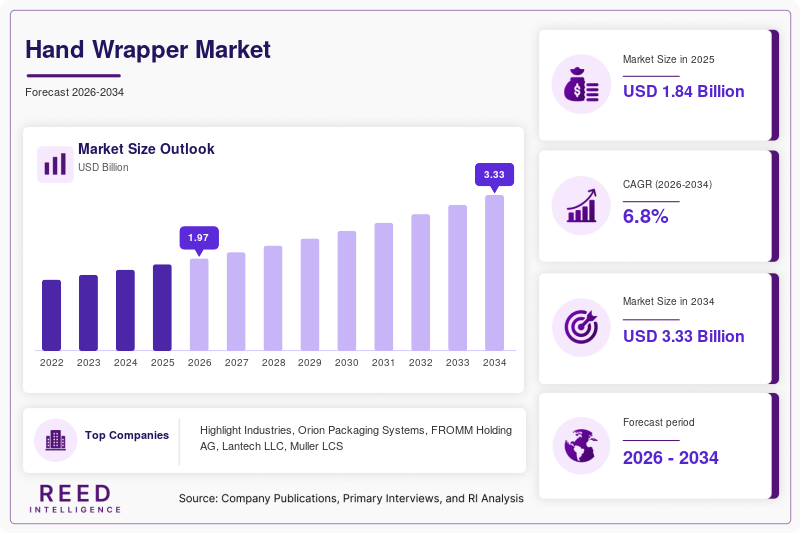
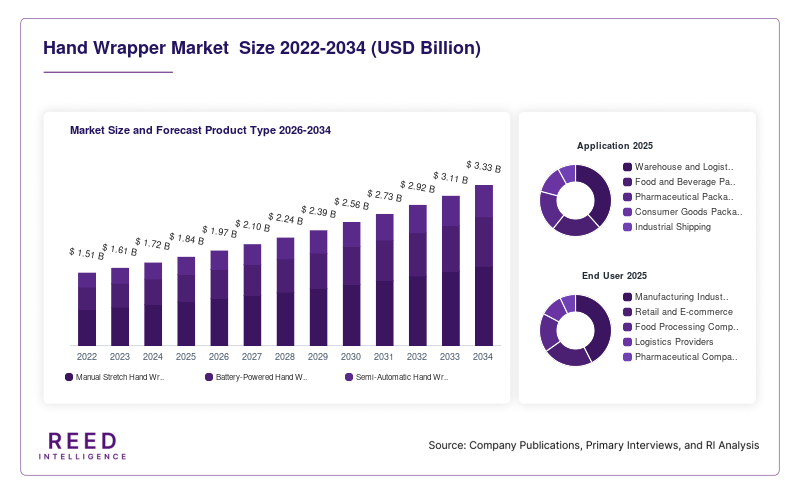
The global Hand Wrapper Market size was valued at approximately USD 1.84 billion in 2026 and is projected to reach nearly USD 3.12 billion by 2034, expanding at a CAGR of 6.8% during the forecast period from 2026 to 2034. Hand wrappers are widely used across food packaging, logistics, retail distribution, industrial shipping, and warehouse management applications. These systems help improve packaging efficiency, product safety, and transport stability while reducing material wastage in manual wrapping operations. Rising growth in e-commerce fulfillment centers and increasing demand for flexible packaging solutions across small and medium-scale industries continue to support market expansion globally.
A major global factor contributing to market growth is the rapid expansion of warehouse automation and supply chain optimization activities. Companies involved in transportation, pharmaceuticals, consumer goods, and food processing are investing in packaging equipment that improves operational productivity and reduces handling damage. Hand wrappers remain preferred in facilities that require low-cost, portable, and adaptable wrapping systems for varying load sizes. In addition, growth in export-oriented manufacturing activities has increased the demand for efficient pallet stabilization and protective packaging solutions.
Key Highlights
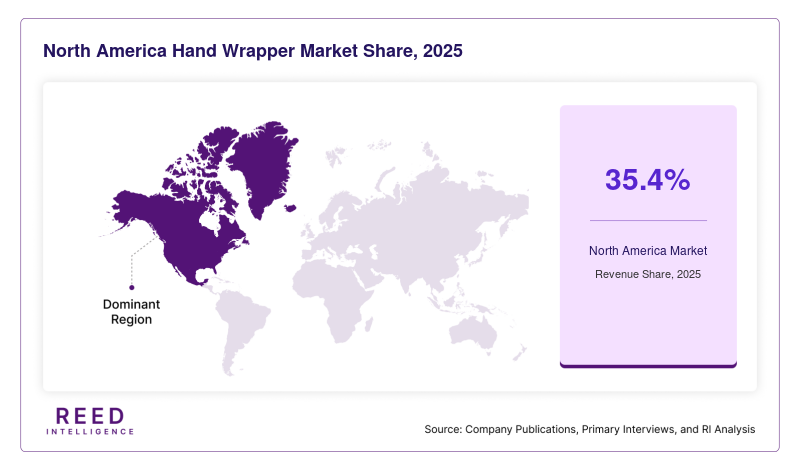
- North America dominated the market with a 35.4% share in 2025.
- Asia Pacific is expected to grow at the fastest CAGR of 8.9% during 2026–2034.
- By product type, manual stretch hand wrappers accounted for the largest share of 42.1%.
- while battery-powered hand wrappers are projected to grow at a CAGR of 9.6%.
- By application, warehouse and logistics operations led with a 39.8% share.
- whereas food and beverage packaging is expected to expand at a CAGR of 8.7%.
- The United States remained the dominant country, with market values of USD 420 million in 2024 and USD 455 million in 2025.
Market Trends
Integration of Ergonomic and Lightweight Packaging Equipment
Manufacturers in the Hand Wrapper Market are increasingly focusing on ergonomic equipment development to improve operator comfort and reduce workplace fatigue. Traditional hand wrapping equipment often caused repetitive motion strain and inconsistent wrapping performance in warehouses and distribution facilities. As a result, companies are introducing lightweight aluminum-based hand wrappers, adjustable grip systems, and tension-control mechanisms that improve user efficiency during long operational hours. These improvements are particularly beneficial for high-volume logistics facilities where workers handle large pallet loads daily. Businesses are prioritizing employee safety and operational consistency, which has accelerated demand for ergonomically designed wrapping systems across manufacturing and retail sectors.
The growing emphasis on labor productivity is also encouraging packaging equipment suppliers to introduce semi-assisted hand wrapping tools with improved maneuverability. These solutions help reduce packaging time and lower film consumption without requiring major automation investments. Small and medium enterprises are rapidly adopting these systems because they offer affordability alongside operational efficiency. Rising warehouse expansion activities across Asia Pacific and North America continue to strengthen this trend in the global market.
Rising Adoption of Sustainable Packaging Compatibility
Sustainability-focused packaging practices are becoming an important trend shaping the Hand Wrapper Market. Industrial packaging companies are under pressure to reduce plastic waste and improve recyclable material usage within supply chains. Consequently, hand wrapper manufacturers are designing equipment compatible with biodegradable stretch films, recycled polyethylene films, and thinner wrapping materials that maintain load stability while minimizing material consumption. These advancements help businesses align with environmental packaging standards and corporate sustainability goals.
Growing awareness regarding carbon reduction strategies has encouraged logistics providers and retail distributors to modernize packaging operations. Many food processing and pharmaceutical companies are shifting toward eco-friendly wrapping materials that require precise film tension management, increasing demand for upgraded hand wrapper systems. Government regulations targeting industrial plastic waste reduction in Europe and North America are further accelerating adoption. In addition, packaging equipment suppliers are integrating adjustable film pre-stretch functions that optimize film utilization and reduce packaging costs for industrial users.
Market Drivers
Expansion of E-commerce and Warehouse Infrastructure
The rapid growth of global e-commerce activities is significantly driving demand in the Hand Wrapper Market. Online retail businesses require efficient packaging and pallet stabilization systems to support high shipment volumes and fast-moving warehouse operations. Hand wrappers are widely used for securing goods during storage and transportation because they provide flexibility, cost efficiency, and mobility across different warehouse environments. The increasing number of fulfillment centers established by retail and logistics companies has created strong demand for manual and battery-powered wrapping systems.
Warehousing operators are also investing in improved packaging processes to minimize transit damage and improve load stability. Hand wrappers help reduce packaging inconsistencies while supporting faster order processing activities. Small distribution centers and regional logistics facilities particularly prefer hand wrappers because they require lower capital investment compared to fully automated stretch wrapping systems. Rapid urbanization, rising consumer spending, and expansion of same-day delivery networks continue to strengthen the demand for efficient packaging solutions globally.
Increasing Demand from Food and Beverage Packaging Operations
The food and beverage industry represents a major growth driver for the Hand Wrapper Market due to rising packaged food consumption and expanding cold-chain logistics operations. Food manufacturers require reliable wrapping systems to secure palletized goods during transportation and storage while maintaining hygiene and product integrity. Hand wrappers provide flexibility for varying pallet sizes and support fast packaging activities in food processing facilities.
Growing demand for frozen foods, ready-to-eat meals, and beverage exports has increased the need for efficient load containment systems across supply chains. Food distributors are focusing on reducing product damage and maintaining packaging consistency during long-distance transportation. In addition, rising investments in supermarket distribution centers and temperature-controlled warehouses are supporting market expansion. Packaging companies are also introducing food-grade compatible wrapping equipment that meets industry hygiene requirements, further accelerating adoption across global food processing industries.
Market Restraint
Competition from Automated Stretch Wrapping Systems
The growing adoption of automated and semi-automated stretch wrapping systems presents a significant restraint for the Hand Wrapper Market. Large manufacturing plants and high-volume logistics facilities are increasingly investing in automated packaging technologies that improve operational speed, reduce labor dependency, and ensure consistent wrapping performance. Automated systems can process larger shipment volumes with minimal operator involvement, making them attractive for industrial-scale operations seeking long-term cost optimization.
This shift toward automation has limited the adoption of manual hand wrappers in some developed markets where labor costs are relatively high. Industries handling large pallet quantities often prefer automated equipment because it reduces workplace injuries and improves packaging uniformity. In addition, technological advancements in robotic pallet wrapping systems have enhanced operational efficiency for warehouse operators. Smaller businesses continue to rely on hand wrappers due to affordability, but increasing automation penetration may gradually impact demand growth in mature industrial economies over the forecast period.
Market Opportunities
Growth Potential in Emerging Manufacturing Economies
Emerging economies across Asia Pacific, Latin America, and Africa present substantial growth opportunities for the Hand Wrapper Market. Rapid industrialization and expansion of export-oriented manufacturing activities are increasing the need for cost-effective packaging equipment in developing countries. Small and medium enterprises involved in textiles, consumer goods, automotive components, and food processing are actively investing in affordable packaging systems that improve transportation safety and operational productivity.
Many developing economies continue to experience strong growth in warehouse construction and logistics modernization projects. Hand wrappers are gaining popularity because they offer portability, ease of operation, and lower maintenance requirements compared to automated systems. Government initiatives supporting manufacturing growth and industrial exports are further encouraging packaging equipment adoption. Additionally, rising investments in regional distribution hubs and transportation infrastructure are expected to create long-term market opportunities for packaging equipment suppliers operating in emerging markets.
Technological Advancements in Battery-Assisted Wrapping Systems
The development of battery-powered and semi-assisted hand wrappers is creating new opportunities for market participants. These advanced systems improve wrapping speed, reduce operator fatigue, and enhance packaging consistency while maintaining the flexibility associated with manual wrapping equipment. Companies operating large warehouses and retail distribution centers are increasingly adopting battery-assisted solutions to improve workforce productivity without transitioning fully toward automated machinery.
Advancements in rechargeable battery technology and lightweight material engineering are supporting the commercialization of portable high-performance wrapping equipment. Manufacturers are also introducing digital tension-control systems and adjustable film stretching mechanisms that help reduce film waste and improve load security. Growing demand for mobile packaging equipment in industries such as pharmaceuticals, food processing, and third-party logistics is expected to support strong adoption of advanced hand wrapping technologies during the forecast period.
Segmental Analysis
By Product Type
Manual stretch hand wrappers accounted for the largest share of the Hand Wrapper Market in 2024, contributing nearly 42.1% of total revenue. These systems remain widely preferred because they offer affordability, ease of use, and compatibility with multiple industrial applications. Warehouses, manufacturing facilities, and retail distribution centers continue to rely on manual hand wrappers for pallet stabilization and packaging efficiency. Small and medium enterprises particularly favor these solutions because they require minimal maintenance and low operational investment. In addition, manual hand wrappers provide flexibility for varying pallet dimensions and irregular shipment loads, making them suitable for diverse industrial environments. Growing demand for portable packaging solutions across logistics and transportation sectors further supports segment dominance globally.
By Application
Warehouse and logistics operations represented the dominant application segment in 2024, accounting for approximately 39.8% of the global Hand Wrapper Market share. The expansion of e-commerce fulfillment centers and transportation networks has significantly increased the need for pallet stabilization and secure packaging solutions. Hand wrappers are widely utilized in warehouses to improve load containment, minimize product movement during transportation, and enhance packaging efficiency. Distribution centers handling consumer goods, industrial materials, and retail shipments rely heavily on these systems due to their portability and cost-effectiveness. Increasing investments in regional logistics infrastructure and supply chain modernization projects continue to support strong demand for hand wrapping equipment across global warehouse operations.
By End User
Manufacturing industries held the largest share of the Hand Wrapper Market in 2024, accounting for nearly 44.3% of total revenue. Industrial manufacturers require reliable wrapping systems to secure palletized goods during storage, domestic transportation, and export shipments. Sectors including automotive components, electronics, chemicals, textiles, and industrial machinery extensively utilize hand wrappers because of their operational flexibility and cost efficiency. Growing export-oriented production activities across developing economies have significantly increased the adoption of pallet wrapping equipment. Manufacturing facilities also prefer hand wrappers for smaller production batches where automated systems may not be economically feasible. The expansion of industrial packaging operations and warehouse facilities continues to support segment leadership globally.
Regional Analysis
North America
North America accounted for the largest share of the Hand Wrapper Market in 2025, representing approximately 35.4% of global revenue. The region is projected to grow at a CAGR of 6.1% during the forecast period due to continued expansion in warehouse automation and retail distribution infrastructure. Strong demand from food processing, pharmaceuticals, and consumer goods packaging operations continues to support market stability. The presence of established logistics providers and advanced supply chain networks also contributes to consistent equipment demand across the region.
The United States remained the dominant country within North America due to the strong presence of e-commerce fulfillment centers and industrial packaging facilities. Rising investments in warehouse modernization and transportation safety initiatives continue to drive equipment adoption. .
Europe
Europe represented a significant portion of the global Hand Wrapper Market in 2025 and is expected to expand steadily at a CAGR of 5.8% through 2034. Growth is supported by strong packaging regulations, increasing industrial exports, and rising demand for sustainable wrapping solutions. Manufacturing industries across Germany, France, and Italy continue to invest in efficient packaging systems to improve transportation reliability and reduce material waste during logistics operations.
Germany emerged as the leading country in the European market due to its extensive manufacturing base and advanced industrial packaging sector. The country benefits from strong automotive, machinery, and food export industries that require reliable pallet stabilization systems. .
Asia Pacific
Asia Pacific is expected to register the fastest CAGR of 8.9% during the forecast period due to rapid industrialization and expanding logistics infrastructure. The region is witnessing strong growth in manufacturing activities, warehousing operations, and export-oriented production across several developing economies. Increasing demand for low-cost packaging equipment among small and medium enterprises is further supporting market expansion. Rising e-commerce penetration and urban retail distribution activities also contribute to growing hand wrapper adoption..
Middle East & Africa
The Middle East & Africa region is gradually expanding within the Hand Wrapper Market and is forecast to grow at a CAGR of 5.4% during 2026–2034. Increasing investments in industrial packaging facilities and regional logistics hubs are supporting market development. Countries within the Gulf Cooperation Council are focusing on supply chain diversification and warehouse infrastructure expansion, creating demand for packaging solutions suitable for transportation and export operations.
Latin America
Latin America maintained a moderate share of the Hand Wrapper Market in 2025 and is projected to grow at a CAGR of 5.9% during the forecast period. Growth is supported by expanding food exports, retail logistics development, and increasing industrial packaging activities across regional economies. Companies are focusing on improving transportation safety and reducing product losses during shipping operations. Hand wrappers remain widely adopted due to their affordability and operational flexibility for small and medium-scale businesses.
Competitive Landscape
The Hand Wrapper Market remains moderately fragmented with the presence of international packaging equipment manufacturers and regional suppliers competing across industrial sectors. Companies are focusing on ergonomic product innovation, sustainable packaging compatibility, and lightweight equipment development to strengthen market positioning. Strategic partnerships with logistics providers and warehouse operators are also becoming common as manufacturers seek to expand customer reach across emerging markets.
Highlight Industries maintained a leading position in the market due to its extensive product portfolio and strong distribution network across North America and Europe. The company recently introduced a battery-assisted wrapping system with adjustable tension control designed for warehouse and food packaging applications. Other prominent players are investing in sustainable film compatibility and advanced operator safety features to enhance product competitiveness.
Key Players
- Highlight Industries
- Orion Packaging Systems
- FROMM Holding AG
- Lantech LLC
- Muller LCS
- Phoenix Wrappers
- Packway Inc.
- Cousins Packaging Inc.
- Webster Griffin Ltd.
- Italdibipack Group
- Atlanta Stretch S.p.A.
- Robopac S.p.A.
- Samuel Packaging Systems Group
- Cyklop International
- Technowrapp S.r.l.
Recent Developments
- Highlight Industries launched a lightweight battery-powered hand wrapper series in 2025 designed for high-volume warehouse operations and reduced operator fatigue.
- Robopac S.p.A. expanded its packaging equipment distribution network across Southeast Asia to strengthen regional market presence in logistics and food packaging sectors.
- FROMM Holding AG introduced sustainable stretch film compatibility features in its latest hand wrapper systems to support recyclable industrial packaging initiatives.
Hand Wrapper Market Segments
Product Type
- Manual Stretch Hand Wrappers
- Battery-Powered Hand Wrappers
- Semi-Automatic Hand Wrappers
Application
- Warehouse and Logistics
- Food and Beverage Packaging
- Pharmaceutical Packaging
- Consumer Goods Packaging
- Industrial Shipping
End User
- Manufacturing Industries
- Retail and E-commerce
- Food Processing Companies
- Logistics Providers
- Pharmaceutical Companies
By Region
- North America
- Europe
- APAC
- Middle East and Africa
- LATAM