Handheld Gimbal Market Size, Share, Growth & Trends Analysis Report By Type (2-Axis Gimbals, 3-Axis Gimbals), By Application (Smartphone Videography, Action Camera Stabilization), By End-Use (Content Creators & Influencers), By Distribution Channel (Online Retail), By Region & Segment Forecasts, 2026–2034
USD 3950
Market Overview
The global Handheld Gimbal Market size is valued at USD 1.94 billion in 2026 and is projected to reach USD 4.28 billion by 2034, registering a CAGR of 10.4% during the forecast period. The market expansion is primarily driven by the rapid growth of digital content creation ecosystems, where stabilized video capture has become a standard requirement across professional and consumer applications. Rising integration of high-resolution cameras in smartphones and compact devices has further accelerated adoption of handheld stabilization systems.
A key global factor supporting the Handheld Gimbal Market is the widespread expansion of short-form video platforms and live-streaming services, which has significantly increased demand for portable, easy-to-use stabilization tools among creators, influencers, and media professionals.
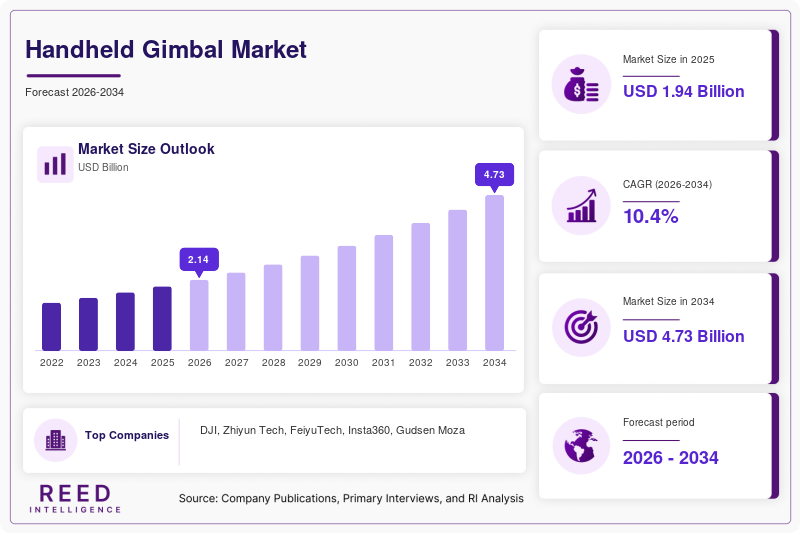
Key Highlights:
- Dominant region share: Asia Pacific (39% in 2025)
- Fastest-growing region CAGR: Latin America (11.5% CAGR, 2026–2034)
- Leading subsegment (Type): 3-axis gimbals (63% share in 2025)
- Fastest-growing subsegment (Type): AI-powered smart gimbals (12.8% CAGR)
- Dominant country market value: United States – USD 430 million (2024), USD 468 million (2025)
Market Trends
AI-Based Motion Tracking Integration
The Handheld Gimbal Market is witnessing increasing adoption of AI-enabled tracking systems that allow automatic subject recognition, gesture-based control, and predictive stabilization. These technologies improve usability for both amateur and professional users, enabling smoother video capture without manual adjustments.
Shift Toward Compact Mobile-Optimized Devices
Another major trend is the transition toward lightweight and foldable gimbals optimized for smartphone users. Manufacturers are focusing on portability, app connectivity, and multi-device compatibility, reflecting the growing dominance of mobile-first content creation.
Market Drivers
Expansion of Digital Content Creation Ecosystem
The rapid growth of social media platforms, influencer marketing, and online video consumption is driving demand for professional-grade stabilization tools. The Handheld Gimbal Market benefits from increasing expectations for cinematic-quality visuals across all user levels.
Advancements in Multi-Axis Stabilization Technology
Technological improvements in brushless motors, sensor accuracy, and battery optimization are enhancing gimbal performance. These innovations are making handheld stabilizers more reliable, energy-efficient, and suitable for long-duration shooting environments.
Market Restraint
High Cost of Advanced Stabilization Devices
A key restraint in the Handheld Gimbal Market is the relatively high price of premium gimbals featuring AI tracking, multi-device integration, and extended battery performance. This limits penetration in price-sensitive consumer segments and emerging economies.
Market Opportunities
Expansion of Professional Filmmaking Equipment Demand
Increasing demand for independent filmmaking and digital advertising content is creating opportunities for advanced stabilization systems. Professional users are increasingly adopting high-performance gimbals for cinematic production environments.
Growth in Emerging Creator Economies
The rise of digital entrepreneurship in developing regions is expanding the user base for handheld stabilization devices. Affordable models and improved distribution channels are expected to support broader adoption in these markets.
Segmental Analysis
By Type
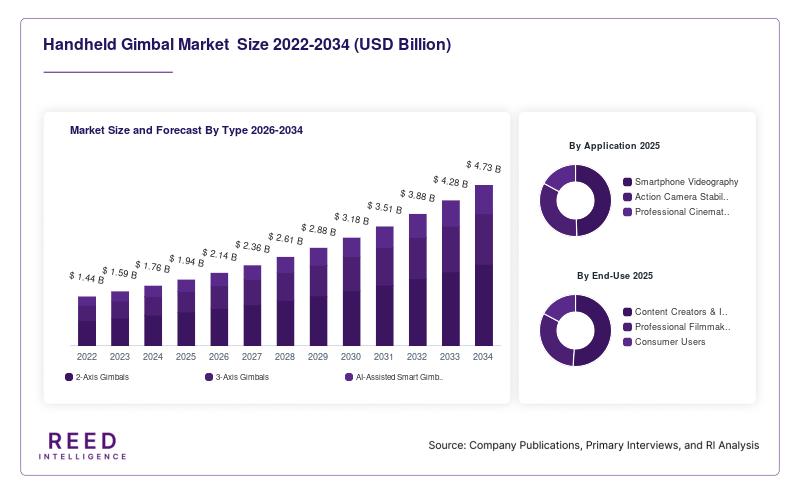
The Handheld Gimbal Market is segmented into 2-axis gimbals, 3-axis gimbals, and AI-assisted gimbals. In 2025, 3-axis gimbals accounted for 63% share, driven by their superior stabilization accuracy and widespread use in both professional and consumer applications.
AI-assisted gimbals are expected to grow at a CAGR of 12.8%, supported by increasing integration of machine learning-based tracking systems, which enhance automated framing and user convenience.
By Application
Applications include smartphone videography, action camera stabilization, and professional cinematography. In 2025, smartphone videography held 53% share, driven by rising mobile-first content creation trends.
Professional cinematography is expected to grow at a CAGR of 11.7%, supported by increasing demand for high-quality visual production in advertising, filmmaking, and streaming content.
By End-Use
The market includes content creators, professional filmmakers, and consumer users. In 2025, content creators accounted for 47% share, reflecting the expansion of influencer-driven digital platforms.
Professional filmmakers are expected to grow at a CAGR of 10.8%, driven by increasing demand for advanced stabilization in commercial and cinematic production environments.
By Distribution Channel
Distribution channels include online retail and offline retail. In 2025, online retail dominated with 59% share, supported by e-commerce expansion and direct-to-consumer sales models.
Offline retail is expected to grow at a CAGR of 9.3%, driven by consumer preference for physical product evaluation before purchase.
Regional Analysis
North America
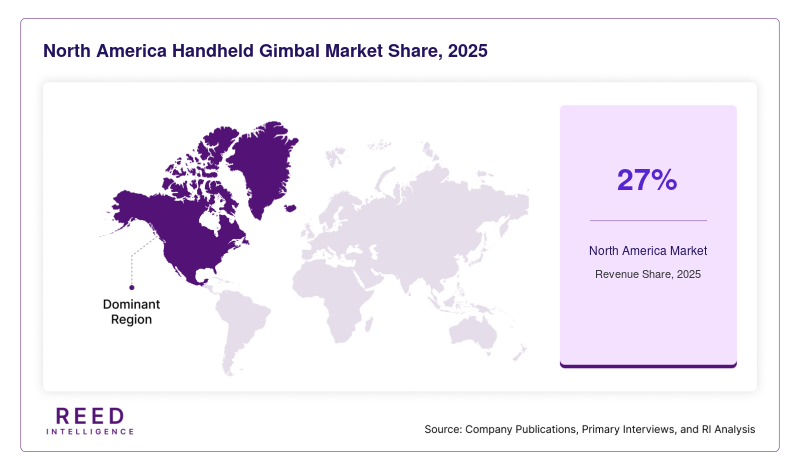
North America accounted for approximately 27% share of the Handheld Gimbal Market in 2025, and is projected to grow at a CAGR of 9.7% during 2026–2034. The region benefits from strong demand for professional video production tools, supported by advanced media infrastructure and high adoption of digital content platforms.
The United States dominates the regional market due to strong filmmaking industry presence and high penetration of content creation tools among independent creators. Increasing demand for high-quality commercial video production further supports market expansion.
Europe
Europe held around 21% share of the Handheld Gimbal Market in 2025, with a projected CAGR of 9.4% during 2026–2034. Growth is driven by increasing use of stabilization equipment in journalism, tourism promotion, and corporate video production.
Germany leads the regional market due to its strong engineering capabilities and growing adoption of advanced imaging systems. Rising demand for high-quality visual communication tools in media sectors supports regional growth.
Asia Pacific
Asia Pacific dominated the Handheld Gimbal Market with 39% share in 2025, and is expected to grow at a CAGR of 11.2% during 2026–2034. The region’s growth is strongly supported by high smartphone penetration and rapid expansion of digital content creation ecosystems.
China leads the regional market due to large-scale manufacturing capacity and strong domestic demand for imaging devices. The growth of influencer-driven content creation and e-commerce video marketing further strengthens regional expansion.
Middle East & Africa
Middle East & Africa accounted for 6% share of the Handheld Gimbal Market in 2025, and is projected to grow at a CAGR of 10.6% during 2026–2034. Growth is driven by increasing investments in digital media infrastructure and tourism-based content development.
The United Arab Emirates leads the region due to strong government initiatives supporting digital innovation and smart media production ecosystems.
Latin America
Latin America held approximately 7% share of the Handheld Gimbal Market in 2025, and is expected to grow at the fastest CAGR of 11.5% during 2026–2034. The region’s growth is supported by increasing social media engagement and rising adoption of mobile-based video creation tools.
Brazil dominates the regional market due to a rapidly growing creator economy and increasing demand for affordable content production devices.
Competitive Landscape
The Handheld Gimbal Market is moderately consolidated with strong competition among global manufacturers focusing on innovation, portability, and software integration.
DJI remains the leading player in the market, supported by its strong product ecosystem and continuous innovation in AI-enabled stabilization systems. Its latest development includes enhanced subject tracking algorithms integrated into its compact Osmo series.
Other major players include Zhiyun, FeiyuTech, Insta360, and Gudsen Moza. These companies are focusing on lightweight designs, improved battery efficiency, and advanced mobile app integration to strengthen their market position.
Key Players List
- DJI
- Zhiyun
- FeiyuTech
- Insta360
- Gudsen Moza
- Hohem
- Benro
- Freefly Systems
- Tilta
- Snoppa Technology
- EVO Gimbals
- Pilotfly
- Moza Racing Imaging Division
- Zhima Technology
- Removu
Recent Developments
- DJI introduced upgraded AI-based tracking features in its latest handheld stabilization systems to improve automated filming accuracy.
- Zhiyun launched a new compact foldable gimbal designed for smartphone-based creators targeting social media platforms.
- Insta360 enhanced its stabilization ecosystem with advanced horizon-lock technology for immersive video capture.
- FeiyuTech released an entry-level gimbal series focused on affordability for emerging markets.
- Gudsen Moza improved battery optimization across its product line to support longer professional shooting sessions.
Handheld Gimbal Market Segments
By Type
- 2-Axis Gimbals
- 3-Axis Gimbals
- AI-Assisted Smart Gimbals
By Application
- Smartphone Videography
- Action Camera Stabilization
- Professional Cinematography
By End-Use
- Content Creators & Influencers
- Professional Filmmakers
- Consumer Users
By Distribution Channel
- Online Retail
- Offline Retail
By Region
- North America
- Europe
- APAC
- Middle East and Africa
- LATAM