Handheld Reference Thermometer Market Size, Share & Demand Report By Product Type (Digital Handheld Reference Thermometers,Wireless-Enabled Handheld Reference Thermometers), By Application (Industrial Calibration, Pharmaceutical Monitoring, Food Safety and Processing, Laboratory Testing), By End User (Pharmaceutical & Biotechnology Companies, Food & Beverage Companies, Industrial Manufacturing Facilities), By Region & Segment Forecasts, 2026–2034
USD 3950
Market Overview
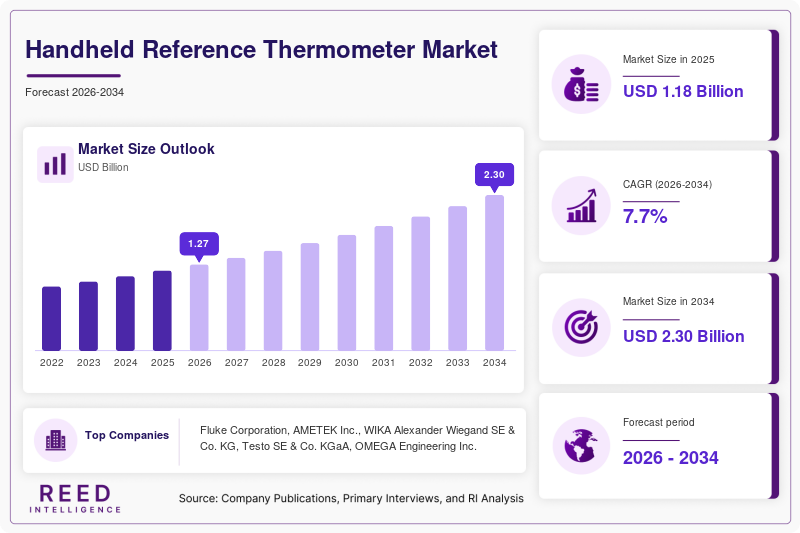
The global Handheld Reference Thermometer Market size was valued at USD 1.18 billion in 2026 and is projected to reach USD 2.14 billion by 2034, expanding at a CAGR of 7.7% during the forecast period from 2026 to 2034. The market is witnessing stable expansion due to rising demand for precise temperature calibration and verification across pharmaceutical manufacturing, food processing, industrial automation, healthcare diagnostics, and laboratory testing environments. Handheld reference thermometers are increasingly used in calibration laboratories and industrial facilities where high measurement accuracy and portability are required for quality assurance processes.
One of the major global factors supporting market growth is the increasing implementation of stringent temperature monitoring regulations across manufacturing and healthcare sectors. Industries handling temperature-sensitive materials are investing in portable calibration equipment to improve compliance with international standards and maintain operational reliability. The growth of vaccine storage monitoring, cold chain logistics, and semiconductor manufacturing has also increased the need for accurate handheld temperature verification systems. Furthermore, advancements in digital sensors, wireless connectivity, and multi-channel temperature recording capabilities are encouraging end users to replace conventional thermometers with advanced handheld reference solutions.
Key Highlights
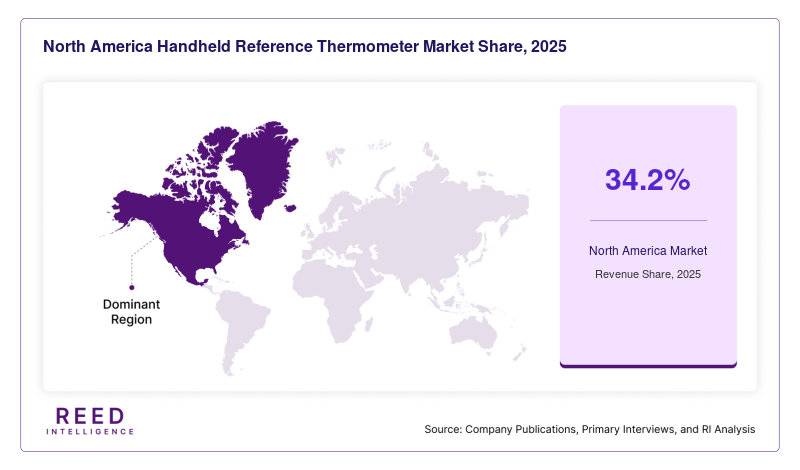
- North America dominated the market with a 34.2% share in 2025.
- Asia Pacific is expected to grow at the fastest CAGR of 9.8% during 2026–2034.
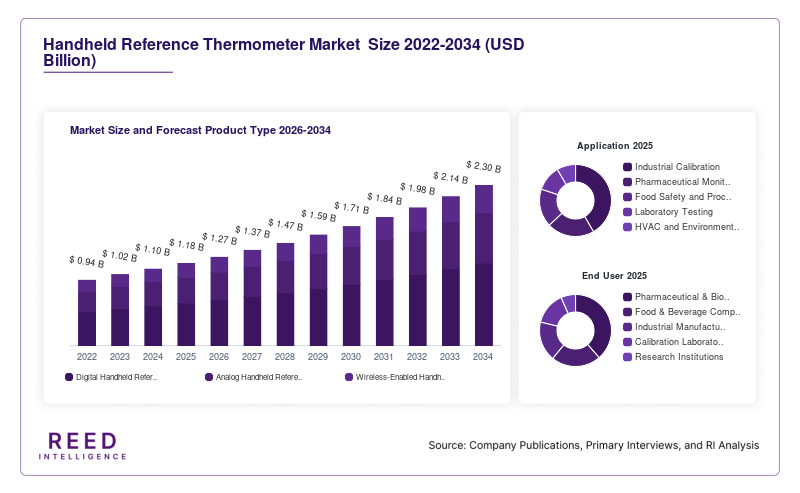
- By product type, digital handheld reference thermometers accounted for the largest share of 44.6%.
- while wireless-enabled thermometers are projected to grow at a CAGR of 10.7%.
- By application, industrial calibration led with a 39.4% share, whereas pharmaceutical monitoring is expected to expand at a CAGR of 10.2%.
- The United States remained the dominant country, with market values of USD 286 million in 2024 and USD 312 million in 2025.
Market Trends
Integration of Wireless Connectivity and Smart Calibration Platforms
The market is witnessing a transition toward smart handheld reference thermometers equipped with wireless communication technologies and cloud-enabled calibration management systems. Manufacturers are increasingly integrating Bluetooth, Wi-Fi, and USB-based synchronization features that allow technicians to transfer temperature records directly into centralized monitoring platforms. This trend is gaining traction across pharmaceutical plants, research laboratories, and industrial processing facilities where automated documentation and traceability are important for compliance audits. Smart thermometers reduce manual recording errors and improve operational efficiency during field inspections and calibration activities.
The adoption of digital ecosystems is also supporting predictive maintenance and remote monitoring capabilities. Calibration engineers can now analyze performance data in real time and generate automated validation reports through connected software applications. The increasing use of Industry 4.0 infrastructure is encouraging industrial facilities to deploy interconnected handheld instruments for temperature verification. Compact touchscreen displays, customizable alarms, and multi-sensor compatibility are further improving usability and supporting the transition from traditional analog devices to intelligent handheld reference thermometers.
Growing Demand from Pharmaceutical and Cold Chain Applications
The expansion of pharmaceutical production and biologics transportation is creating strong demand for high-precision handheld reference thermometers. Temperature-sensitive products such as vaccines, blood samples, and specialty medicines require accurate monitoring during manufacturing, storage, and transportation. Regulatory agencies are implementing stricter compliance requirements for temperature validation, which is increasing the use of calibrated handheld devices for verification procedures. Pharmaceutical companies are investing in portable thermometers with high accuracy ranges and data logging functionality to maintain product integrity across the supply chain.
Cold chain logistics providers are also adopting handheld reference thermometers to improve transportation safety and reduce spoilage risks. The growth of global vaccine distribution networks and temperature-controlled warehouses is strengthening market expansion across emerging economies. Portable thermometers with rugged construction and extended battery life are becoming essential for field technicians operating in remote environments. As healthcare infrastructure expands in Asia Pacific and Latin America, the requirement for reliable temperature verification systems is expected to increase steadily throughout the forecast period.
Market Drivers
Expansion of Industrial Quality Assurance and Calibration Activities
Industrial manufacturers are increasingly emphasizing precision measurement and equipment calibration to maintain product quality and operational consistency. Handheld reference thermometers are widely used in calibration laboratories, manufacturing plants, and industrial maintenance activities to verify temperature accuracy across critical production systems. Industries such as chemicals, electronics, aerospace, and automotive manufacturing require highly accurate portable temperature measurement solutions to comply with international quality standards. This growing focus on quality assurance is significantly supporting market demand.
The expansion of automated industrial systems is also increasing the need for routine calibration and preventive maintenance procedures. Portable reference thermometers allow technicians to perform rapid field inspections without interrupting production activities. The adoption of advanced manufacturing technologies and sensor-driven production environments is creating sustained demand for accurate handheld temperature verification instruments. In addition, government regulations related to industrial safety and process validation are encouraging companies to invest in modern calibration tools that improve measurement reliability and reduce operational errors.
Rising Food Safety Regulations and Temperature Monitoring Requirements
The food and beverage industry is emerging as an important growth area for handheld reference thermometers due to increasing global food safety regulations. Temperature control plays a critical role in food processing, packaging, storage, and transportation. Companies are using handheld reference thermometers to validate temperature readings within refrigeration systems, cooking equipment, and cold storage facilities. Regulatory compliance related to food hygiene and contamination prevention is driving investments in accurate temperature monitoring devices.
Growing consumer awareness regarding food quality and product safety is encouraging manufacturers to strengthen quality inspection procedures throughout the supply chain. Portable thermometers provide quick verification during audits and inspections, making them valuable tools for food processing operators. The increasing adoption of frozen foods, dairy products, and temperature-sensitive packaged goods is further contributing to market growth. Emerging economies are also implementing stricter food storage standards, creating additional opportunities for handheld reference thermometer manufacturers across retail, logistics, and food production sectors.
Market Restraint
High Calibration and Maintenance Costs Limiting Adoption Among Small Enterprises
Despite growing adoption across industrial and healthcare sectors, the market faces challenges associated with the high cost of advanced handheld reference thermometers and their recurring calibration requirements. Precision thermometers require periodic recalibration to maintain measurement accuracy and regulatory compliance. These procedures often involve specialized laboratories, certified technicians, and temporary equipment downtime, which can increase operational expenses for end users. Small manufacturing firms and regional laboratories frequently hesitate to adopt premium handheld reference devices because of the long-term maintenance burden.
The cost challenge becomes more significant in price-sensitive emerging markets where companies prioritize basic monitoring solutions over advanced calibration systems. In several developing economies, small food processors and local laboratories continue using conventional thermometers due to budget limitations. In addition, highly accurate thermometers with wireless connectivity, multi-channel measurement capabilities, and cloud integration are priced substantially higher than standard portable devices. This pricing gap can delay technology upgrades among small enterprises. The shortage of skilled calibration professionals in certain regions also affects device servicing efficiency and increases maintenance turnaround time. These factors collectively restrict broader adoption, particularly among smaller organizations operating with limited technical infrastructure and capital expenditure budgets.
Market Opportunities
Increasing Adoption Across Renewable Energy and Electronics Manufacturing
The growing renewable energy and electronics manufacturing sectors are creating new opportunities for handheld reference thermometer providers. Solar panel manufacturing, battery production, and semiconductor fabrication processes require precise thermal monitoring to ensure operational stability and product quality. Handheld reference thermometers are increasingly used for equipment testing, environmental monitoring, and thermal validation procedures in these industries. As countries invest in renewable energy infrastructure and electric vehicle battery manufacturing, the demand for accurate portable temperature measurement devices is expected to rise steadily.
Electronics manufacturing facilities are also expanding their use of calibration instruments to maintain high production accuracy. Semiconductor fabrication processes operate within tightly controlled thermal environments, increasing the requirement for precision temperature verification systems. Portable reference thermometers with fast response times and digital connectivity features are becoming essential tools for maintenance engineers and production technicians. The rapid expansion of electronics assembly facilities across Asia Pacific is expected to generate long-term growth opportunities for market participants throughout the forecast period.
Expansion of Laboratory Infrastructure in Emerging Economies
Developing countries are investing significantly in laboratory modernization and healthcare infrastructure, creating favorable conditions for market expansion. Governments and private healthcare providers are establishing new diagnostic laboratories, pharmaceutical research centers, and food testing facilities that require accurate temperature monitoring instruments. Handheld reference thermometers are widely used in these environments for sample validation, equipment calibration, and environmental monitoring applications. The rising focus on healthcare quality and laboratory accreditation is encouraging institutions to adopt advanced portable measurement solutions.
Educational institutions and industrial training centers are also contributing to growing demand for handheld reference thermometers. Universities and technical laboratories increasingly require reliable temperature verification devices for research and experimental applications. Emerging economies in Asia Pacific, Latin America, and the Middle East are witnessing rising industrialization, which is accelerating the establishment of calibration and testing facilities. Market participants are responding by introducing cost-effective product lines tailored for developing regions. These investments are expected to create sustained growth opportunities for manufacturers focusing on affordable and technologically advanced handheld reference thermometer solutions.
Segmental Analysis
By Product Type
Digital handheld reference thermometers represented the dominant product segment and accounted for approximately 44.6% of the global market share in 2024. These devices are widely preferred due to their high measurement accuracy, portability, and ability to provide rapid temperature readings across industrial and laboratory applications. Digital systems are increasingly replacing analog thermometers because they offer improved readability, programmable calibration settings, and integrated data logging capabilities. Industries including pharmaceuticals, food processing, aerospace, and electronics manufacturing are major users of digital handheld reference thermometers. The availability of rugged designs with extended battery life has further strengthened adoption in field operations and industrial maintenance activities. Manufacturers are also integrating touchscreen interfaces and advanced sensor technologies to improve user efficiency and support high-precision measurement requirements in regulated environments.
Wireless-enabled handheld reference thermometers are projected to record the fastest CAGR of 10.7% during the forecast period. The growth of this subsegment is strongly linked to the increasing adoption of connected industrial systems and remote monitoring technologies. Wireless thermometers allow technicians to transfer calibration data directly into cloud-based platforms, reducing manual documentation efforts and improving operational traceability. Pharmaceutical manufacturing plants and cold chain logistics providers are rapidly adopting wireless devices to strengthen compliance and monitoring efficiency. The integration of Bluetooth and Wi-Fi connectivity also enables real-time analysis and predictive maintenance applications. Growing demand for smart industrial infrastructure and automated quality assurance systems is expected to accelerate adoption. Manufacturers are responding by launching compact devices with enhanced cybersecurity features, multi-channel connectivity, and mobile application integration for field calibration operations.
By Application
Industrial calibration emerged as the leading application segment and accounted for nearly 39.4% of the market share in 2024. Manufacturing industries rely heavily on handheld reference thermometers for verifying temperature-sensitive equipment and maintaining production consistency. Calibration laboratories and industrial maintenance teams use these devices to validate the accuracy of sensors, process controllers, and environmental monitoring systems. The increasing implementation of international quality standards across manufacturing operations is driving demand for precise portable temperature verification tools. Industries such as chemicals, aerospace, electronics, and automotive manufacturing continue investing in advanced calibration systems to improve process reliability and reduce operational errors. Handheld reference thermometers also provide flexibility for field inspections and equipment diagnostics, making them essential tools for industrial quality assurance programs and preventive maintenance operations.
Pharmaceutical monitoring is expected to witness the fastest growth, expanding at a CAGR of 10.2% through 2034. The pharmaceutical industry requires strict temperature control throughout manufacturing, storage, and transportation activities to maintain product safety and effectiveness. Handheld reference thermometers are increasingly used for validating cold storage systems, clean rooms, vaccine transportation units, and laboratory equipment. The rapid expansion of biologics manufacturing and global vaccine distribution networks is supporting strong demand for high-accuracy portable thermometers. Regulatory agencies are also implementing stricter compliance standards related to temperature validation and documentation. As pharmaceutical companies strengthen quality assurance procedures, demand for portable devices with data logging and wireless synchronization capabilities is increasing steadily. The growth of healthcare infrastructure in emerging economies is expected to create additional opportunities for this application segment.
By End User
Pharmaceutical and biotechnology companies accounted for the largest share of the end-user segment in 2024, contributing nearly 36.8% of total market revenue. These organizations require highly accurate temperature monitoring solutions to maintain regulatory compliance and product integrity throughout research, manufacturing, and storage operations. Handheld reference thermometers are extensively used for validating refrigeration systems, incubators, laboratory equipment, and vaccine storage facilities. The increasing production of temperature-sensitive biologics and specialty medicines is driving investments in advanced portable calibration devices. Pharmaceutical companies are also adopting digital handheld thermometers integrated with automated documentation platforms to improve audit readiness and operational transparency. The growing focus on healthcare quality assurance and international pharmaceutical trade continues to support sustained demand from this end-user category across both developed and emerging markets.
Food and beverage companies are anticipated to register the fastest CAGR of 9.9% during the forecast period. The expansion of processed food production, refrigerated transportation, and cold storage infrastructure is creating rising demand for portable temperature verification devices. Food manufacturers use handheld reference thermometers to validate processing equipment, refrigeration systems, and storage facilities to ensure product safety and compliance with hygiene regulations. The increasing adoption of international food safety standards is encouraging companies to strengthen temperature monitoring practices across the supply chain. Portable devices are becoming important tools for inspections, quality assurance audits, and contamination prevention procedures. Emerging economies are also witnessing rapid growth in packaged food consumption, which is increasing investments in temperature-controlled logistics systems and supporting the adoption of advanced handheld reference thermometers.
Regional Analysis
North America
North America accounted for 34.2% of the global Handheld Reference Thermometer Market share in 2025 and is expected to maintain a stable growth trajectory with a forecast CAGR of 6.9% through 2034. The region benefits from strong demand across pharmaceutical manufacturing, food processing, aerospace, and industrial automation sectors. Companies in the United States and Canada continue investing in advanced calibration systems to maintain compliance with strict quality assurance regulations. The widespread adoption of Industry 4.0 technologies and digital monitoring systems is further supporting market expansion across industrial facilities and laboratory environments.
The United States remains the dominant country within North America due to its advanced healthcare infrastructure and large industrial calibration network. The country recorded market values exceeding USD 312 million in 2025, supported by increasing investments in pharmaceutical cold chain systems and semiconductor manufacturing. A unique growth factor in the region is the rising adoption of connected calibration platforms that integrate handheld reference thermometers with cloud-based industrial monitoring systems. This integration improves operational traceability and supports automated regulatory documentation processes.
Europe
Europe represented approximately 27.4% of the global market in 2025 and is projected to expand at a CAGR of 6.8% during the forecast period. The region has a strong presence of pharmaceutical manufacturers, food safety laboratories, and industrial automation companies that require accurate portable temperature verification systems. Regulatory agencies across Europe continue implementing strict quality standards for manufacturing and healthcare operations, increasing demand for certified handheld reference thermometers. Growth is also supported by the expansion of environmental monitoring and renewable energy applications requiring thermal calibration equipment.
Germany remains the leading country within the European market due to its extensive industrial manufacturing base and advanced engineering sector. The country continues investing in smart factories and precision instrumentation technologies to improve production efficiency. One unique growth factor supporting the German market is the rapid deployment of automated laboratory systems integrated with digital calibration devices. These developments are increasing the use of wireless handheld reference thermometers capable of supporting real-time data analysis and remote calibration management across industrial and research environments.
Asia Pacific
Asia Pacific held nearly 23.8% of the global market share in 2025 and is expected to register the fastest CAGR of 9.8% from 2026 to 2034. Rapid industrialization, pharmaceutical manufacturing expansion, and rising investments in healthcare infrastructure are contributing to regional growth. Countries across Asia Pacific are strengthening food safety regulations and increasing laboratory modernization efforts, creating higher demand for portable temperature calibration devices. The region is also benefiting from growing electronics manufacturing activities and the expansion of temperature-controlled logistics networks.
China dominates the Asia Pacific market due to its extensive manufacturing ecosystem and growing pharmaceutical production capacity. The country is experiencing rising demand for handheld reference thermometers across industrial quality control facilities and healthcare institutions. A unique growth factor supporting the Chinese market is the rapid development of electric vehicle battery manufacturing plants requiring precise thermal monitoring systems. Increased government support for advanced manufacturing and renewable energy production is further accelerating the adoption of high-accuracy portable temperature measurement devices.
Middle East & Africa
The Middle East & Africa region accounted for around 7.1% of the global market in 2025 and is projected to grow at a CAGR of 7.2% during the forecast period. Industrial diversification initiatives and healthcare infrastructure development are supporting demand for handheld reference thermometers across the region. Governments are investing in pharmaceutical production, food storage systems, and laboratory testing facilities to improve public health standards and industrial efficiency. These developments are increasing the need for accurate portable temperature monitoring and calibration solutions.
Saudi Arabia represents the dominant market within the Middle East & Africa region due to its investments in industrial modernization and healthcare expansion programs. The country is witnessing increased deployment of calibration instruments across petrochemical plants, pharmaceutical facilities, and food processing units. A unique growth factor in Saudi Arabia is the expansion of temperature-controlled logistics infrastructure associated with healthcare and food import activities. This trend is encouraging businesses to adopt reliable handheld reference thermometers for transportation monitoring and compliance verification procedures.
Latin America
Latin America captured approximately 7.5% of the global Handheld Reference Thermometer Market share in 2025 and is anticipated to expand at a CAGR of 7.4% through 2034. The region is benefiting from increasing industrial automation investments and the gradual modernization of food processing and pharmaceutical sectors. Growing awareness regarding quality assurance standards is encouraging manufacturers and laboratories to adopt portable calibration equipment. Demand for handheld reference thermometers is also rising across healthcare facilities and cold chain logistics operations supporting vaccine and biologics transportation.
Brazil remains the dominant country within the Latin American market due to its large food processing industry and expanding pharmaceutical manufacturing sector. Industrial facilities across the country are increasingly investing in portable calibration technologies to improve operational reliability and meet export quality standards. One unique growth factor supporting the Brazilian market is the rapid expansion of refrigerated transportation systems for agricultural and pharmaceutical exports. This trend is increasing the requirement for portable high-accuracy temperature verification devices across logistics and storage operations.
Competitive Landscape
The Handheld Reference Thermometer Market is moderately competitive, with established instrumentation manufacturers focusing on technological innovation, product accuracy, and software integration capabilities. Companies are increasingly investing in wireless connectivity, cloud-based calibration systems, and rugged portable designs to strengthen their market position. Product differentiation is largely based on measurement precision, durability, battery performance, and compliance with international calibration standards.
Fluke Corporation remains one of the leading players in the market due to its broad calibration instrument portfolio and strong global distribution network. The company recently introduced upgraded portable reference thermometers with enhanced Bluetooth-enabled calibration management features designed for industrial maintenance applications. Other major companies are also expanding their digital thermometer offerings to address increasing demand from pharmaceutical, food safety, and industrial automation sectors.
Competition is intensifying as regional manufacturers introduce cost-effective handheld thermometers targeting emerging markets. Strategic partnerships with calibration laboratories and industrial automation providers are becoming common among leading participants. Several companies are also focusing on acquisitions and product portfolio expansion to strengthen their presence in Asia Pacific and Latin America. The increasing shift toward smart industrial monitoring systems is expected to encourage further innovation across the competitive landscape during the forecast period.
Key Players
- Fluke Corporation
- AMETEK Inc.
- WIKA Alexander Wiegand SE & Co. KG
- Testo SE & Co. KGaA
- OMEGA Engineering Inc.
- Additel Corporation
- Isotech North America
- Digitron Italia Srl
- Palmer Wahl Instruments Inc.
- TEGAM Inc.
- Dostmann Electronic GmbH
- Hanna Instruments
- ThermoWorks Inc.
- CHINO Corporation
- Ebro Electronic GmbH
Recent Developments
- Fluke Corporation introduced a next-generation handheld reference thermometer series with integrated wireless calibration synchronization for industrial automation facilities in 2025.
- Testo SE & Co. KGaA expanded its portable calibration instrument portfolio by launching compact high-accuracy thermometers designed for pharmaceutical cold chain applications in 2024.
- WIKA Alexander Wiegand SE & Co. KG announced a strategic expansion of its Asia Pacific calibration equipment distribution network to strengthen regional market penetration in 2025.
Handheld Reference Thermometer Market Segments
Product Type
- Digital Handheld Reference Thermometers
- Analog Handheld Reference Thermometers
- Wireless-Enabled Handheld Reference Thermometers
Application
- Industrial Calibration
- Pharmaceutical Monitoring
- Food Safety and Processing
- Laboratory Testing
- HVAC and Environmental Monitoring
End User
- Pharmaceutical & Biotechnology Companies
- Food & Beverage Companies
- Industrial Manufacturing Facilities
- Calibration Laboratories
- Research Institutions
By Region
- North America
- Europe
- APAC
- Middle East and Africa
- LATAM