Handheld Spectrum Analyzer Market Size, Share & Demand Report By Frequency Range (Below 6 GHz, 6 GHz to 18 GHz, Above 18 GHz), By Technology (Real-Time Spectrum Analyzers, Swept-Tuned Spectrum Analyzers), By Application (Telecommunications, Aerospace and Defense, Industrial Electronics), By End-Use Industry (Telecommunications Industry, Electronics Manufacturing Industry), By Distribution Channel (Direct Sales, Authorized Distributors), By Region & Segment Forecasts, 2026–2034
USD 3950
Market Overview
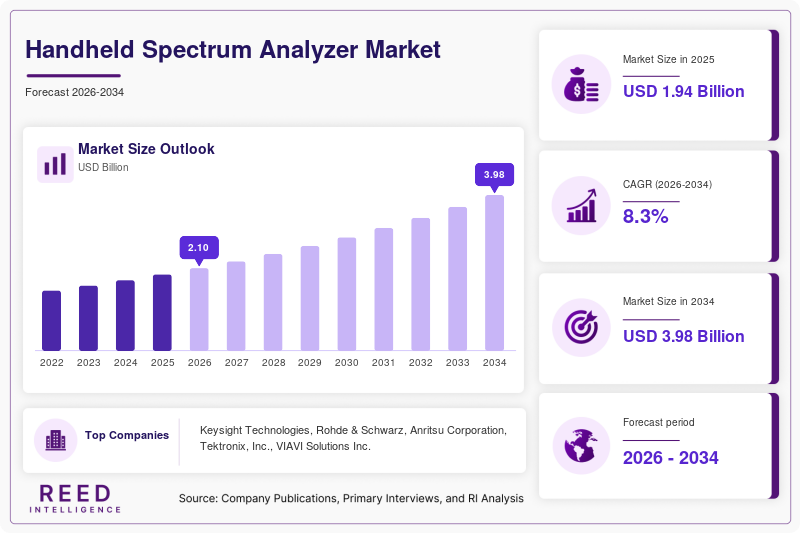
The global Handheld Spectrum Analyzer Market size was valued at USD 1.94 billion in 2026 and is projected to reach USD 3.67 billion by 2034, expanding at a CAGR of 8.3% during the forecast period (2026–2034). The market growth has been supported by increasing deployment of wireless communication infrastructure and rising demand for portable RF testing equipment across telecommunications, aerospace, defense, electronics, and industrial sectors. The growing adoption of 5G networks and connected technologies has accelerated the requirement for compact and high-performance spectrum analysis solutions.
Handheld spectrum analyzers are portable electronic instruments used to measure and analyze signal frequencies, electromagnetic interference, and wireless communication performance. These devices are widely utilized by field engineers, communication technicians, and defense personnel for real-time signal testing and troubleshooting applications. The expansion of wireless connectivity and network optimization activities has contributed significantly to market demand.
Key Highlights
- North America accounted for 34.2% of the global Handheld Spectrum Analyzer Market share in 2025, while Asia Pacific is projected to register the fastest CAGR of 9.1% during the forecast period.
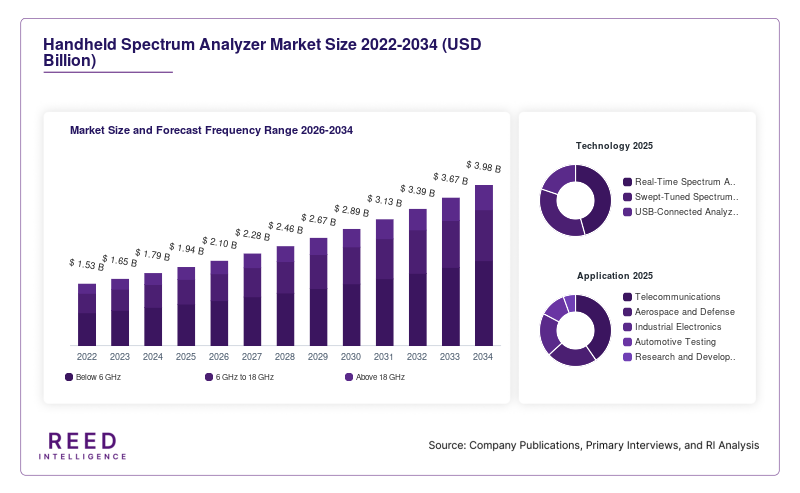
- By frequency range, 6 GHz to 18 GHz analyzers dominated with a 41.8% market share in 2025, whereas above 18 GHz analyzers are anticipated to grow at a CAGR of 9.4% through 2034.
- By application, telecommunications held the largest market share of 38.7% in 2025, while aerospace and defense applications are expected to expand at a CAGR of 9.0%.
- By technology, real-time spectrum analyzers captured 46.5% of the market in 2025, whereas USB-connected analyzers are forecast to grow at a CAGR of 8.9%.
- The United States remained the dominant country market, valued at USD 412.6 million in 2024 and USD 441.3 million in 2025.
Market Trends
Increasing Deployment of 5G Network Testing Solutions
The rapid rollout of 5G communication infrastructure is shaping the Handheld Spectrum Analyzer Market. Telecommunication companies and network service providers are increasingly using portable spectrum analyzers for network installation, optimization, and interference analysis. These devices enable field engineers to identify signal issues and improve network performance efficiently. The growing complexity of high-frequency communication systems is expected to accelerate demand for advanced handheld analyzers.
Growing Integration of Multi-Function Testing Capabilities
Manufacturers are increasingly integrating multiple testing functions into handheld spectrum analyzers to improve operational flexibility. Modern devices now combine spectrum analysis, signal generation, cable testing, and network diagnostics within a single portable platform. This trend is helping technicians reduce equipment costs and improve field-testing efficiency across industrial and communication environments.
Market Drivers
Expansion of Wireless Communication Infrastructure
The expansion of wireless communication infrastructure has significantly supported the Handheld Spectrum Analyzer Market. Governments and private telecommunication operators are investing heavily in mobile networks, satellite communication systems, and broadband expansion projects. Handheld spectrum analyzers are increasingly utilized to monitor signal integrity and optimize network performance during deployment and maintenance activities.
Rising Demand from Aerospace and Defense Sector
The aerospace and defense industry is witnessing growing adoption of handheld spectrum analyzers for radar testing, signal intelligence, and communication system diagnostics. Defense agencies and aerospace manufacturers require portable testing equipment for field operations and mission-critical communication systems. Increasing modernization of defense electronics and surveillance technologies is expected to strengthen market growth.
Market Restraint
High Cost of Advanced RF Testing Equipment
Advanced handheld spectrum analyzers with high-frequency coverage and real-time analysis capabilities often involve substantial acquisition costs. Small enterprises and budget-sensitive organizations may face challenges in adopting premium RF testing solutions. In addition, periodic calibration and software upgrade requirements can increase operational expenses for end users.
Market Opportunities
Expansion of Industrial IoT Applications
The growing deployment of industrial IoT infrastructure is creating new opportunities for the Handheld Spectrum Analyzer Market. Industrial operators increasingly require portable RF testing solutions to monitor wireless communication networks and connected devices within smart factories. Rising adoption of connected industrial systems is expected to increase demand for advanced field-testing equipment.
Increasing Adoption in Smart Transportation Systems
The development of smart transportation infrastructure is generating growth opportunities for handheld spectrum analyzer manufacturers. Transportation authorities and automotive technology providers are deploying wireless communication systems for traffic management, connected vehicles, and railway communication networks. Portable signal analysis equipment is expected to witness rising demand for maintenance and troubleshooting applications.
Segmental Analysis
By Frequency Range
6 GHz to 18 GHz Segment Dominated the Market
The 6 GHz to 18 GHz segment accounted for 41.8% of the Handheld Spectrum Analyzer Market share in 2025. The segment maintained dominance because of its broad application in telecommunications, wireless testing, satellite communication, and industrial RF diagnostics. Industries widely adopted analyzers within this frequency range due to their versatility and operational efficiency.
Above 18 GHz Segment to Witness Fastest Growth
The above 18 GHz segment is projected to expand at a CAGR of 9.4% during the forecast period. The segment is expected to gain traction due to increasing deployment of millimeter-wave communication technologies and advanced radar systems. Rising adoption of high-frequency 5G infrastructure and aerospace communication systems will support segment growth.
By Application
Telecommunications Held the Largest Share
Telecommunications represented 38.7% of the global Handheld Spectrum Analyzer Market share in 2025. The segment dominated because telecom operators extensively utilized portable spectrum analyzers for network optimization, signal monitoring, and interference management. Expanding mobile communication infrastructure globally supported segment growth.
Aerospace and Defense Applications Expected to Grow Rapidly
Aerospace and defense applications are anticipated to register a CAGR of 9.0% during the forecast period. Increasing investments in military communication systems and radar technologies will support segment expansion. Defense organizations are expected to deploy advanced portable RF testing solutions for field communication diagnostics and surveillance applications.
By Technology
Real-Time Spectrum Analyzers Led the Market
Real-time spectrum analyzers accounted for 46.5% of the Handheld Spectrum Analyzer Market share in 2025. The segment benefited from its ability to capture transient signals and provide accurate real-time analysis in complex RF environments. Industries increasingly adopted these analyzers for communication troubleshooting and high-frequency signal monitoring applications.
USB-Connected Analyzers to Register Strong Growth
USB-connected analyzers are projected to grow at a CAGR of 8.9% through 2034. The segment is expected to benefit from rising demand for compact, portable, and software-integrated testing solutions. Increasing utilization in field diagnostics and remote communication analysis will support segment demand.
By End-Use Industry
Telecommunications Industry Dominated the Market
The telecommunications industry held 36.1% of the Handheld Spectrum Analyzer Market share in 2025. The segment maintained dominance because communication service providers continuously require portable RF testing devices for network deployment and maintenance operations. Growing expansion of wireless infrastructure supported market demand.
Electronics Manufacturing Industry to Expand Significantly
The electronics manufacturing industry segment is expected to grow at a CAGR of 8.8% during the forecast period. Increasing production of connected devices, wireless modules, and smart electronic systems will support segment growth. Manufacturers are expected to adopt handheld analyzers for quality testing and RF performance verification applications.
Regional Analysis
North America
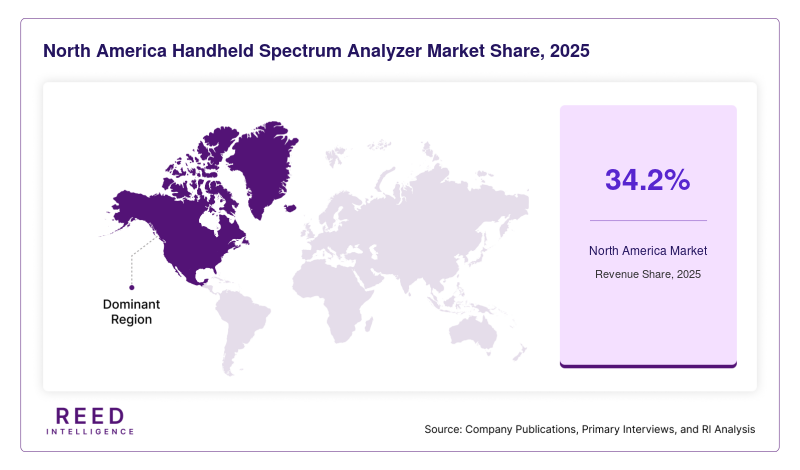
North America accounted for 34.2% of the global Handheld Spectrum Analyzer Market share in 2025 and is projected to grow at a CAGR of 7.9% during the forecast period. The regional market benefited from strong investments in advanced telecommunications infrastructure and defense modernization programs. The United States dominated the regional market due to increasing deployment of 5G networks and rising aerospace testing activities. Growing adoption of industrial wireless communication systems also supported market expansion.
Europe
Europe held 26.8% of the global Handheld Spectrum Analyzer Market share in 2025 and is anticipated to expand at a CAGR of 8.0% through 2034. The regional market was supported by increasing industrial automation and advanced communication technology development. Germany emerged as the leading country market due to strong electronics manufacturing capabilities and expanding automotive communication systems. Rising investments in smart factory infrastructure contributed to regional market development.
Asia Pacific
Asia Pacific represented 28.9% of the global Handheld Spectrum Analyzer Market share in 2025 and is forecast to register the fastest CAGR of 9.1% during the forecast period. China dominated the regional market due to rapid expansion of telecommunication infrastructure and electronics manufacturing activities. Increasing investments in semiconductor production and wireless connectivity projects are expected to strengthen regional demand.
Middle East & Africa
The Middle East & Africa accounted for 5.8% of the global Handheld Spectrum Analyzer Market share in 2025 and is projected to grow at a CAGR of 8.4% between 2026 and 2034. Saudi Arabia led the regional market owing to increasing investments in smart city infrastructure and advanced communication systems. Expanding industrial digitalization initiatives are expected to support market growth across the region.
Latin America
Latin America captured 4.3% of the global Handheld Spectrum Analyzer Market share in 2025 and is expected to grow at a CAGR of 7.6% during the forecast period. Brazil dominated the regional market due to increasing deployment of wireless communication networks and industrial connectivity projects. Growing investments in public communication infrastructure are anticipated to contribute to regional market expansion.
Competitive Landscape
The Handheld Spectrum Analyzer Market remains moderately competitive with the presence of electronic test equipment manufacturers, RF technology companies, and industrial communication solution providers. Market participants are focusing on frequency range expansion, software integration, compact device development, and strategic collaborations to strengthen their competitive position.
Keysight Technologies emerged as a leading market participant due to its broad RF testing portfolio and advanced portable spectrum analyzer technologies. The company recently expanded its real-time handheld analyzer solutions targeting 5G field-testing applications.
Rohde & Schwarz strengthened its portable RF testing product lineup through advanced signal analysis technologies.
Anritsu Corporation focused on handheld network testing and spectrum monitoring solutions for telecommunications applications.
Tektronix, Inc. expanded its portable signal analysis systems for industrial and aerospace communication diagnostics.
VIAVI Solutions Inc. invested in cloud-connected field testing technologies for communication infrastructure projects.
Key Players List
- Keysight Technologies
- Rohde & Schwarz
- Anritsu Corporation
- Tektronix, Inc.
- VIAVI Solutions Inc.
- National Instruments Corporation
- Advantest Corporation
- B&K Precision Corporation
- Rigol Technologies
- GW Instek
- Aaronia AG
- Bird Technologies
- EXFO Inc.
- Signal Hound
- Yokogawa Electric Corporation
Recent Developments
- In 2025, Keysight Technologies expanded its handheld real-time spectrum analyzer portfolio for 5G testing applications.
- In 2024, Rohde & Schwarz introduced portable RF analysis solutions with advanced cloud-based monitoring capabilities.
- In 2025, Anritsu Corporation launched upgraded handheld communication analyzers for wireless network diagnostics.
- In 2024, Tektronix, Inc. expanded its compact spectrum analyzer offerings for industrial field-testing operations.
- In 2025, VIAVI Solutions Inc. invested in AI-supported wireless communication testing technologies.
Handheld Spectrum Analyzer Market Segments
Frequency Range
- Below 6 GHz
- 6 GHz to 18 GHz
- Above 18 GHz
Technology
- Real-Time Spectrum Analyzers
- Swept-Tuned Spectrum Analyzers
- USB-Connected Analyzers
Application
- Telecommunications
- Aerospace and Defense
- Industrial Electronics
- Automotive Testing
- Research and Development
End-Use Industry
- Telecommunications Industry
- Electronics Manufacturing Industry
- Aerospace and Defense Industry
- Automotive Industry
- Industrial Manufacturing Industry
Distribution Channel
- Direct Sales
- Authorized Distributors
- Online B2B Platforms
- Electronics Equipment Retailers
- Industrial Solution Providers
By Region
- North America
- Europe
- APAC
- Middle East and Africa
- LATAM