Harbor Management Software Market Size, Share & Demand Report By Component (Software Solutions, Services), By Deployment Mode (On-Premise, Cloud-Based), By Application (Vessel Traffic Management, Cargo & Logistics Optimization, Port Operations Management, Safety & Compliance), By Region & Segment Forecasts, 2026–2034
USD 3950
Market Overview
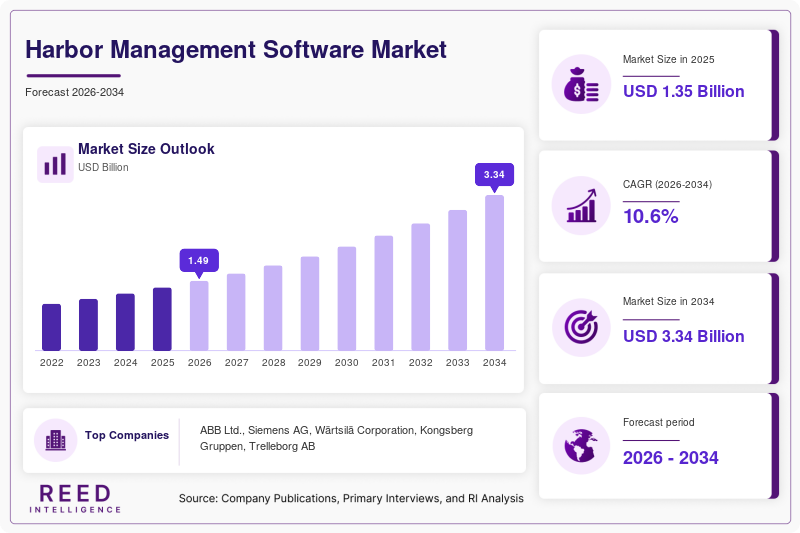
The Harbor Management Software Market size was valued at approximately USD 1.35 billion in 2026 and is projected to reach USD 3.02 billion by 2034, expanding at a CAGR of 10.6% during the forecast period (2026–2034). The market is witnessing steady growth due to the increasing digitization of maritime infrastructure and the need for efficient port operations management. Harbor management software solutions help port authorities and operators streamline vessel traffic, berth allocation, cargo handling, and compliance processes, thereby improving operational efficiency and reducing turnaround time.
A key global factor supporting market growth is the rise in international maritime trade, driven by globalization and the expansion of supply chain networks. Ports are under pressure to handle increasing vessel volumes while maintaining safety and regulatory compliance. This has accelerated the adoption of advanced software platforms that integrate real-time analytics, IoT data, and automation capabilities. Additionally, governments and port authorities are investing in smart port initiatives, further boosting the demand for digital harbor management solutions.
Key Highlights
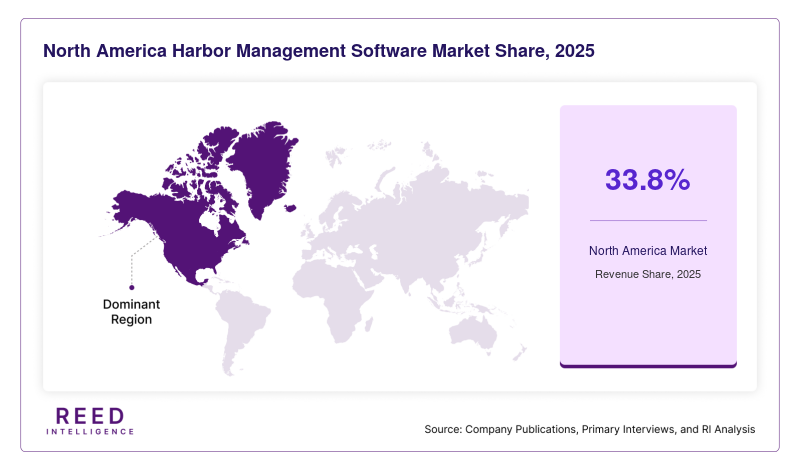
- North America dominated the market with a 33.8% share in 2025.
- Asia Pacific is expected to grow at the fastest CAGR of 11.9% during 2026–2034.
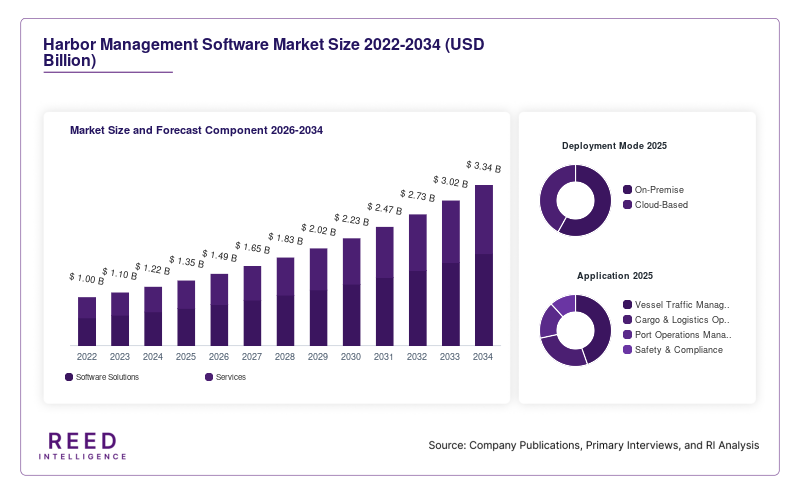
- By component, software solutions accounted for the largest share of 62.4%, while cloud-based deployment is projected to grow at a CAGR of 12.6%.
- By application, vessel traffic management led with a 39.5% share, whereas cargo and logistics optimization is expected to expand at a CAGR of 11.7%.
- The United States remained the dominant country, with market values of USD 420 million in 2024 and USD 455 million in 2025.
Market Trends
Integration of AI and Predictive Analytics in Port Operations
The integration of artificial intelligence and predictive analytics is reshaping harbor management software capabilities. Ports are increasingly adopting AI-driven systems to forecast vessel arrival times, optimize berth scheduling, and manage cargo flows efficiently. These technologies enable predictive maintenance of port infrastructure, reducing downtime and operational disruptions. Additionally, AI-powered analytics enhance decision-making by processing large volumes of data from sensors, vessels, and logistics systems. This trend is particularly relevant as ports seek to improve efficiency while handling growing trade volumes. The ability to predict congestion and automate scheduling processes reduces delays and enhances throughput. As digital transformation accelerates across maritime industries, the adoption of intelligent harbor management platforms is expected to increase steadily.
Growth of Cloud-Based Harbor Management Platforms
Cloud-based deployment models are gaining traction in the harbor management software market due to their scalability, flexibility, and cost-effectiveness. Port authorities and operators are shifting from traditional on-premise systems to cloud platforms to enable real-time data access and seamless collaboration across stakeholders. Cloud solutions also support remote monitoring and centralized control of multiple port operations, which is critical for large port networks. Furthermore, these platforms reduce IT infrastructure costs and allow for faster implementation and upgrades. As cybersecurity measures improve and cloud adoption becomes more widespread, even smaller ports are embracing cloud-based harbor management systems. This trend is expected to drive significant market expansion over the forecast period.
Market Drivers
Increasing Demand for Efficient Port Operations
The growing complexity of global supply chains has increased the demand for efficient and streamlined port operations. Harbor management software plays a critical role in optimizing vessel traffic, cargo handling, and resource allocation. Ports are facing rising pressure to reduce turnaround times and minimize congestion, especially in high-traffic regions. Software solutions enable real-time monitoring and coordination, allowing port authorities to manage operations more effectively. Additionally, automation of routine processes reduces human error and improves operational accuracy. The increasing need to enhance productivity while maintaining safety standards is a key driver for the adoption of harbor management software across major ports worldwide.
Government Initiatives for Smart Port Development
Governments across the globe are investing heavily in smart port infrastructure to improve trade efficiency and competitiveness. These initiatives include the implementation of digital platforms, IoT-enabled systems, and advanced analytics tools. Harbor management software is a fundamental component of smart port ecosystems, enabling seamless integration of various port functions. Public-private partnerships and funding programs are further accelerating the adoption of digital solutions in port operations. Regulatory requirements for environmental compliance and safety are also encouraging the use of advanced software systems. As governments continue to prioritize modernization of maritime infrastructure, the demand for harbor management software is expected to rise significantly.
Market Restraint
High Implementation and Integration Costs
One of the primary challenges in the harbor management software market is the high cost associated with implementation and integration. Deploying advanced software systems requires significant investment in infrastructure, training, and system customization. Smaller ports and developing regions often face budget constraints, limiting their ability to adopt such solutions. Additionally, integrating new software with existing legacy systems can be complex and time-consuming, leading to operational disruptions. The need for skilled personnel to manage and maintain these systems further adds to the overall cost. This restraint can slow down market adoption, particularly among smaller port operators. Despite these challenges, vendors are working to develop cost-effective and scalable solutions to address these barriers.
Market Opportunities
Expansion of Emerging Port Infrastructure
The rapid development of new ports and expansion of existing ones in emerging economies presents significant growth opportunities for the harbor management software market. Countries in Asia, Africa, and Latin America are investing in port infrastructure to support economic growth and trade expansion. These projects often include the integration of modern digital systems from the outset, creating demand for advanced harbor management software. The adoption of such solutions helps new ports achieve operational efficiency and global competitiveness. As trade volumes continue to increase, the need for scalable and efficient port management systems is expected to grow, providing substantial opportunities for market players.
Increasing Focus on Environmental Sustainability
Environmental sustainability is becoming a key priority for port authorities worldwide. Harbor management software can support sustainability initiatives by optimizing vessel movements, reducing fuel consumption, and minimizing emissions. Advanced systems enable monitoring of environmental parameters and compliance with regulations. Ports are increasingly adopting green practices, including the use of renewable energy and efficient resource management. Software solutions that integrate environmental monitoring and reporting capabilities are gaining traction. This focus on sustainability is expected to create new opportunities for vendors offering innovative and eco-friendly harbor management solutions.
Segmental Analysis
By Component
The software solutions segment dominated the harbor management software market in 2024, accounting for approximately 62.4% of the total market share. This dominance is attributed to the increasing demand for integrated platforms that can manage multiple port operations, including vessel traffic, cargo handling, and compliance management. Software solutions provide real-time data insights, enabling port authorities to make informed decisions and improve operational efficiency. Additionally, the ability to customize these solutions according to specific port requirements enhances their adoption. The growing complexity of port operations and the need for automation are further driving the demand for advanced software solutions.
The services segment is expected to be the fastest-growing subsegment, with a projected CAGR of 11.5% during the forecast period. This growth is driven by the increasing need for system integration, maintenance, and support services. As ports adopt advanced software solutions, the demand for professional services to ensure smooth implementation and operation is rising. Training and consulting services are also gaining importance as organizations seek to maximize the benefits of their software investments. The expansion of digital transformation initiatives in the maritime industry is expected to further boost the demand for services.
By Deployment Mode
The on-premise deployment segment held the largest market share in 2024, accounting for approximately 55.2%. This is primarily due to concerns related to data security and the need for greater control over system operations. Many large ports prefer on-premise solutions as they offer higher levels of customization and integration with existing systems. Additionally, regulatory requirements in certain regions mandate the use of secure and controlled IT environments, supporting the adoption of on-premise solutions.
The cloud-based deployment segment is expected to grow at the fastest CAGR of 12.6% during the forecast period. The increasing adoption of cloud technology is driven by its scalability, flexibility, and cost-effectiveness. Cloud-based solutions enable real-time data access and remote monitoring, which are critical for modern port operations. Additionally, advancements in cybersecurity and data protection are addressing concerns related to cloud adoption. As more ports seek to modernize their operations, the demand for cloud-based harbor management software is expected to increase significantly.
By Application
The vessel traffic management segment dominated the market in 2024, accounting for approximately 39.5% of the total share. This segment’s growth is driven by the need to manage increasing vessel traffic efficiently and ensure safety in port operations. Harbor management software enables real-time monitoring and coordination of vessel movements, reducing congestion and improving turnaround times. The integration of advanced technologies such as AI and IoT further enhances the capabilities of these systems.
The cargo and logistics optimization segment is expected to be the fastest-growing, with a CAGR of 11.7% during the forecast period. The growth of this segment is driven by the increasing demand for efficient cargo handling and supply chain management. Harbor management software helps optimize cargo flows, reduce delays, and improve overall logistics efficiency. As global trade continues to expand, the importance of efficient cargo management is expected to drive the adoption of advanced software solutions.
Regional Analysis
North America
North America accounted for a significant share of the harbor management software market in 2025, contributing approximately 33.8% of the global revenue. The region is expected to maintain steady growth with a CAGR of around 9.8% during the forecast period. The presence of advanced port infrastructure and high adoption of digital technologies are key factors supporting market growth. Additionally, the region’s strong focus on operational efficiency and regulatory compliance drives the demand for sophisticated harbor management solutions.
The United States dominates the North American market due to its extensive port network and high trade volumes. A unique growth factor in the region is the adoption of automation and AI technologies in port operations. Major ports are investing in smart systems to enhance efficiency and reduce operational costs. This trend is expected to continue, driving the adoption of advanced harbor management software solutions.
Europe
Europe held a substantial share of the harbor management software market in 2025, accounting for approximately 27.5% of global revenue. The region is projected to grow at a CAGR of 9.5% during the forecast period. The presence of well-established ports and strong regulatory frameworks contributes to the adoption of advanced software solutions. Additionally, the region’s focus on sustainability and environmental compliance supports market growth.
Germany is a leading country in the European market, driven by its strong maritime trade and advanced logistics infrastructure. A unique growth factor in the region is the emphasis on green port initiatives. Ports are adopting digital solutions to reduce emissions and improve energy efficiency. This focus on sustainability is expected to drive further adoption of harbor management software.
Asia Pacific
Asia Pacific is expected to be the fastest-growing region in the harbor management software market, with a CAGR of 11.9% during the forecast period. The region accounted for approximately 24.3% of the global market share in 2025. Rapid industrialization, increasing trade activities, and expanding port infrastructure are key factors driving market growth. Governments are investing in smart port development, further boosting demand.
China dominates the Asia Pacific market due to its extensive port network and high trade volumes. A unique growth factor in the region is the large-scale investment in port modernization projects. These initiatives include the adoption of digital technologies and automation, which are driving the demand for advanced harbor management software solutions.
Middle East & Africa
The Middle East & Africa region accounted for approximately 8.4% of the global harbor management software market in 2025 and is expected to grow at a CAGR of 10.2% during the forecast period. The region’s strategic location as a global trade hub supports the growth of port infrastructure and related technologies. Increasing investments in port development are driving demand for advanced management systems.
The United Arab Emirates is a key country in the region, with a strong focus on port modernization. A unique growth factor is the development of smart ports integrated with digital technologies. These initiatives are aimed at enhancing operational efficiency and attracting global trade, thereby increasing the adoption of harbor management software.
Latin America
Latin America held a share of approximately 6.0% in the harbor management software market in 2025 and is projected to grow at a CAGR of 9.3% during the forecast period. The region is witnessing gradual growth due to increasing trade activities and investments in port infrastructure. Governments are focusing on improving logistics efficiency to support economic development.
Brazil is the dominant country in the region, driven by its large port network and growing trade volumes. A unique growth factor is the modernization of port operations through digital transformation initiatives. These efforts are expected to enhance efficiency and drive the adoption of harbor management software across the region.
Competitive Landscape
The harbor management software market is characterized by the presence of several established players focusing on innovation and strategic partnerships. Companies are investing in research and development to enhance their product offerings and integrate advanced technologies such as AI, IoT, and cloud computing. The market is moderately competitive, with players competing based on functionality, scalability, and cost-effectiveness of their solutions.
ABB Ltd. is considered a leading player in the market due to its comprehensive portfolio of digital solutions for port operations. The company has recently introduced advanced analytics capabilities in its harbor management systems to improve operational efficiency and decision-making. Other key players are also focusing on expanding their global presence through partnerships and acquisitions. Continuous innovation and the development of customized solutions are expected to remain key strategies for market players.
Key Players
- ABB Ltd.
- Siemens AG
- Wärtsilä Corporation
- Kongsberg Gruppen
- Trelleborg AB
- Saab AB
- PortXchange
- Innovez One
- Softship AG
- Navis LLC
- IBM Corporation
- Oracle Corporation
- Accenture plc
- Thales Group
- Honeywell International Inc.
Recent Developments
- ABB Ltd. launched an upgraded harbor management platform with enhanced predictive analytics capabilities in 2025.
- Wärtsilä Corporation partnered with a major port authority to implement a cloud-based port management solution.
- Siemens AG introduced a new digital twin solution for port operations to improve efficiency and sustainability.
Harbor Management Software Market Segments
Component
- Software Solutions
- Services
Deployment Mode
- On-Premise
- Cloud-Based
Application
- Vessel Traffic Management
- Cargo & Logistics Optimization
- Port Operations Management
- Safety & Compliance
By Region
- North America
- Europe
- APAC
- Middle East and Africa
- LATAM