Hazardous Location Thermostats Market Size, Share Demand Report By Product Type (Explosion-Proof Thermostats, Intrinsically Safe Thermostats, Purged/Pressurized Thermostats), By Application (Oil & Gas, Chemical, Mining, Pharmaceuticals, Others), By Certification Type (Class I, Class II, Class III) & Segment Forecasts, 2026–2034
USD 3950
Hazardous Location Thermostats Market Size
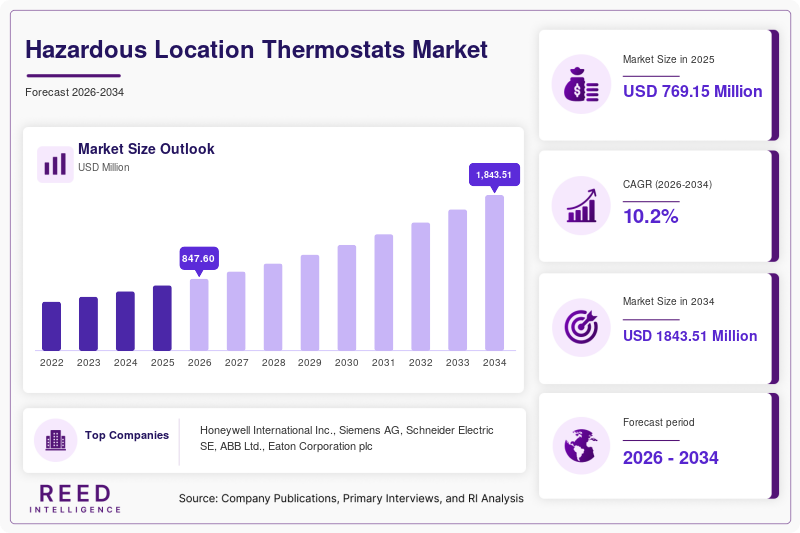
Hazardous Location Thermostats market size is projected at USD 847.6 million in 2026 and is expected to hit USD 1,847.5 million by 2034 with a CAGR of 10.2% during the forecast period. The increasing focus on workplace safety in industries with explosive atmospheres, coupled with stringent government regulations and the growing demand for reliable temperature control in hazardous environments, underpins market expansion. This report delivers a comprehensive analysis of the Hazardous Location Thermostats market, including segmentation by type and application, competitive dynamics, and regional growth patterns, equipping stakeholders with critical intelligence. The Hazardous Location Thermostats market continues to demonstrate strong growth potential, fueled by the expansion of the oil & gas and chemical sectors, the increasing adoption of automation in hazardous areas, and continuous innovation in safety-certified thermostat technologies.
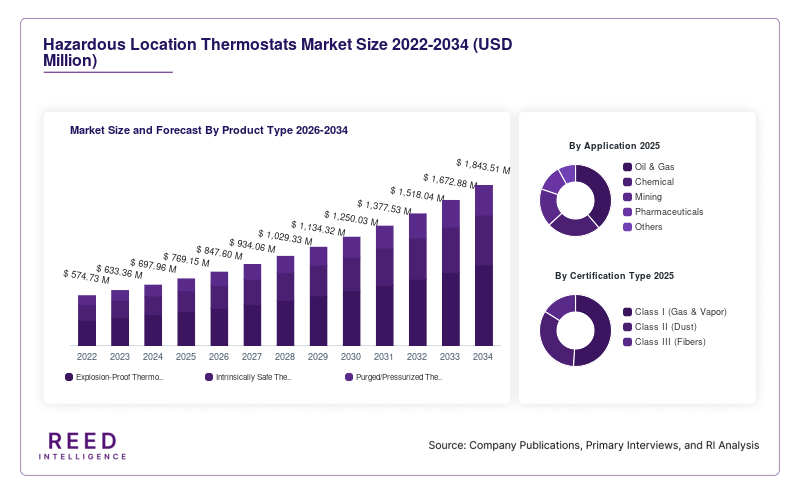
Hazardous location thermostats are specialized temperature control devices designed for use in environments where flammable gases, vapors, or dust are present. These thermostats are built to prevent ignition and ensure safe operation in classified hazardous areas. The global production volume of hazardous location thermostats exceeded 1.2 million units in 2025, reflecting a 9% increase from 2023, driven by the growing demand for safety equipment in high-risk industries. Adoption patterns reveal that the Explosion-Proof Thermostats type dominates the market, accounting for 45% of total demand, followed by Intrinsically Safe Thermostats at 32%, and Purged/Pressurized Thermostats at 23%. The Hazardous Location Thermostats market's trajectory is closely linked to the growth of the global industrial safety market, which is projected to reach USD 50 billion by 2028, and the increasing need to comply with stringent safety standards.
Hazardous Location Thermostats Market Trends
Integration of Smart and Wireless Technologies
The Hazardous Location Thermostats market is witnessing a significant trend toward the integration of smart and wireless technologies, driven by the need for remote monitoring, predictive maintenance, and enhanced safety. The revenue from smart hazardous location thermostats grew to USD 280 million in 2025, a year-on-year increase of 18%, as 30% of new product launches in 2025 specified wireless communication and IoT capabilities. Adoption rates of smart thermostats in oil & gas applications reached 25%, with this figure projected to exceed 45% by 2030. The Hazardous Location Thermostats market's trend toward smart technology is reinforced by the need for real-time data, the increasing focus on operational efficiency, and the continuous innovation in wireless and sensor technologies.
Growing Focus on Compact and Corrosion-Resistant Designs
The increasing focus on compact and corrosion-resistant designs is a major trend shaping the Hazardous Location Thermostats market, with the development of smaller, more durable devices for harsh environments. The market has seen a 12% increase in the demand for compact thermostats since 2022, with 25% of new products in 2025 featuring reduced size and enhanced corrosion resistance. The use of advanced materials like stainless steel and specialized coatings for improved durability has also gained significant traction. The Hazardous Location Thermostats market's trend toward compactness and durability is reinforced by the need for space optimization, the increasing severity of operating conditions, and the continuous innovation in material science and manufacturing techniques.
Hazardous Location Thermostats Market Drivers
The Hazardous Location Thermostats market's expansion is primarily driven by the increasing focus on workplace safety and the need to comply with stringent regulatory standards, with the global industrial safety market valued at USD 35 billion in 2025 and growing at a steady pace. The need for reliable temperature control in explosive atmospheres to prevent accidents has been a major driver. The expansion of the oil & gas, chemical, and mining industries has also fueled market growth. Additionally, the increasing adoption of automation and control systems in hazardous areas has spurred demand. The Hazardous Location Thermostats market's growth is further reinforced by the continuous improvement in thermostat technology, leading to better safety and reliability.
Hazardous Location Thermostats Market Restraints
Despite favorable growth prospects, the Hazardous Location Thermostats market faces significant constraints, primarily related to the high cost of safety-certified thermostats, which can be 30-50% more expensive than standard units. The complexity of certification and the need for specialized installation can also be a limitation. The Hazardous Location Thermostats market's growth is also tempered by the challenge of ensuring compatibility with various hazardous area classifications and the need for regular maintenance and inspection.
Hazardous Location Thermostats Market Opportunities
The Hazardous Location Thermostats market presents significant opportunities in the rapidly expanding market for process automation and digitalization in hazardous areas, where smart thermostats are essential. The development of thermostats with enhanced diagnostics and predictive maintenance capabilities is expected to grow at a CAGR of 12% through 2034. Emerging opportunities also exist in the use of advanced materials for improved corrosion resistance and the expansion into emerging economies with growing industrial sectors. The Hazardous Location Thermostats market's opportunity profile is further enhanced by the increasing focus on reducing downtime and improving operational efficiency.
Challenges in Hazardous Location Thermostats Market
The Hazardous Location Thermostats market faces persistent challenges related to the need for continuous innovation to meet evolving safety standards and application requirements. The complexity of designing thermostats that are safe, reliable, and cost-effective for various hazardous environments can also be a challenge. The market is also contending with the challenge of managing the lifecycle of certified products and ensuring compliance with changing regulations. Additionally, the Hazardous Location Thermostats market is challenged by the need to educate end-users on the importance of proper selection and installation of certified equipment.
Hazardous Location Thermostats Market Segmentation
The Hazardous Location Thermostats market is segmented by Type and Application to provide a comprehensive market perspective. By Type, Explosion-Proof Thermostats dominate with a 45% market share, driven by their robustness and wide acceptance. The Application segment is led by Oil & Gas, which accounts for 35% of the market, followed by Chemical at 28%, Mining at 18%, Pharmaceuticals at 12%, and Others at 7%.
By Type
Explosion-Proof Thermostats represent the largest segment in the Hazardous Location Thermostats market, commanding a 45% share, with production exceeding 0.54 million units in 2025. These are characterized by their robust enclosures designed to contain an explosion and prevent ignition of the surrounding atmosphere. Technical specifications include enclosure type (Class I, II, III), temperature class, and NEMA rating. The Hazardous Location Thermostats market's Explosion-Proof segment is driven by its use in oil & gas and chemical applications.
Intrinsically Safe Thermostats capture a 32% share of the Hazardous Location Thermostats market, with production of 0.384 million units in 2025. These are characterized by their design that limits energy to prevent ignition. Technical specifications include safety barriers, energy limitation, and certification standards. The Hazardous Location Thermostats market's Intrinsically Safe segment is driven by its use in areas with sensitive instrumentation.
Purged/Pressurized Thermostats represent the remaining 23% of the Hazardous Location Thermostats market, with production of 0.276 million units in 2025. These are characterized by their use of a purge system to prevent the ingress of hazardous gases. Technical specifications include purge gas type, flow rate, and pressure monitoring. The Hazardous Location Thermostats market's Purged segment is driven by its use in large enclosures and complex systems.
By Application
Oil & Gas dominates the Hazardous Location Thermostats market, accounting for 35% of sales, representing 0.42 million units in 2025. This segment includes use in refineries, offshore platforms, and pipelines. Usage penetration exceeds 40% in the sector. The Hazardous Location Thermostats market's Oil & Gas segment is characterized by its focus on high reliability and corrosion resistance.
Chemical accounts for 28% of the Hazardous Location Thermostats market, with sales of 0.336 million units in 2025. This segment encompasses use in chemical plants and processing facilities. The segment is growing at a steady CAGR, driven by the expansion of the chemical industry. The Hazardous Location Thermostats market's Chemical segment is characterized by its focus on chemical resistance and precise control.
Mining represents 18% of the Hazardous Location Thermostats market, with sales of 0.216 million units in 2025. This segment includes use in underground and surface mining operations. The segment is growing at a moderate rate. The Hazardous Location Thermostats market's Mining segment is characterized by its focus on ruggedness and dust resistance.
Pharmaceuticals accounts for 12% of the Hazardous Location Thermostats market, with sales of 0.144 million units in 2025. This segment includes use in pharmaceutical manufacturing with flammable solvents. The segment is growing at a robust pace. The Hazardous Location Thermostats market's Pharmaceuticals segment is characterized by its focus on cleanliness and precision.
Others comprises the remainder of the Hazardous Location Thermostats market, accounting for 7% of total sales, with 0.084 million units in 2025. This includes use in food processing, wastewater treatment, and other niche applications. The segment is projected to grow at a steady CAGR through 2034. The Hazardous Location Thermostats market's Others segment is characterized by its diverse and specialized applications.
Hazardous Location Thermostats Market Regional Outlook
North America Hazardous Location Thermostats Market
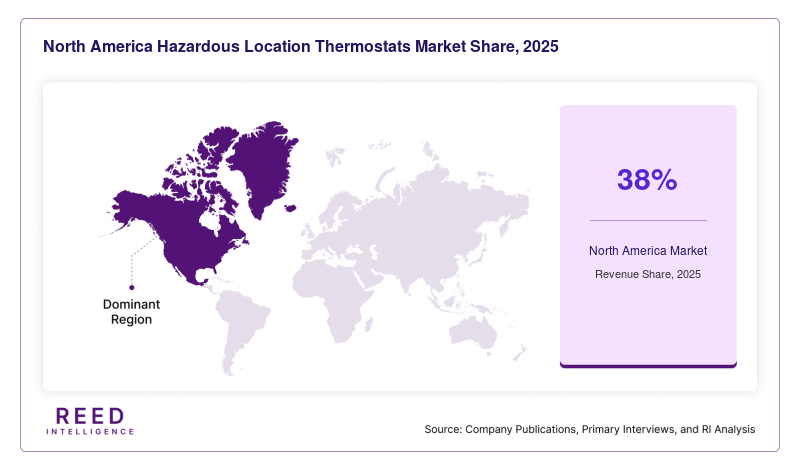
Leads the Hazardous Location Thermostats market, commanding a 38% share, with a revenue of USD 322.0 million in 2025. The United States is the primary driver, accounting for 85% of regional demand, driven by the large oil & gas and chemical industries, stringent safety regulations, and a strong focus on workplace safety. The North American Hazardous Location Thermostats market is characterized by its focus on innovation and high-quality products.
Europe Hazardous Location Thermostats Market
Represents the second-largest market, capturing a 30% share with a revenue of USD 254.3 million in 2025. The UK, Germany, and France are the primary drivers, collectively accounting for 60% of regional demand, driven by a strong industrial base, strict safety standards, and a focus on quality. The Hazardous Location Thermostats market in Europe is characterized by its focus on compliance and advanced technology.
Asia-Pacific Hazardous Location Thermostats Market
Accounts for 22% of the global Hazardous Location Thermostats market, with a revenue of USD 186.5 million in 2025. China, India, and Japan are the primary drivers, together accounting for 70% of regional demand, driven by rapid industrialization, expansion of the oil & gas and chemical sectors, and growing safety awareness. The Asia-Pacific Hazardous Location Thermostats market is projected to grow at the fastest CAGR of 13% through 2034.
Middle East & Africa and Latin America Hazardous Location Thermostats Market
Together account for the remaining 10% of the Hazardous Location Thermostats market, with the UAE leading the Middle East market and Brazil leading the Latin American market. Both regions are projected to grow at CAGRs exceeding 11%, driven by oil & gas investments and industrial growth.
Top players in Hazardous Location Thermostats Market
- Honeywell International Inc.
- Siemens AG
- Schneider Electric SE
- ABB Ltd.
- Eaton Corporation plc
- Emerson Electric Co.
- Johnson Controls International plc
- Rockwell Automation, Inc.
- General Electric Company
- Yokogawa Electric Corporation
- Parker Hannifin Corporation
- Nidec Corporation
- Dwyer Instruments, Inc.
- WIKA Alexander Wiegand SE & Co. KG
- Asco (Emerson)
Honeywell International Inc.
Honeywell International holds a dominant position in the Hazardous Location Thermostats market, with an estimated 18% global market share, particularly strong in the oil & gas and chemical segments. The company's portfolio of hazardous location thermostats is widely recognized for its quality, reliability, and safety certifications. Honeywell's market leadership is reinforced by its significant R&D investment, its comprehensive product line, and its strong global presence. Honeywell commands over 20% of the North American market and 16% of the European market, positioning it as a key player in the Hazardous Location Thermostats market.
Siemens AG
Siemens AG is a leading player in the Hazardous Location Thermostats market, commanding approximately 14% of the global market share through its comprehensive portfolio of industrial automation and safety solutions. The company's expertise in process automation and its focus on safety have solidified its position. Siemens' hazardous location thermostats are known for their precision, reliability, and integration with its control systems. The company's commitment to innovation and its strong presence in the European and Asian markets have enhanced its competitive advantage.
Schneider Electric SE holds a significant 12% market share, with particular strength in the chemical and pharmaceutical segments. ABB Ltd. is a major player in the oil & gas and industrial automation market, holding a 10% share.
Recent Developments in Hazardous Location Thermostats Market
- 2025: Honeywell launched a new series of smart hazardous location thermostats with integrated wireless monitoring for real-time temperature data and predictive maintenance.
- 2025: Siemens AG introduced a new compact intrinsically safe thermostat with enhanced diagnostics for chemical and pharmaceutical applications.
Hazardous Location Thermostats Market Segments
By Product Type
- Explosion-Proof Thermostats
- Intrinsically Safe Thermostats
- Purged/Pressurized Thermostats
By Application
- Oil & Gas
- Chemical
- Mining
- Pharmaceuticals
- Others
By Certification Type
- Class I (Gas & Vapor)
- Class II (Dust)
- Class III (Fibers)
By Region
- North America
- Europe
- APAC
- Middle East and Africa
- LATAM