HDPE Wax Market Size, Share & Demand Report By Product Type (Oxidized HDPE Wax, Micronized HDPE Wax, Non-Oxidized HDPE Wax, Emulsified HDPE Wax), By Application (Plastics Processing, Hot-Melt Adhesives, Printing Inks, Industrial Coatings, Rubber Processing, Textile Processing), By End-Use Industry (Packaging, Automotive, Construction, Consumer Goods, Textile, Electrical & Electronics), By Region & Segment Forecasts, 2026–2034
USD 3950
Market Overview
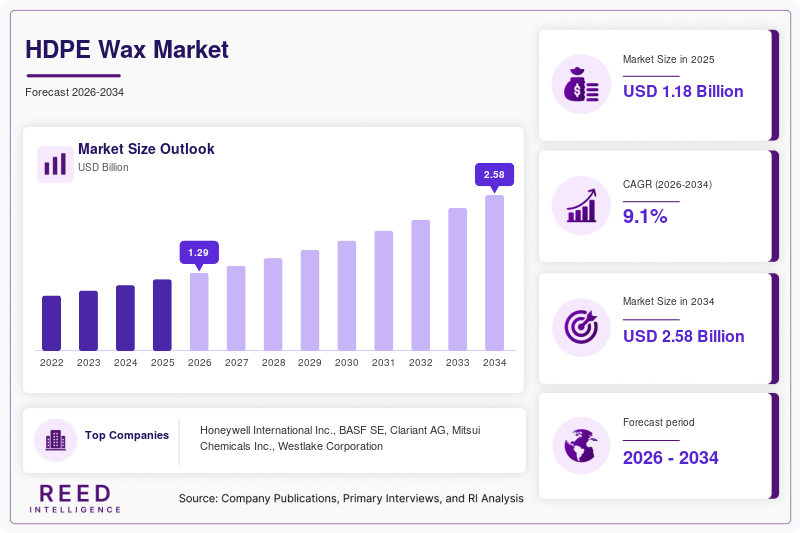
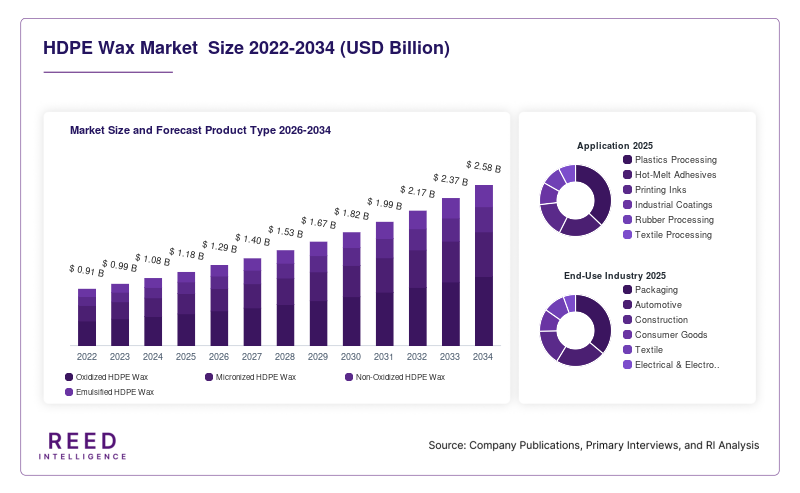
The global HDPE Wax Market size was valued at USD 1.18 billion in 2026 and is projected to reach USD 2.37 billion by 2034, expanding at a CAGR of 9.1% during the forecast period from 2026 to 2034. HDPE wax, also known as high-density polyethylene wax, is widely used as a lubricant, dispersing agent, processing aid, and surface modifier across plastics, coatings, adhesives, inks, rubber, and textile applications. The material delivers strong chemical resistance, improved thermal stability, high hardness, and enhanced scratch resistance, making it suitable for industrial manufacturing processes that require performance consistency and operational efficiency.
Growing demand for advanced polymer processing materials across packaging, construction, automotive, and consumer goods industries has supported the expansion of the HDPE Wax Market. Manufacturers are increasingly adopting HDPE wax in PVC processing, hot-melt adhesives, color masterbatches, and industrial coatings due to its ability to improve melt flow, reduce friction, and enhance production output. In addition, rapid industrialization in developing economies and the expansion of flexible packaging production facilities have created favorable conditions for long-term market growth. Increased investments in sustainable packaging and lightweight polymer products have also encouraged the use of HDPE wax formulations that support improved processing efficiency and lower material waste.
Key Highlights
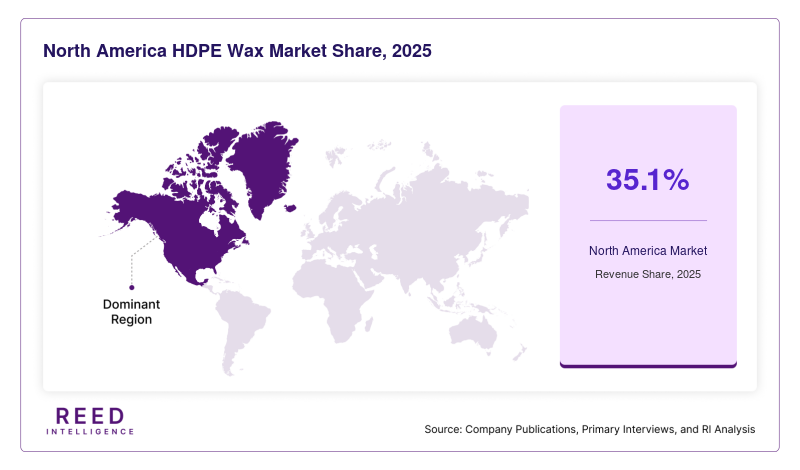
- North America dominated the market with a 35.1% share in 2025, while Asia Pacific is expected to grow at the fastest CAGR of 10.8% during 2026–2034.
- By product type, oxidized HDPE wax accounted for the largest share of 39.4%, while micronized HDPE wax is projected to grow at a CAGR of 11.6%.
- By application, plastics processing led with a 42.3% share, whereas hot-melt adhesives are expected to expand at a CAGR of 11.2%.
- By end-use industry, packaging accounted for the largest share of 31.7%, while automotive is projected to grow at a CAGR of 10.9%.
- The United States remained the dominant country, with market values of USD 298 million in 2024 and USD 327 million in 2025.
Market Trends
Rising Adoption of Micronized HDPE Wax in High-Performance Coatings
The HDPE Wax Market is experiencing growing demand for micronized HDPE wax in industrial coatings and printing ink formulations. Manufacturers are increasingly incorporating micronized wax additives into coatings to improve abrasion resistance, anti-blocking properties, gloss control, and slip performance. The growing use of durable coatings in automotive components, industrial machinery, and metal packaging has accelerated product demand across developed and emerging economies. In addition, stricter quality requirements in wood coatings and decorative paints are encouraging producers to adopt advanced wax technologies that improve surface protection and processing efficiency. Micronized HDPE wax is also gaining traction in powder coatings due to its compatibility with multiple resin systems and its ability to provide consistent particle distribution.
The shift toward premium packaging and visually appealing consumer products is further supporting the demand for specialty wax formulations in coatings and inks. Packaging manufacturers are using HDPE wax additives to improve print quality and scratch resistance in labels, flexible films, and cartons. Producers are investing in research activities to develop customized wax grades that support low volatile organic compound coatings and environmentally conscious industrial applications. This trend is expected to continue as industries prioritize durable surface finishes, operational efficiency, and enhanced product aesthetics.
Expansion of HDPE Wax Consumption in Polymer and Masterbatch Processing
The increasing use of color masterbatches and engineered polymers in packaging, automotive, and electrical applications has become a notable trend in the HDPE Wax Market. HDPE wax is widely used as a dispersing agent in masterbatch production because it supports pigment distribution, improves melt flow, and reduces processing time. The rising consumption of plastic compounds and specialty polymer blends has encouraged manufacturers to increase production capacities for synthetic wax additives. Demand is particularly strong in Asia Pacific, where expanding manufacturing activity and rising polymer exports continue to create favorable growth opportunities.
The transition toward lightweight plastic products and high-speed extrusion processes is also contributing to higher HDPE wax consumption. Manufacturers are using advanced wax formulations to improve throughput efficiency and reduce energy consumption during polymer processing. The packaging sector is increasingly adopting high-performance additives that enhance the appearance and durability of plastic products without affecting production costs. As industrial automation and high-volume polymer production continue to expand globally, the use of HDPE wax in masterbatch and polymer processing applications is expected to increase steadily during the forecast period.
Market Drivers
Increasing Demand from the Packaging and Plastics Industry
The rapid growth of the global packaging sector is one of the major factors driving the HDPE Wax Market. Flexible packaging, rigid packaging, and industrial plastic products require high-performance additives that improve manufacturing efficiency and product quality. HDPE wax is widely utilized in plastic processing applications because it enhances lubrication, minimizes equipment wear, and improves surface smoothness. Rising consumption of packaged food, consumer goods, and pharmaceutical products has increased the production of polymer-based packaging materials, creating sustained demand for HDPE wax across processing facilities.
Plastic manufacturers are increasingly adopting HDPE wax in extrusion, injection molding, and compounding operations to improve productivity and maintain product consistency. The material supports improved pigment dispersion and reduces friction during high-speed processing operations. In emerging economies, expanding urban populations and increasing retail distribution networks are encouraging investments in plastic packaging production. In addition, the growth of e-commerce and logistics industries has accelerated demand for durable packaging solutions that rely on advanced polymer additives. These factors continue to strengthen long-term demand for HDPE wax products across global manufacturing industries.
Growth of Industrial Coatings and Adhesives Applications
The expanding use of industrial coatings and hot-melt adhesives is supporting the growth of the HDPE Wax Market. HDPE wax is increasingly used in coating formulations because it improves scratch resistance, slip performance, and surface durability. Automotive manufacturers, furniture producers, and construction material suppliers are investing in advanced coating systems that enhance product lifespan and visual quality. This has created strong demand for wax additives capable of delivering reliable performance under varying environmental conditions.
The hot-melt adhesives sector is also witnessing increased use of HDPE wax due to the material’s ability to improve viscosity control, thermal resistance, and bonding performance. Demand for adhesives in packaging, woodworking, hygiene products, and labeling applications has increased significantly in recent years. Manufacturers are focusing on improving production efficiency while maintaining strong adhesive performance, which has encouraged the adoption of specialty wax formulations. Furthermore, rising industrial output and infrastructure development projects in Asia Pacific and the Middle East are generating additional opportunities for coating and adhesive manufacturers, thereby supporting the broader expansion of the HDPE Wax Market.
Market Restraint
Volatility in Raw Material Prices and Supply Chain Disruptions
Fluctuations in crude oil prices and polyethylene feedstock costs remain a significant restraint for the HDPE Wax Market. HDPE wax production is closely linked to petrochemical supply chains, making manufacturers vulnerable to raw material price instability and transportation disruptions. Sudden increases in feedstock costs can reduce profit margins for wax producers and create pricing challenges for downstream industries such as plastics, coatings, and adhesives. In highly competitive markets, manufacturers often face difficulties passing increased production costs to customers, particularly in price-sensitive applications.
Supply chain disruptions caused by geopolitical tensions, shipping delays, and fluctuations in energy costs have also affected market stability. Many small and medium-sized manufacturers rely on imported raw materials and face procurement challenges during periods of market uncertainty. Production slowdowns in major petrochemical hubs can reduce the availability of polyethylene-based feedstocks, leading to inconsistent supply conditions. For example, disruptions in global shipping routes during periods of trade imbalance have increased logistics costs for industrial additives and specialty chemicals. These challenges can delay manufacturing schedules and affect long-term procurement planning for end-use industries. Although companies are investing in regional production facilities and alternative sourcing strategies, raw material volatility continues to remain a key concern for market participants.
Market Opportunities
Growing Demand for Sustainable and Recyclable Packaging Solutions
The increasing focus on sustainable packaging presents significant opportunities for the HDPE Wax Market. Packaging manufacturers are investing in recyclable plastic materials and energy-efficient production technologies to meet changing environmental regulations and consumer expectations. HDPE wax is being used in recyclable polymer formulations to improve process efficiency, reduce material waste, and enhance product performance. As governments and regulatory bodies continue to encourage circular economy practices, manufacturers are exploring advanced additive technologies that support sustainable plastic processing.
The demand for lightweight and durable packaging materials is also creating opportunities for specialty wax producers. HDPE wax supports improved extrusion performance and helps reduce processing defects, making it suitable for high-volume packaging applications. Food packaging, personal care products, and industrial shipping materials increasingly require additives that improve durability and visual appearance while maintaining recyclability. Companies that develop environmentally compatible wax formulations are expected to gain a competitive advantage as sustainability becomes a key purchasing criterion across packaging industries.
Expansion of Automotive and Construction Manufacturing Activities
The growth of automotive and construction industries across emerging economies is creating strong opportunities for the HDPE Wax Market. Automotive manufacturers are increasing the use of lightweight plastic components to improve fuel efficiency and support electric vehicle production. HDPE wax is used in polymer compounding and coatings for automotive parts because it enhances processing performance and surface durability. Rising investments in electric vehicle manufacturing facilities across Asia Pacific and Europe are expected to generate sustained demand for advanced polymer additives.
Construction activity is also contributing to market expansion through increased demand for PVC pipes, cables, flooring materials, and protective coatings. HDPE wax improves lubrication and processing efficiency in construction-related plastic products, supporting faster production cycles and improved product quality. Rapid urbanization and infrastructure development projects in countries such as India, China, Brazil, and Saudi Arabia are encouraging manufacturers to expand production capacity for industrial materials and specialty chemicals. As industrial production and infrastructure spending continue to rise, demand for HDPE wax in automotive and construction applications is projected to increase steadily throughout the forecast period.
Segmental Analysis
By Product Type
Oxidized HDPE wax accounted for the largest share of the HDPE Wax Market in 2024, representing 39.4% of total revenue. The segment maintained strong demand due to its broad application range in coatings, inks, PVC processing, and textile manufacturing. Oxidized HDPE wax provides improved emulsification properties, excellent dispersion capability, and enhanced compatibility with water-based systems. Manufacturers prefer this product type because it supports better surface protection, abrasion resistance, and gloss enhancement in industrial applications. The increasing use of water-based coatings and environmentally conscious formulations has further contributed to the strong demand for oxidized HDPE wax products.
The segment also benefits from rising adoption in printing inks and hot-melt adhesives where consistent viscosity and thermal stability are essential. Industrial coating manufacturers increasingly utilize oxidized HDPE wax to improve durability and anti-blocking performance. In developing economies, rapid growth in packaging production and construction material manufacturing has further strengthened the use of oxidized wax formulations. The availability of customized product grades and continuous technological advancements in synthetic wax production continue to support the segment’s dominant position within the global market.
By Application
Plastics processing dominated the HDPE Wax Market in 2024 with a market share of 42.3%, supported by extensive usage in polymer compounding, extrusion, and injection molding operations. HDPE wax acts as an effective internal and external lubricant that reduces friction during plastic manufacturing processes. Manufacturers use the material to improve melt flow, reduce energy consumption, and enhance product consistency in high-volume production environments. The segment has experienced stable growth due to increasing demand for flexible packaging, PVC products, consumer goods, and engineering plastics across global industries.
The rapid expansion of the packaging sector has significantly contributed to higher HDPE wax consumption in plastics processing applications. Polymer producers increasingly rely on wax additives to improve pigment dispersion and maintain production efficiency during color masterbatch manufacturing. In addition, the growing demand for lightweight plastic products in automotive and consumer electronics industries has strengthened the need for advanced polymer processing aids. Expanding industrial production capacity in emerging economies continues to create favorable growth opportunities for HDPE wax suppliers serving the plastics processing segment.
By End-Use Industry
Packaging emerged as the leading end-use industry in the HDPE Wax Market in 2024, accounting for 31.7% of total revenue. The packaging industry extensively uses HDPE wax in plastic films, coatings, printing inks, and adhesive applications to improve product durability and processing efficiency. Rising consumption of packaged food, beverages, pharmaceuticals, and personal care products has created strong demand for advanced packaging materials worldwide. HDPE wax supports enhanced gloss, abrasion resistance, and surface smoothness, making it suitable for high-quality packaging applications.
The rapid growth of e-commerce and organized retail distribution has further accelerated packaging production across both developed and emerging markets. Flexible packaging manufacturers are increasingly incorporating HDPE wax additives to improve production efficiency and reduce material defects during extrusion and printing processes. In addition, sustainability initiatives encouraging recyclable and lightweight packaging solutions have strengthened demand for polymer additives that improve material performance without compromising recyclability. These factors continue to support the dominant position of the packaging segment in the global market.
Regional Analysis
North America
North America accounted for 35.1% of the global HDPE Wax Market in 2025 and is expected to maintain a stable growth trajectory with a CAGR of 8.4% during the forecast period. The region benefits from strong demand across packaging, coatings, and polymer processing industries. The presence of advanced manufacturing infrastructure and established chemical companies has supported the widespread adoption of HDPE wax in industrial applications. Increasing investments in specialty additives and sustainable polymer processing technologies are further contributing to market expansion across the United States and Canada.
The United States remained the dominant country in North America due to its large plastics manufacturing sector and high demand for industrial coatings and adhesives. Strong consumption of flexible packaging materials and engineered polymers continues to support market growth in the country. The increasing adoption of lightweight plastic components in automotive manufacturing has also strengthened demand for HDPE wax in polymer compounding applications. In addition, technological innovation in synthetic wax production and the availability of advanced distribution networks continue to support long-term market development across the region.
Europe
Europe represented 26.4% of the global HDPE Wax Market in 2025 and is projected to expand at a CAGR of 8.1% from 2026 to 2034. The region is characterized by strong regulatory standards, advanced industrial production, and rising demand for environmentally responsible manufacturing materials. HDPE wax is widely used in printing inks, coatings, and plastics processing across European countries. Manufacturers are increasingly investing in specialty wax formulations that support low-emission industrial processes and high-performance surface finishes.
Germany remained the leading country within the European market due to its strong automotive, industrial machinery, and chemical manufacturing industries. The country has a well-established polymer processing sector that extensively uses HDPE wax for PVC processing and color masterbatch production. Rising demand for advanced coatings in automotive and industrial applications has also encouraged greater adoption of synthetic wax additives. Furthermore, investments in sustainable manufacturing technologies and recycling infrastructure are expected to strengthen regional demand for HDPE wax during the forecast period.
Asia Pacific
Asia Pacific held 24.7% of the global HDPE Wax Market in 2025 and is expected to register the fastest CAGR of 10.8% through 2034. Rapid industrialization, expanding manufacturing capacity, and increasing plastic consumption are major factors driving regional growth. Countries across the region are experiencing rising demand for polymer additives in packaging, construction, automotive, and consumer goods industries. The availability of low-cost manufacturing facilities and growing export activity has also encouraged the expansion of HDPE wax production across Asia Pacific.
China emerged as the dominant country in the region due to its extensive plastics processing industry and large-scale manufacturing operations. The country continues to invest heavily in polymer production, packaging infrastructure, and industrial coatings, creating strong demand for HDPE wax products. Rapid urbanization and growth in e-commerce packaging have further increased the consumption of specialty additives. In addition, increasing investments in electric vehicle manufacturing and industrial automation are expected to generate additional growth opportunities for HDPE wax suppliers throughout the forecast period.
Middle East & Africa
The Middle East & Africa accounted for 7.2% of the global HDPE Wax Market in 2025 and is anticipated to grow at a CAGR of 8.9% during the forecast period. The region is witnessing increasing investments in petrochemical production, industrial manufacturing, and infrastructure development. HDPE wax demand is expanding across construction materials, PVC processing, and industrial coatings applications. Growing industrial diversification strategies in Gulf countries are encouraging the development of downstream petrochemical industries that rely on specialty additives and polymer processing materials.
Saudi Arabia remained the dominant country in the regional market due to its strong petrochemical base and expanding industrial manufacturing capabilities. The country continues to invest in industrial development projects and advanced polymer production facilities to support economic diversification initiatives. Increasing construction activity and rising demand for durable plastic products have also contributed to higher HDPE wax consumption. In addition, government-led investments in logistics, infrastructure, and manufacturing zones are expected to create favorable growth conditions for industrial wax suppliers across the region.
Latin America
Latin America represented 6.6% of the global HDPE Wax Market in 2025 and is projected to expand at a CAGR of 8.3% during the forecast period. The region is benefiting from increasing demand for plastic packaging, industrial coatings, and consumer goods manufacturing. Economic recovery in several Latin American countries has encouraged investments in industrial production and polymer processing facilities. HDPE wax consumption is growing steadily as manufacturers seek additives that improve processing efficiency and reduce production costs.
Brazil remained the leading country in the Latin American market due to its expanding packaging and construction industries. The country has experienced increasing demand for flexible packaging materials and PVC products used in infrastructure development projects. Growing consumer spending and rising industrial output have supported the expansion of polymer processing activities across major manufacturing centers. Furthermore, the increasing adoption of modern production technologies and improved distribution networks are expected to strengthen HDPE wax demand in Brazil and neighboring countries over the coming years.
Competitive Landscape
The HDPE Wax Market is moderately fragmented, with several international and regional manufacturers competing through product innovation, capacity expansion, and strategic partnerships. Leading companies are focusing on developing specialty wax formulations for coatings, adhesives, and polymer processing applications. Investments in research and development activities have increased as manufacturers seek to improve product performance, thermal stability, and compatibility with environmentally responsible industrial processes. Market participants are also expanding distribution networks and strengthening regional production capabilities to address rising demand from emerging economies.
Honeywell International Inc. remains one of the leading companies in the market due to its extensive product portfolio, strong global distribution network, and advanced synthetic wax technologies. The company continues to focus on expanding its specialty additives business through innovation and customer-specific product development. In 2025, Honeywell introduced a new range of micronized HDPE wax products designed for high-performance industrial coatings and advanced packaging applications.
Key Players
- Honeywell International Inc.
- BASF SE
- Clariant AG
- Mitsui Chemicals Inc.
- Westlake Corporation
- Innospec Inc.
- Lubrizol Corporation
- Trecora Resources
- SCG Chemicals
- Marcus Oil & Chemical
- Euroceras Sp. z o.o.
- Baker Hughes Company
- Coschem Inc.
- Paramelt B.V.
- Hase Petroleum Wax Co.
Recent Developments
- In February 2025, BASF SE expanded its specialty wax production capacity in Germany to support growing demand from coatings and polymer processing industries.
- In July 2025, Clariant AG introduced a new oxidized HDPE wax formulation designed for water-based industrial coating applications with improved abrasion resistance.
- In November 2024, Honeywell International Inc. partnered with a packaging solutions provider to develop recyclable polymer additives for flexible packaging production.
- In March 2025, Mitsui Chemicals Inc. announced investments in advanced wax manufacturing technologies to improve product consistency and operational efficiency.
- In August 2025, Lubrizol Corporation launched a new range of micronized HDPE wax products targeting automotive coating applications and engineered plastic compounds.
HDPE Wax Market Segments
Product Type
- Oxidized HDPE Wax
- Micronized HDPE Wax
- Non-Oxidized HDPE Wax
- Emulsified HDPE Wax
Application
- Plastics Processing
- Hot-Melt Adhesives
- Printing Inks
- Industrial Coatings
- Rubber Processing
- Textile Processing
End-Use Industry
- Packaging
- Automotive
- Construction
- Consumer Goods
- Textile
- Electrical & Electronics
By Region
- North America
- Europe
- APAC
- Middle East and Africa
- LATAM