Head Mirror Market Size, Share & Demand Report By Type (Traditional Head Mirrors, LED-Integrated Head Mirrors), By Material (Stainless Steel, Polymer, Aluminum), By Application (ENT Examination, Dental Examination, General Diagnostics), By End-Use (Hospitals, Clinics, Ambulatory Surgical Centers), By Distribution Channel (Offline, Online), By Region & Segment Forecasts, 2025–2034
USD 3950
Market Overview
The Head Mirror Market size was valued at approximately USD 185 million in 2025 and is projected to reach USD 312 million by 2034, expanding at a CAGR of 6.0% during 2025–2034. The market reflects steady growth driven by sustained demand across medical, dental, and diagnostic applications. Head mirrors, traditionally used in ENT (ear, nose, and throat) examinations, continue to maintain relevance due to their precision illumination capabilities and cost-effectiveness compared to advanced lighting systems.
A key global factor supporting market expansion is the increasing emphasis on primary healthcare accessibility, particularly in emerging economies. Governments and healthcare organizations are investing in basic diagnostic tools for rural and semi-urban clinics, where head mirrors remain essential due to their affordability, durability, and independence from power sources.
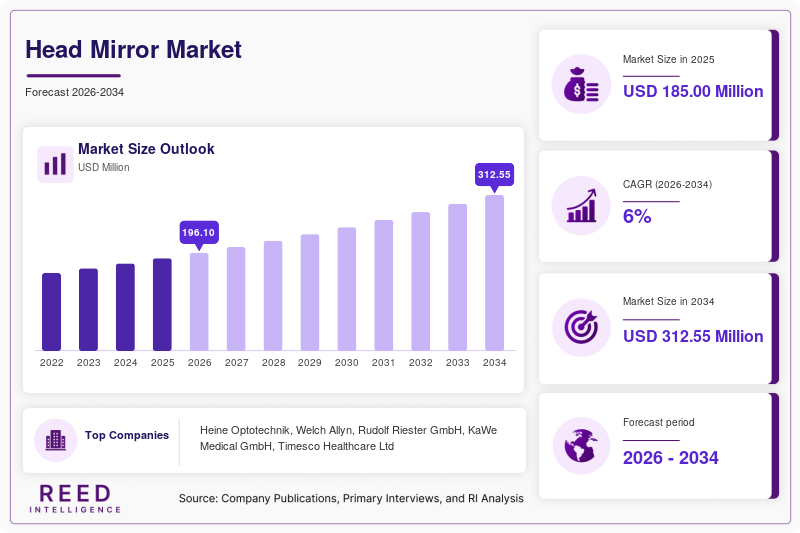
Key Highlights
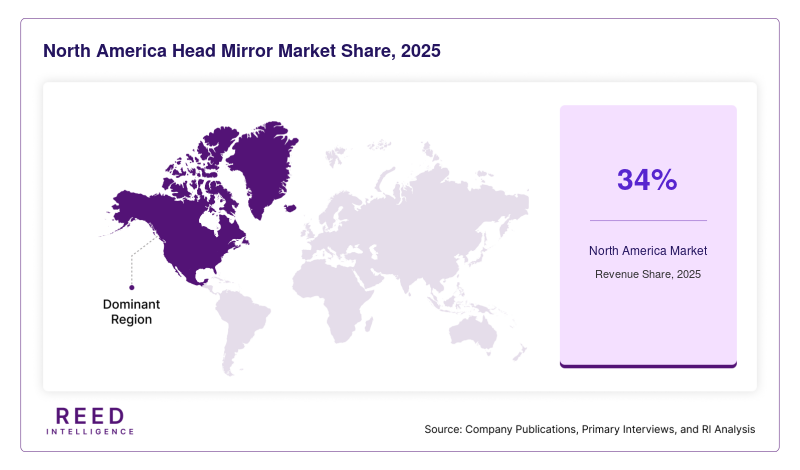
- Dominant region: North America held 34% market share in 2025, while Asia Pacific is expected to register the fastest growth at a CAGR of 7.2%.
- Leading subsegments: Traditional concave head mirrors dominated the type segment with 61% share, while LED-integrated variants are projected to grow fastest at a CAGR of 7.8%. Stainless steel materials led with 48% share, whereas lightweight polymer variants are expected to grow at 7.5% CAGR. Hospitals represented the leading end-use segment with 52% share, while ambulatory surgical centers are expected to expand at 7.1% CAGR.
- Dominant country: The United States accounted for USD 58 million in 2025 and is expected to reach USD 61 million in 2026.
Market Trends
Transition Toward Hybrid Illumination Devices
The Head Mirror Market is witnessing a gradual transition from purely reflective head mirrors to hybrid models incorporating LED illumination. While traditional mirrors rely on external light sources, hybrid devices combine reflective surfaces with integrated lighting for improved visibility. This trend is particularly evident in outpatient clinics and mobile healthcare units where lighting conditions vary. The integration of LED components enhances diagnostic accuracy and reduces dependency on overhead lighting infrastructure.
Rising Preference for Lightweight and Ergonomic Designs
Manufacturers are increasingly focusing on ergonomic improvements to enhance user comfort during prolonged procedures. Lightweight materials such as reinforced polymers and adjustable headbands are gaining traction among healthcare professionals. This trend reflects the growing demand for user-friendly medical tools that minimize fatigue and improve workflow efficiency. As practitioners prioritize comfort alongside functionality, ergonomic head mirrors are becoming a preferred choice across both developed and emerging healthcare systems.
Market Drivers
Expansion of Primary Healthcare Infrastructure
The expansion of primary healthcare facilities globally is a significant driver of the Head Mirror Market. Many developing regions are prioritizing cost-effective diagnostic tools for frontline medical services. Head mirrors serve as essential equipment in basic examination kits, enabling healthcare professionals to conduct accurate visual assessments without reliance on advanced or expensive devices. This trend is particularly strong in rural outreach programs and government-led healthcare initiatives.
Continued Demand in ENT and Dental Practices
Head mirrors remain widely used in ENT and dental examinations due to their precision and simplicity. Despite advancements in imaging technologies, these devices provide reliable illumination and visualization for routine procedures. Their durability and minimal maintenance requirements make them a preferred choice in busy clinical environments. The consistent demand from specialized practices continues to support steady market growth across both developed and emerging regions.
Market Restraint
Increasing Adoption of Advanced Diagnostic Lighting Tools
The growing adoption of advanced diagnostic equipment, such as fiber-optic headlights and endoscopic imaging systems, presents a notable restraint for the Head Mirror Market. These modern tools offer enhanced illumination, flexibility, and imaging capabilities, making them more suitable for complex diagnostic procedures. As healthcare facilities upgrade their infrastructure, particularly in urban and developed regions, the reliance on traditional head mirrors is gradually declining.
Additionally, technological advancements have made alternative devices more accessible and user-friendly, further reducing the dependency on manual reflective tools. Younger healthcare professionals, trained with modern equipment, often prefer advanced lighting systems over conventional head mirrors. This shift in preference is expected to limit market expansion, particularly in high-income regions where technological adoption rates are higher.
Market Opportunities
Growth in Emerging Healthcare Markets
Emerging economies present significant opportunities for the Head Mirror Market due to increasing healthcare investments and expanding patient access. In regions where budget constraints limit the adoption of high-end diagnostic equipment, head mirrors offer a practical and economical solution. The rising number of clinics and small healthcare centers in these markets is expected to drive demand over the forecast period.
Product Innovation and Customization
Opportunities are also emerging through product innovation, particularly in customization and design enhancements. Manufacturers are developing adjustable, multi-functional head mirrors tailored to specific medical disciplines. Innovations such as anti-glare coatings, improved reflective surfaces, and adjustable focal lengths are expected to attract healthcare professionals seeking improved performance. Customization based on user preferences and clinical requirements is likely to open new growth avenues in the market.
Segmental Analysis
By Type
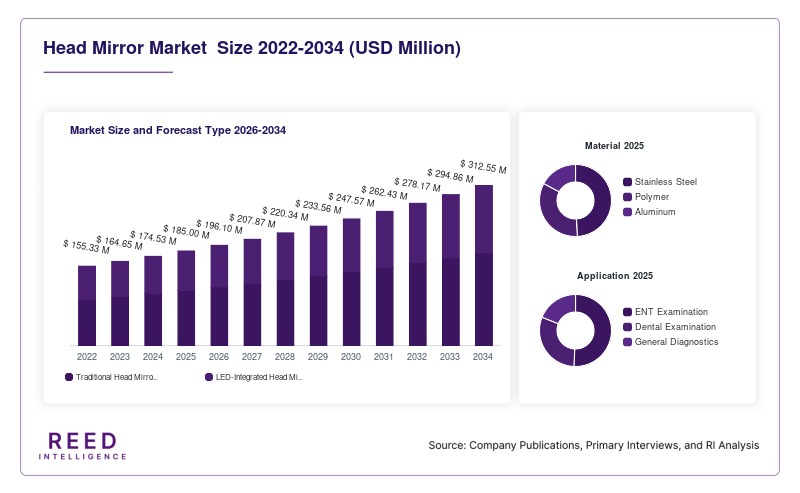
Traditional concave head mirrors dominated the segment, accounting for 61% of market share in 2025. Their widespread use in ENT examinations and familiarity among practitioners contributed to their leading position.
LED-integrated head mirrors will register the fastest growth at a CAGR of 7.8%. Their ability to provide consistent illumination without external light sources will drive adoption, particularly in mobile and remote healthcare settings.
By Material
Stainless steel head mirrors led the segment with 48% share in 2025, owing to their durability and resistance to corrosion. These materials are widely preferred in clinical environments requiring frequent sterilization.
Polymer-based head mirrors are expected to grow at a CAGR of 7.5%, driven by their lightweight properties and improved comfort. Advances in material engineering will further enhance their adoption among healthcare professionals.
By Application
ENT examinations represented the dominant application segment with 44% share in 2025, reflecting the traditional use of head mirrors in this field. Their precision and effectiveness in focused illumination supported their widespread use.
Dental applications are projected to grow at a CAGR of 6.9%, driven by increasing dental care awareness and expanding dental clinics globally. Head mirrors provide effective illumination for routine dental procedures.
By End-Use
Hospitals accounted for 52% of the market share in 2025, driven by high patient volumes and the need for reliable diagnostic tools.
Ambulatory surgical centers will grow at a CAGR of 7.1%, supported by the increasing shift toward outpatient procedures. These centers require compact and efficient diagnostic equipment.
By Distribution Channel
Offline sales channels dominated with 68% share in 2025, as healthcare institutions prefer direct procurement from suppliers for quality assurance.
Online distribution channels will expand at a CAGR of 8.0%, driven by digitalization and increasing adoption of e-commerce platforms for medical supplies.
Regional Analysis
North America
North America accounted for 34% of the Head Mirror Market share in 2025 and will expand at a CAGR of 5.4% during 2025–2034. The region has an established healthcare infrastructure and consistent demand for diagnostic tools in clinical settings.
The United States dominated the regional market due to widespread adoption in ENT and dental practices. A key growth factor is the presence of structured clinical training programs that continue to incorporate traditional diagnostic tools, ensuring sustained usage across generations of healthcare professionals.
Europe
Europe held approximately 27% market share in 2025 and is expected to grow at a CAGR of 5.6% through 2034. The region demonstrates stable demand supported by well-developed healthcare systems and standardized clinical practices.
Germany led the market, driven by its strong medical device manufacturing base. The country’s emphasis on precision medical instruments has contributed to consistent product quality and adoption across healthcare facilities.
Asia Pacific
Asia Pacific represented 22% market share in 2025 and will register the fastest growth at a CAGR of 7.2%. Rapid healthcare expansion and increasing patient volumes are key contributors to market growth.
China dominated the region due to large-scale investments in healthcare infrastructure. The country’s focus on expanding rural healthcare services has significantly increased the demand for cost-effective diagnostic tools, including head mirrors.
Middle East & Africa
The Middle East & Africa accounted for 9% market share in 2025 and is projected to grow at a CAGR of 6.3%. The region is witnessing gradual improvements in healthcare accessibility and infrastructure.
Saudi Arabia emerged as the dominant country, supported by government initiatives aimed at modernizing healthcare services. Investments in medical facilities have increased the procurement of essential diagnostic equipment.
Latin America
Latin America held 8% market share in 2025 and is expected to grow at a CAGR of 6.1%. The region’s market growth is supported by expanding healthcare coverage and rising awareness of early diagnosis.
Brazil led the regional market due to its large population and increasing number of healthcare institutions. The country’s growing focus on public health programs has driven demand for affordable diagnostic tools.
Competitive Landscape
The Head Mirror Market is moderately fragmented, with a mix of established medical device manufacturers and regional players. Companies focus on product quality, durability, and ergonomic design to maintain competitiveness.
A leading player in the market is Heine Optotechnik, known for its precision diagnostic instruments. The company recently introduced enhanced head mirror models featuring improved reflective coatings and adjustable designs to meet evolving clinical needs.
Other key players are investing in lightweight materials and hybrid illumination technologies to strengthen their market presence. Strategic partnerships with healthcare providers and distributors are also common approaches to expand market reach. Continuous product innovation remains a central strategy among leading companies to address changing user preferences and maintain relevance in the evolving diagnostic equipment landscape.
Key Players
- Heine Optotechnik
- Welch Allyn
- Rudolf Riester GmbH
- KaWe Medical GmbH
- Timesco Healthcare Ltd
- Sklar Surgical Instruments
- Integra LifeSciences
- Medline Industries
- American Diagnostic Corporation
- Spirit Medical Co.
- Prestige Medical
- GF Health Products
- Dixion Distribution of Medical Devices
- Fazzini Srl
- Honsun Medical Technology
Recent Developments
- 2024: Heine Optotechnik launched an upgraded head mirror with enhanced reflective precision and adjustable headband design.
- 2024: Welch Allyn expanded its diagnostic portfolio with ergonomic head mirror solutions for outpatient settings.
- 2023: Rudolf Riester GmbH introduced lightweight polymer-based head mirrors to improve user comfort.
- 2023: Timesco Healthcare strengthened its distribution network in Asia Pacific to support regional growth.
- 2023: KaWe Medical GmbH focused on customization options for specialized clinical applications.
Head Mirror Market Segments
Type
- Traditional Head Mirrors
- LED-Integrated Head Mirrors
Material
- Stainless Steel
- Polymer
- Aluminum
Application
- ENT Examination
- Dental Examination
- General Diagnostics
End-Use
- Hospitals
- Clinics
- Ambulatory Surgical Centers
Distribution Channel
- Offline Distribution
- Online Distribution
By Region
- North America
- Europe
- APAC
- Middle East and Africa
- LATAM