Health Massage Equipment Market Size, Share & Trends Analysis Report By Product Type, Technology, Application, End User, Distribution Channel and By Region (North America, Europe, APAC, Middle East and Africa, LATAM) Forecasts, 2026-2034
USD 3950
Health Massage Equipment Market Size
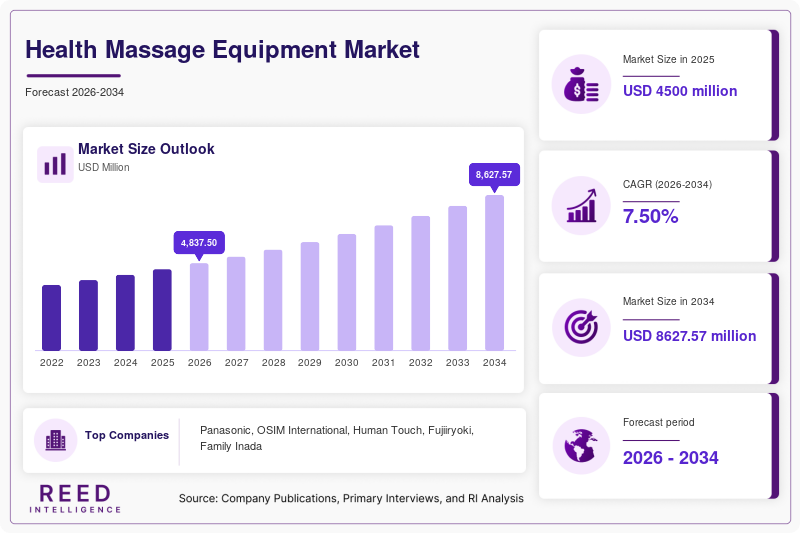
The global health massage equipment market was valued at USD 4,500 million in 2025 and is estimated to reach USD 4,840 million in 2026. Based on the supplied forecast, the market is projected to reach USD 8,627.57 million by 2034, with a stated compound annual growth rate (CAGR) of 7.50% over the forecast period.
The market includes powered and manually operated products designed to provide massage, relaxation, muscle recovery, and selected therapeutic functions. Major product categories include massage chairs, handheld massagers, percussion massage devices, foot and leg massagers, massage cushions, and professional massage tables and systems. The commercial opportunity spans household wellness purchases, fitness and sports recovery, hospitality, spas, and clinical or rehabilitation environments.
Forecast consistency note: The supplied market values and CAGR do not fully reconcile mathematically. Growth from USD 4,500 million in 2025 to USD 8,627.57 million in 2034 implies a CAGR of approximately 6.90%; growth from USD 4,840 million in 2026 to USD 8,627.57 million in 2034 implies approximately 6.82%. A 7.50% CAGR applied from 2026 through 2034 would produce a higher 2034 value. This report preserves the supplied figures and uses the CAGR as the user-provided headline assumption.
The health massage equipment market combines consumer wellness electronics with equipment used in professional massage, fitness recovery, and selected healthcare settings. Product economics vary considerably: massage chairs typically command higher selling prices and require more space, while portable percussion devices, handheld massagers, and foot massagers are more accessible purchases. This creates a market in which premium features, convenience, perceived effectiveness, durability, and after-sales service can matter as much as the number of units sold.
At-home use is a major commercial proposition because a consumer can purchase equipment once and use it repeatedly without paying for each session with a professional provider. Panasonic’s massage-chair product announcements illustrate how manufacturers are positioning equipment around home integration, personalized massage functions, and compact or furniture-compatible designs. The commercial mechanism is a combination of convenience and product differentiation, although the initial purchase price and space requirements remain barriers for larger systems.
Health Massage Equipment Market Drivers
Home-based wellness supports demand for convenient massage equipment. Consumers can use home massage products on their own schedules, reducing dependence on appointments and travel. For manufacturers, this supports a broad product ladder, from relatively inexpensive handheld products to premium chairs, with opportunities to serve different household budgets. The limitation is that convenience alone does not guarantee repeat use or justify a premium price; product comfort, reliability, and perceived value still determine purchase satisfaction.
Musculoskeletal discomfort creates a relevant use case, but not a guaranteed treatment outcome. The World Health Organization reports that approximately 1.71 billion people worldwide live with musculoskeletal conditions, and identifies low back pain as a leading cause of disability. This establishes a large population with musculoskeletal health needs, but it should not be interpreted as a direct estimate of the addressable market for massage equipment. Consumers with discomfort may use a range of interventions, and product suitability differs by condition.
Product personalization helps manufacturers differentiate premium equipment. Massage-chair makers are adding features such as adjustable programs, heating, body-position or body-shape sensing, air compression, and more elaborate roller mechanisms. Panasonic’s 2025 Real Pro Casa Line announcement emphasized a home-oriented design and multiple massage functions. These features can support premium positioning when buyers can perceive a meaningful improvement in comfort or fit. They also raise engineering, component, and service costs, so the commercial benefit depends on customer willingness to pay.
Sports and fitness recovery broaden demand beyond general relaxation. Portable percussion and handheld devices are marketed for muscle preparation and post-exercise recovery. Their portability and lower space requirements make them practical for individual users, gyms, sports facilities, and trainers. However, performance claims need to be distinguished from evidence for a specific clinical outcome; marketing that overstates benefits can create reputational and regulatory risk.
Health Massage Equipment Market Restraints
High upfront costs limit penetration of full-size massage chairs. Premium chairs require more household space and typically involve higher purchase, delivery, installation, and maintenance costs than handheld products. Buyers may defer a purchase or choose a lower-priced alternative when the perceived benefit is uncertain. Manufacturers can address this through product tiers, demonstrations, financing, warranties, and transparent comparisons of features, although these measures cannot eliminate affordability constraints.
Safety concerns and unsupported therapeutic claims can weaken consumer trust. Users may apply excessive pressure, use devices incorrectly, or have medical conditions that make some forms of massage unsuitable. The U.S. National Center for Complementary and Integrative Health notes that massage is generally low risk when appropriately performed, but rare serious adverse effects have been reported, including nerve injury and fractures in some circumstances. This evidence concerns massage therapy broadly and should not be generalized to the incidence of injuries from every equipment category.
Product quality and service reliability affect long-term value. Motors, rollers, batteries, heating elements, controls, and upholstery can influence product life and customer satisfaction. Large equipment also creates more complicated warranty and repair logistics than portable devices. Manufacturers that lack accessible replacement parts or service coverage may face higher return rates and weaker repeat purchase or referral performance.
Regulatory obligations can increase product-development costs. The IEC massage-appliance safety standard provides a technical reference for covered electrical products. In the European Union, the General Product Safety Regulation has applied since 13 December 2024 and strengthened the general safety framework for consumer products, including those sold online. Requirements depend on product design, intended use, applicable legislation, and destination market; a general consumer massager should not automatically be assumed to have the same regulatory status as a medical device.
Health Massage Equipment Market Opportunities
Compact and portable equipment for everyday use
Portable percussion devices, handheld massagers, and compact foot and neck products give manufacturers a way to reach consumers who do not have the space or budget for a massage chair. Compact products can also be sold through fitness retailers, specialist wellness shops, marketplaces, and direct-to-consumer channels. The opportunity is strongest when design, noise, battery performance, ergonomics, and ease of cleaning provide tangible benefits rather than simply adding features.
Premium products with credible personalization
Premium massage chairs and multi-function systems can differentiate through adjustable intensity, massage programs, body-position sensing, heat, and ergonomics. Manufacturers can strengthen the proposition through in-store demonstrations, product-fit guidance, clear warranty terms, and service availability. Personalization is commercially useful when it improves usability across different body sizes and preferences; complexity without a clear user benefit can instead increase costs and troubleshooting.
Commercial and institutional procurement
Hotels, spas, fitness clubs, wellness centres, and selected rehabilitation facilities may purchase equipment for repeated use by multiple customers. This creates a different buying case from household retail: uptime, cleanability, durability, service response, and cost per use become central. Suppliers that develop commercial-grade products and reliable maintenance networks may compete more effectively than brands focused only on consumer advertising.
Safer product design and clearer claims
Manufacturers can build trust by testing electrical and mechanical safety, providing clear instructions and contraindication warnings, and keeping wellness claims within the evidence and regulatory status of the product. The IEC’s massage-appliance safety standard provides a relevant technical reference for many powered products. Better documentation and transparent claims may also help retailers assess supplier quality and reduce avoidable product complaints.
Segmental Analysis
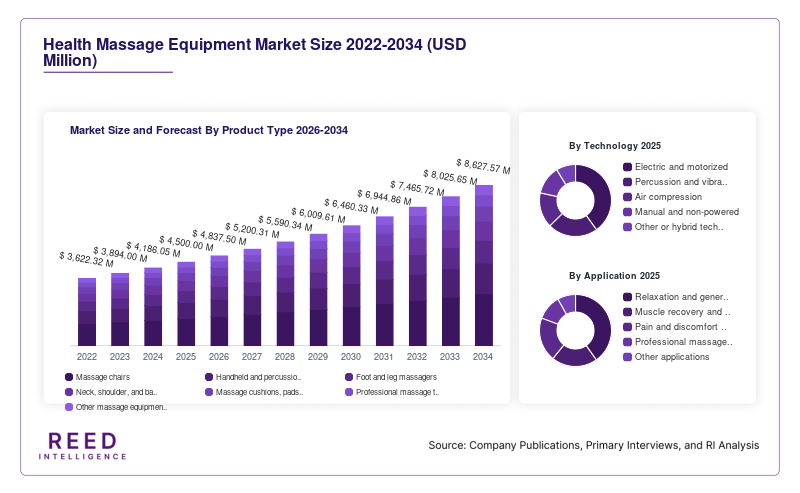
The shares and segment values in this section are modeled estimates for analytical planning, not externally reported statistics. Each segmentation dimension is allocated independently, so the same market revenue is classified from different perspectives; these segment tables must not be added together across dimensions. Segment growth assumptions reflect product economics and plausible adoption patterns, and are not company-reported or statistically measured CAGRs.
By Product Type
Massage chairs are modeled at approximately 28% of the 2025 market, equivalent to about USD 1,260 million under internal analytical allocation. The segment is modeled at approximately 7.2% CAGR through 2034, producing an indicative value of about USD 2,370 million. Their high average selling prices give them a material revenue contribution even when unit sales are lower than those of portable devices. Space, affordability, and servicing remain important purchase constraints.
Handheld and percussion massagers represent approximately 24% of the 2025 market, or about USD 1,080 million under the internal allocation. The segment is modeled at approximately 8.8% CAGR, reaching an indicative USD 2,300 million by 2034. Portability and lower entry prices support their suitability for personal use and sports recovery. Product differentiation is difficult where specifications are similar, making ergonomics, noise, battery performance, durability, and credible claims important competitive factors.
Foot and leg massagers account for a modeled 13% of the 2025 market, equivalent to approximately USD 585 million. At an assumed 7.0% CAGR, the segment reaches an indicative USD 1,075 million by 2034. These products address a specific body area and generally require less space than full-body chairs. Fit, comfort, ease of cleaning, and suitable pressure settings are relevant product-selection factors.
Neck, shoulder, and back massagers represent an estimated 14% of the 2025 market, or about USD 630 million. The segment is modeled at 7.8% CAGR, corresponding to approximately USD 1,240 million in 2034. Compact form factors make these products relevant to desk workers and household users. The key commercial challenge is to balance convenience with appropriate pressure, comfort, and product safety.
By Technology
Electric and motorized equipment represents approximately 52% of the 2025 market, equivalent to about USD 2,340 million. The segment is modeled at 7.5% CAGR, producing an indicative value of approximately USD 4,550 million by 2034. Motors, rollers, and electronic controls enable repeatable programs and adjustable settings, but introduce electrical safety, reliability, and repair considerations.
Percussion and vibration technology accounts for a modeled 18% of the 2025 market, or USD 810 million. At an assumed 8.8% CAGR, the segment reaches about USD 1,730 million by 2034. Portable form factors suit fitness and personal-use settings, though consumers need clear instructions on appropriate intensity and duration.
Air-compression technology represents approximately 10% of the 2025 market, equivalent to USD 450 million. At a modeled 7.5% CAGR, the segment reaches approximately USD 910 million by 2034. Air chambers and compression sequences are used in some foot, leg, and chair systems. Comfort, fit, pressure control, and product-specific suitability shape the consumer proposition.
Manual and non-powered equipment accounts for a modeled 12% of the 2025 market, or USD 540 million. At an assumed 5.0% CAGR, the segment reaches about USD 840 million by 2034. Its lower purchase cost and lack of electrical components are advantages, although manual products generally offer fewer automated functions.
Other or hybrid technologies represent the remaining 8% of the 2025 market, equivalent to USD 360 million. At a modeled 6.5% CAGR, the segment reaches about USD 630 million by 2034. Hybrid designs may combine heat, vibration, rollers, or other functions, but additional complexity must translate into a clear benefit to justify higher prices.
By Application
Relaxation and general wellness is modeled at 36% of the 2025 market, equivalent to approximately USD 1,620 million. At an assumed 7.0% CAGR, it reaches about USD 2,970 million by 2034. This broad application supports home and hospitality purchases, but repeat use and perceived value determine whether consumers continue to regard the equipment as worth its cost.
Muscle recovery and sports use accounts for an estimated 22% of the 2025 market, or USD 990 million. The segment is modeled at 9.0% CAGR, reaching approximately USD 2,140 million by 2034. Portability and quick access are relevant to athletes and recreational exercisers. The commercial opportunity depends on product usability and evidence-appropriate performance claims rather than broad promises of injury prevention or treatment.
Pain and discomfort management represents approximately 20% of the 2025 market, equivalent to USD 900 million. At a modeled 7.2% CAGR, it reaches about USD 1,720 million by 2034. The category includes users seeking relief from muscle discomfort, but equipment should not be positioned as a substitute for appropriate medical assessment. Evidence for massage as an intervention varies by condition and the quality of the evidence.
Professional massage and spa services accounts for an estimated 15% of the 2025 market, or USD 675 million. At an assumed 6.5% CAGR, the segment reaches approximately USD 1,185 million by 2034. Equipment demand follows service capacity and facility investment, with commercial buyers placing more weight on durability, hygiene, and serviceability.
Other applications represent the remaining 7% of the 2025 market, equivalent to USD 315 million. At an assumed 5.5% CAGR, this category reaches approximately USD 495 million by 2034. It includes specialized uses that may not scale as broadly as household wellness or fitness recovery.
By End User
Residential consumers are modeled at 60% of the 2025 market, equivalent to USD 2,700 million. At an assumed 7.5% CAGR, the segment reaches approximately USD 5,240 million by 2034. Home convenience supports purchases across several price points, while affordability, space, ease of use, and warranty coverage influence conversion.
Spas, salons, and wellness centres account for a modeled 15% of the 2025 market, or USD 675 million. At 6.8% CAGR, the segment reaches about USD 1,220 million by 2034. The value proposition is tied to customer throughput, reliability, and the quality of the service experience.
Fitness centres and sports facilities represent approximately 10% of the 2025 market, equivalent to USD 450 million. At a modeled 8.5% CAGR, the segment reaches approximately USD 930 million by 2034. Recovery-oriented equipment can support facility differentiation, although usage intensity and maintenance costs can be higher than in a household setting.
Healthcare and rehabilitation providers account for a modeled 8% of the 2025 market, or USD 360 million. At an assumed 6.5% CAGR, the segment reaches about USD 630 million by 2034. Procurement requires particular care around intended use, patient suitability, evidence, and applicable regulatory requirements.
Hotels and other commercial establishments represent the remaining 7% of the 2025 market, equivalent to USD 315 million. At a modeled 6.5% CAGR, the segment reaches approximately USD 550 million by 2034. Shared-use environments place a premium on cleaning, uptime, safety instructions, and responsive service.
By Distribution Channel
Online retail and direct-to-consumer channels are modeled at 32% of the 2025 market, or USD 1,440 million. At an assumed 9.0% CAGR, the segment reaches approximately USD 3,120 million by 2034. Online distribution offers broad reach and convenient comparison, but products with complex functions or high prices may be harder to sell without demonstrations and trusted after-sales support.
Specialty wellness and fitness retailers represent approximately 25% of the 2025 market, equivalent to USD 1,125 million. At a modeled 7.0% CAGR, the segment reaches about USD 2,215 million by 2034. Demonstrations and staff guidance can help buyers compare comfort and features, especially for higher-priced products.
Consumer electronics and department stores account for a modeled 20% of the 2025 market, or USD 900 million. At an assumed 6.0% CAGR, the segment reaches approximately USD 1,520 million by 2034. These outlets can expose massage products to shoppers already comparing household electronics and appliances, though shelf space and retailer margins can constrain assortment.
Professional and institutional distributors represent approximately 15% of the 2025 market, equivalent to USD 675 million. At a modeled 6.5% CAGR, the segment reaches about USD 1,180 million by 2034. Specialist distribution can support installation, servicing, and procurement requirements for commercial customers.
Other channels account for the remaining 8% of the 2025 market, or USD 360 million. At an assumed 5.5% CAGR, the segment reaches approximately USD 565 million by 2034. This includes miscellaneous retail and sales routes not captured in the primary categories.
Regional Analysis
North America
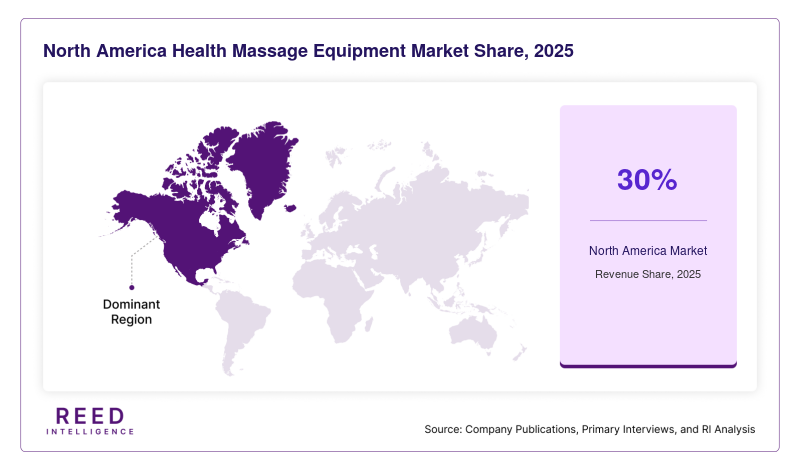
North America is an important market for home wellness products, premium consumer equipment, and fitness-oriented recovery devices. Retail availability and direct-to-consumer sales give consumers access to products at multiple price points. Commercial opportunities include household purchases, gyms, wellness businesses, and hospitality settings. The principal constraints are the cost of premium equipment, crowded product positioning, and the need for credible safety and performance claims. The market outlook depends on manufacturers demonstrating practical value rather than relying only on broad wellness messaging.
Europe
Europe presents opportunities for both consumer and professional massage equipment, with sales shaped by purchasing power, household space, retailer access, and national preferences. Product compliance is a material consideration: the EU General Product Safety Regulation has applied since 13 December 2024 and covers consumer products in its scope, including products sold through online channels. Manufacturers need to account for applicable safety, traceability, and economic-operator obligations. These requirements can add compliance work, but clear documentation and reliable product quality can also support retailer and consumer confidence.
Asia-Pacific
Asia-Pacific is strategically important because it includes major consumer markets as well as established manufacturing and electronics supply chains. Products range from compact handheld devices to premium massage chairs, and manufacturers can use regional supply capabilities to develop multiple price tiers. Panasonic’s product announcements in Japan and South Korea illustrate ongoing investment in massage-chair design and feature differentiation. However, Asia-Pacific is not a uniform market: purchasing power, retail structure, product preferences, and regulatory requirements differ substantially between countries.
Middle East and Africa
The Middle East and Africa offer potential through household wellness purchases, premium hospitality, spas, and selected fitness or rehabilitation facilities. Commercial procurement may be especially relevant where equipment is installed as part of a wider guest or wellness service. Market development can be constrained by affordability, uneven distribution coverage, access to replacement parts, and the availability of trained service providers. Suppliers should prioritize dependable distribution and servicing instead of assuming that premium positioning alone will generate demand across the region.
Latin America
Latin America represents a mixed opportunity across portable personal-use products and equipment purchased by wellness businesses. Lower-priced handheld and compact products can reach a wider consumer base than premium massage chairs, while commercial buyers assess equipment based on durability, financing, and service availability. Exchange-rate volatility, import costs, and uneven retail access can affect final consumer prices. A localized product and channel strategy is therefore more appropriate than a single region-wide premium approach.
Competitive Landscape
Competition spans established massage-chair and wellness-appliance manufacturers, specialist massage-device brands, fitness-recovery suppliers, and lower-priced manufacturers selling through online marketplaces. Competitive positions differ by product category. Full-size chair manufacturers compete on comfort, mechanisms, features, design, and servicing; portable-device brands compete on portability, performance, battery life, ergonomics, and price; commercial suppliers must also demonstrate reliability under repeated use.
Product differentiation is increasingly feature-led, but additional functions are not automatically a durable competitive advantage. Manufacturers need to show that the features improve user experience, justify the price, and do not introduce avoidable complexity or reliability problems. The IEC’s dedicated safety standard for electric massage appliances is a relevant reference point for product development and compliance processes.
Key Market Players
Recent Market Developments
- August 2025, Panasonic announced a new Real Pro Casa Line massage-chair model designed to fit more naturally into residential spaces, with a compact footprint and multiple massage functions. The announcement illustrates product development focused on home integration and premium functionality. Manufacturers may compete not only on massage mechanisms but also on furniture-like design and the suitability of equipment for everyday living spaces.
- September 2025, Panasonic Korea announced the EP-MAL1, highlighting AI-based personalized massage functions, a modern design, heated rollers, and airbag features. The launch provides another example of premium chair positioning around customization and home aesthetics. Feature differentiation can support premium positioning, but commercial success will depend on consumer willingness to pay and the ability to deliver a reliable, comfortable experience.
Health Massage Equipment Market Segments
By Product Type
- Massage chairs
- Handheld and percussion massagers
- Foot and leg massagers
- Neck, shoulder, and back massagers
- Massage cushions, pads, and belts
- Professional massage tables and systems
- Other massage equipment
By Technology
- Electric and motorized
- Percussion and vibration
- Air compression
- Manual and non-powered
- Other or hybrid technologies
By Application
- Relaxation and general wellness
- Muscle recovery and sports use
- Pain and discomfort management
- Professional massage and spa services
- Other applications
By End User
- Residential consumers
- Spas, salons, and wellness centres
- Fitness centres and sports facilities
- Healthcare and rehabilitation providers
- Hotels and other commercial establishments
By Distribution Channel
- Online retail and direct-to-consumer
- Specialty wellness and fitness retailers
- Consumer electronics and department stores
- Professional and institutional distributors
- Other channels
By Region
- North America
- Europe
- APAC
- Middle East and Africa
- LATAM