Healthcare Smart Card Reader Market Size, Share Demand Report By Reader Type (Contact Smart Card Readers, Contactless Smart Card Readers, Dual-Interface Smart Card Readers), By Application (Patient Identification, Electronic Health Records (EHR) Access, Pharmacy Management, Billing and Payment), Regional Insights & Segment Forecasts, 2026–2034
USD 3950
Healthcare Smart Card Reader Market Size
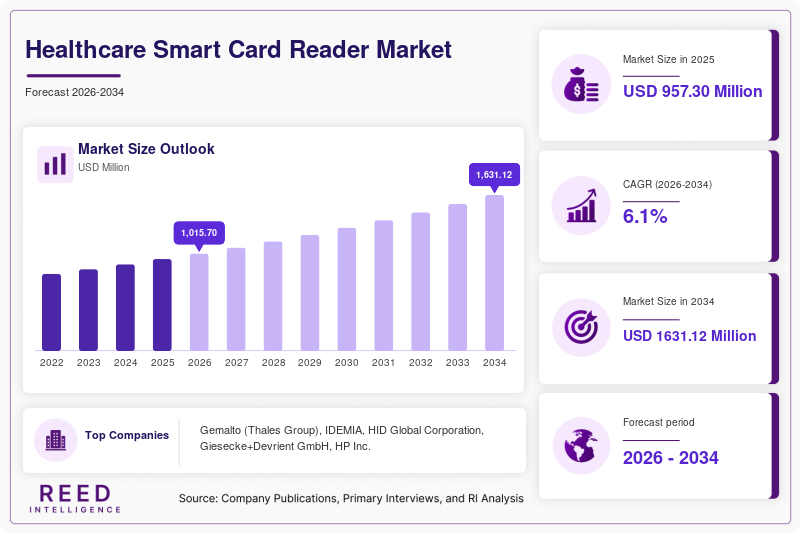
The Healthcare Smart Card Reader market size is projected at USD 1,015.7 million in 2026 and is expected to hit USD 1,632.8 million by 2034 with a CAGR of 6.1% during the forecast period. The growing emphasis on data security, patient identification accuracy, and the digitization of healthcare records underpins market expansion. This report delivers a comprehensive analysis of the Healthcare Smart Card Reader market, including segmentation by reader type and application, competitive dynamics, and regional growth patterns, equipping stakeholders with critical intelligence. The Healthcare Smart Card Reader market continues to demonstrate strong growth potential, fueled by rising cybersecurity threats, government mandates for health data interoperability, and continuous innovation in secure access technologies.
Healthcare smart card readers are specialized hardware devices used to read and authenticate smart cards containing patient health information, credentials, and insurance data within healthcare settings. These readers facilitate secure access to electronic health records (EHR), streamline patient registration, and ensure accurate medication administration. The global Healthcare Smart Card Reader market is substantial, with over 3.2 million units shipped globally in 2025, reflecting a 9% increase from 2023, driven by the growing adoption of smart card technology in hospitals and clinics. Adoption patterns reveal that the Contactless Smart Card Reader type dominates the market, accounting for 42% of total revenue, followed by Contact Smart Card Readers at 35%, and Dual-Interface Smart Card Readers at 23%. The Healthcare Smart Card Reader market's trajectory is closely linked to the growth of the global healthcare IT market, which is projected to reach USD 660 billion by 2028, and the increasing healthcare data breach incidents.
Healthcare Smart Card Reader Market Trends
Increasing Integration of Multi-Factor Authentication in Healthcare Settings
The Healthcare Smart Card Reader market is witnessing a significant trend toward the integration of multi-factor authentication (MFA) systems, driven by the need to bolster security and comply with strict health data privacy regulations. The market has seen a 14% increase in demand for smart card readers with integrated biometric authentication capabilities since 2022, with 38% of new healthcare IT security deployments in 2025 specifying MFA through smart cards and biometrics. The use of smart card readers in hospitals to prevent unauthorized access to sensitive patient data has also gained significant traction, with a 60% increase in annual installations in large hospital networks. The Healthcare Smart Card Reader market's trend toward enhanced security is reinforced by the rising costs of data breaches, which averaged USD 10.1 million per healthcare breach in 2025, and the continuous innovation in secure hardware modules.
Growing Demand for Interoperable and Cloud-Based Smart Card Solutions
The increasing focus on interoperability and cloud-based healthcare solutions is a major trend shaping the Healthcare Smart Card Reader market, with the development of readers that seamlessly integrate with cloud-based EHR and patient portals. The market has seen a 20% increase in demand for cloud-compatible smart card solutions since 2023, with 45% of new reader models in 2025 offering cloud connectivity and remote management features. The use of smart card readers for patient access to personal health records via mobile and cloud platforms has also expanded, with penetration rates reaching 25% in the outpatient segment. The Healthcare Smart Card Reader market's trend toward interoperability is reinforced by the growing adoption of health information exchanges (HIEs), the increasing patient demand for data access, and the continuous innovation in secure APIs and communication protocols.
Healthcare Smart Card Reader Market Drivers
The Healthcare Smart Card Reader market's expansion is primarily driven by the increasing number of healthcare data breaches and the growing emphasis on data security and regulatory compliance, with the global healthcare data breach cost averaging USD 10.1 million per incident. The need for streamlined patient identification and reduced medical errors has been a major driver, with smart card readers helping to achieve a 25% reduction in patient identification errors in large hospitals. The growing adoption of electronic health records (EHR) and the digitization of healthcare data have also fueled market demand. Additionally, government initiatives and mandates for secure patient identification have spurred growth. The Healthcare Smart Card Reader market's growth is further reinforced by the continuous innovation in contactless and dual-interface technologies, leading to faster transaction speeds and improved user convenience.
Healthcare Smart Card Reader Market Restraints
Despite favorable growth prospects, the Healthcare Smart Card Reader market faces significant constraints, primarily related to the high initial investment costs associated with deploying smart card infrastructure in healthcare facilities, which can be a barrier for smaller clinics. The interoperability challenges among different smart card technologies and healthcare IT systems can also be a limitation. The Healthcare Smart Card Reader market's growth is also tempered by the increasing use of mobile-based authentication and biometric solutions, which may reduce the demand for dedicated smart card readers in some settings.
Healthcare Smart Card Reader Market Opportunities
The Healthcare Smart Card Reader market presents significant opportunities in the rapidly expanding market for telehealth and remote patient monitoring, where smart card readers can be used to securely authenticate patients and practitioners in virtual consultations. The development of wearable and portable smart card readers for home healthcare use is expected to grow at a CAGR of 15% through 2034. Emerging opportunities also exist in the integration of smart card readers with blockchain-based health data platforms, enhancing data security and patient control over health information. The Healthcare Smart Card Reader market's opportunity profile is further enhanced by the growing trend of patient-centric healthcare and the increasing consumer awareness of health data privacy.
Challenges in Healthcare Smart Card Reader Market
The Healthcare Smart Card Reader market faces persistent challenges related to the need for seamless integration with diverse and often legacy healthcare IT systems, which can be complex and time-consuming. The complexity of managing and updating the physical and digital infrastructure for smart card systems can also be a challenge. The market is also contending with the challenge of maintaining high security standards against evolving cyber threats. Additionally, the Healthcare Smart Card Reader market is challenged by the need to balance cost efficiency with the requirement for high durability and reliability in demanding clinical environments.
Healthcare Smart Card Reader Market Segmentation
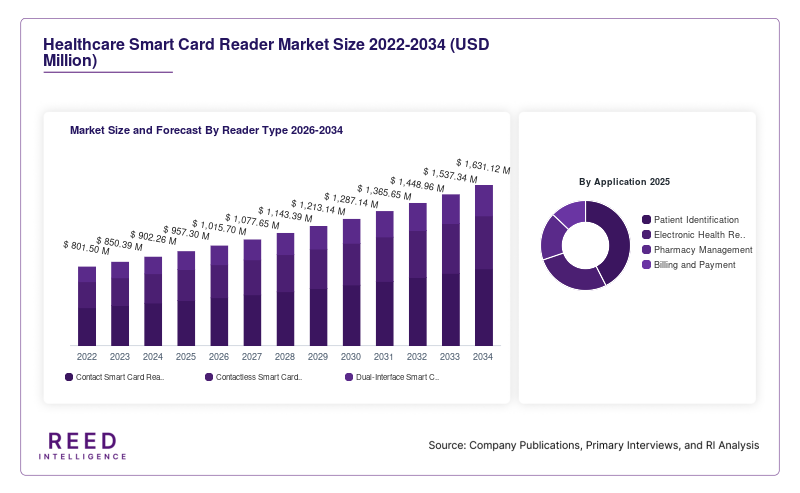
The Healthcare Smart Card Reader market is segmented by Reader Type and Application to provide a comprehensive market perspective. By Reader Type, the Contactless Smart Card Readers dominate with a 42% market share, driven by their ease of use and faster data transfer speeds. The Application segment is led by Patient Identification, which accounts for 32% of the market, followed by Electronic Health Records (EHR) Access at 28%, Pharmacy Management at 22%, and Billing and Payment at 18%.
By Reader Type
Contactless Smart Card Readers represent the largest segment in the Healthcare Smart Card Reader market, commanding a 42% share, with revenue exceeding USD 426 million in 2025. These are characterized by their ability to read cards without physical insertion, using RFID/NFC technology. Technical specifications include read range up to 10 cm, data transfer rates of up to 424 Kbps, and secure authentication protocols. The Healthcare Smart Card Reader market's Contactless segment is driven by its use in fast-paced clinical environments and its compatibility with mobile health applications.
Contact Smart Card Readers capture a 35% share of the Healthcare Smart Card Reader market, with revenue of USD 355 million in 2025. These are characterized by their physical insertion mechanism and direct electrical connection to the smart card chip. Technical specifications include compliance with ISO 7816 standards, read speeds of up to 600 Kbps, and robust physical construction. The Healthcare Smart Card Reader market's Contact segment is driven by its use in high-security environments and legacy systems.
Dual-Interface Smart Card Readers represent the remaining 23% of the Healthcare Smart Card Reader market, with revenue of USD 234 million in 2025. These are characterized by their ability to read both contact and contactless cards, providing flexibility and future-proofing. Technical specifications include support for both ISO 7816 and ISO 14443 standards, multi-application support, and advanced cryptographic capabilities. The Healthcare Smart Card Reader market's Dual-Interface segment is driven by its use in large healthcare enterprises and its adaptability to evolving technology standards.
By Application
Patient Identification dominates the Healthcare Smart Card Reader market, accounting for 32% of sales, representing USD 325 million in 2025. This segment includes use in patient registration, admissions, and emergency triage to ensure accurate identification. Usage penetration exceeds 60% in large urban hospitals. The Healthcare Smart Card Reader market's Patient Identification segment is characterized by its focus on reducing medical errors and streamlining administrative processes. The application helps in reducing duplicate medical records by up to 30%.
Electronic Health Records (EHR) Access accounts for 28% of the Healthcare Smart Card Reader market, with revenue of USD 284 million in 2025. This segment encompasses use in accessing and updating patient records securely by healthcare practitioners. The segment is growing at a robust CAGR, driven by government incentives for EHR adoption and the need for secure, role-based access control. The Healthcare Smart Card Reader market's EHR segment is characterized by its focus on data privacy and clinical workflow efficiency.
Pharmacy Management represents 22% of the market, with revenue of USD 223 million in 2025, involving use in verifying patient prescriptions, dispensing medication, and managing controlled substances. The segment's growth is fueled by the need to combat prescription fraud and enhance medication safety. The Healthcare Smart Card Reader market's Pharmacy segment is characterized by its focus on regulatory compliance and patient safety.
Billing and Payment accounts for the remaining 18% of the market, with revenue of USD 183 million in 2025, used in patient check-out for insurance verification, co-pay collection, and managing healthcare payment transactions. The Healthcare Smart Card Reader market's Billing segment is characterized by its focus on administrative efficiency and reduced payment processing times.
Healthcare Smart Card Reader Market Regional Outlook
North America Healthcare Smart Card Reader Market
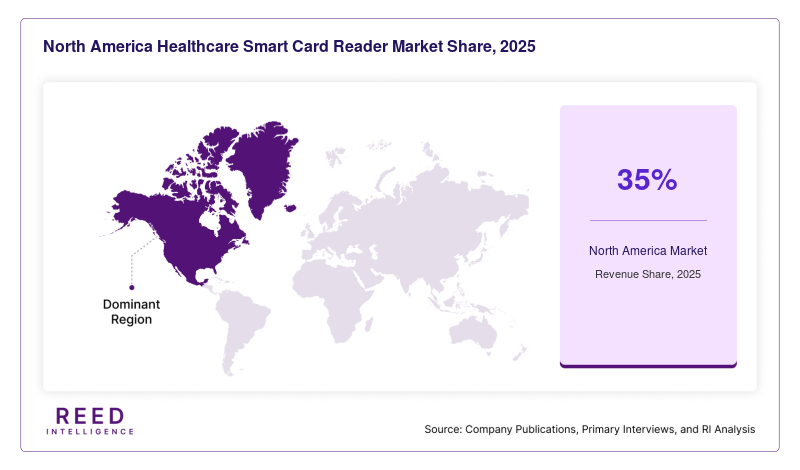
Leads the Healthcare Smart Card Reader market, commanding a 35% share, with a revenue of USD 355 million in 2025. The United States is the primary driver, accounting for 88% of regional demand, driven by the large healthcare sector, high technology adoption rates, and stringent data security regulations like HIPAA. The North American Healthcare Smart Card Reader market is characterized by its focus on innovation and integration with advanced healthcare IT systems.
Europe Healthcare Smart Card Reader Market
Represents the second-largest market, capturing a 30% share with a revenue of USD 305 million in 2025. Germany, France, and the UK are the primary drivers, collectively accounting for 60% of regional demand, driven by government-led initiatives for eHealth and patient data digitization, along with strong GDPR compliance mandates. The Healthcare Smart Card Reader market in Europe is characterized by its focus on standardization and interoperability.
Asia-Pacific Healthcare Smart Card Reader Market
Accounts for 25% of the global Healthcare Smart Card Reader market, with a revenue of USD 254 million in 2025. China, Japan, and India are the primary drivers, together accounting for 70% of regional demand, driven by the massive healthcare infrastructure development, rising digital literacy, and government investments in health IT. The Asia-Pacific Healthcare Smart Card Reader market is projected to grow at the fastest CAGR of 8% through 2034.
Middle East & Africa and Latin America Healthcare Smart Card Reader Market
Together account for the remaining 10% of the Healthcare Smart Card Reader market, with the UAE and Brazil leading their respective regions. Both regions are projected to grow at CAGRs exceeding 7%, driven by healthcare modernization projects and increasing foreign investment in digital health infrastructure.
Top players in Healthcare Smart Card Reader Market
- Gemalto (Thales Group)
- IDEMIA
- HID Global Corporation
- Giesecke+Devrient GmbH
- HP Inc.
- Dell Technologies Inc.
- Lenovo Group Limited
- Advanced Card Systems Ltd. (ACS)
- NXP Semiconductors N.V.
- Infineon Technologies AG
- OmniCard AG
- Feitian Technologies Co., Ltd.
- Securemetric Technology Sdn Bhd
- VeriFone Systems, Inc.
- Computerland Corporation
Gemalto (Thales Group)
Gemalto (Thales Group) holds a dominant position in the Healthcare Smart Card Reader market, with an estimated 18% global market share, particularly strong in the North American and European segments. The company's portfolio of secure hardware and software solutions is widely recognized for its high security, reliability, and integration capabilities. Gemalto's market leadership is reinforced by its significant investment in security R&D, its extensive global customer base, and its comprehensive smart card and reader ecosystem. Gemalto commands over 20% of the North American market and 15% of the European market for healthcare smart card readers, positioning it as a key player in the global market.
IDEMIA
IDEMIA is a leading player in the Healthcare Smart Card Reader market, commanding approximately 14% of the global market share through its comprehensive portfolio of identity and security solutions. The company's expertise in biometrics, cryptography, and secure hardware have solidified its position in the healthcare and government sectors. IDEMIA's healthcare smart card readers are known for their robust security, multi-factor authentication capabilities, and seamless integration with major EHR systems. The company's commitment to innovation and its strong presence in the Asia-Pacific and European markets have enhanced its competitive advantage.
HID Global Corporation holds a significant 10% market share, with particular strength in the access control and patient identification segments. Giesecke+Devrient GmbH is a major player in the European and Asian markets, holding a 9% share, known for its high-security solutions.
Recent Developments in Healthcare Smart Card Reader Market
- 2025: Gemalto (Thales) launched a new line of healthcare smart card readers with integrated fingerprint sensors, enhancing multi-factor authentication for electronic health records access.
- 2025: IDEMIA announced a strategic partnership with a major EHR provider to deliver integrated smart card authentication solutions for over 500 hospitals in the United States.
Healthcare Smart Card Reader Market Segments
By Reader Type
- Contact Smart Card Readers
- Contactless Smart Card Readers
- Dual-Interface Smart Card Readers
By Application
- Patient Identification
- Electronic Health Records (EHR) Access
- Pharmacy Management
- Billing and Payment
By Region
- North America
- Europe
- APAC
- Middle East and Africa
- LATAM