Hearing Loop Market Size, Share & Demand Report By Product Type (Fixed Hearing Loop Systems, Portable Hearing Loop Systems), By Application (Public Infrastructure, Healthcare, Transportation, Retail, Others), By End-Use (Commercial, Residential, Educational, Government), By Technology (Analog, Digital), By Region & Segment Forecasts, 2025–2034
USD 3950
Market Overview
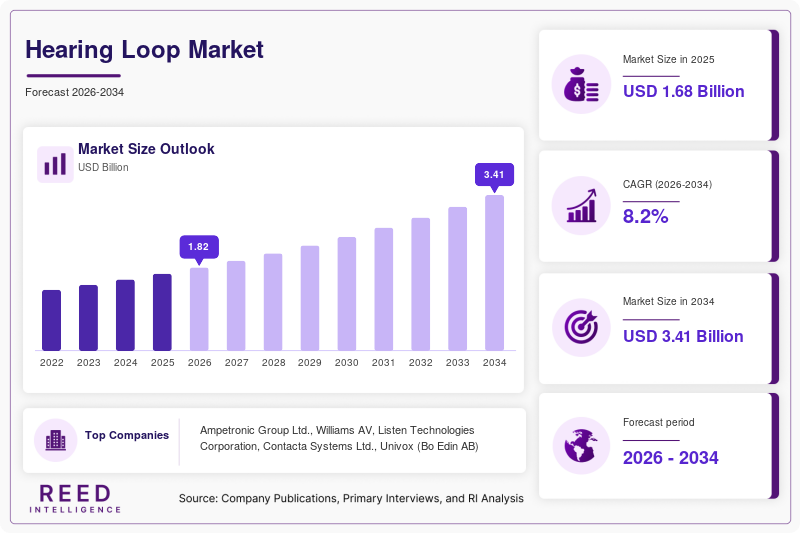
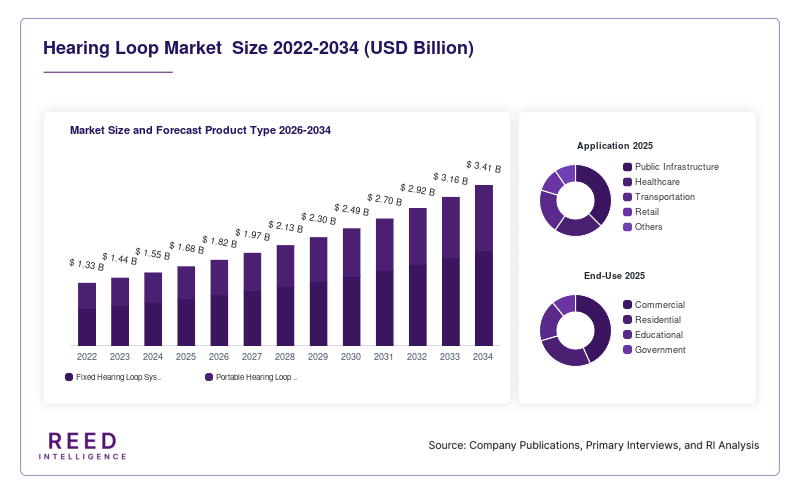
The global Hearing Loop Market size was valued at USD 1.68 billion in 2025 and is projected to reach USD 3.42 billion by 2034, expanding at a CAGR of 8.2% during the forecast period (2025–2034). The market growth reflects the increasing need for assistive listening solutions in public and private infrastructure, particularly for individuals with hearing impairments. Hearing loop systems, also known as induction loop systems, are being adopted across transportation hubs, educational institutions, healthcare facilities, and entertainment venues to improve audio accessibility and compliance with accessibility regulations.
A key global factor supporting the growth of the Hearing Loop Market is the rising prevalence of hearing loss among aging populations. Governments and organizations are investing in inclusive infrastructure to ensure equal communication access, thereby accelerating demand for hearing loop installations. Additionally, advancements in digital signal processing and wireless integration have enhanced system performance, enabling broader adoption.
Key Highlights:
- North America dominated the market with a 34.6% share in 2025, while Asia Pacific is expected to register the fastest CAGR of 9.5% during the forecast period.
- By product type, fixed hearing loop systems held the largest share at 58.3% in 2024, whereas portable hearing loop systems are anticipated to grow at the fastest CAGR of 9.1%.
- By application, public infrastructure accounted for the dominant share of 42.7% in 2024, while the healthcare segment is projected to expand at a CAGR of 8.9%.
- The United States remained the leading country, with market values of USD 520 million in 2024 and USD 548 million in 2025.
Market Trends
Integration with Smart Infrastructure
The integration of hearing loop systems into smart building infrastructure is emerging as a key trend in the Hearing Loop Market. Modern buildings are incorporating IoT-enabled devices and centralized control systems, allowing hearing loop technologies to integrate seamlessly with public address and emergency communication systems. This integration enhances user experience and ensures real-time adaptability of sound transmission in complex environments such as airports, auditoriums, and commercial complexes.
Growing Adoption in Transportation and Retail Spaces
Another notable trend shaping the Hearing Loop Market is the increasing adoption of these systems in transportation hubs and retail environments. Airports, railway stations, and metro systems are installing hearing loops to enhance accessibility for passengers with hearing impairments. Similarly, retail chains are incorporating these systems at service counters to improve customer interaction. This trend is driven by customer experience strategies and compliance with accessibility standards, further contributing to market growth.
Market Drivers
Rising Prevalence of Hearing Impairment
The increasing global incidence of hearing impairment is a significant driver of the Hearing Loop Market. Factors such as aging populations, prolonged exposure to noise pollution, and lifestyle changes are contributing to a higher number of individuals requiring assistive listening solutions. Hearing loop systems provide a reliable and cost-effective way to enhance sound clarity, particularly in noisy environments, which has led to their growing adoption across multiple sectors.
Government Regulations for Accessibility Compliance
Government initiatives and regulatory frameworks promoting accessibility are also driving market growth. Many countries have introduced legislation mandating the installation of assistive listening systems in public spaces to ensure inclusivity. These regulations have encouraged facility owners to invest in hearing loop solutions, particularly in developed economies. Compliance requirements are expected to remain a strong growth driver throughout the forecast period.
Market Restraint
High Installation and Maintenance Costs
One of the primary restraints in the Hearing Loop Market is the high initial cost associated with installation and ongoing maintenance. Installing hearing loop systems in large or complex infrastructures often requires significant investment in wiring, amplifiers, and calibration. Additionally, retrofitting existing buildings can be challenging and expensive due to structural constraints. Maintenance costs, including system testing and repairs, further add to the financial burden.
Small and medium-sized enterprises and facilities in developing regions may find it difficult to allocate budgets for such installations, limiting market penetration. Moreover, lack of awareness regarding long-term benefits and return on investment can hinder adoption. While technological advancements are gradually reducing costs, affordability remains a key challenge that could slow the overall growth of the Hearing Loop Market.
Market Opportunities
Expansion in Emerging Economies
Emerging economies present a significant growth opportunity for the Hearing Loop Market. Rapid urbanization, infrastructure development, and increasing awareness about accessibility are driving demand for assistive technologies. Governments in regions such as Asia Pacific and Latin America are investing in public infrastructure, creating opportunities for hearing loop system providers to expand their presence.
Technological Advancements in Wireless Systems
Advancements in wireless hearing loop technologies offer another promising opportunity. Innovations such as portable and battery-operated systems are making installations more flexible and cost-effective. These solutions are particularly beneficial for temporary events, small venues, and mobile applications. As technology continues to evolve, improved sound quality, energy efficiency, and ease of installation are expected to enhance market adoption and create new revenue streams.
Segmental Analysis
By Product Type
Fixed hearing loop systems dominated the Hearing Loop Market with a share of 58.3% in 2024. These systems are widely used in large venues such as auditoriums, theaters, and transportation hubs due to their ability to provide consistent and high-quality sound transmission. Their reliability and long-term performance have made them the preferred choice for permanent installations.
Portable hearing loop systems are expected to grow at the fastest CAGR of 9.1% during the forecast period. Their flexibility and ease of installation will drive adoption in smaller venues and temporary events. The increasing demand for cost-effective and adaptable solutions will further support the growth of this subsegment.
By Application
Public infrastructure accounted for the largest share of 42.7% in 2024 in the Hearing Loop Market. Applications in airports, railway stations, and government buildings have driven demand for hearing loop systems, ensuring accessibility for individuals with hearing impairments.
The healthcare segment is projected to grow at a CAGR of 8.9% during the forecast period. Hospitals and clinics will increasingly adopt hearing loop systems to improve patient communication and enhance service quality. The growing emphasis on patient-centric care will contribute to the expansion of this subsegment.
By End-Use
Commercial establishments held the dominant share of 46.2% in 2024. Retail stores, corporate offices, and hospitality venues have adopted hearing loop systems to enhance customer experience and comply with accessibility standards.
The educational sector is expected to grow at the fastest CAGR of 8.7%. Schools and universities will increasingly implement hearing loop systems to support students with hearing impairments, driven by inclusive education policies.
By Technology
Analog hearing loop systems dominated the market with a share of 61.4% in 2024. These systems have been widely used due to their simplicity and cost-effectiveness.
Digital hearing loop systems are anticipated to grow at a CAGR of 9.3%. Advancements in digital signal processing will enhance sound clarity and reduce interference, making these systems more attractive for modern applications.
Regional Analysis
North America
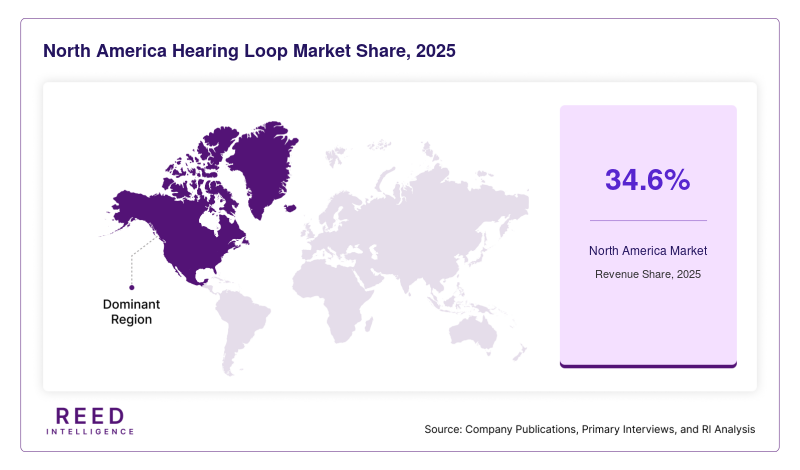
North America accounted for 34.6% of the Hearing Loop Market share in 2025 and is expected to grow at a CAGR of 7.8% during the forecast period. The region’s established infrastructure and strong regulatory framework supporting accessibility contributed to its leading position.
The United States dominated the regional market due to widespread adoption of assistive listening technologies in public facilities. Increased awareness among organizations and strict compliance requirements have driven installations across sectors such as healthcare, education, and transportation.
Europe
Europe held a 28.3% share of the Hearing Loop Market in 2025 and will grow at a CAGR of 7.6% through 2034. The region has been a pioneer in adopting hearing loop systems, supported by well-established accessibility standards and public awareness.
The United Kingdom emerged as the dominant country in Europe, driven by strong government initiatives and widespread implementation of hearing loops in public venues. The country’s focus on inclusive infrastructure has encouraged continuous adoption across sectors.
Asia Pacific
Asia Pacific represented 21.5% of the Hearing Loop Market in 2025 and is projected to grow at the fastest CAGR of 9.5%. Rapid urbanization and increasing investments in infrastructure development are driving demand for assistive technologies in the region.
China led the regional market due to large-scale infrastructure projects and rising awareness of accessibility solutions. Government initiatives aimed at improving public facilities have significantly contributed to market growth.
Middle East & Africa
The Middle East & Africa accounted for 8.1% of the Hearing Loop Market share in 2025 and is expected to grow at a CAGR of 8.4%. Increasing investments in smart city projects and public infrastructure are supporting market expansion.
The United Arab Emirates dominated the region, driven by its focus on advanced infrastructure and accessibility standards. The country’s commitment to inclusive urban development has encouraged the adoption of hearing loop systems.
Latin America
Latin America held a 7.5% share of the Hearing Loop Market in 2025 and is projected to grow at a CAGR of 8.1% during the forecast period. Growing awareness of assistive technologies and improving economic conditions are supporting market growth.
Brazil emerged as the leading country in the region due to increasing investments in public infrastructure and healthcare facilities. Efforts to enhance accessibility in urban areas have contributed to the adoption of hearing loop systems.
Competitive Landscape
The Hearing Loop Market is moderately fragmented, with several regional and global players competing based on product quality, innovation, and pricing. Leading companies are focusing on expanding their product portfolios and enhancing technological capabilities to maintain competitive advantage.
Ampetronic Group Ltd. is a key market leader, known for its comprehensive range of hearing loop solutions and strong global presence. The company recently introduced advanced digital loop amplifiers with improved energy efficiency and sound clarity, strengthening its position in the market.
Other prominent players are investing in research and development to introduce innovative products and expand their market reach. Strategic partnerships and collaborations are also being adopted to enhance distribution networks and cater to a broader customer base.
Key Players
- Ampetronic Group Ltd.
- Williams AV
- Listen Technologies Corporation
- Contacta Systems Ltd.
- Univox (Bo Edin AB)
- Geemarc Telecom SA
- GN Hearing A/S
- Phonak Communications AG
- ClearSounds Communications
- Harris Communications
Recent Developments
- Ampetronic launched a new range of digital loop amplifiers designed for smart building integration.
- Williams AV expanded its product portfolio with advanced portable hearing loop systems.
- Listen Technologies introduced wireless-compatible hearing loop solutions for hybrid environments.
- Contacta Systems partnered with infrastructure developers to deploy hearing loops in transportation hubs.
- Univox enhanced its digital product line with improved noise reduction capabilities.
Hearing Loop Market Segments
Product Type
- Fixed Hearing Loop Systems
- Portable Hearing Loop Systems
Application
- Public Infrastructure
- Healthcare
- Transportation
- Retail
- Others
End-Use
- Commercial
- Residential
- Educational
- Government
Technology
- Analog
- Digital
By Region
- North America
- Europe
- APAC
- Middle East and Africa
- LATAM