Heat Stress Monitor Market Size, Share & Demand Report By Product Type (Wearable Monitors, Fixed Monitors, IoT-Enabled Smart Monitors), By Component (Hardware, Software, Services), By Application (Industrial Safety, Sports & Fitness, Military, Healthcare), By End-Use Industry (Construction, Manufacturing, Oil & Gas, Healthcare, Agriculture), By Region & Segment Forecasts, 2025–2034
USD 3950
Market Overview
The global Heat Stress Monitor Market size was valued at approximately USD 1.85 billionin 2025 and is projected to reach USD 4.72 billion by 2034, expanding at a CAGR of 11.0% from 2025 to 2034. The market growth is being supported by the rising global emphasis on occupational health and safety regulations across industrial sectors such as construction, mining, manufacturing, and oil & gas. Increasing awareness regarding heat-related illnesses, including heat exhaustion and heatstroke, has led organizations to adopt advanced monitoring systems to safeguard workforce productivity and compliance.
The growing impact of climate change, resulting in higher global temperatures and prolonged heatwaves, has further accelerated demand for real-time heat stress monitoring devices. Additionally, integration of wearable technology and IoT-enabled monitoring solutions has enabled predictive analytics and proactive risk management, thereby enhancing adoption across both industrial and healthcare environments.
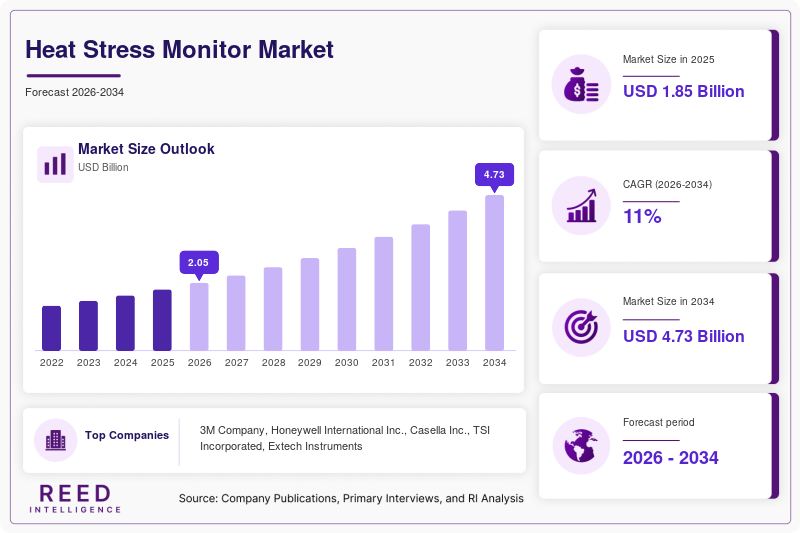
Key Highlights:
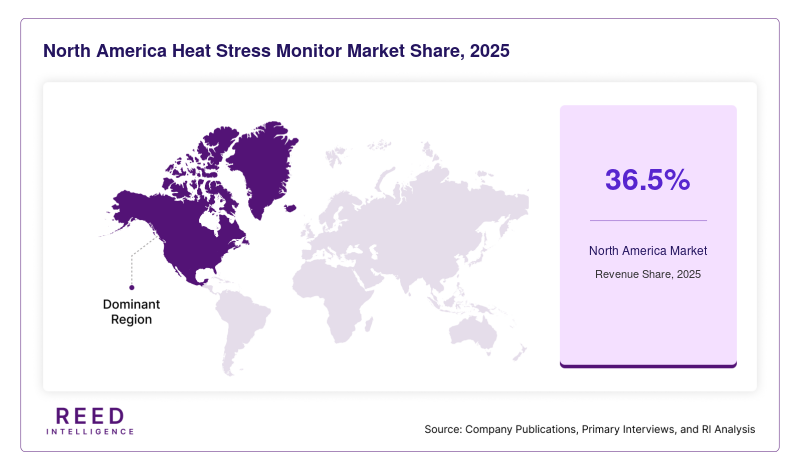
- North America dominated the market with a 36.5% share in 2025, while Asia Pacific is expected to register the fastest growth at a CAGR of 13.2%.
- In the product segment, wearable heat stress monitors led with a 54% share in 2024, while IoT-enabled smart monitors are projected to grow fastest at a CAGR of 14.1%.
- By application, industrial safety monitoring dominated in 2024, whereas sports and fitness monitoring is expected to grow at a CAGR of 13.6%.
- The U.S. market was valued at USD 620 million in 2024 and reached USD 680 million in 2025, maintaining its leading position globally.
Market Trends
Integration of IoT and AI in Monitoring Systems
The Heat Stress Monitor Market is witnessing a shift toward smart monitoring solutions integrated with IoT and artificial intelligence. These advanced systems enable real-time data collection, predictive analytics, and automated alerts, improving workplace safety outcomes. Cloud-based platforms allow centralized monitoring across multiple sites, supporting large-scale industrial operations. This trend is particularly prominent in sectors requiring continuous environmental monitoring, such as mining and construction.
Rising Adoption of Wearable Devices
Wearable heat stress monitors are gaining traction due to their portability, ease of use, and ability to track physiological parameters such as body temperature, heart rate, and hydration levels. These devices are increasingly used in sports, military training, and outdoor labor-intensive industries. The convergence of wearable technology with mobile applications is enhancing user engagement and enabling personalized health insights, which is contributing to market expansion.
Market Drivers
Stringent Occupational Safety Regulations
Governments and regulatory bodies across developed and developing economies are enforcing stricter workplace safety standards to prevent heat-related illnesses. Compliance requirements have encouraged organizations to invest in heat stress monitoring systems, especially in high-risk industries. This regulatory push is a major driver influencing market demand.
Increasing Global Temperature Levels
Rising global temperatures and frequent heatwaves have significantly increased the risk of heat stress among workers and athletes. Organizations are adopting preventive measures, including monitoring systems, to mitigate health risks and maintain productivity. This environmental factor continues to drive demand for advanced monitoring solutions.
Market Restraint
High Initial Investment and Maintenance Costs
Despite growing demand, the Heat Stress Monitor Market faces challenges related to the high cost of advanced monitoring systems. IoT-enabled devices, wearable sensors, and integrated software platforms require significant upfront investment. Additionally, ongoing maintenance, calibration, and data management costs can be substantial for small and medium enterprises. These financial constraints may limit adoption, particularly in cost-sensitive regions. Furthermore, the lack of technical expertise for system integration and data interpretation can hinder market growth in developing economies.
Market Opportunities
Expansion in Emerging Economies
Emerging markets in Asia Pacific, Latin America, and Africa present significant growth opportunities due to rapid industrialization and increasing awareness of occupational safety. Governments in these regions are gradually implementing safety regulations, creating a favorable environment for market expansion.
Integration with Smart Infrastructure
The integration of heat stress monitoring systems with smart city infrastructure and connected workplaces offers new growth avenues. These systems can be linked with environmental sensors, HVAC systems, and emergency response frameworks, enabling comprehensive risk management. This integration is expected to enhance adoption in urban industrial zones and large-scale infrastructure projects.
Segmental Analysis
By Product Type
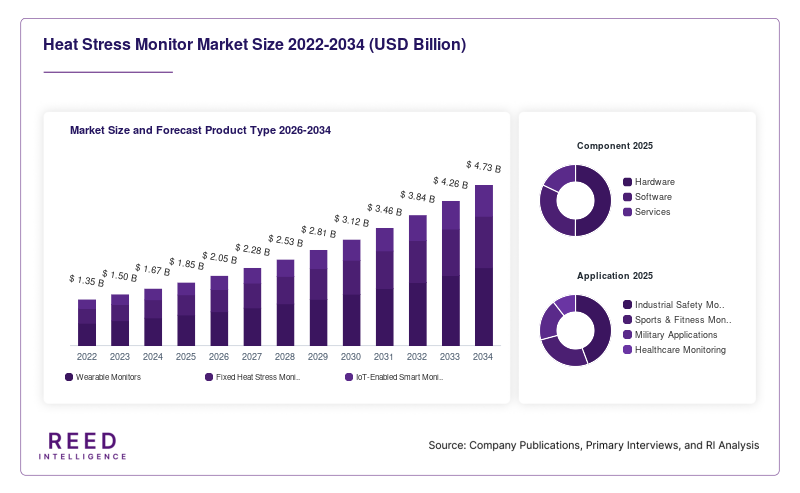
Wearable heat stress monitors dominated the market with a 54% share in 2024, driven by their portability and real-time monitoring capabilities. These devices are widely used across industrial and sports applications due to ease of deployment.
IoT-enabled smart monitors are projected to grow at the fastest CAGR of 14.1%, supported by their ability to integrate with centralized systems and provide predictive insights. Their scalability and advanced analytics capabilities will drive adoption in large enterprises.
By Component
Hardware components held the dominant share in 2024, accounting for 61% of the market, as they form the core of monitoring systems. Sensors and wearable devices represented a significant portion of this segment.
Software solutions are expected to grow at a CAGR of 13.7%, driven by increasing demand for data analytics, cloud integration, and real-time reporting capabilities.
By Application
Industrial safety monitoring led the market with a 48% share in 2024, as industries prioritize worker safety and regulatory compliance. High-risk sectors such as mining and construction contributed significantly to this dominance.
Sports and fitness monitoring is expected to grow at a CAGR of 13.6%, driven by increasing adoption of wearable devices among athletes and fitness enthusiasts seeking performance optimization.
By End-Use Industry
The construction sector dominated with a 32% share in 2024, due to high exposure to outdoor working conditions and stringent safety requirements.
Healthcare is projected to grow at a CAGR of 12.9%, as hospitals and research institutions adopt monitoring systems to manage patient safety during heatwaves.
Regional Analysis
North America
North America accounted for 36.5% of the Heat Stress Monitor Market share in 2025 and is expected to grow at a CAGR of 10.2% through 2034. The region benefited from strong regulatory frameworks and high awareness of occupational health standards.
The United States dominated the regional market due to widespread adoption of advanced safety technologies. The presence of established industrial sectors and continuous investment in worker safety programs contributed to steady growth.
Europe
Europe held a 27.8% share in 2025 and will expand at a CAGR of 9.8% during the forecast period. The region experienced steady adoption driven by stringent labor laws and environmental regulations.
Germany led the market due to its strong manufacturing base and emphasis on workplace safety innovation. Industrial automation initiatives further supported adoption of monitoring systems.
Asia Pacific
Asia Pacific captured 21.4% of the market in 2025 and is projected to grow at the fastest CAGR of 13.2%. Rapid industrialization and increasing awareness of heat-related risks drove market expansion.
China dominated the region due to large-scale industrial operations and government initiatives promoting workplace safety. The country’s growing manufacturing sector created strong demand for monitoring solutions.
Middle East & Africa
The Middle East & Africa region held a 7.2% share in 2025 and is expected to grow at a CAGR of 11.5%. High ambient temperatures and expanding construction activities contributed to market demand.
Saudi Arabia emerged as the leading country due to extensive infrastructure projects and increasing focus on worker safety in extreme climatic conditions.
Latin America
Latin America accounted for 7.1% of the market in 2025 and will grow at a CAGR of 10.8%. Industrial growth and rising awareness of occupational hazards supported market expansion.
Brazil dominated the region due to its large workforce in agriculture and construction sectors, where heat stress monitoring is increasingly being adopted.
Competitive Landscape
The Heat Stress Monitor Market is moderately fragmented, with several global and regional players competing on technology innovation and product differentiation. Leading companies are focusing on integrating advanced analytics and IoT capabilities to strengthen their market position.
A key market leader is 3M Company, which continues to expand its product portfolio with advanced wearable monitoring solutions. The company recently introduced a next-generation heat stress monitoring device featuring real-time alerts and cloud connectivity.
Other prominent players are investing in strategic partnerships, product launches, and geographic expansion to enhance their competitive presence. Continuous innovation and customization remain key strategies for maintaining market share.
Key Players
- 3M Company
- Honeywell International Inc.
- Casella Inc.
- TSI Incorporated
- Extech Instruments
- REED Instruments
- Quest Technologies
- General Tools & Instruments
- Sper Scientific
- Kestrel Instruments
Recent Developments
- 3M Company launched an advanced wearable heat stress monitoring system with enhanced connectivity features in 2025.
- Honeywell introduced a cloud-based safety monitoring platform integrating heat stress analytics.
- TSI Incorporated expanded its product line with portable monitoring devices targeting industrial applications.
- Casella Inc. developed upgraded environmental monitoring solutions with improved sensor accuracy.
- Kestrel Instruments released a next-generation handheld heat stress monitor for field applications.
Heat Stress Monitor Market Segments
Product Type
- Wearable Monitors
- Fixed Heat Stress Monitors
- IoT-Enabled Smart Monitors
Component
- Hardware
- Software
- Services
Application
- Industrial Safety Monitoring
- Sports & Fitness Monitoring
- Military Applications
- Healthcare Monitoring
End-Use Industry
- Construction
- Manufacturing
- Oil & Gas
- Healthcare
- Agriculture
By Region
- North America
- Europe
- APAC
- Middle East and Africa
- LATAM