Heated Wiper Fluid Market Size, Share & Demand Report By Vehicle Type (Passenger Vehicles, Commercial Vehicles, Electric Vehicles), By System Type (Integrated Heating Systems, On-Demand Heating Systems), By Sales Channel (OEM, Aftermarket), By Application (Windshield Cleaning, Sensor Cleaning), By Region & Segment Forecasts, 2025–2034
USD 3950
Market Overview
The global Heated Wiper Fluid Market was valued at approximately USD 2.1 billion in 2025 and is projected to reach USD 4.8 billion by 2034, expanding at a compound annual growth rate (CAGR) of 9.5% during the forecast period (2025–2034). The market growth is primarily supported by increasing vehicle safety regulations and consumer awareness regarding enhanced visibility during adverse weather conditions such as snow, frost, and freezing rain.
Heated wiper fluid systems play a critical role in maintaining windshield clarity by preventing freezing and improving cleaning efficiency in cold climates. The integration of these systems into both passenger and commercial vehicles has accelerated due to advancements in automotive electronics and rising demand for driver assistance features. Additionally, OEMs are incorporating heated fluid systems into premium and mid-range vehicle segments, further driving adoption.
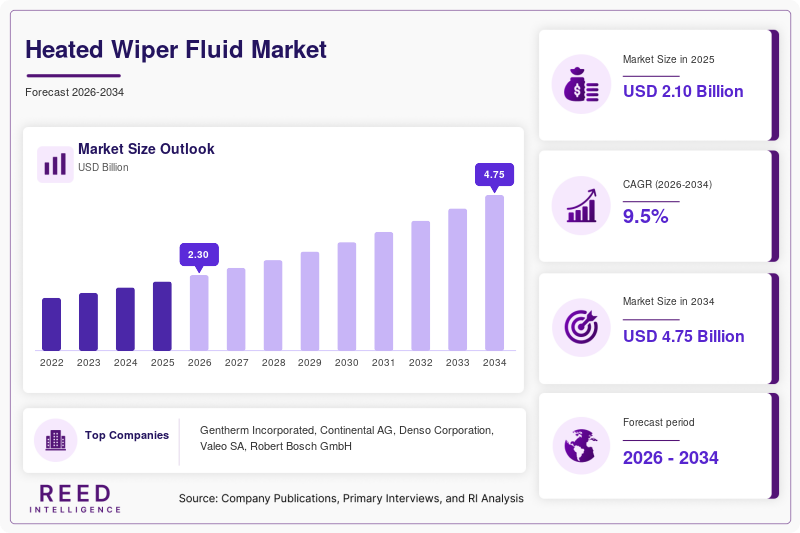
Key Highlights:
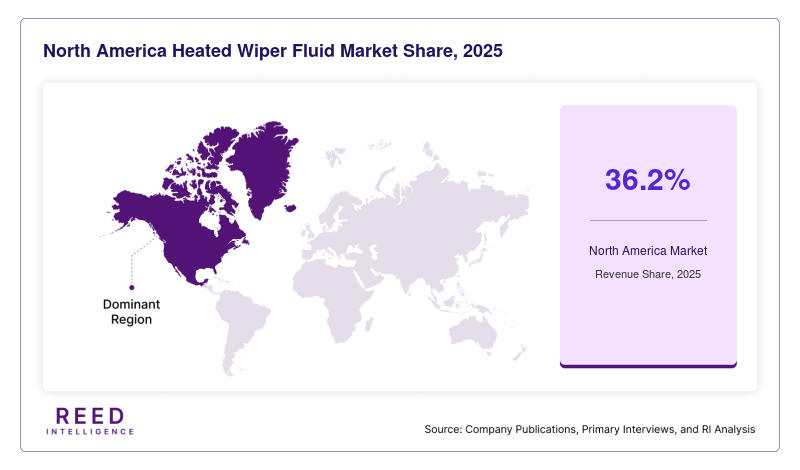
- North America dominated the market with a 36.2% share in 2025, while Asia Pacific is projected to grow at the fastest CAGR of 11.3% during the forecast period.
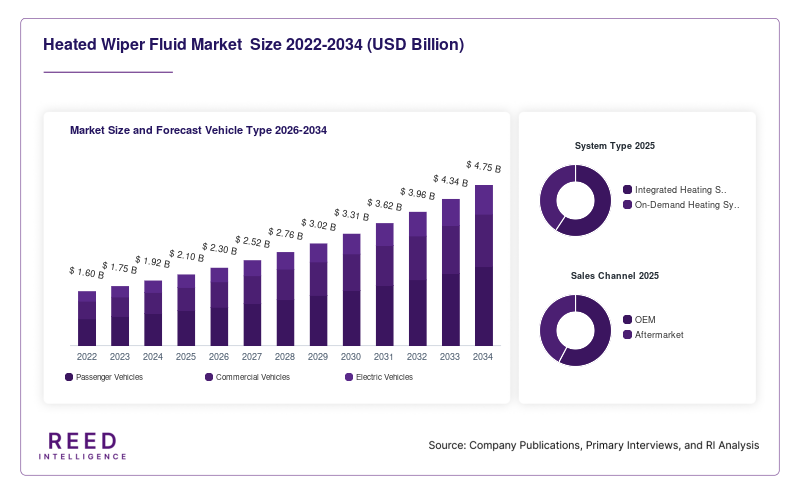
- By vehicle type, passenger vehicles held the largest share of 62.5% in 2024, while electric vehicles are anticipated to grow at the fastest CAGR of 12.1%.
- By system type, integrated heating systems led the market, whereas on-demand heating systems are expected to witness the highest growth at a CAGR of 10.8%.
- The United States remained the dominant country, with market values of USD 620 million in 2024 and USD 660 million in 2025.
Market Trends
Integration with Advanced Driver Assistance Systems (ADAS)
The integration of heated wiper fluid systems with ADAS is emerging as a notable trend in the Heated Wiper Fluid Market. As vehicles increasingly rely on sensors, cameras, and radar systems for safety and navigation, maintaining clear visibility becomes essential. Heated fluid systems help ensure that sensors remain unobstructed in cold weather conditions, thereby supporting the effective functioning of ADAS technologies. Automakers are aligning these systems with broader vehicle safety ecosystems, which is strengthening their adoption across premium and mid-range segments.
Shift Toward Energy-Efficient Heating Technologies
Manufacturers are focusing on developing energy-efficient heating solutions to reduce power consumption and improve vehicle performance. Innovations such as instant heating elements and smart temperature regulation systems are gaining traction. These technologies optimize energy usage, particularly in electric vehicles where battery efficiency is critical. This trend is expected to influence product design and encourage widespread adoption across different vehicle categories.
Market Drivers
Increasing Demand for Enhanced Vehicle Safety Systems
The growing emphasis on road safety is a major driver for the Heated Wiper Fluid Market. Governments and regulatory bodies are mandating improved visibility standards in vehicles, particularly in regions with harsh winter conditions. Heated wiper fluid systems contribute to safer driving by preventing windshield icing and ensuring clear visibility, thereby reducing accident risks.
Growth in Automotive Production and Premiumization
Rising global automotive production, coupled with the increasing demand for premium features, is driving market growth. Consumers are opting for vehicles equipped with advanced comfort and safety features, including heated fluid systems. Automakers are responding by incorporating these technologies into standard and optional packages, thereby expanding the market base.
Market Restraint
High Installation and Maintenance Costs
One of the key challenges in the Heated Wiper Fluid Market is the relatively high cost associated with system installation and maintenance. Heated wiper fluid systems require additional components such as heating elements, sensors, and control units, which increase the overall vehicle cost. This can limit adoption, particularly in price-sensitive markets and entry-level vehicle segments. Additionally, maintenance and repair costs may be higher compared to conventional systems, which can deter aftermarket adoption.
Market Opportunities
Expansion in Electric and Autonomous Vehicles
The rise of electric and autonomous vehicles presents significant growth opportunities for the Heated Wiper Fluid Market. These vehicles rely heavily on sensors and cameras, which require consistent visibility. Heated fluid systems can enhance sensor performance in cold climates, making them an essential component in next-generation vehicles.
Growth in Emerging Markets with Cold Climate Zones
Emerging economies with seasonal cold climates are witnessing increased vehicle ownership and infrastructure development. This creates opportunities for manufacturers to expand their presence and introduce cost-effective heated fluid solutions tailored to these markets. Localization strategies and partnerships with regional distributors can further enhance market penetration.
Segmental Analysis
By Vehicle Type
Passenger vehicles dominated the Heated Wiper Fluid Market, accounting for 62.5% of the market share in 2024. This dominance was attributed to higher adoption of comfort and safety features in personal vehicles.
Electric vehicles are projected to grow at the fastest CAGR of 12.1% during the forecast period. The increasing reliance on electronic systems and sensors in EVs will drive demand for heated fluid systems to maintain optimal performance in cold conditions.
By System Type
Integrated heating systems held the largest share of 58.3% in 2024, owing to their seamless incorporation into vehicle design and efficient performance.
On-demand heating systems are expected to grow at a CAGR of 10.8%. These systems offer energy efficiency by heating fluid only when required, making them suitable for modern vehicles with advanced energy management systems.
By Sales Channel
OEM sales dominated the market with a share of 65.4% in 2024, driven by the integration of heated systems during vehicle manufacturing.
The aftermarket segment is anticipated to grow at a CAGR of 9.9%, supported by increasing retrofitting of vehicles and rising awareness among consumers regarding safety upgrades.
By Component
Heating elements accounted for the largest share of 41.7% in 2024, as they are essential for system functionality.
Control units are expected to grow at a CAGR of 10.5%, driven by advancements in smart and automated temperature control technologies.
By Application
Windshield cleaning applications dominated with a share of 72.8% in 2024, as maintaining clear visibility remains the primary function.
Sensor cleaning applications are projected to grow at a CAGR of 11.6%, due to increasing adoption of sensor-based systems in vehicles.
Regional Analysis
North America
North America accounted for 36.2% of the Heated Wiper Fluid Market share in 2025 and is expected to grow at a CAGR of 8.7% during 2025–2034. The region’s established automotive industry and high adoption of advanced vehicle technologies have contributed to its leading position.
The United States dominated the regional market due to widespread use of heated systems in vehicles operating in cold climates. The presence of stringent safety standards and consumer preference for enhanced driving comfort has supported consistent demand.
Europe
Europe held a significant share of 28.4% in 2025 and is projected to expand at a CAGR of 9.1% over the forecast period. The region’s strong automotive manufacturing base and regulatory focus on safety have driven adoption.
Germany emerged as the dominant country, supported by its advanced automotive engineering sector. The demand for premium vehicles equipped with advanced safety features has contributed to the widespread use of heated wiper fluid systems.
Asia Pacific
Asia Pacific represented 21.6% of the market in 2025 and is expected to grow at the fastest CAGR of 11.3% through 2034. Rapid urbanization, increasing vehicle production, and rising consumer awareness are key factors driving growth.
China led the regional market due to its large automotive manufacturing capacity and growing adoption of advanced vehicle technologies. The expansion of electric vehicle production has further supported demand for heated fluid systems.
Middle East & Africa
The Middle East & Africa accounted for 7.1% of the market in 2025 and is anticipated to grow at a CAGR of 8.2%. While the region has limited cold climate areas, certain regions experience seasonal weather conditions that necessitate visibility solutions.
South Africa dominated the regional market, driven by increasing vehicle imports and gradual adoption of advanced automotive features.
Latin America
Latin America held a share of 6.7% in 2025 and is expected to grow at a CAGR of 8.5% during the forecast period. The market is driven by expanding automotive sales and improving infrastructure.
Brazil emerged as the leading country, supported by its growing automotive industry and rising consumer demand for improved vehicle safety and comfort features.
Competitive Landscape
The Heated Wiper Fluid Market is moderately competitive, with key players focusing on innovation, product integration, and strategic partnerships. Leading companies are investing in advanced heating technologies and expanding their product portfolios to cater to evolving automotive requirements.
The market leader, Gentherm Incorporated, has strengthened its position through continuous innovation in thermal management solutions. The company recently introduced an advanced energy-efficient heated fluid system designed for electric vehicles, enhancing its competitive edge.
Other prominent players are focusing on expanding their geographic presence and collaborating with OEMs to increase market penetration. The competitive landscape is characterized by technological advancements and a strong emphasis on product differentiation.
Key Players List
- Gentherm Incorporated
- Continental AG
- Denso Corporation
- Valeo SA
- Robert Bosch GmbH
- HELLA GmbH & Co. KGaA
- Mitsuba Corporation
- Prestone Products Corporation
- Trico Products Corporation
- Federal-Mogul Motorparts
- Standard Motor Products Inc.
- Aisin Corporation
- Delphi Technologies
- Marelli Holdings Co., Ltd.
- WABCO Holdings Inc.
Recent Developments
- Gentherm Incorporated launched a new energy-efficient heated fluid system tailored for electric vehicles in 2025.
- Continental AG expanded its thermal system portfolio with advanced heated washer solutions.
- Denso Corporation introduced smart control units for improved temperature regulation.
- Valeo SA partnered with OEMs to integrate heated fluid systems into next-generation vehicles.
- Robert Bosch GmbH invested in R&D for sensor-cleaning solutions integrated with heated fluid systems.
Heated Wiper Fluid Market Segments
Vehicle Type
- Passenger Vehicles
- Commercial Vehicles
- Electric Vehicles
System Type
- Integrated Heating Systems
- On-Demand Heating Systems
Sales Channel
- OEM
- Aftermarket
Application
- Windshield Cleaning
- Sensor Cleaning
By Region
- North America
- Europe
- APAC
- Middle East and Africa
- LATAM