Heatstroke Treatment Market Size, Share & Demand Report By Treatment Type (Intravenous Rehydration Therapies, Pharmaceutical Support, Oxygen Therapy, Critical Care Support), By Device Type (Wearable Monitoring Devices, Cooling Equipment, Portable Emergency Systems, Diagnostic Monitoring Systems), By End Use (Hospitals, Ambulatory Care Centers, Sports Medicine Centers), By Region & Segment Forecasts, 2026–2034
USD 3950
Market Overview
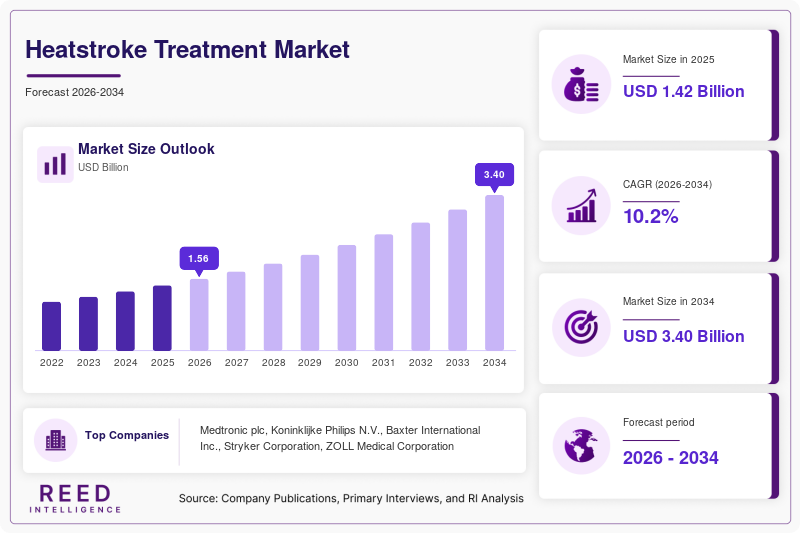
The global Heatstroke Treatment Market size was valued at approximately USD 1.42 billion in 2026 and is projected to reach nearly USD 3.08 billion by 2034, expanding at a CAGR of 10.2% during the forecast period from 2026 to 2034. The market continues to gain momentum due to the rising frequency of extreme heat events, increasing awareness regarding heat-related illnesses, and growing healthcare investments across developed and developing economies. Heatstroke treatment includes emergency cooling therapies, intravenous fluids, temperature monitoring systems, pharmaceutical support, and critical care management solutions used to prevent organ damage and reduce mortality associated with severe heat exposure.
The growing impact of climate change has become one of the primary global factors supporting market expansion. Prolonged heatwaves across North America, Europe, Asia Pacific, and the Middle East have increased hospitalization rates related to heatstroke, particularly among elderly individuals, outdoor workers, athletes, and patients with chronic illnesses. Governments and healthcare organizations are also expanding emergency preparedness programs and investing in advanced cooling equipment for hospitals and emergency response centers. In addition, increasing urbanization and rising occupational exposure in construction, mining, logistics, and manufacturing industries are contributing to sustained demand for rapid heatstroke intervention solutions.
Key Highlights
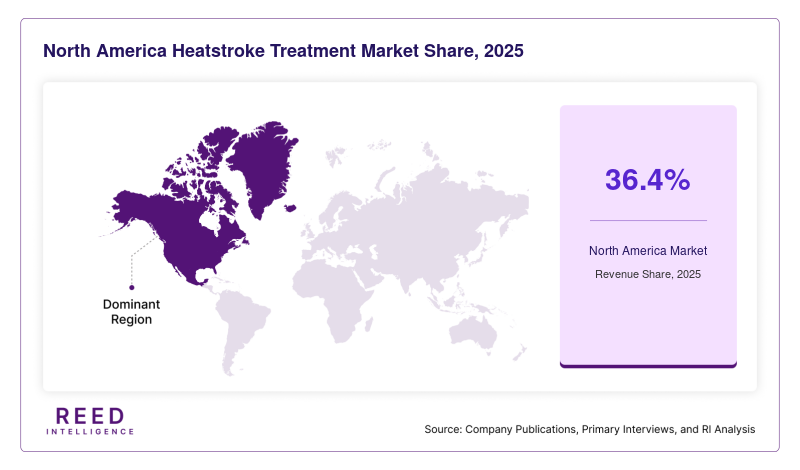
- North America dominated the market with a 36.4% share in 2025.
- Asia Pacific is expected to grow at the fastest CAGR of 11.8% during 2026–2034.
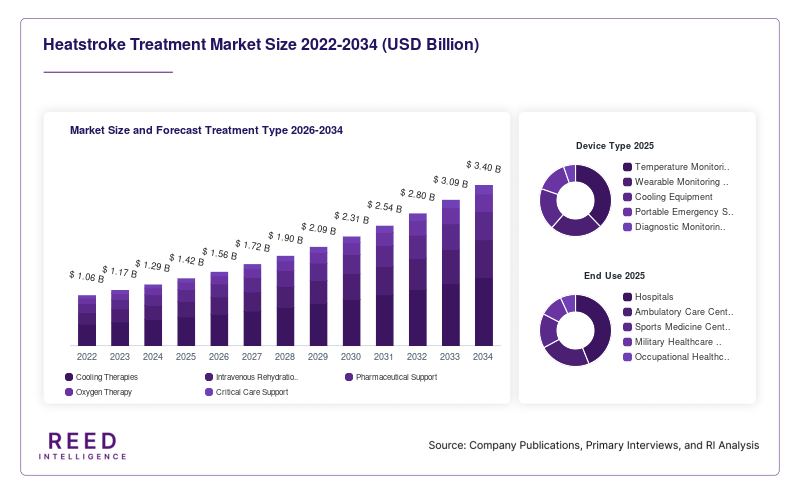
- By treatment type, cooling therapies accounted for the largest share of 42.7%.
- while wearable monitoring devices are projected to grow at a CAGR of 12.9%.
- By end use, hospitals led with a 48.5% share.
- whereas ambulatory care centers are expected to expand at a CAGR of 11.6%.
- The United States remained the dominant country, with market values of USD 420 million in 2024 and USD 468 million in 2025.
Market Trends
Integration of Wearable Monitoring Technologies in Heatstroke Management
Healthcare systems and occupational safety providers are increasingly integrating wearable monitoring technologies into heatstroke prevention and treatment strategies. Smart wearable sensors capable of tracking body temperature, hydration levels, heart rate, and environmental exposure are becoming more common in sports medicine, military operations, and industrial workplaces. These devices help identify early symptoms of heat exhaustion before patients progress to severe heatstroke conditions. Hospitals are also using connected monitoring systems to improve emergency response times and patient stabilization procedures.
The growing use of artificial intelligence and cloud-based analytics in healthcare monitoring platforms is further improving the effectiveness of wearable heatstroke management solutions. Real-time alerts and predictive risk assessment tools are helping healthcare professionals monitor vulnerable populations more efficiently. Demand for these solutions is especially increasing in countries experiencing frequent heatwaves and rising outdoor labor activity. The trend is encouraging medical device manufacturers to invest in lightweight, portable, and cost-effective monitoring technologies designed for both clinical and field environments.
Expansion of Rapid Cooling Infrastructure Across Emergency Care Facilities
Emergency care facilities are increasingly adopting advanced rapid cooling infrastructure to improve heatstroke treatment outcomes and reduce mortality risks. Healthcare institutions are investing in cooling blankets, evaporative cooling systems, cold-water immersion units, and advanced temperature control devices to manage severe hyperthermia cases more effectively. This trend is particularly visible in urban hospitals and sports medicine facilities where rapid patient stabilization is essential.
Public health agencies are also supporting the establishment of temporary cooling centers during seasonal heat emergencies. Governments in several countries are expanding heat emergency response programs by funding cooling equipment procurement for ambulances, military medical units, and disaster management teams. Rising patient admissions linked to extreme weather events are accelerating demand for scalable and mobile cooling technologies. In addition, healthcare providers are focusing on improving emergency room preparedness through staff training and protocol standardization, contributing to broader adoption of specialized heatstroke treatment systems.
Market Drivers
Rising Frequency of Extreme Heatwaves and Climate-Related Health Risks
The increasing occurrence of extreme heatwaves across multiple regions has significantly contributed to the expansion of the Heatstroke Treatment Market. Global temperatures continue to rise due to climate change, leading to prolonged periods of excessive heat exposure. Heat-related illnesses are becoming more common among elderly populations, outdoor workers, athletes, military personnel, and individuals with cardiovascular or respiratory disorders. Hospitals and emergency medical services are witnessing higher patient inflows during summer seasons, increasing demand for effective heatstroke treatment solutions.
Governments and public health organizations are also implementing heat action plans and emergency preparedness initiatives to reduce mortality associated with severe heat conditions. These programs are driving investments in cooling technologies, intravenous rehydration systems, and emergency monitoring equipment. Urban areas with dense populations and limited green infrastructure are particularly vulnerable to heat stress, creating long-term demand for improved treatment infrastructure. As climate variability continues to intensify, healthcare systems are expected to prioritize heatstroke management capabilities across both developed and emerging economies.
Growth in Occupational Safety Regulations and Sports Health Programs
Increasing occupational safety regulations and expanding sports health programs are supporting market growth across industrial and healthcare sectors. Employers in construction, mining, transportation, agriculture, and manufacturing industries are adopting preventive healthcare measures to protect workers from heat-related illnesses. Many companies are investing in portable cooling equipment, hydration systems, and wearable temperature monitoring devices to comply with workplace safety guidelines and reduce medical emergencies.
The sports industry is also contributing to market expansion due to rising awareness regarding athlete safety during high-temperature conditions. Professional sports organizations, schools, and training academies are adopting advanced cooling therapies and rapid emergency response protocols to minimize the risk of exertional heatstroke. Sports medicine clinics are increasingly equipped with cold-water immersion tanks and temperature stabilization systems to manage severe cases efficiently. The combined impact of workplace health policies and sports safety initiatives is creating sustained demand for advanced heatstroke treatment products and services worldwide.
Market Restraint
Limited Healthcare Access and High Treatment Costs in Developing Economies
Limited healthcare access and the high cost of advanced heatstroke treatment solutions remain major challenges for market expansion in several developing economies. Many rural and low-income regions continue to face shortages of emergency medical infrastructure, trained healthcare professionals, and specialized cooling equipment. Heatstroke cases in such areas are often diagnosed late, increasing the risk of complications including organ failure and neurological damage. The absence of rapid response systems and intensive care facilities further restricts effective treatment availability.
Advanced cooling devices, wearable monitoring systems, and critical care management technologies also involve significant procurement and maintenance costs, limiting adoption among smaller hospitals and community healthcare centers. In several countries, healthcare reimbursement frameworks for heat-related illnesses remain underdeveloped, reducing affordability for patients and institutions. Seasonal demand fluctuations additionally create uncertainty for healthcare providers considering large-scale investments in heatstroke treatment infrastructure. These factors collectively slow market penetration in cost-sensitive regions despite rising awareness regarding heat-related health risks.
Market Opportunities
Increasing Adoption of Telemedicine and Remote Patient Monitoring Solutions
The rapid expansion of telemedicine and remote patient monitoring solutions is creating new opportunities in the Heatstroke Treatment Market. Healthcare providers are increasingly using connected platforms to monitor high-risk individuals during heatwaves, particularly elderly patients and people with chronic diseases. Remote temperature monitoring devices and mobile health applications enable early identification of heat-related symptoms, allowing timely medical intervention before conditions become severe.
Telehealth integration is especially beneficial in remote and underserved regions where access to emergency care facilities remains limited. Governments and healthcare organizations are supporting digital health initiatives to strengthen disaster preparedness and climate resilience strategies. Technology companies are also collaborating with hospitals to develop AI-enabled predictive analytics platforms capable of identifying patients at higher risk of heatstroke complications. As healthcare digitization accelerates globally, the demand for integrated remote heatstroke management systems is expected to rise steadily during the forecast period.
Expansion of Heat Emergency Preparedness Programs in Emerging Economies
Emerging economies are increasingly investing in heat emergency preparedness programs, creating substantial growth opportunities for market participants. Countries across Asia Pacific, the Middle East, and Latin America are experiencing rising temperatures, urban heat island effects, and growing industrial activity, increasing the prevalence of heat-related illnesses. Governments are responding by expanding public cooling infrastructure, emergency response systems, and healthcare training initiatives focused on heatstroke management.
Healthcare institutions in these regions are gradually upgrading emergency care units with advanced cooling therapies, rehydration equipment, and portable patient monitoring technologies. International health organizations are also supporting climate adaptation programs aimed at reducing heat-related mortality. Market players have opportunities to expand through partnerships with public healthcare agencies, local distributors, and occupational safety providers. The growing focus on climate resilience and public health preparedness is expected to accelerate demand for affordable and scalable heatstroke treatment solutions across emerging economies.
Segmental Analysis
By Treatment Type
Cooling therapies represented the dominant subsegment within the Heatstroke Treatment Market in 2024, accounting for approximately 42.7% of total market share. The widespread use of cold-water immersion systems, evaporative cooling devices, cooling blankets, and ice-pack therapies in emergency care settings contributed significantly to segment dominance. Rapid reduction of body temperature remains the primary clinical objective in severe heatstroke treatment, making cooling therapies an essential component of hospital emergency protocols. Healthcare institutions across developed economies continue to expand investments in specialized cooling infrastructure to improve patient survival rates and reduce long-term neurological complications.
Intravenous rehydration therapies are projected to emerge as the fastest-growing subsegment during the forecast period, expanding at a CAGR of 11.9%. Increasing awareness regarding dehydration-related complications and electrolyte imbalance management is supporting the adoption of advanced intravenous treatment solutions in hospitals and ambulatory care facilities. Medical professionals are increasingly combining rehydration therapies with rapid cooling techniques to stabilize critically ill patients more effectively. Demand is particularly increasing in regions experiencing frequent heatwaves and rising occupational heat exposure. In addition, healthcare manufacturers are introducing portable and easy-to-administer intravenous systems designed for emergency field operations and disaster response scenarios.
By Device Type
Temperature monitoring devices held the largest share within the device type segment in 2024, accounting for nearly 39.4% of the global market. Hospitals, sports medicine centers, military healthcare facilities, and industrial employers are increasingly relying on continuous temperature monitoring systems to identify heat stress symptoms and support rapid intervention. Advanced wearable sensors, infrared thermometers, and wireless patient monitoring devices are improving the accuracy of heatstroke diagnosis and enabling real-time patient assessment. The growing adoption of connected healthcare technologies and remote patient monitoring systems is further strengthening demand for advanced temperature management devices.
Wearable monitoring devices are anticipated to register the fastest growth rate during the forecast period, with a projected CAGR of 12.9%. The rising integration of wearable health technology in occupational safety and sports medicine applications is supporting strong segment expansion. Employers operating in high-temperature environments are adopting wearable sensors to monitor worker hydration and body temperature levels continuously. Healthcare providers are also using wearable devices to track vulnerable patients during heat emergencies. Technological advancements in battery efficiency, wireless connectivity, and artificial intelligence-based analytics are encouraging broader adoption of compact and cost-effective monitoring solutions across both clinical and non-clinical environments.
By End Use
Hospitals accounted for the dominant share of the Heatstroke Treatment Market in 2024, representing approximately 48.5% of total revenue. Severe heatstroke cases often require immediate hospitalization, intensive monitoring, and access to advanced cooling therapies, making hospitals the primary treatment centers globally. Emergency departments and critical care units are increasingly equipped with specialized cooling systems, intravenous rehydration equipment, and rapid diagnostic tools to improve patient outcomes. The availability of skilled healthcare professionals and comprehensive emergency infrastructure further supports hospital dominance within the market.
Ambulatory care centers are expected to witness the fastest growth during the forecast period, expanding at a CAGR of 11.6%. Increasing pressure on hospital emergency departments and rising demand for cost-effective treatment alternatives are encouraging the expansion of ambulatory care services. These facilities are increasingly equipped to provide early-stage heatstroke management, hydration therapy, and patient stabilization services. Urban healthcare networks are integrating ambulatory centers into broader emergency preparedness strategies to improve treatment accessibility during seasonal heatwaves. Growing healthcare investments in outpatient care infrastructure and rising awareness regarding early heatstroke intervention are expected to support strong segment growth over the coming years.
Regional Analysis
North America
North America accounted for the largest share of the Heatstroke Treatment Market in 2025, representing approximately 36.4% of global revenue. The regional market is projected to expand at a CAGR of 9.8% during the forecast period due to rising heat-related hospital admissions and increasing investments in emergency healthcare infrastructure. The United States and Canada are experiencing more frequent heatwaves, which has increased demand for advanced cooling therapies, temperature monitoring systems, and emergency medical response services. Healthcare providers across the region are also integrating digital monitoring technologies to improve patient management during extreme weather conditions.
The United States remained the dominant country within North America due to its advanced healthcare infrastructure and growing adoption of occupational heat safety programs. Rising outdoor employment across construction, logistics, and agriculture sectors has encouraged employers to invest in heat illness prevention and treatment solutions. Sports medicine institutions and military healthcare facilities are also expanding the use of rapid cooling systems and wearable temperature monitoring devices. Federal and state-level climate resilience initiatives are further supporting investments in emergency preparedness and heatstroke treatment infrastructure.
Europe
Europe represented a significant share of the Heatstroke Treatment Market in 2025 and is expected to witness stable growth at a CAGR of 9.5% through 2034. The increasing frequency of summer heatwaves across Southern and Western Europe has contributed to higher rates of heat-related illnesses, particularly among elderly populations. Countries including France, Spain, Italy, and Germany are strengthening public healthcare systems to address rising climate-related health risks. Hospitals are increasingly adopting advanced cooling technologies and emergency care protocols to improve patient outcomes during periods of extreme heat.
Germany emerged as the dominant country within the European market due to its strong healthcare expenditure and extensive emergency medical infrastructure. The country has implemented national heat action plans aimed at protecting vulnerable populations and improving hospital readiness during heat emergencies. Occupational health regulations in industrial sectors are also driving demand for wearable monitoring systems and preventive cooling solutions. In addition, collaborations between medical technology companies and research institutions are encouraging the development of innovative heatstroke management products tailored for aging populations.
Asia Pacific
Asia Pacific is expected to register the fastest growth in the Heatstroke Treatment Market, expanding at a CAGR of 11.8% during the forecast period. Rapid urbanization, increasing industrial activity, and rising average temperatures are contributing to greater incidence of heatstroke cases across the region. Countries such as China, India, Japan, and Australia are witnessing increased healthcare demand during prolonged summer seasons. Governments are investing in healthcare modernization and emergency preparedness initiatives to improve treatment accessibility and reduce mortality associated with severe heat exposure.
China remained the leading country in the Asia Pacific market due to its large population base and growing healthcare infrastructure investments. The country is experiencing rising demand for portable cooling devices, intravenous rehydration therapies, and emergency monitoring systems in hospitals and occupational healthcare settings. Expanding construction and manufacturing sectors are also increasing awareness regarding workplace heat safety. In addition, public health campaigns promoting heatstroke prevention and early diagnosis are supporting broader adoption of rapid treatment technologies across urban and semi-urban healthcare facilities.
Middle East & Africa
The Middle East & Africa region is witnessing gradual growth in the Heatstroke Treatment Market and is projected to expand at a CAGR of 10.1% between 2026 and 2034. High environmental temperatures and desert climate conditions make heat-related illnesses a major public health concern across several countries in the region. Governments are investing in emergency medical infrastructure, particularly in Gulf Cooperation Council countries where outdoor labor exposure remains significant. Healthcare providers are increasingly adopting cooling equipment and rapid response systems to address growing hospitalization rates during summer months.
Saudi Arabia emerged as the dominant country within the regional market due to increasing healthcare investments and rising focus on worker safety during extreme heat conditions. Large-scale infrastructure and construction projects have encouraged companies to implement heat illness prevention programs and emergency cooling facilities. Religious tourism and mass gatherings also increase the need for advanced heatstroke management capabilities during high-temperature seasons. In Africa, international healthcare support programs are gradually improving access to emergency treatment technologies in underserved regions.
Latin America
Latin America accounted for a moderate share of the Heatstroke Treatment Market in 2025 and is anticipated to grow at a CAGR of 9.3% through 2034. Rising urban temperatures, changing climate conditions, and expanding industrial activity are increasing the prevalence of heat-related illnesses across the region. Countries including Brazil, Mexico, and Argentina are investing in healthcare modernization and public awareness programs to improve emergency response capacity. Hospitals and ambulatory care centers are gradually adopting advanced cooling therapies and patient monitoring technologies.
Brazil remained the leading country within the Latin American market due to its large healthcare network and increasing exposure to prolonged heat events. Outdoor sports activities and agricultural employment contribute significantly to heatstroke risks in several regions of the country. Public health agencies are strengthening educational campaigns related to hydration, early symptom recognition, and emergency treatment protocols. In addition, rising private healthcare investments and improving medical technology access are supporting the adoption of advanced heatstroke treatment systems across urban healthcare facilities.
Competitive Landscape
The Heatstroke Treatment Market remains moderately fragmented, with several multinational healthcare companies competing through product innovation, strategic partnerships, and geographic expansion initiatives. Key market participants are focusing on developing advanced cooling technologies, portable monitoring systems, and integrated emergency care solutions to strengthen their market presence. Companies are also increasing investments in wearable health technologies and digital monitoring platforms to address growing demand for preventive heatstroke management.
Medtronic plc maintained a leading position within the market due to its extensive patient monitoring portfolio and strong global distribution network. The company has expanded its emergency care product offerings through continuous technological advancements in connected healthcare solutions. Koninklijke Philips N.V. is focusing on remote patient monitoring systems designed for emergency and critical care applications. Baxter International Inc. continues to strengthen its intravenous therapy product portfolio to support dehydration management and critical care treatment.
Recent competitive activity has also increased across Asia Pacific and the Middle East, where regional healthcare investments are accelerating. Stryker Corporation and ZOLL Medical Corporation are expanding partnerships with hospitals and emergency response organizations to improve access to rapid cooling and monitoring technologies. Companies are increasingly prioritizing product affordability, portability, and interoperability to address evolving healthcare requirements in both developed and emerging markets.
Key Players
- Medtronic plc
- Koninklijke Philips N.V.
- Baxter International Inc.
- Stryker Corporation
- ZOLL Medical Corporation
- GE HealthCare Technologies Inc.
- Smiths Medical
- Nihon Kohden Corporation
- Drägerwerk AG & Co. KGaA
- Cardinal Health Inc.
- 3M Company
- BD (Becton, Dickinson and Company)
- ICU Medical Inc.
Recent Developments
- Medtronic plc introduced an advanced wireless patient temperature monitoring platform in 2025 to support real-time heat stress assessment in emergency care settings.
- Koninklijke Philips N.V. expanded its remote patient monitoring partnership network across Asia Pacific in 2024 to improve digital heatstroke management capabilities.
- Baxter International Inc. launched a portable intravenous hydration therapy solution in 2025 designed for rapid deployment during extreme heat emergencies and disaster response operations.
- Stryker Corporation increased investments in emergency cooling technology research in 2024 to strengthen its critical care treatment portfolio.
Heatstroke Treatment Market Segments
Treatment Type
- Cooling Therapies
- Intravenous Rehydration Therapies
- Pharmaceutical Support
- Oxygen Therapy
- Critical Care Support
Device Type
- Temperature Monitoring Devices
- Wearable Monitoring Devices
- Cooling Equipment
- Portable Emergency Systems
- Diagnostic Monitoring Systems
End Use
- Hospitals
- Ambulatory Care Centers
- Sports Medicine Centers
- Military Healthcare Facilities
- Occupational Healthcare Units
By Region
- North America
- Europe
- APAC
- Middle East and Africa
- LATAM