Heavy Duty Robot Platform Market Size, Share & Demand Report By Payload Capacity (Below 1,000 kg, 1,000–3,000 kg, Above 3,000 kg), By Application (Material Handling and Transportation, Mining Operations, Construction Automation, Defense and Security, Energy and Utilities, Others), By End-Use Industry (Manufacturing, Logistics and Warehousing, Mining, Defense, Construction, Energy, Others), By Region & Segment Forecasts, 2026–2034
USD 3950
Market Overview
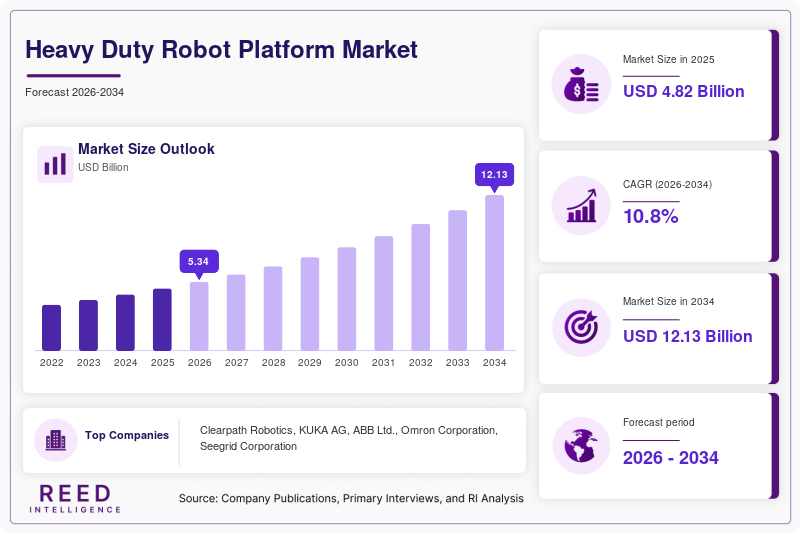
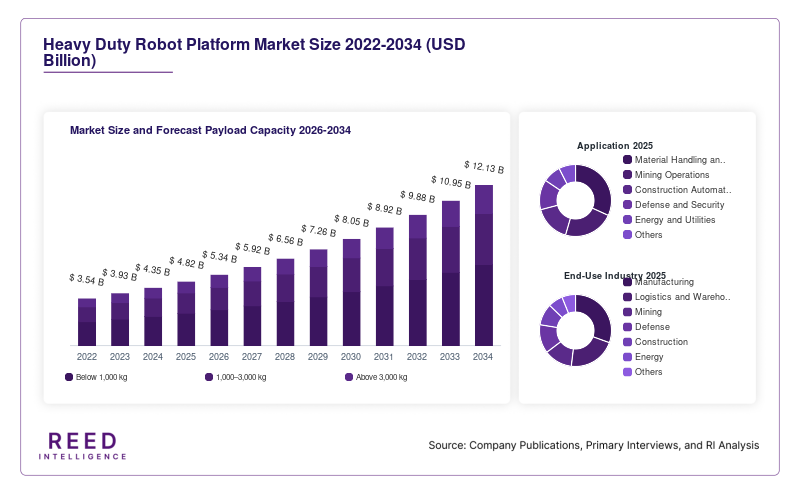
The global Heavy Duty Robot Platform Market size was valued at approximately USD 4.82 billion in 2026 and is projected to reach USD 10.94 billion by 2034, expanding at a CAGR of 10.8% during 2026–2034. Heavy-duty robot platforms are increasingly deployed across manufacturing, mining, defense, logistics, construction, and energy industries where high payload capacity, operational endurance, and autonomous mobility are essential. These platforms support demanding industrial applications by carrying heavy equipment, transporting materials, and performing tasks in hazardous environments with improved precision and safety.
A major factor supporting market growth is the accelerating adoption of industrial automation worldwide. Companies across multiple sectors are investing in robotic systems to address labor shortages, improve operational efficiency, and reduce workplace risks. The integration of artificial intelligence, advanced sensors, machine vision, and autonomous navigation technologies has significantly enhanced the capabilities of heavy-duty robot platforms. These developments allow organizations to automate repetitive and physically demanding operations while maintaining productivity and reducing operational costs.
Key Highlights
- North America dominated the market with a 35.4% share in 2025, while Asia Pacific is expected to grow at the fastest CAGR of 12.6% during 2026–2034.
- By payload capacity, 1,000–3,000 kg platforms accounted for the largest share of 42.8%, while above 3,000 kg platforms are projected to grow at a CAGR of 12.9%.
- By application, material handling and transportation led with a 39.6% share, whereas construction automation is expected to expand at a CAGR of 13.4%.
- By end-use industry, manufacturing held the largest share of 37.2%, while logistics and warehousing are anticipated to grow at a CAGR of 13.1%.
- The United States remained the dominant country, with market values of USD 1.18 billion in 2024 and USD 1.31 billion in 2025.
Market Trends
AI-Driven Autonomous Navigation Becoming Standard Across Industrial Operations
A significant trend shaping the Heavy Duty Robot Platform Market is the increasing adoption of AI-enabled autonomous navigation systems. Industrial operators are demanding robotic platforms that can navigate complex environments with minimal human intervention. Modern platforms utilize machine learning algorithms, LiDAR, radar, GPS positioning, and real-time mapping technologies to optimize movement and task execution. These capabilities enable robots to identify obstacles, adapt routes, and operate efficiently in changing environments. Industries such as mining, manufacturing, and defense are particularly adopting these solutions to improve safety and operational continuity. As computational capabilities become more affordable, manufacturers are integrating advanced intelligence directly into robotic platforms, allowing organizations to achieve higher productivity while reducing dependency on manual control systems.
Growing Integration of Electrified and Hybrid Power Systems
Another important trend is the transition toward electric and hybrid-powered heavy-duty robot platforms. Traditional diesel-powered robotic systems are increasingly being replaced by energy-efficient alternatives due to sustainability initiatives and operational cost considerations. Advances in battery energy density, charging infrastructure, and power management technologies have improved the performance of electric robotic platforms. Hybrid systems are also gaining attention because they combine long operating hours with reduced emissions. Industries operating in enclosed environments, including warehouses and manufacturing facilities, are particularly adopting electric solutions to comply with environmental standards. This trend is encouraging manufacturers to develop more efficient power architectures capable of supporting higher payload capacities while maintaining longer operational cycles and lower maintenance requirements.
Market Drivers
Rising Industrial Automation Investments Across Key End-Use Industries
Growing investments in industrial automation continue to drive demand for heavy-duty robot platforms globally. Manufacturing companies are increasingly adopting robotic technologies to improve production efficiency, reduce labor dependency, and minimize workplace accidents. Heavy-duty platforms enable automated transportation of raw materials, finished products, and industrial equipment across large facilities. As labor shortages persist in several regions, organizations are accelerating automation initiatives to maintain competitiveness. The integration of robotics into smart factory ecosystems also supports real-time monitoring and predictive maintenance capabilities. These advantages encourage enterprises to deploy advanced robotic platforms that can operate continuously while handling substantial loads, contributing significantly to market expansion during the forecast period.
Expansion of Logistics and Warehouse Automation Infrastructure
The rapid growth of e-commerce and global supply chain modernization is creating strong demand for heavy-duty robotic platforms within logistics environments. Distribution centers and warehouses require automated systems capable of moving heavy inventory efficiently across large facilities. Heavy-duty robots provide reliable transportation, pallet movement, and inventory handling capabilities while reducing operational bottlenecks. Companies are increasingly investing in automated fulfillment centers to meet rising consumer expectations for faster deliveries. In addition, technological improvements in fleet management software and warehouse automation systems are enabling seamless integration of robotic platforms into existing operations. These developments continue to strengthen adoption rates across logistics and warehousing sectors worldwide.
Market Restraint
High Initial Investment and Integration Complexity Limiting Adoption
One of the primary challenges affecting the Heavy Duty Robot Platform Market is the substantial upfront investment required for deployment. Heavy-duty robotic platforms incorporate advanced sensors, navigation technologies, power systems, and control software, resulting in high acquisition costs. Small and medium-sized enterprises often face financial barriers when considering large-scale robotic automation projects. Beyond hardware expenses, organizations must also invest in infrastructure modifications, workforce training, software integration, and ongoing maintenance. Integration challenges become more pronounced in facilities with legacy equipment and complex operational workflows. For example, manufacturing plants transitioning from conventional material handling systems to autonomous robotic platforms may experience extended implementation timelines and additional customization expenses. These factors can delay purchasing decisions and slow adoption rates, particularly in developing economies where capital expenditure budgets remain constrained. Although long-term productivity benefits are significant, the initial financial commitment continues to act as a restraint for broader market penetration.
Market Opportunities
Emerging Demand from Construction and Infrastructure Development Projects
The increasing use of robotics within construction and infrastructure development presents substantial opportunities for market participants. Large-scale infrastructure projects require efficient transportation of materials, equipment, and tools across challenging environments. Heavy-duty robot platforms can automate repetitive transportation tasks while improving safety and operational efficiency. Governments worldwide are increasing investments in transportation networks, smart cities, energy facilities, and industrial infrastructure, creating favorable conditions for robotic deployment. Construction companies are exploring robotic solutions to address labor shortages and improve project timelines. As robotic technologies become more rugged and adaptable, their adoption across construction sites is expected to increase significantly, generating new revenue opportunities for manufacturers and technology providers.
Growing Utilization in Defense and Hazardous Environment Operations
Defense organizations are increasingly deploying heavy-duty robot platforms for logistics, surveillance support, explosive handling, and autonomous transportation missions. These systems reduce personnel exposure to dangerous environments while enhancing operational effectiveness. Similar demand is emerging from energy, mining, and disaster response sectors where hazardous working conditions create safety concerns. Heavy-duty robotic platforms equipped with advanced sensors and remote operation capabilities can perform critical tasks in environments unsuitable for human workers. Continuous defense modernization programs and rising investments in autonomous military technologies are expected to support long-term market growth. Manufacturers capable of developing rugged, mission-critical robotic systems tailored for challenging environments are likely to benefit from expanding procurement opportunities across multiple sectors.
Segmental Analysis
By Payload Capacity
The 1,000–3,000 kg payload capacity segment dominated the market and accounted for approximately 42.8% of revenue share in 2024. These platforms provide an effective balance between carrying capability, operational flexibility, and deployment cost. Manufacturing facilities, logistics centers, mining operations, and defense organizations widely utilize these robotic platforms because they can transport heavy materials while maintaining efficient mobility. Their versatility allows deployment across both indoor and outdoor environments. As industries continue automating material transportation processes, demand for medium-to-high payload robotic platforms remains strong. Manufacturers are also introducing enhanced navigation systems and improved power management technologies to increase productivity and support broader adoption across industrial applications.
The above 3,000 kg payload capacity segment is expected to witness the fastest growth, registering a CAGR of 12.9% during the forecast period. Increasing demand from mining, construction, heavy manufacturing, and military sectors is supporting expansion within this category. Organizations require robotic platforms capable of transporting oversized equipment, raw materials, and industrial components efficiently. Technological improvements in drivetrain systems, battery performance, and structural engineering are enhancing the reliability of high-capacity robotic platforms. Furthermore, infrastructure development projects and autonomous mining initiatives are generating substantial demand for robots capable of handling extremely heavy loads while operating in challenging environments.
By Application
The material handling and transportation segment accounted for the largest market share of approximately 39.6% in 2024. Heavy-duty robot platforms are increasingly used to automate movement of pallets, containers, machinery components, and bulk materials across industrial facilities. Companies benefit from reduced labor costs, improved workplace safety, and greater operational consistency. Warehouses, manufacturing plants, ports, and distribution centers rely on these systems to optimize logistics workflows and improve throughput. The growing emphasis on supply chain efficiency continues supporting demand for robotic transportation solutions. Advancements in autonomous navigation and fleet coordination software further strengthen adoption by enabling seamless movement of materials across large operational environments.
The construction automation segment is anticipated to register the highest CAGR of 13.4% during the forecast period. Construction firms are increasingly utilizing robotic platforms for material transportation, equipment movement, and site logistics management. Rising labor shortages and increasing pressure to improve project efficiency are encouraging investment in automation technologies. Heavy-duty robotic systems can operate continuously while reducing physical strain on workers and enhancing workplace safety. Growing global infrastructure investments, including transportation networks, industrial facilities, and energy projects, are creating favorable conditions for construction-focused robotic platforms. As technology becomes more rugged and adaptable, adoption across construction environments is expected to accelerate significantly.
By End-Use Industry
The manufacturing segment held the largest revenue share of approximately 37.2% in 2024. Manufacturers across automotive, aerospace, electronics, and industrial equipment sectors increasingly deploy heavy-duty robot platforms to improve operational efficiency and streamline material flow. These platforms facilitate transportation of components, tools, and finished products while reducing manual handling requirements. The transition toward smart manufacturing environments continues driving demand for autonomous robotic solutions. Integration with industrial IoT systems, real-time monitoring tools, and predictive maintenance platforms further enhances operational effectiveness. As manufacturers seek greater productivity and cost optimization, heavy-duty robotic platforms remain a critical element of automation strategies.
The logistics and warehousing segment is projected to expand at the fastest CAGR of 13.1% through 2034. Rapid growth in e-commerce activity and consumer demand for faster order fulfillment are encouraging warehouse operators to automate material movement processes. Heavy-duty robot platforms support efficient transportation of inventory, pallets, and bulk shipments across large facilities. Technological advancements in warehouse management software, autonomous navigation, and robotic fleet coordination continue enhancing deployment capabilities. Additionally, increasing investments in automated distribution centers and fulfillment networks worldwide are expected to generate substantial demand for advanced heavy-duty robotic platforms over the forecast period.
Regional Analysis
North America
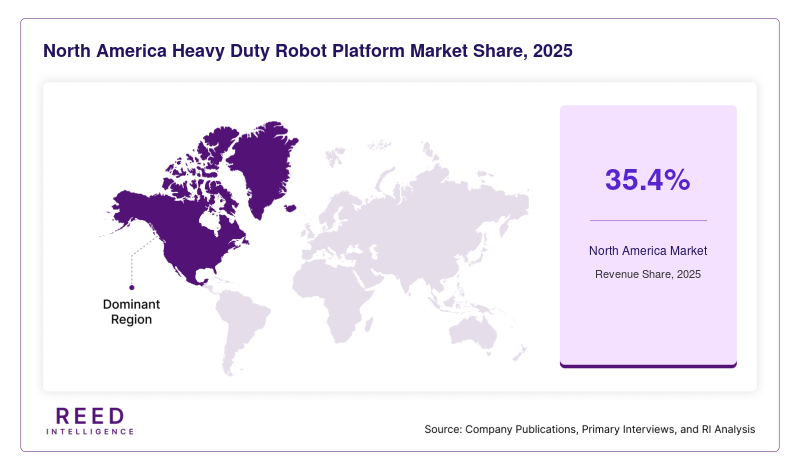
North America accounted for approximately 35.4% of the Heavy Duty Robot Platform Market in 2025 and continues to maintain a leading position within the global industry. The region benefits from extensive investments in industrial automation, robotics research, and advanced manufacturing technologies. Strong adoption across logistics, defense, mining, and automotive sectors contributes to market expansion. The regional market is expected to register a CAGR of 10.1% through 2034 as enterprises increasingly implement autonomous material handling and transportation solutions to improve productivity and operational efficiency.
The United States remains the dominant contributor to regional revenue generation. A unique growth factor supporting market expansion is the country's significant investment in warehouse automation infrastructure. Large distribution centers and fulfillment facilities continue integrating autonomous robotic platforms to manage increasing shipment volumes. Furthermore, defense modernization programs and advanced robotics development initiatives support innovation and deployment of heavy-duty robotic systems across both commercial and government applications.
Europe
Europe represented approximately 27.1% of the global market share in 2025 and continues to experience steady growth driven by industrial modernization efforts. Manufacturing companies throughout the region are adopting robotic platforms to improve production efficiency and address labor constraints. Industries including automotive, aerospace, and industrial equipment manufacturing are key adopters of heavy-duty robotic systems. The European market is projected to expand at a CAGR of 9.7% during the forecast period as automation investments continue increasing.
Germany leads the regional market due to its advanced manufacturing ecosystem and strong robotics adoption rates. A unique growth factor supporting the German market is the widespread implementation of Industry 4.0 initiatives across industrial facilities. Companies are integrating autonomous robotic platforms into interconnected production environments to optimize material flow, improve productivity, and enhance operational visibility. These developments strengthen demand for intelligent heavy-duty robotic solutions throughout the country.
Asia Pacific
Asia Pacific held approximately 24.8% market share in 2025 and is expected to record the fastest CAGR of 12.6% through 2034. Rapid industrialization, expanding manufacturing capacity, and increasing automation investments are supporting regional growth. Countries throughout the region are modernizing industrial infrastructure while adopting advanced robotics to remain globally competitive. The growth of e-commerce, logistics automation, and smart manufacturing initiatives further contributes to rising demand for heavy-duty robotic platforms.
China dominates the Asia Pacific market due to its large manufacturing base and extensive industrial automation programs. A unique growth factor is the government's strong support for domestic robotics development and intelligent manufacturing transformation. Public and private investments are accelerating deployment of autonomous robotic systems across factories, warehouses, ports, and mining operations. These initiatives continue positioning China as a major growth engine for the regional market.
Middle East & Africa
The Middle East & Africa accounted for approximately 6.5% of global market revenue in 2025 and is gradually emerging as a promising market for heavy-duty robotic technologies. Industrial diversification initiatives, infrastructure investments, and mining sector expansion are supporting adoption across several countries. Organizations are increasingly exploring automation solutions to improve efficiency and reduce operational risks in demanding environments. The regional market is anticipated to register a CAGR of 10.4% during the forecast period.
Saudi Arabia represents the leading country market within the region. A unique growth factor is the ongoing development of large-scale industrial and infrastructure projects associated with economic diversification strategies. These projects require efficient material transportation and autonomous operational capabilities, creating favorable conditions for heavy-duty robotic platform deployment. Growing investments in logistics hubs and smart industrial facilities further support long-term demand growth.
Latin America
Latin America captured approximately 6.2% of the Heavy Duty Robot Platform Market in 2025 and continues to show gradual adoption across industrial sectors. Companies operating in manufacturing, mining, and logistics are increasingly investing in automation technologies to improve operational performance. Economic modernization efforts and growing awareness of robotic solutions are supporting regional market development. The market is projected to expand at a CAGR of 9.8% through 2034 as adoption broadens across multiple industries.
Brazil remains the dominant country in the region owing to its large industrial sector and expanding logistics infrastructure. A unique growth factor driving growth is the increasing automation of mining operations. Mining companies are implementing robotic technologies to improve productivity, reduce workplace hazards, and optimize transportation activities in challenging environments. These developments continue creating opportunities for heavy-duty robot platform providers throughout the Brazilian market.
Competitive Landscape
The Heavy Duty Robot Platform Market is characterized by the presence of established robotics manufacturers, industrial automation providers, and specialized autonomous vehicle developers. Competition primarily focuses on payload capability, autonomous functionality, durability, and system integration capabilities. Market participants are investing heavily in research and development to enhance navigation accuracy, battery performance, and operational intelligence.
Clearpath Robotics remains one of the leading companies within the market due to its strong portfolio of autonomous robotic platforms and industrial mobility solutions. The company recently expanded its heavy-payload autonomous vehicle capabilities through advanced fleet management software enhancements designed for large-scale industrial environments.
Other notable participants include KUKA, ABB, Omron, and Seegrid, all of which continue investing in intelligent automation technologies and strategic partnerships. Many companies are focusing on industry-specific solutions tailored for manufacturing, logistics, defense, and mining applications. Product innovation, software integration, and geographic expansion remain key competitive strategies. As demand for autonomous industrial operations increases, competition is expected to intensify, encouraging further technological advancements and broader market penetration.
Key Players
- Clearpath Robotics
- KUKA AG
- ABB Ltd.
- Omron Corporation
- Seegrid Corporation
- Boston Dynamics
- Autonomous Solutions Inc.
- Kollmorgen
- Toyota Industries Corporation
- Oceaneering International
- Milrem Robotics
- BAE Systems
- Rheinmetall AG
- AGILOX Services GmbH
- Dematic Corporation
Recent Developments
- In 2025, Clearpath Robotics introduced an enhanced autonomous heavy-duty platform featuring AI-based route optimization and improved fleet coordination capabilities for industrial facilities.
- In 2025, ABB expanded its industrial mobile robotics portfolio with new heavy-payload autonomous transport solutions designed for manufacturing and warehouse applications.
- In 2024, KUKA launched an upgraded robotic platform equipped with advanced LiDAR navigation and predictive maintenance functionality to support smart factory operations.
- In 2024, Seegrid introduced next-generation autonomous material transport vehicles incorporating real-time analytics and enhanced obstacle detection systems.
- In 2025, Milrem Robotics expanded its heavy-duty unmanned ground vehicle capabilities for defense logistics and autonomous transportation missions.
Heavy Duty Robot Platform Market Segments
Payload Capacity
- Below 1,000 kg
- 1,000–3,000 kg
- Above 3,000 kg
Application
- Material Handling and Transportation
- Mining Operations
- Construction Automation
- Defense and Security
- Energy and Utilities
- Others
End-Use Industry
- Manufacturing
- Logistics and Warehousing
- Mining
- Defense
- Construction
- Energy
- Others
By Region
- North America
- Europe
- APAC
- Middle East and Africa
- LATAM