Helical Antenna Market Size, Share & Demand Report By Type (Axial Mode Helical Antennas, Normal Mode Helical Antennas, Broadband Helical Antennas, Quadrifilar Helical Antennas), By Application (Satellite Communication, Navigation Systems, Unmanned Aerial Systems, Marine Communication, Radar and Surveillance, Remote Sensing), By End Use (Defense and Aerospace, Commercial Telecommunications, Industrial and Manufacturing, Transportation and Logistics, Research and Scientific Institutions) By Region
USD 3950
Market Overview
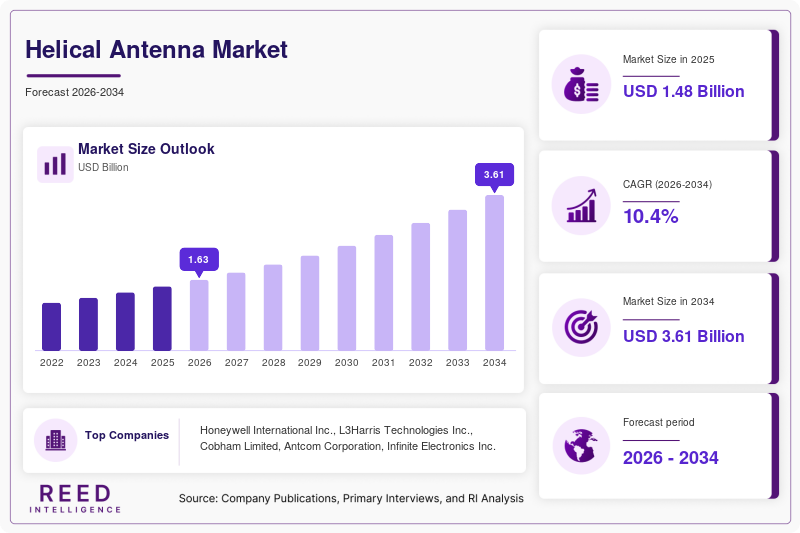
The global Helical Antenna Market size was valued at USD 1.48 billion in 2026 and is projected to reach USD 3.27 billion by 2034, expanding at a CAGR of 10.4% during the forecast period from 2026 to 2034. The market is experiencing stable expansion due to increasing deployment of satellite communication systems, rising defense modernization programs, and growing use of wireless connectivity infrastructure across commercial and industrial sectors. Helical antennas are widely preferred in applications that require circular polarization, compact structure, and reliable signal transmission. Their adoption has increased across aerospace, marine communication, remote sensing, telemetry, and unmanned systems.
The rising global demand for satellite-enabled communication networks has supported market growth significantly. Governments and private operators are investing in low-earth orbit satellite constellations to improve broadband connectivity and strengthen communication infrastructure in remote regions. Helical antennas provide dependable signal reception and transmission for these systems due to their directional performance and bandwidth efficiency. Growing demand for advanced navigation systems, defense surveillance equipment, and aviation communication devices has also contributed to the market expansion.
Key Highlights
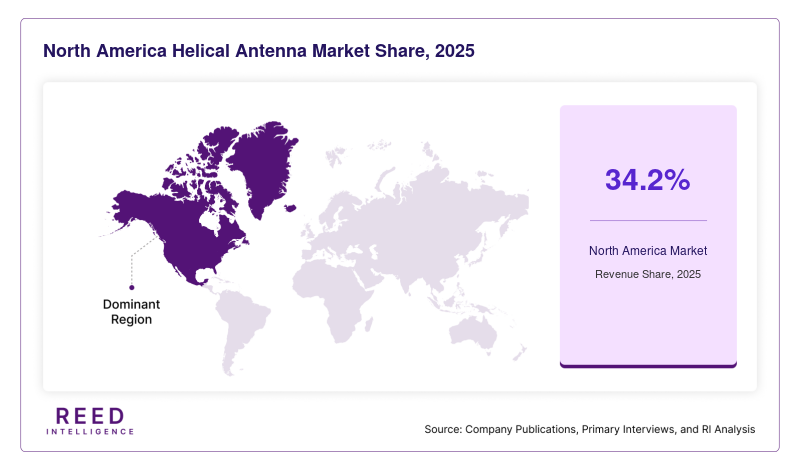
- North America dominated the market with a 34.2% share in 2025.
- Asia Pacific is expected to grow at the fastest CAGR of 11.8% during 2026–2034.
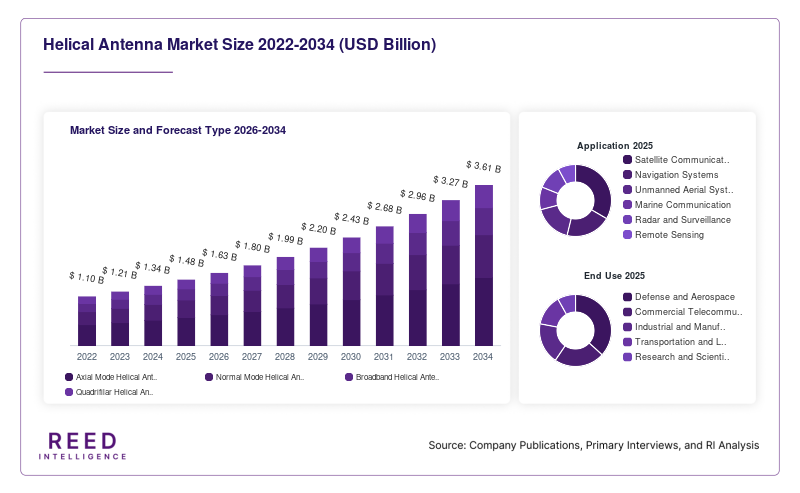
- By type, axial mode helical antennas accounted for the largest share of 44.1%, while normal mode helical antennas are projected to grow at a CAGR of 12.1%.
- By application, satellite communication led with a 39.6% share, whereas unmanned aerial systems are expected to expand at a CAGR of 12.7%.
- By end use, defense and aerospace held the dominant share of 42.4%, while commercial telecommunications are anticipated to grow at a CAGR of 11.9%.
- The United States remained the dominant country, with market values of USD 430 million in 2024 and USD 475 million in 2025.
Market Trends
Integration of Helical Antennas in Low-Earth Orbit Satellite Networks
The increasing deployment of low-earth orbit satellite constellations is influencing the adoption of helical antennas across global communication networks. Satellite operators are focusing on compact and lightweight communication components that can deliver stable signal transmission under varying environmental conditions. Helical antennas are gaining preference because they support circular polarization and provide reliable communication performance over long distances. Demand from broadband satellite providers, navigation service companies, and remote sensing operators has increased significantly over the past few years. The expansion of commercial space activities and satellite launch programs has further strengthened the requirement for advanced antenna systems that can operate efficiently at higher frequencies.
Manufacturers are developing improved helical antenna configurations with enhanced gain, reduced interference, and stronger signal stability. The market is also witnessing growing integration of these antennas in portable ground terminals and mobile satellite communication devices. Increased investment in global broadband connectivity projects is expected to sustain this trend during the forecast period. Several communication equipment suppliers are expanding their product portfolios to address rising requirements from aviation, maritime, and military communication systems that depend heavily on satellite-based connectivity.
Rising Demand for Compact Communication Systems in Defense Applications
Defense organizations are increasingly adopting compact communication systems for surveillance, tactical communication, and unmanned operations. This trend is driving the use of helical antennas because of their ability to provide dependable performance in mobile and space-constrained environments. Military agencies are emphasizing secure communication systems that can operate efficiently in harsh environments and deliver uninterrupted signal transmission. Helical antennas are being integrated into drones, tactical radios, portable communication systems, and electronic warfare equipment due to their durable design and directional communication capabilities.
The expansion of border security initiatives and growing investment in autonomous defense technologies are further accelerating product demand. Countries across North America, Europe, and Asia Pacific are increasing defense budgets to strengthen intelligence and surveillance operations. This is encouraging manufacturers to design ruggedized antenna systems with higher frequency support and stronger resistance to environmental interference. The trend toward advanced battlefield communication systems and connected defense platforms is expected to maintain strong momentum for helical antenna adoption during the long-term forecast period.
Market Drivers
Expansion of Global Satellite Communication Infrastructure
The rapid expansion of satellite communication infrastructure is a major factor driving the Helical Antenna Market. Governments and private telecommunications companies are investing heavily in satellite-based broadband systems to improve internet accessibility and strengthen communication coverage in underserved regions. Helical antennas are widely used in satellite communication systems because they support circular polarization and provide reliable signal quality in varying atmospheric conditions. The increasing number of satellite launches for commercial, navigation, weather monitoring, and defense applications is creating sustained demand for advanced antenna solutions.
In addition, rising adoption of satellite-enabled communication in aviation, maritime transportation, and emergency response services is contributing to market growth. Airlines and shipping operators are integrating high-performance communication systems to improve operational efficiency and passenger connectivity. Helical antennas are preferred for these applications because of their compact design and effective signal transmission capabilities. The expansion of global satellite networks and connected communication platforms is expected to continue supporting market growth throughout the forecast period.
Increasing Adoption of Unmanned and Autonomous Systems
The growing use of unmanned aerial vehicles, autonomous marine systems, and robotic communication platforms is driving the demand for compact and efficient antenna technologies. Helical antennas are increasingly deployed in these systems because they offer stable communication performance, lightweight structure, and strong directional transmission. Defense organizations, logistics providers, and industrial operators are investing in autonomous technologies to improve surveillance, inspection, and operational efficiency. These systems require reliable wireless communication components that can support long-range connectivity and uninterrupted data transmission.
The expansion of drone-based applications in agriculture, infrastructure monitoring, environmental research, and public safety is also supporting market development. Helical antennas help maintain communication stability for drones operating in complex environments and remote locations. The growing focus on autonomous transportation systems and connected industrial equipment is further increasing demand for advanced antenna technologies. Manufacturers are responding by developing compact multi-band helical antennas designed for integration into next-generation autonomous systems.
Market Restraint
High Design Complexity and Performance Limitations in Certain Frequency Bands
The Helical Antenna Market faces challenges related to design complexity and operational limitations across specific frequency ranges. Although helical antennas provide strong performance in satellite communication and directional transmission applications, their efficiency can decline when used in compact devices operating at lower frequencies. Designing antennas that deliver stable gain, bandwidth, and polarization while maintaining a compact structure requires advanced engineering expertise and higher manufacturing costs. This increases product development expenses for manufacturers and can limit adoption among small and medium-sized communication equipment providers.
In addition, integration challenges associated with high-frequency communication systems can affect operational reliability in densely connected environments. Industries using advanced wireless systems often require antennas that support multiple bands and maintain consistent performance under varying environmental conditions. Helical antennas may require additional tuning and shielding components to minimize interference and signal distortion. For example, certain portable communication devices used in industrial automation and emergency response systems experience reduced efficiency when exposed to electromagnetic interference in urban environments. These technical constraints can slow adoption in price-sensitive sectors and create pressure on manufacturers to invest continuously in research and design optimization.
Market Opportunities
Increasing Use of Helical Antennas in Smart Transportation Networks
The expansion of smart transportation infrastructure is creating new opportunities for the Helical Antenna Market. Transportation authorities and automotive technology providers are integrating connected communication systems into intelligent traffic management platforms, railway communication systems, and autonomous vehicle networks. Helical antennas are becoming valuable in these applications because they support stable wireless communication and maintain strong signal quality in mobile environments. The increasing focus on connected mobility and real-time vehicle communication is expected to accelerate the demand for advanced antenna technologies.
Several countries are investing in next-generation transportation infrastructure to improve road safety, traffic monitoring, and navigation efficiency. Connected transportation systems require communication devices capable of operating efficiently across long distances and varying environmental conditions. Helical antennas provide reliable signal reception and directional communication, making them suitable for transportation applications involving navigation and remote monitoring. Manufacturers are also introducing compact antenna systems designed for integration into modern vehicle communication platforms and intelligent transportation devices.
Growth Potential in Commercial Space Exploration Programs
Commercial space exploration activities are generating strong opportunities for helical antenna manufacturers. Private aerospace companies and research organizations are increasing investments in satellite deployment, deep-space exploration missions, and reusable launch systems. These initiatives require advanced communication technologies capable of maintaining stable connectivity between spacecraft, satellites, and ground stations. Helical antennas are widely adopted in space communication systems because of their circular polarization characteristics and dependable signal performance.
The increasing number of partnerships between governments and private aerospace operators is strengthening demand for specialized antenna solutions. Research institutions and commercial space companies are developing compact communication modules for small satellites and exploration vehicles, which require lightweight and efficient antenna systems. The growing commercialization of space tourism and satellite-based earth observation services is also contributing to long-term market potential. Manufacturers focusing on high-frequency and radiation-resistant antenna technologies are expected to benefit from the expanding commercial space ecosystem.
Segmental Analysis
By Type
Axial mode helical antennas accounted for the largest share of 44.1% in 2024 due to their extensive use in satellite communication, aerospace systems, and defense applications. These antennas are widely preferred because they provide high gain, directional radiation patterns, and circular polarization characteristics suitable for long-distance communication. The growing deployment of satellite-enabled communication systems and advanced navigation platforms has strengthened demand for axial mode designs across both military and commercial sectors. Their ability to deliver reliable performance in varying atmospheric conditions has also contributed to strong adoption in aviation and marine communication networks. Manufacturers are continuously enhancing antenna efficiency and bandwidth performance to support next-generation communication infrastructure and space exploration projects.
By Application
Satellite communication held the dominant market share of 39.6% in 2024 because of increasing deployment of communication satellites and rising investments in global broadband infrastructure. Helical antennas are widely used in satellite systems due to their strong directional performance and ability to maintain reliable communication over long distances. Growing demand for high-speed connectivity in remote areas, maritime operations, and aviation services has accelerated adoption across commercial and defense sectors. Several countries are investing in satellite communication projects to strengthen digital connectivity and improve emergency communication capabilities. The increasing number of low-earth orbit satellite launches is further supporting the use of advanced helical antenna systems in communication networks.
By End Use
Defense and aerospace accounted for the largest market share of 42.4% in 2024 owing to rising investments in military communication infrastructure, surveillance technologies, and aerospace research programs. Helical antennas are widely integrated into radar systems, tactical communication devices, navigation platforms, and satellite communication equipment. Governments across major economies are increasing defense budgets to improve border security and strengthen communication capabilities in modern warfare environments. The expansion of space exploration missions and satellite deployment activities is also contributing to segment growth. Manufacturers are focusing on ruggedized antenna designs capable of operating efficiently in extreme environmental conditions and high-frequency communication systems.
Regional Analysis
North America
North America accounted for 34.2% of the global Helical Antenna Market share in 2025 and is expected to maintain a stable growth trajectory with a CAGR of 9.8% during the forecast period. The region benefits from strong investments in aerospace technology, defense communication systems, and satellite infrastructure. The presence of advanced telecommunications companies and defense contractors has accelerated the adoption of high-performance antenna technologies across military and commercial applications. Demand for secure communication systems and satellite-enabled broadband services continues to support market expansion.
Europe
Europe held a significant share of the Helical Antenna Market in 2025 and is projected to grow at a CAGR of 9.5% during 2026–2034. The region is benefiting from increasing investments in advanced communication systems and aerospace research programs. Several European countries are expanding satellite communication infrastructure to support defense, navigation, and environmental monitoring operations. The adoption of connected transportation systems and industrial automation technologies is further strengthening market demand for efficient wireless communication components.
Asia Pacific
Asia Pacific represented a rapidly expanding region in the Helical Antenna Market and is expected to register the fastest CAGR of 11.8% during the forecast period. Rising investments in telecommunications infrastructure, satellite deployment, and defense modernization are contributing to market growth across the region. Governments are increasing funding for wireless communication networks and advanced surveillance systems to strengthen national connectivity and security capabilities. The region is also experiencing significant growth in drone manufacturing and connected mobility solutions.
Middle East & Africa
The Middle East & Africa region is witnessing gradual growth in the Helical Antenna Market and is forecast to expand at a CAGR of 8.7% during the assessment period. Increasing investments in defense communication systems and smart city infrastructure are contributing to market development. Several countries in the region are focusing on strengthening communication networks for border security, oil and gas operations, and transportation management. Growing adoption of wireless monitoring systems in industrial facilities is also supporting demand for advanced antenna technologies.
Latin America
Latin America accounted for a moderate share of the global Helical Antenna Market in 2025 and is expected to grow at a CAGR of 8.9% through 2034. The region is benefiting from increasing telecommunications investments and gradual expansion of satellite communication services. Governments and private operators are improving connectivity infrastructure to support rural communication access and digital transformation initiatives. The market is also gaining support from growing demand for wireless monitoring systems in mining, agriculture, and public safety applications.
Competitive Landscape
The Helical Antenna Market is characterized by the presence of global aerospace manufacturers, defense communication providers, and specialized antenna technology companies. Market participants are focusing on product innovation, strategic partnerships, and expansion of satellite communication capabilities to strengthen their competitive positions. Companies are investing in research and development activities to improve antenna efficiency, bandwidth support, and miniaturization features for next-generation wireless systems.
Honeywell International Inc. emerged as a leading company in the market due to its broad portfolio of aerospace communication technologies and strong presence in defense communication systems. The company has expanded its advanced antenna solutions for satellite-enabled aviation communication platforms and unmanned systems. Other major participants are also strengthening their market presence through collaborations with satellite operators and defense contractors.
Key Players
- Honeywell International Inc.
- L3Harris Technologies Inc.
- Cobham Limited
- Antcom Corporation
- Infinite Electronics Inc.
- Southwest Antennas
- MTI Wireless Edge Ltd.
- Rohde & Schwarz GmbH & Co KG
- TE Connectivity Ltd.
- Harxon Corporation
- Pulse Electronics Corporation
- Amphenol Corporation
- Taoglas Limited
- Pasternack Enterprises Inc.
- Comba Telecom Systems Holdings Ltd.
Recent Developments
- In February 2026, Honeywell International Inc. introduced a compact helical antenna platform designed for satellite-enabled aviation communication systems with improved bandwidth efficiency.
- In July 2025, L3Harris Technologies Inc. expanded its defense communication portfolio through the development of ruggedized helical antennas for unmanned surveillance systems.
- In October 2025, Cobham Limited announced a strategic collaboration with a commercial satellite operator to supply advanced helical antenna solutions for low-earth orbit communication networks.
- In March 2026, Taoglas Limited launched a lightweight multi-band helical antenna solution targeted at industrial Internet of Things and smart transportation applications.
Helical Antenna Market Segments
Type
- Axial Mode Helical Antennas
- Normal Mode Helical Antennas
- Broadband Helical Antennas
- Quadrifilar Helical Antennas
Application
- Satellite Communication
- Navigation Systems
- Unmanned Aerial Systems
- Marine Communication
- Radar and Surveillance
- Remote Sensing
End Use
- Defense and Aerospace
- Commercial Telecommunications
- Industrial and Manufacturing
- Transportation and Logistics
- Research and Scientific Institutions
By Region
- North America
- Europe
- APAC
- Middle East and Africa
- LATAM