Helicopter Blades Market Size, Share Demand Report By Blade Position (Main Rotor Blades, Tail Rotor Blades), By Material (Metal Blades, Composite Blades), By Application (Military Helicopters, Commercial Helicopters), By End Use (OEM, Aftermarket), By Weight Class (Light Helicopters, Medium Helicopters), By Region & Segment Forecasts, 2026–2034
USD 3950
Market Overview
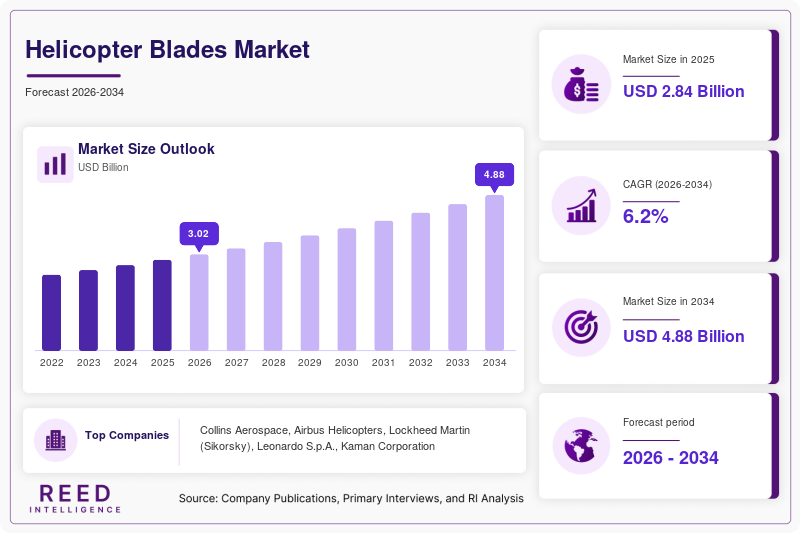
The global Helicopter Blades Market size was valued at USD 2.84 billion in 2026 and is projected to reach USD 4.61 billion by 2034, expanding at a CAGR of 6.2% from 2026 to 2034. The market growth is being supported by the steady expansion of civil aviation fleets, defense modernization programs, and the increasing replacement demand for aging rotorcraft components. Helicopter blades are mission-critical components that directly affect lift efficiency, maneuverability, vibration control, and fuel performance. As fleet operators seek longer service life and lower maintenance costs, demand for advanced blade systems is increasing across commercial, military, emergency medical, offshore transport, and utility operations.
A key global factor supporting market expansion has been the rise in public safety, disaster response, and emergency medical transport missions. Governments and private operators have increased helicopter deployment for rescue, firefighting, law enforcement, and medical evacuation, creating recurring demand for durable and lightweight rotor blades.
Key Highlights
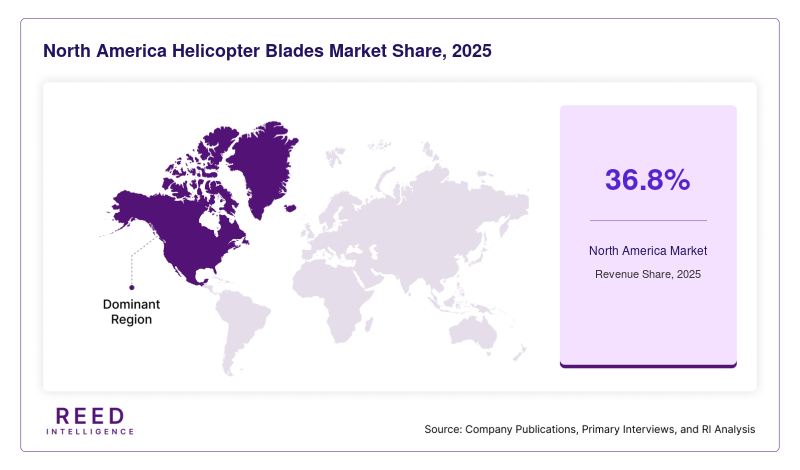
- North America dominated the Helicopter Blades Market with 36.8% share in 2025.
- Asia Pacific is expected to be the fastest-growing region at a 7.4% CAGR through 2034.
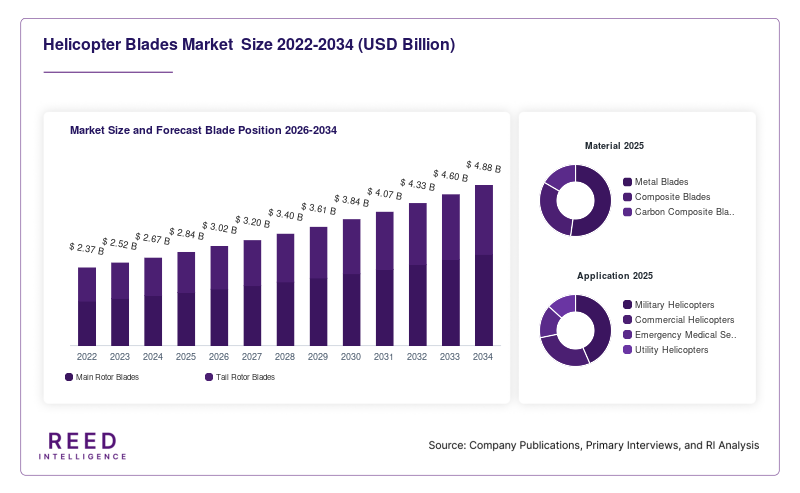
- By blade position, main rotor blades led the market with 62.5% share in 2025.
- By material, composite blades accounted for the largest share at 58.9% in 2025.
- By application, military helicopters remained the leading segment with 44.2% share in 2025.
- By end use, OEM demand held the highest share at 55.6% in 2025.
- Fastest-growing subsegments include tail rotor blades at 6.8% CAGR, advanced carbon composite blades at 7.6% CAGR, EMS helicopters at 7.2% CAGR, and aftermarket sales at 6.9% CAGR.
- The U.S., the dominant country, was valued at USD 0.79 billion in 2024 and USD 0.83 billion in 2025.
Market Trends
Shift Toward Composite and Carbon Fiber Blade Systems
Manufacturers are increasingly replacing traditional metal blades with composite structures made from fiberglass, carbon fiber, and hybrid materials. These blades offer lower weight, higher fatigue resistance, better corrosion performance, and reduced lifecycle costs. The trend is improving helicopter payload efficiency and lowering fuel consumption.
Integration of Smart Blade Monitoring Technologies
Blade health monitoring systems using embedded sensors are gaining traction. Operators are using vibration sensors, strain monitoring, and predictive maintenance tools to identify wear, cracks, and structural imbalance before failure occurs. This trend is reducing unscheduled downtime and improving fleet readiness.
Market Drivers
Growing Defense Helicopter Procurement Programs
Many countries are expanding military helicopter fleets for transport, surveillance, naval missions, and combat support. New rotorcraft procurement directly increases demand for OEM blade systems, while older fleets require replacement blades during overhaul cycles.
Rising Demand for Helicopter Maintenance and Overhaul
The installed base of aging helicopters across civil and military sectors continues to generate recurring demand for spare blades. Blade erosion, fatigue stress, foreign object damage, and regulatory replacement cycles are supporting steady aftermarket revenue.
Market Restraint
High Certification and Manufacturing Costs
Helicopter blades require strict airworthiness certification, advanced materials processing, and precision balancing. These factors raise production costs and extend approval timelines, limiting rapid market entry for smaller suppliers.
Market Opportunities
Expansion of Urban Air Mobility and Heavy-Lift Rotorcraft
New-generation vertical lift programs and urban mobility aircraft concepts are creating opportunities for compact, low-noise rotor blade technologies. Suppliers with expertise in aerodynamic blade design may benefit from future demand.
Retrofit Programs for Legacy Helicopter Fleets
Many operators are upgrading older helicopters with quieter, lighter, and more fuel-efficient blade sets. Retrofit demand offers opportunities for aftermarket suppliers focused on performance enhancement rather than full aircraft replacement.
Segmental Analysis
By Blade Position
Main rotor blades dominated the Helicopter Blades Market with 62.5% share in 2025 due to their higher unit value, larger size, and central role in aircraft lift generation.
Tail rotor blades will be the fastest-growing segment at 6.8% CAGR through 2034 as operators increasingly upgrade anti-torque systems for improved control stability and lower noise output.
By Material
Composite blades held the largest share of 58.9% in 2025 because of their lower weight, corrosion resistance, and longer fatigue life compared with metal alternatives.
Advanced carbon composite blades will grow at 7.6% CAGR as next-generation fleets seek lighter blade assemblies that improve fuel efficiency and payload capacity.
By Application
Military helicopters accounted for 44.2% share in 2025 due to steady procurement of utility, attack, and naval rotorcraft platforms.
Emergency medical service helicopters will witness the fastest growth at 7.2% CAGR, supported by rising demand for rapid patient transport in urban and remote areas.
By End Use
OEM sales captured 55.6% share in 2025 as new aircraft deliveries required certified blade installations directly from manufacturers.
Aftermarket sales will grow at 6.9% CAGR as operators increasingly replace worn blades and adopt upgraded blade kits during maintenance cycles.
By Helicopter Weight Class
Medium helicopters led with 41.8% share in 2025 because they are widely used in offshore transport, defense logistics, and rescue missions.
Light helicopters are projected to expand at 7.0% CAGR due to rising use in tourism, training, policing, and private charter operations.
Regional Analysis
North America
North America held 36.8% of the Helicopter Blades Market in 2025 and will grow at a 5.8% CAGR through 2034. The U.S. remained the dominant country due to large military rotorcraft inventories and active emergency medical aviation fleets. Continued fleet sustainment spending will support demand for replacement blades.
Europe
Europe accounted for 24.1% share in 2025 and will expand at a 5.9% CAGR during the forecast period. France led regional demand due to its strong helicopter manufacturing ecosystem and export-oriented aerospace production base. Ongoing civil fleet modernization will support growth.
Asia Pacific
Asia Pacific represented 22.6% of the market in 2025 and will register the fastest 7.4% CAGR through 2034. China dominated regional revenue due to expanding domestic aerospace production and increasing public service helicopter adoption. Regional fleet additions will create strong OEM demand.
Middle East & Africa
Middle East & Africa captured 9.2% share in 2025 and will grow at a 6.1% CAGR. Saudi Arabia led the region due to defense aviation investment and offshore transport requirements. Fleet renewal programs will continue to generate blade replacement demand.
Latin America
Latin America held 7.3% market share in 2025 and will advance at a 5.6% CAGR. Brazil remained the leading country owing to regional helicopter manufacturing presence and high usage in utility and energy operations. Expanding agricultural aviation services will aid future growth.
Competitive Landscape
The Helicopter Blades Market remains moderately consolidated, with established aerospace manufacturers competing on material science, certification capability, lifecycle support, and long-term supply contracts. Leading companies focus on OEM partnerships, retrofit programs, and advanced composite blade systems.
Collins Aerospace remained a key market leader due to its broad rotorcraft systems portfolio and global aftermarket reach. The company recently expanded composite blade repair support services for fleet operators, improving turnaround times and maintenance efficiency.
Airbus Helicopters continues to strengthen proprietary blade technologies for civil and defense platforms. Lockheed Martin (Sikorsky) maintains strong demand through military helicopter programs and sustainment contracts. Leonardo S.p.A. benefits from medium and heavy helicopter blade integration across commercial and defense fleets. Kaman Corporation remains active in precision composite blade manufacturing and aftermarket solutions.
Competition is expected to intensify as operators prioritize lighter blades, lower vibration systems, and predictive maintenance compatibility.
Key Players List
- Collins Aerospace
- Airbus Helicopters
- Lockheed Martin (Sikorsky)
- Leonardo S.p.A.
- Kaman Corporation
- Boeing Defense, Space & Security
- Bell Textron Inc.
- Russian Helicopters
- Hindustan Aeronautics Limited
- Mitsubishi Heavy Industries
- Korea Aerospace Industries
- Enstrom Helicopter Corporation
- Robinson Helicopter Company
- GKN Aerospace
- MTorres Aerostructures
Recent Developments
- Collins Aerospace launched expanded rotor blade repair and overhaul support centers to reduce maintenance lead times.
- Airbus Helicopters introduced quieter composite blade technology for selected civil platforms.
- Leonardo S.p.A. increased investment in advanced rotor aerodynamics for medium-lift helicopters.
- Sikorsky secured sustainment contracts involving blade replacement programs for military fleets.
- Bell Textron advanced next-generation blade designs focused on lower vibration and improved lift efficiency.
Helicopter Blades Market Segments
Blade Position
- Main Rotor Blades
- Tail Rotor Blades
Material
- Metal Blades
- Composite Blades
- Carbon Composite Blades
Application
- Military Helicopters
- Commercial Helicopters
- Emergency Medical Services Helicopters
- Utility Helicopters
End Use
- OEM
- Aftermarket
Weight Class
- Light Helicopters
- Medium Helicopters
- Heavy Helicopters
By Region
- North America
- Europe
- APAC
- Middle East and Africa
- LATAM