Helicopter Emergency Flotation System Market Size, Share & Demand Report By System Type (Skid-Mounted Flotation Systems, Pop-Out Flotation Systems, Fixed Bag Flotation Systems, Amphibious Support Flotation Systems), By Application (Offshore Transportation, Search and Rescue, Military Operations, Emergency Medical Services, VIP & Commercial Transport), By End-Use (Commercial Operators, Military & Defense, Government & Public Safety, Private Aviation) By Region & Segment Forecasts, 2026–2034
USD 3950
Market Overview
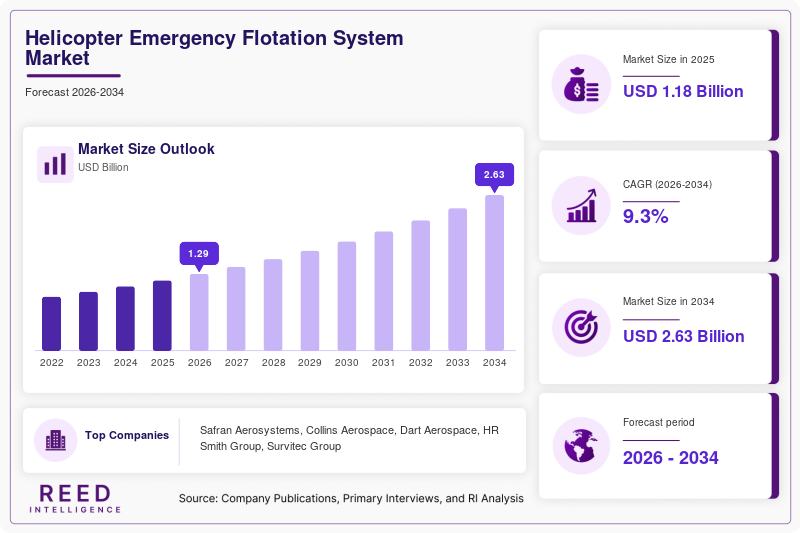
The Helicopter Emergency Flotation System Market size was valued at USD 1.18 billion in 2026 and is projected to reach USD 2.41 billion by 2034, expanding at a CAGR of 9.3% during 2026–2034. This market is gaining traction due to increasing offshore helicopter operations, stricter aviation safety regulations, and rising investments in maritime transport and defense aviation. Helicopter emergency flotation systems are designed to keep rotorcraft buoyant after water landings, making them essential for offshore oil and gas missions, coast guard services, naval aviation, and search-and-rescue applications. As helicopter operators face mounting pressure to enhance passenger and crew safety, the adoption of advanced inflatable flotation bags, automatic deployment systems, and lightweight materials continues to rise. A major global factor supporting market growth is the expansion of offshore wind farms and deepwater energy projects, which require frequent helicopter transportation over water. This has significantly increased procurement of safety-certified helicopters equipped with emergency flotation systems. In parallel, modernization of civil helicopter fleets and replacement of aging safety systems are strengthening market demand. Manufacturers are also integrating corrosion-resistant materials, smart sensors, and rapid deployment inflation technologies to improve operational reliability in extreme marine conditions. Regulatory agencies across North America and Europe are reinforcing safety compliance, which is encouraging retrofit installations alongside OEM demand.
Key Highlights
- North America dominated the market with a 36.4% share in 2025.
- Asia Pacific is expected to grow at the fastest CAGR of 10.8% during 2026–2034.
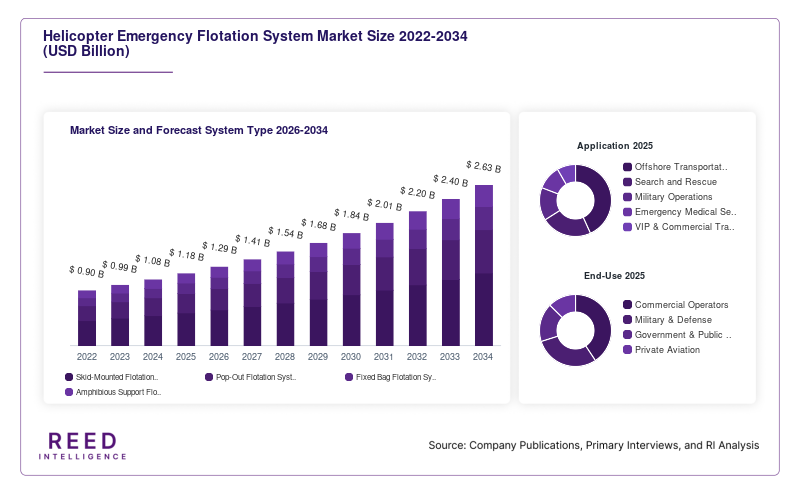
- By system type, skid-mounted emergency flotation systems accounted for the largest share of 42.7%, while pop-out flotation systems are projected to grow at a CAGR of 11.6%.
- By application, offshore transportation led with a 44.9% share, whereas search and rescue operations are expected to expand at a CAGR of 10.9%.
- The United States remained the dominant country, with market values of USD 420 million in 2024 and USD 458 million in 2025.
Market Trends
Integration of Smart Inflation Monitoring and Automated Deployment Technologies
A prominent trend in the Helicopter Emergency Flotation System Market is the increasing integration of digital monitoring systems and automated deployment technologies. Manufacturers are introducing sensor-enabled flotation systems capable of detecting water impact, tilt angle, and pressure changes within milliseconds, ensuring rapid inflation during emergency ditching scenarios. These systems reduce pilot workload during critical incidents and improve survival outcomes. Smart diagnostics also allow predictive maintenance by monitoring inflation cartridge conditions and pressure integrity in real time. This trend is particularly relevant for military and offshore commercial operators that require continuous operational readiness. As safety technology evolves, helicopter manufacturers are increasingly partnering with avionics providers to create fully integrated flotation solutions.
Growing Preference for Lightweight Composite-Based Flotation Equipment
Another key trend shaping the market is the transition from conventional rubberized flotation bags to lightweight composite and reinforced polymer systems. Operators are seeking weight reduction to improve fuel efficiency and payload capacity without compromising safety compliance. New materials offer improved puncture resistance, corrosion protection, and longer lifecycle performance in harsh marine environments. Lightweight emergency flotation systems are especially attractive for offshore transport helicopters, where lower equipment weight can directly reduce operational costs. The adoption of advanced textiles and modular flotation architecture is also helping retrofit older fleets more efficiently. This shift aligns with broader aerospace industry trends emphasizing performance optimization and sustainability.
Market Drivers
Expansion of Offshore Energy, Wind Farms, and Maritime Logistics
The steady expansion of offshore oil platforms, gas exploration fields, and marine renewable energy projects is a major driver for the Helicopter Emergency Flotation System Market. Helicopters are essential for transporting personnel and equipment to remote offshore installations, especially in regions with limited marine accessibility. As offshore wind projects accelerate in Europe, Asia Pacific, and North America, operators are increasing procurement of helicopters equipped with advanced safety systems. Emergency flotation systems have become a critical requirement for overwater missions due to heightened passenger safety standards. This infrastructure growth directly supports both OEM sales and retrofit opportunities across civil and industrial aviation fleets.
Stringent Aviation Safety Regulations and Compliance Standards
Regulatory frameworks from aviation authorities such as the FAA, EASA, and offshore petroleum safety organizations are driving mandatory adoption of helicopter emergency flotation systems. Operators serving offshore industries often must comply with ditching certification requirements, survivability standards, and emergency preparedness protocols. Governments and defense organizations are also modernizing helicopter safety requirements in response to accident investigations. These regulations are increasing replacement demand for legacy flotation systems while supporting adoption of advanced certified solutions. Compliance pressure is particularly strong in commercial transport and search-and-rescue fleets, where safety failures carry significant legal and financial implications.
Market Restraint
High Installation, Maintenance, and Certification Costs Limiting Adoption in Cost-Sensitive Fleets
A major restraint in the Helicopter Emergency Flotation System Market is the substantial cost associated with system procurement, integration, certification, and recurring maintenance. Advanced flotation systems involve specialized engineering, deployment testing, pressure system servicing, and periodic replacement of inflation components. Smaller operators, private charter companies, and regional fleets often face budget limitations that delay adoption or upgrades. Retrofit installations can be particularly expensive due to aircraft downtime and certification requirements specific to helicopter models. In emerging economies, operators may prioritize basic operational expansion over premium safety investments, slowing market penetration. For example, older utility helicopters used in developing coastal markets may continue operating without advanced flotation systems if regulations remain less stringent. This cost barrier creates uneven market adoption despite rising awareness of safety benefits.
Market Opportunities
Rising Demand for Retrofit Programs in Aging Helicopter Fleets
A significant opportunity lies in retrofitting existing helicopter fleets with updated emergency flotation systems. Many commercial, military, and offshore helicopters currently in operation were deployed with older-generation flotation technologies or limited ditching support. As regulatory standards tighten and operators prioritize crew survivability, retrofit demand is increasing. Manufacturers can capitalize by offering modular systems tailored to legacy platforms, minimizing downtime and reducing certification complexity. Retrofit programs are especially promising in North America and Europe, where large fleets continue operating beyond original lifecycle projections. This creates recurring revenue opportunities through maintenance contracts and component upgrades.
Expansion of Naval Modernization and Defense Helicopter Procurement
Global defense modernization is creating strong growth potential for helicopter emergency flotation systems, particularly in naval aviation and maritime patrol sectors. Countries investing in anti-submarine warfare, amphibious transport, and coast guard expansion increasingly require helicopters capable of safe overwater operations. Emergency flotation systems are becoming standard in procurement specifications for naval rotorcraft platforms. Asia Pacific and Middle Eastern defense budgets are accelerating this trend through new helicopter acquisitions and fleet modernization initiatives. Manufacturers offering military-grade flotation systems with enhanced durability and rapid deployment can benefit from long-term defense contracts and cross-border partnerships.
Segmental Analysis
By System Type
Skid-mounted emergency flotation systems held the dominant market share of 42.7% in 2024 due to their broad compatibility with utility, transport, and offshore helicopters. These systems are widely preferred because they provide reliable buoyancy support while maintaining structural integration with common skid-based helicopter designs. Their established certification history and lower installation complexity make them attractive for commercial operators and defense fleets. Skid-mounted systems are especially common in offshore transport because they balance safety performance with moderate maintenance requirements. Operators often select these systems for medium-sized helicopters serving petroleum, tourism, and emergency medical services.
Pop-out flotation systems are projected to grow at the fastest CAGR of 11.6% through 2034 due to their aerodynamic efficiency and reduced drag during normal flight operations. Unlike permanent skid-based solutions, pop-out systems remain compact until deployment, improving helicopter performance and fuel optimization. These systems are increasingly favored in advanced commercial and military platforms seeking higher payload flexibility. Their growth is supported by innovations in rapid inflation triggers, compact gas storage, and sensor integration. As operators prioritize lightweight safety enhancements, pop-out systems are gaining wider acceptance.
By Application
Offshore transportation accounted for the largest market share of 44.9% in 2024, supported by extensive use of helicopters for oil rigs, gas fields, offshore wind installations, and marine logistics. Helicopters operating over water require robust emergency flotation systems to meet safety regulations and passenger transport standards. This segment benefits from ongoing offshore industrial activity and strict ditching survivability requirements. Large offshore transport fleets in North America, Europe, and the Middle East continue to drive system demand, particularly for medium and heavy-lift rotorcraft.
Search and rescue operations are expected to expand at the fastest CAGR of 10.9% during the forecast period. Governments and humanitarian organizations are investing in rescue helicopter fleets capable of responding to floods, maritime accidents, and natural disasters. Emergency flotation systems are essential for these missions because they improve survivability during water-based rescues. Growth is also driven by climate-related disaster preparedness and coastal security investments, particularly in Asia Pacific and Europe.
By End Use
Commercial operators held the largest share of 48.3% in 2024 due to the widespread deployment of helicopters in offshore energy, tourism, passenger transport, and emergency medical services. Commercial fleets prioritize safety compliance to meet insurance and regulatory obligations, particularly for overwater flights. The need for passenger confidence and operational certification has made flotation systems a standard feature in many transport fleets. Commercial growth is further supported by offshore wind logistics and expanding regional air mobility.
Military and defense end use is projected to grow at the fastest CAGR of 10.7% through 2034, fueled by naval aviation modernization and maritime surveillance expansion. Defense agencies increasingly require helicopters equipped for amphibious missions, coast guard patrol, and anti-submarine warfare. These missions often involve extended overwater exposure, making advanced flotation systems critical. Rising defense budgets across Asia Pacific and the Middle East are expected to accelerate this segment.
Regional Analysis
North America
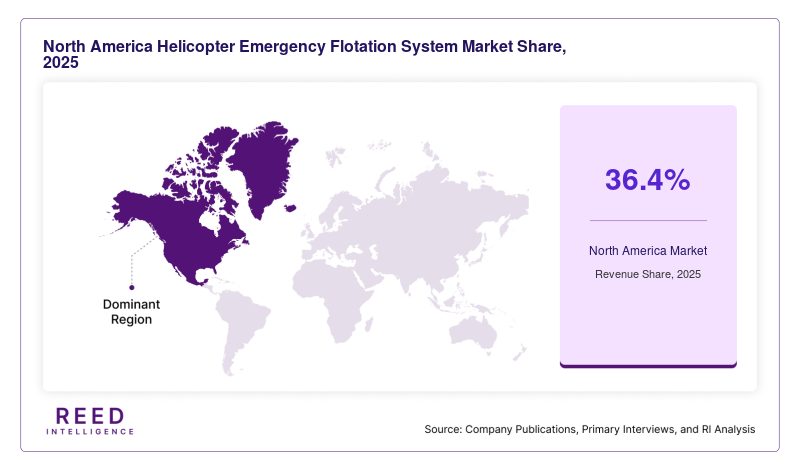
North America held the largest Helicopter Emergency Flotation System Market share of 36.4% in 2025 and is projected to maintain stable growth at a CAGR of 8.7% through 2034. The region benefits from mature offshore oil and gas operations in the Gulf of Mexico, high helicopter fleet modernization rates, and strict aviation safety mandates. Strong military procurement and search-and-rescue investments further strengthen market leadership.
The United States dominates the regional market due to extensive offshore transport networks, defense aviation capacity, and FAA-enforced compliance standards. One unique growth factor is the country’s increasing investment in offshore wind infrastructure along coastal zones, creating sustained demand for safety-equipped transport helicopters supporting installation and maintenance crews.
Europe
Europe accounted for 27.8% of the global market in 2025 and is expected to grow at a CAGR of 8.9% during the forecast period. Regional demand is supported by North Sea offshore operations, advanced aerospace manufacturing, and robust EASA regulations. Europe also benefits from growing maritime rescue initiatives and helicopter safety retrofits across civil aviation sectors.
The United Kingdom leads the European market due to its strong offshore energy logistics network and extensive North Sea helicopter transport operations. A distinct growth factor is Europe’s accelerated offshore wind deployment, particularly in the UK and Nordic nations, which is increasing the need for certified overwater rotorcraft safety systems.
Asia Pacific
Asia Pacific represented 21.6% of the Helicopter Emergency Flotation System Market in 2025 and is forecast to register the fastest CAGR of 10.8% through 2034. Rapid expansion of offshore exploration, rising defense aviation budgets, and growing emergency response capabilities are supporting regional growth. Increasing helicopter acquisitions across Southeast Asia and East Asia are also fueling demand.
China remains the dominant country in Asia Pacific due to expanding naval modernization, offshore energy infrastructure, and broader aerospace investments. A unique growth factor is the country’s strategic development of coastal rescue networks and marine patrol systems, which are driving procurement of advanced rotorcraft safety technologies.
Middle East & Africa
Middle East & Africa held 8.1% of market share in 2025 and is projected to grow at a CAGR of 9.1% over the forecast period. Offshore petroleum logistics, military modernization, and regional investments in emergency aviation are key contributors. Gulf nations are especially active due to their reliance on offshore helicopter transportation.
Saudi Arabia leads this region due to strong offshore oil infrastructure and defense aviation investments. A major growth factor is the expansion of integrated maritime security operations in the Red Sea and Arabian Gulf, which is increasing the deployment of helicopters requiring flotation systems for overwater missions.
Latin America
Latin America captured 6.1% of the global market in 2025 and is expected to grow at a CAGR of 8.4% during 2026–2034. Brazil and Mexico are major contributors due to offshore energy logistics and coastal security operations. Regional fleet modernization remains gradual but consistent, particularly in energy-rich maritime zones.
Brazil dominates the Latin American market because of extensive offshore oil exploration in deepwater reserves. A unique growth factor is Petrobras-linked offshore helicopter transport demand, which continues to support procurement and retrofitting of emergency flotation systems for enhanced crew safety.
Competitive Landscape
The Helicopter Emergency Flotation System Market is moderately consolidated, with established aerospace safety providers competing through innovation, certification capabilities, and defense partnerships. Key players focus on lightweight materials, automated deployment, and retrofit compatibility. The market leader, Safran Aerosystems, maintains strong positioning through its integrated aviation safety portfolio and partnerships with major helicopter OEMs. In 2025, the company expanded its next-generation flotation technology line for offshore and military rotorcraft applications. Other notable companies include Collins Aerospace, Dart Aerospace, HR Smith Group, and Survitec Group, each emphasizing specialized flotation technologies and regional expansion. Competitive differentiation increasingly depends on regulatory certification speed, lifecycle support, and compatibility across helicopter classes.
Key Players
- Safran Aerosystems
- Collins Aerospace
- Dart Aerospace
- HR Smith Group
- Survitec Group
- Musthane
- EAM Worldwide
- Aviation Survival Technologies
- Life Support International
- Switlik Survival Products
- Heli-One
- Kaman Aerospace
- Recoil Aerospace
- Pall Corporation Aerospace Systems
- Aerazur
Recent Developments
- Safran Aerosystems introduced an advanced lightweight flotation platform in 2025 for medium-lift offshore helicopters.
- Collins Aerospace expanded retrofit safety solutions for aging commercial helicopter fleets in 2024.
- Survitec Group strengthened its maritime aviation safety portfolio through new defense-focused flotation system contracts in 2025.
Helicopter Emergency Flotation System Market Segments
System Type
- Skid-Mounted Flotation Systems
- Pop-Out Flotation Systems
- Fixed Bag Flotation Systems
- Amphibious Support Flotation Systems
Application
- Offshore Transportation
- Search and Rescue
- Military Operations
- Emergency Medical Services
- VIP & Commercial Transport
End-Use
- Commercial Operators
- Military & Defense
- Government & Public Safety
- Private Aviation
By Region
- North America
- Europe
- APAC
- Middle East and Africa
- LATAM