Helicopter Seats Market Size, Share Demand Report By Seat Type (Pilot Seats, Passenger Seats), By Material (Aluminum, Composite, Others), By End-Use (Military, Commercial, Civil & Utility), By Region & Segment Forecasts, 2026–2034
USD 3950
Market Overview
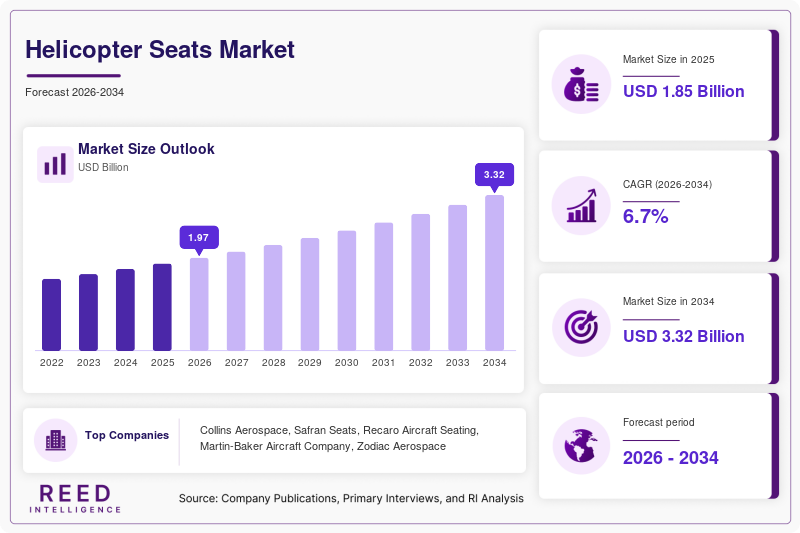
The Helicopter Seats Market size was valued at approximately USD 1.85 billion in 2026 and is projected to reach USD 3.12 billion by 2034, growing at a CAGR of 6.7% during the forecast period (2026–2034). The market is witnessing steady expansion due to increasing global demand for rotorcraft across civil, military, and emergency service applications. The rising procurement of helicopters for search and rescue operations, offshore transport, and defense modernization programs is driving the need for advanced seating systems that offer improved safety, comfort, and durability.
One of the major global factors supporting market growth is the continuous increase in defense expenditure across developed and emerging economies. Governments are investing in fleet upgrades and next-generation helicopters, which require technologically advanced seating systems integrated with crashworthy designs, energy absorption features, and lightweight materials. Additionally, growing demand for VIP and corporate helicopters has created a parallel need for premium seating solutions, further expanding the scope of innovation within the market.
Key Highlights
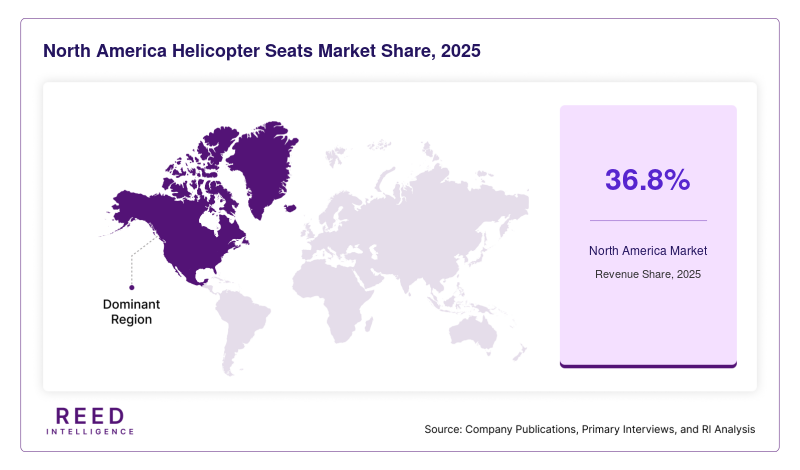
- North America dominated the market with a 36.8% share in 2025.
- Asia Pacific is expected to grow at the fastest CAGR of 8.9% during 2026–2034.
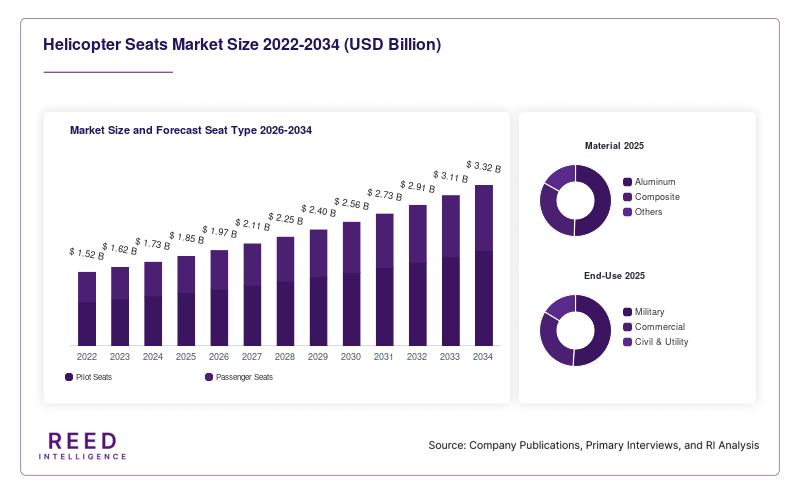
- By seat type, pilot seats accounted for the largest share of 42.3%, while passenger seats are projected to grow at a CAGR of 7.5%.
- By material, aluminum-based seats led with a 47.6% share, whereas composite materials are expected to expand at a CAGR of 8.2%.
- The United States remained the dominant country, with market values of USD 620 million in 2024 and USD 675 million in 2025.
Market Trends
Increasing Integration of Lightweight and Composite Materials
The growing focus on fuel efficiency and performance optimization in helicopters has led manufacturers to adopt lightweight materials in seat design. Composite materials such as carbon fiber and advanced polymers are increasingly replacing traditional metals due to their high strength-to-weight ratio and durability. These materials help reduce the overall aircraft weight, contributing to lower fuel consumption and enhanced payload capacity. Additionally, lightweight seating improves operational efficiency, especially in applications such as offshore transport and emergency medical services, where weight constraints are critical.
Manufacturers are also focusing on hybrid material structures that combine aluminum frames with composite components to achieve optimal performance. This trend is further supported by regulatory requirements that emphasize safety and crashworthiness without compromising weight efficiency. As helicopter operators seek cost-effective solutions, the adoption of lightweight seating systems is expected to become a standard practice across both new aircraft and retrofit programs.
Growing Demand for Ergonomic and Customizable Seating Solutions
The demand for ergonomic seating solutions is increasing across civil and military helicopter segments. Operators are prioritizing passenger comfort and crew efficiency, leading to the development of seats with advanced cushioning, vibration reduction, and adjustable configurations. In long-duration missions, especially in offshore and defense operations, ergonomic seating plays a crucial role in reducing fatigue and enhancing operational performance.
Customization has also emerged as a key trend, particularly in VIP and corporate helicopter segments. Customers are seeking tailored seating solutions with premium materials, aesthetic finishes, and integrated functionalities such as entertainment systems and connectivity features. This trend is driving manufacturers to offer modular seating designs that can be easily adapted to different configurations. As customer expectations continue to evolve, the demand for personalized and high-comfort seating solutions is expected to increase significantly.
Market Drivers
Rising Global Helicopter Fleet Expansion
The expansion of global helicopter fleets is a major driver of the Helicopter Seats Market. Increasing applications across sectors such as defense, emergency medical services, law enforcement, and offshore transportation are fueling the demand for new helicopters. As fleet sizes grow, the need for advanced seating systems also rises, both for new installations and aftermarket replacements.
Military modernization programs are particularly contributing to this growth, as governments invest in advanced rotorcraft equipped with modern safety and comfort features. Additionally, the growing use of helicopters in urban air mobility and disaster management has further increased demand. The expansion of fleets not only boosts initial seat installations but also drives long-term maintenance, repair, and overhaul activities, creating sustained market opportunities.
Emphasis on Safety Regulations and Crashworthiness Standards
Stringent safety regulations and evolving crashworthiness standards are significantly influencing the Helicopter Seats Market. Regulatory bodies are mandating the use of energy-absorbing seats designed to protect occupants during crash scenarios. These seats are engineered to reduce impact forces and improve survivability, making them essential components in modern helicopter design.
Manufacturers are investing heavily in research and development to meet these regulatory requirements while maintaining cost efficiency. The integration of advanced technologies such as dynamic testing, improved restraint systems, and impact-resistant materials is becoming increasingly common. As safety standards continue to evolve globally, the demand for compliant and high-performance seating systems is expected to grow, further driving market expansion.
Market Restraint
High Costs Associated with Advanced Seating Systems
The high cost of advanced helicopter seating systems remains a key restraint for market growth. Modern seats equipped with crashworthy features, lightweight materials, and ergonomic designs require significant investment in research, development, and manufacturing. These costs are often passed on to end users, making them less accessible for smaller operators and emerging markets.
Additionally, retrofit programs involving the replacement of older seating systems with newer models can be expensive, particularly for large fleets. Budget constraints in certain regions may lead operators to delay upgrades or opt for less advanced solutions. This cost sensitivity can limit the adoption of innovative seating technologies, especially in commercial and utility helicopter segments. Despite the long-term benefits of improved safety and efficiency, the initial investment remains a barrier that manufacturers must address through cost optimization and scalable solutions.
Market Opportunities
Expansion of Urban Air Mobility and Air Taxi Services
The emergence of urban air mobility and air taxi services presents a significant opportunity for the Helicopter Seats Market. As cities explore advanced air transportation solutions to address congestion, the demand for compact and efficient rotorcraft is increasing. These aircraft require specialized seating configurations that maximize space utilization while ensuring passenger comfort and safety.
Manufacturers have the opportunity to develop innovative seating solutions tailored to the unique requirements of urban air mobility platforms. Features such as modular designs, lightweight structures, and quick reconfiguration capabilities are becoming essential. As this segment evolves, it is expected to create new revenue streams for seat manufacturers and drive technological advancements in the industry.
Growth in Aftermarket and Retrofit Services
The growing demand for aftermarket services and retrofit programs is creating new opportunities in the Helicopter Seats Market. Aging helicopter fleets require periodic upgrades to meet modern safety standards and enhance operational efficiency. This has led to increased demand for replacement seats and refurbishment services.
Operators are also seeking to upgrade interiors to improve passenger experience, particularly in commercial and VIP segments. This trend is driving demand for customizable and high-performance seating solutions in the aftermarket. Manufacturers can capitalize on this opportunity by offering cost-effective retrofit solutions and expanding their service networks. As the global helicopter fleet continues to age, the aftermarket segment is expected to play a crucial role in market growth.
Segmental Analysis
By Seat Type
Pilot seats accounted for the largest share of 42.3% in 2024, driven by their critical role in ensuring safety and operational efficiency. These seats are designed with advanced features such as energy absorption, ergonomic support, and adjustable configurations to enhance pilot performance during long missions. The demand for pilot seats is particularly strong in military and emergency service applications, where reliability and safety are paramount. Additionally, regulatory requirements mandating crashworthy designs further support the dominance of this segment.
Passenger seats are emerging as the fastest-growing subsegment, with a projected CAGR of 7.5% during the forecast period. The growth is driven by increasing demand for comfort and customization in commercial and VIP helicopters. Operators are investing in high-quality seating solutions to improve passenger experience, particularly in tourism and corporate travel segments. The integration of advanced materials and modular designs is also contributing to the growth of this subsegment.
By Material
Aluminum-based seats dominated the market with a 47.6% share in 2024, owing to their durability, cost-effectiveness, and widespread adoption in traditional helicopter designs. These seats offer a balance between strength and weight, making them suitable for various applications. The established manufacturing processes and availability of raw materials further support the dominance of aluminum-based seating systems.
Composite materials are expected to be the fastest-growing subsegment, with a CAGR of 8.2% during the forecast period. The growth is driven by the increasing focus on lightweight solutions and fuel efficiency. Composite seats offer superior performance in terms of weight reduction and corrosion resistance, making them ideal for modern helicopters. The adoption of advanced manufacturing techniques is further accelerating the growth of this segment.
By End-Use
Military applications accounted for the largest share of 44.8% in 2024, driven by high defense spending and ongoing modernization programs. Helicopter seats used in military applications are designed to meet stringent safety and performance requirements, including crashworthiness and durability. The demand for advanced seating systems is further supported by the increasing deployment of helicopters in combat and rescue missions.
Commercial applications are projected to be the fastest-growing subsegment, with a CAGR of 7.1% during the forecast period. The growth is driven by expanding use of helicopters in tourism, offshore transport, and emergency medical services. Operators are focusing on enhancing passenger comfort and operational efficiency, leading to increased demand for advanced seating solutions. This trend is expected to drive significant growth in the commercial segment.
Regional Analysis
North America
North America accounted for a market share of 36.8% in 2025 and is expected to maintain steady growth with a CAGR of 6.2% during the forecast period. The region benefits from a well-established aerospace industry, high defense spending, and a strong presence of leading helicopter manufacturers. The demand for advanced seating systems is driven by both new aircraft production and extensive retrofit programs across commercial and military fleets.
The United States dominates the regional market, supported by continuous investment in defense modernization and emergency medical services. A unique growth factor in the region is the high adoption of advanced safety technologies, including crashworthy seating systems. This focus on safety and innovation is driving the demand for premium seating solutions across various helicopter applications.
Europe
Europe held a significant share of the Helicopter Seats Market in 2025 and is projected to grow at a CAGR of 6.5% through 2034. The region’s growth is supported by increasing demand for helicopters in offshore operations, particularly in the oil and gas sector. Additionally, the presence of established aerospace companies contributes to the development of advanced seating technologies.
Germany is a leading country in the European market, driven by strong industrial capabilities and technological advancements. A unique growth factor in Europe is the emphasis on sustainability and lightweight materials, which is encouraging the adoption of eco-friendly seating solutions. This trend aligns with regional regulations aimed at reducing environmental impact.
Asia Pacific
Asia Pacific is expected to be the fastest-growing region, with a CAGR of 8.9% during the forecast period. The region’s growth is driven by increasing defense budgets, expanding civil aviation sectors, and rising demand for emergency medical services. Countries such as China and India are investing heavily in helicopter fleet expansion, creating significant demand for seating systems.
China dominates the regional market due to its large-scale investments in aerospace infrastructure. A unique growth factor in Asia Pacific is the rapid development of urban air mobility initiatives, which is driving demand for innovative and space-efficient seating solutions. This trend is expected to accelerate market growth in the region.
Middle East & Africa
The Middle East & Africa region is witnessing moderate growth, with a CAGR of 5.8% during the forecast period. The demand for helicopter seats is primarily driven by offshore oil and gas operations, as well as defense applications. The region’s harsh environmental conditions also necessitate durable and high-performance seating systems.
The United Arab Emirates is a key market in the region, supported by investments in aviation infrastructure and luxury helicopter services. A unique growth factor is the increasing demand for VIP and customized seating solutions, particularly in the corporate and tourism sectors. This trend is driving innovation in premium seating designs.
Latin America
Latin America holds a smaller share of the global market but is expected to grow at a CAGR of 5.9% during the forecast period. The region’s growth is supported by increasing use of helicopters in law enforcement, medical services, and disaster management. Economic development and infrastructure expansion are also contributing to market growth.
Brazil is the dominant country in the region, driven by its large helicopter fleet and growing aviation industry. A unique growth factor in Latin America is the rising demand for cost-effective retrofit solutions, as operators seek to upgrade existing fleets without significant capital investment. This trend is expected to support steady market expansion.
Competitive Landscape
The Helicopter Seats Market is characterized by the presence of several established players focusing on innovation, product development, and strategic partnerships. Companies are investing in advanced materials, ergonomic designs, and safety technologies to strengthen their market position. The competitive landscape is shaped by continuous efforts to meet evolving regulatory standards and customer requirements.
One of the leading companies in the market is Collins Aerospace, which has been actively developing lightweight and crashworthy seating solutions. A recent development includes the introduction of advanced composite seats designed to enhance safety and reduce overall aircraft weight. Other key players are also focusing on expanding their product portfolios and global presence through collaborations and acquisitions. The market remains moderately consolidated, with competition driven by technological advancements and customization capabilities.
Key Players
- Collins Aerospace
- Safran Seats
- Recaro Aircraft Seating
- Martin-Baker Aircraft Company
- Zodiac Aerospace
- Geven S.p.A.
- Stelia Aerospace
- Aviointeriors
- UTC Aerospace Systems
- Thompson Aero Seating
- Mirus Aircraft Seating
- Pitch Aircraft Seating Systems
- IFE Products
- Trelleborg Aerospace
- DART Aerospace
Recent Developments
- Several manufacturers have introduced lightweight composite seating solutions to meet evolving industry requirements for fuel efficiency and performance optimization.
- A leading company launched a new range of crashworthy seats designed for next-generation military helicopters, focusing on enhanced safety and durability.
- Strategic partnerships between seating manufacturers and helicopter OEMs have increased, enabling the development of customized seating solutions tailored to specific aircraft models and applications.
Helicopter Seats Market Segments
Seat Type
- Pilot Seats
- Passenger Seats
Material
- Aluminum
- Composite
- Others
End-Use
- Military
- Commercial
- Civil & Utility
By Region
- North America
- Europe
- APAC
- Middle East and Africa
- LATAM