Helicopter Skid Landing Gear Market Size, Share & Demand Report By Type (Conventional Skid Landing Gear, Energy-Absorbing Skid Landing Gear), By Material (Aluminum Alloys, Steel, Composite Materials), By Application (Civil Helicopters, Military Helicopters), By End-Use (OEM, Aftermarket), By Distribution Channel (Direct Sales, Distributors), By Region & Segment Forecasts, 2025–2034
USD 3950
Market Overview
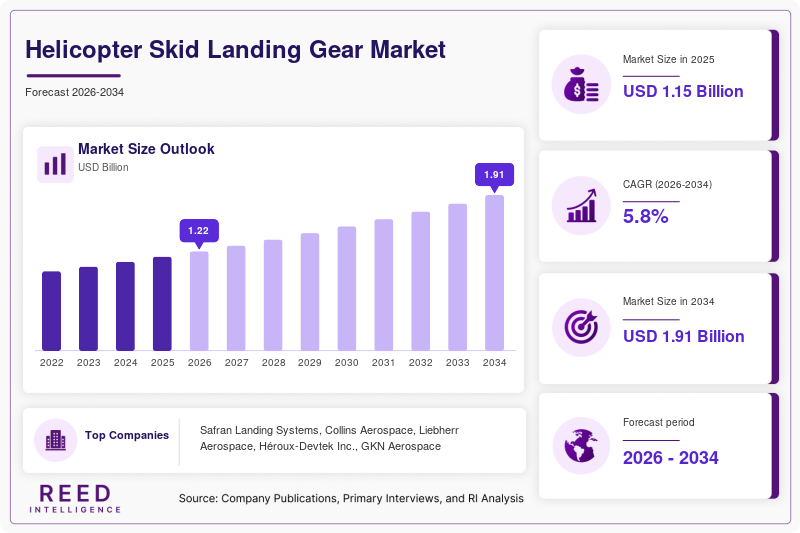
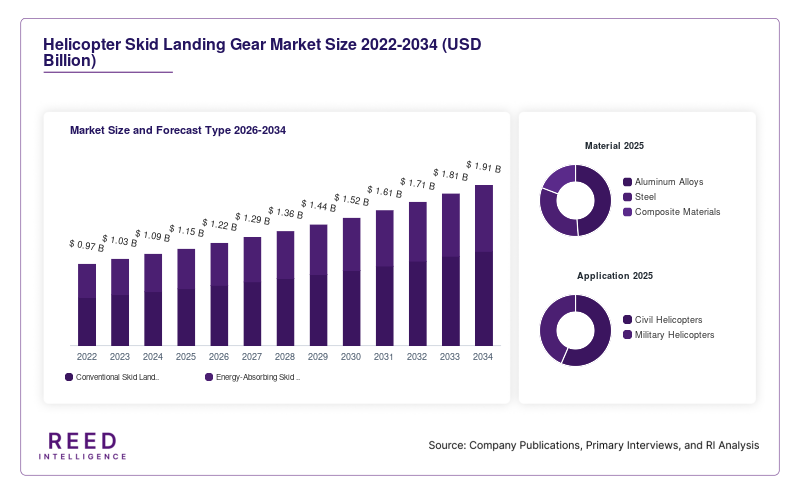
The Helicopter Skid Landing Gear Market size was valued at approximately USD 1.15 billion in 2025 and is projected to reach USD 1.92 billion by 2034, registering a CAGR of 5.8% during the forecast period (2025–2034). The market is driven by the steady expansion of civil and military helicopter fleets across emerging and developed economies. Increasing investments in rotorcraft modernization programs and the replacement of aging landing systems are contributing to sustained demand.
A key global factor supporting market growth is the rising demand for lightweight and durable aerospace components, which has accelerated the adoption of advanced composite materials in skid landing gear systems. Manufacturers are focusing on reducing aircraft weight to enhance fuel efficiency and payload capacity, making skid landing gear systems a preferred choice for light and utility helicopters.
Key Highlights
- North America dominated the market with a 34.6% share in 2025, while Asia Pacific is projected to grow at the fastest CAGR of 6.7%.
- By type, conventional skid landing gear led with a 62.3% share, while energy-absorbing skid systems are expected to grow at a CAGR of 6.5%.
- By material, aluminum alloys accounted for 48.1% share, whereas composite materials are forecasted to expand at 7.1% CAGR.
- The United States remained the dominant country with a market size of USD 395 million in 2025, expected to reach USD 415 million in 2026.
Market Trends
Increasing Use of Composite Materials in Skid Systems
The shift toward advanced composite materials is transforming the Helicopter Skid Landing Gear Market. Manufacturers are increasingly adopting carbon fiber-reinforced polymers and hybrid composites to reduce structural weight while maintaining high strength and corrosion resistance. This trend aligns with the aerospace industry’s broader objective of improving fuel efficiency and lowering maintenance costs. Composite skid landing gear systems also offer improved fatigue life, making them suitable for high-frequency operations such as air ambulances and offshore transport.
Integration of Shock-Absorption and Safety Enhancements
Another key trend is the integration of enhanced shock-absorption technologies into skid landing gear systems. Modern systems are designed to improve crashworthiness and passenger safety by incorporating energy-dissipating structures. These innovations are particularly important for military and emergency medical service (EMS) helicopters, where rough landing conditions are common. The adoption of such technologies is expected to increase as regulatory bodies emphasize safety standards and operators prioritize crew and passenger protection.
Market Drivers
Expansion of Global Helicopter Fleet
The growing deployment of helicopters across commercial, defense, and emergency service sectors is driving demand for skid landing gear systems. Increasing use in tourism, medical evacuation, offshore oil & gas operations, and law enforcement has led to a rise in helicopter procurement. As skid landing gear is widely used in light and medium helicopters, the expansion of these segments is directly boosting market growth.
Rising Focus on Maintenance and Retrofit Programs
Aging helicopter fleets are prompting operators to invest in maintenance, repair, and overhaul (MRO) activities. Skid landing gear systems are subject to wear and tear due to repeated landings, leading to regular replacement cycles. Retrofit programs aimed at upgrading legacy systems with lightweight and high-performance materials are further contributing to market expansion. This driver is particularly strong in regions with mature aviation industries, where fleet modernization remains a priority.
Market Restraints
Limited Adoption in Heavy Helicopters
A major restraint in the Helicopter Skid Landing Gear Market is the limited use of skid landing gear systems in heavy-lift helicopters. These aircraft typically require wheeled landing gear due to their higher weight and operational requirements, such as taxiing capabilities and ground maneuverability. As a result, the addressable market for skid systems is confined primarily to light and medium helicopters.
Additionally, skid landing gear systems can present operational limitations in urban and confined landing zones where precise positioning is required. The lack of mobility compared to wheeled systems restricts their application in certain commercial and defense scenarios. These limitations reduce the overall market penetration and slow down adoption in segments where versatility is critical. Consequently, despite steady demand, the market faces structural constraints that may moderate long-term growth potential.
Market Opportunities
Growth in Urban Air Mobility (UAM) and Light Helicopters
The emergence of urban air mobility solutions and increased production of light helicopters present significant growth opportunities. Skid landing gear systems are well-suited for lightweight aircraft due to their simplicity, lower cost, and reduced maintenance requirements. As cities explore aerial transport solutions, demand for compact and efficient landing systems is expected to rise.
Advancements in Additive Manufacturing
The adoption of additive manufacturing techniques is opening new avenues for innovation in skid landing gear design. Manufacturers can produce complex geometries with improved strength-to-weight ratios, enabling the development of customized and high-performance components. This technology also reduces production time and material waste, making it an attractive option for aerospace manufacturers. As adoption increases, additive manufacturing is likely to play a crucial role in enhancing product efficiency and cost-effectiveness.
Segmental Analysis
By Type
Conventional skid landing gear dominated the Helicopter Skid Landing Gear Market with a 62.3% share in 2025. These systems are widely used due to their simple design, cost-effectiveness, and ease of maintenance. They are particularly popular in light helicopters used for training, surveillance, and utility applications.
Energy-absorbing skid systems are projected to grow at a CAGR of 6.5%. These systems incorporate advanced shock-absorption features, enhancing safety during hard landings. Their adoption will increase as operators prioritize crashworthiness and passenger protection.
By Material
Aluminum alloys accounted for 48.1% of the market share in 2025. Their lightweight properties, corrosion resistance, and cost efficiency make them a preferred choice for skid landing gear manufacturing.
Composite materials are expected to grow at a CAGR of 7.1%. The demand for high-performance materials with superior strength-to-weight ratios will drive this segment. Composites also offer improved durability, making them suitable for high-frequency operations.
By Application
Civil helicopters held the largest share at 57.6% in 2025. These helicopters are widely used in tourism, medical services, and corporate transport, driving demand for skid landing gear systems.
Military applications are anticipated to grow at a CAGR of 6.3%. Increasing defense budgets and modernization programs will support the adoption of advanced skid systems in military helicopters.
By End-Use
Original Equipment Manufacturers (OEMs) dominated the market with a 54.2% share in 2025. The production of new helicopters directly influences demand for skid landing gear systems in this segment.
The aftermarket segment is expected to grow at a CAGR of 6.0%. Rising maintenance and replacement requirements will drive demand for aftermarket components.
By Sales Channel
Direct sales accounted for 63.5% share in 2025, as manufacturers prefer direct engagement with OEMs and large operators.
Distributor-based sales are projected to grow at a CAGR of 5.9%, driven by increasing demand from smaller operators and regional markets.
Regional Analysis
North America
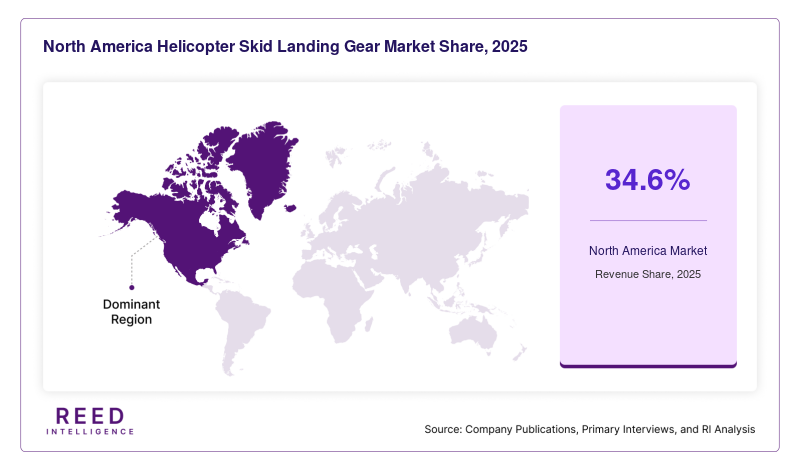
North America accounted for 34.6% of the Helicopter Skid Landing Gear Market in 2025 and will grow at a CAGR of 5.4% during the forecast period. The region has a well-established aerospace industry and a large fleet of civil and military helicopters. High defense spending and strong demand for emergency medical services contribute to steady market growth.
The United States dominated the regional market due to its extensive helicopter fleet and ongoing modernization programs. The presence of leading aerospace manufacturers and a strong MRO ecosystem has supported consistent demand for skid landing gear systems. The country’s focus on upgrading legacy aircraft has further strengthened its market position.
Europe
Europe held 26.2% market share in 2025 and is expected to expand at a CAGR of 5.2%. The region benefits from a strong aerospace manufacturing base and increasing investments in defense and rescue operations. Growth is supported by demand for advanced materials and safety-enhanced landing systems.
Germany emerged as the dominant country due to its advanced engineering capabilities and focus on high-quality aerospace components. The country’s emphasis on technological innovation has contributed to the development of lightweight and durable skid systems.
Asia Pacific
Asia Pacific captured 21.8% share in 2025 and will register the fastest CAGR of 6.7%. Rapid economic development and increasing defense budgets are driving helicopter procurement across the region. Expanding offshore energy exploration activities are also boosting demand.
China led the regional market, driven by significant investments in domestic aerospace manufacturing and military expansion. The country’s efforts to enhance its aviation capabilities have resulted in increased production and adoption of helicopter components.
Middle East & Africa
The Middle East & Africa held 10.4% market share in 2025 and will grow at a CAGR of 5.9%. The region’s demand is driven by oil & gas operations, search and rescue missions, and military applications. Harsh environmental conditions necessitate durable landing gear systems.
Saudi Arabia dominated the market due to its high defense spending and reliance on helicopters for surveillance and transport. Investments in aviation infrastructure have supported steady growth.
Latin America
Latin America accounted for 7.0% share in 2025 and is projected to grow at a CAGR of 5.6%. The region’s market is supported by increasing use of helicopters in law enforcement, agriculture, and disaster management.
Brazil emerged as the leading country due to its expanding aviation sector and growing demand for rotorcraft in remote area operations. The country’s focus on improving connectivity has contributed to market expansion.
Competitive Landscape
The Helicopter Skid Landing Gear Market is moderately consolidated, with key players focusing on product innovation and strategic partnerships. Leading companies are investing in lightweight materials and advanced manufacturing technologies to enhance performance and reduce costs.
A prominent market leader, Safran Landing Systems, has strengthened its position through continuous investment in R&D and the development of advanced composite skid systems. The company recently introduced a new lightweight skid design aimed at improving fuel efficiency and durability.
Other players are focusing on expanding their global footprint and strengthening supply chain capabilities. Strategic collaborations with helicopter manufacturers and MRO providers are common, enabling companies to secure long-term contracts and maintain competitive advantage.
Key Players
- Safran Landing Systems
- Collins Aerospace
- Liebherr Aerospace
- Héroux-Devtek Inc.
- GKN Aerospace
- Kawasaki Heavy Industries
- Sumitomo Precision Products Co., Ltd.
- Magellan Aerospace Corporation
- Triumph Group Inc.
- Spirit AeroSystems
- AAR Corp.
- Moog Inc.
- Precision Castparts Corp.
- Parker Hannifin Corporation
- Airbus Helicopters
Recent Developments
- 2024: Safran Landing Systems introduced a new composite skid landing gear system with improved fatigue resistance.
- 2024: Collins Aerospace expanded its production capacity for helicopter components to meet rising global demand.
- 2023: Liebherr Aerospace launched a lightweight skid system designed for next-generation helicopters.
- 2023: GKN Aerospace invested in additive manufacturing for aerospace components.
- 2023: Airbus Helicopters partnered with suppliers to enhance landing gear system efficiency.
Helicopter Skid Landing Gear Market Segments
Type
- Conventional Skid Landing Gear
- Energy-Absorbing Skid Landing Gear
Material
- Aluminum Alloys
- Steel
- Composite Materials
Application
- Civil Helicopters
- Military Helicopters
End-Use
- Original Equipment Manufacturers (OEMs)
- Aftermarket
Distribution Channel
- Direct Sales
- Distributors
By Region
- North America
- Europe
- APAC
- Middle East and Africa
- LATAM