HELLP Syndrome Market Size, Share Demand Report By Diagnosis Type (Laboratory Testing, Imaging Diagnostics), By Treatment Type (Corticosteroid Therapy, Blood Transfusion, Antihypertensive Medications), By End-Use (Hospitals, Specialty Clinics), By Distribution Channel (Hospital Pharmacies, Retail Pharmacies, Online Pharmacies) By Region & Segment Forecasts, 2026–2034
USD 3950
Market Overview
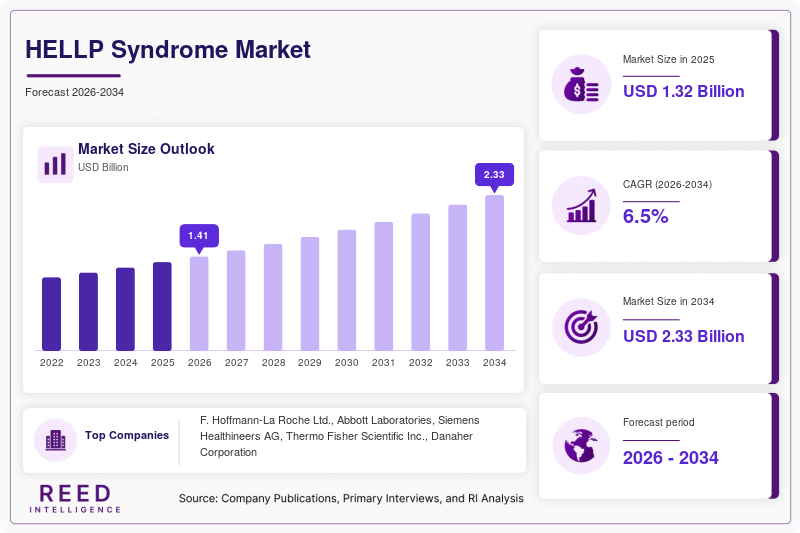
The global HELLP Syndrome Market size was valued at approximately USD 1.32 billion in 2026 and is projected to reach USD 2.18 billion by 2034, expanding at a CAGR of 6.5% during the forecast period (2026–2034). The market is gaining traction due to increasing awareness of maternal health complications and advancements in early diagnostic protocols. HELLP syndrome, a severe form of preeclampsia characterized by hemolysis, elevated liver enzymes, and low platelet count, requires timely diagnosis and clinical intervention, which continues to drive healthcare investments in this space.
A key global factor supporting the HELLP Syndrome Market growth is the rising focus on improving maternal healthcare outcomes through enhanced prenatal screening and hospital-based care systems. Governments and healthcare organizations are strengthening obstetric care infrastructure, which has contributed to increased detection rates and improved treatment accessibility.
Key Highlights
- North America dominated the market with 36.8% share in 2025, while Asia Pacific is projected to grow at the fastest CAGR of 7.6%
- Diagnostics segment led with 44.2% share, while therapeutic management is expected to grow at a CAGR of 7.1%
- Hospital end-use segment held 61.5% share, while specialty clinics are forecasted to grow at a CAGR of 6.9%
- The United States market was valued at USD 410 million in 2024 and reached USD 435 million in 2025
Market Trends
Increasing Adoption of Advanced Diagnostic Technologies
The integration of advanced diagnostic tools such as biomarker-based testing and imaging technologies has improved early detection rates of HELLP syndrome. Healthcare providers are increasingly adopting laboratory-based diagnostics that offer higher accuracy and faster turnaround time, shaping key HELLP Syndrome Market trends.
Rising Focus on Maternal Health Programs
Public health initiatives aimed at reducing maternal mortality rates are promoting awareness and early intervention strategies. Programs focused on prenatal monitoring and risk assessment are driving demand for diagnostic and treatment solutions associated with HELLP syndrome.
Market Drivers
Growing Incidence of Pregnancy-Related Complications
The increasing prevalence of hypertension and related complications during pregnancy has contributed to the rising incidence of HELLP syndrome. This has led to higher demand for effective diagnostic and treatment solutions, supporting the overall HELLP Syndrome Market growth.
Expansion of Healthcare Infrastructure
Investments in hospital infrastructure and maternal care facilities have enhanced the availability of specialized treatment options. Improved access to healthcare services has enabled timely management of HELLP syndrome, driving market expansion.
Market Restraint
Limited Awareness in Low-Income Regions
In several developing regions, lack of awareness and inadequate healthcare facilities hinder early diagnosis and treatment of HELLP syndrome. This limitation affects overall market penetration and growth potential.
Market Opportunities
Development of Targeted Therapeutics
Ongoing research into targeted treatment options for HELLP syndrome presents significant opportunities. Pharmaceutical companies are exploring new drug formulations and therapeutic approaches to improve patient outcomes.
Telemedicine and Remote Monitoring Solutions
The adoption of telehealth platforms for prenatal care offers new growth avenues. Remote monitoring tools enable early detection of complications, particularly in underserved areas, enhancing the HELLP Syndrome Market outlook.
Segmental Analysis
By Diagnosis Type
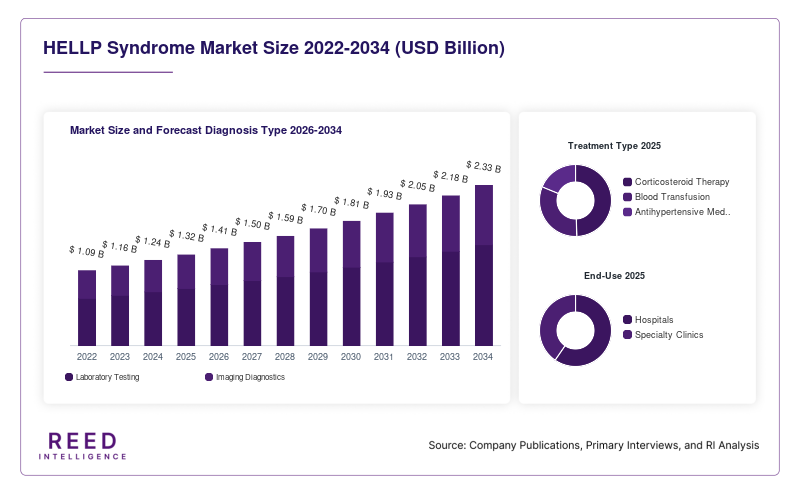
The laboratory testing segment dominated the HELLP Syndrome Market with 44.2% share in 2025 due to its accuracy in detecting key biomarkers such as liver enzymes and platelet counts. The imaging diagnostics segment is expected to grow at the fastest CAGR of 6.8%, driven by advancements in ultrasound and imaging technologies that support early-stage detection.
By Treatment Type
The corticosteroid therapy segment held the largest share of 39.7% in 2025, as it is widely used to improve fetal lung maturity and maternal condition. The blood transfusion segment is projected to grow at a CAGR of 7.1%, supported by increasing cases requiring emergency intervention.
By End-Use
The hospitals segment dominated with 61.5% share in 2025 due to the availability of specialized care units and advanced treatment facilities. Specialty clinics are expected to grow at a CAGR of 6.9%, driven by increasing focus on targeted maternal care services.
By Distribution Channel
The hospital pharmacies segment accounted for 57.3% share in 2025, as most treatments are administered in clinical settings. Retail and online pharmacies are projected to grow at a CAGR of 6.6%, supported by expanding access to medications.
Regional Analysis
North America
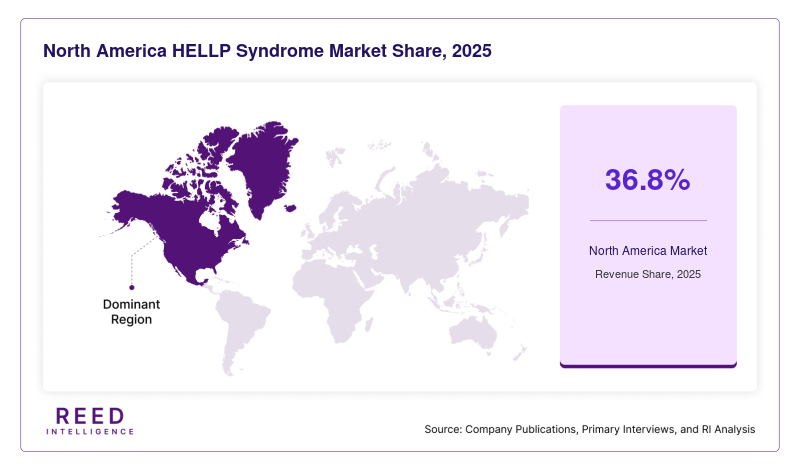
North America accounted for 36.8% of the HELLP Syndrome Market share in 2025 and is expected to grow at a CAGR of 6.0% through 2034. The United States dominated the region due to advanced healthcare infrastructure and high awareness levels regarding maternal complications.
Europe
Europe held 28.1% share in 2025 and is projected to expand at a CAGR of 5.8%. Germany led the regional market, supported by strong healthcare systems and increasing adoption of early diagnostic practices.
Asia Pacific
Asia Pacific captured 20.5% share in 2025 and is expected to grow at the fastest CAGR of 7.6%. China dominated the region due to improving healthcare access and rising investments in maternal health programs.
Middle East & Africa
The Middle East & Africa region held 7.6% share in 2025 and is projected to grow at a CAGR of 6.3%. The UAE led the market due to ongoing improvements in healthcare infrastructure and increased focus on maternal health services.
Latin America
Latin America accounted for 7.0% share in 2025 and is expected to grow at a CAGR of 6.4%. Brazil dominated the region, supported by government initiatives aimed at improving maternal healthcare access.
Competitive Landscape
The HELLP Syndrome Market is characterized by the presence of several pharmaceutical and diagnostic companies focusing on maternal health solutions. Key players are investing in research and development to improve diagnostic accuracy and treatment outcomes. One leading company has recently introduced a novel biomarker-based diagnostic tool aimed at enhancing early detection capabilities.
Other companies are expanding their product portfolios through collaborations and partnerships with healthcare providers. Strategies such as mergers and acquisitions, along with geographic expansion, are being adopted to strengthen market presence. Increasing focus on innovation and patient-centric care continues to shape the competitive environment.
Key Players List
- F. Hoffmann-La Roche Ltd.
- Abbott Laboratories
- Siemens Healthineers AG
- Thermo Fisher Scientific Inc.
- Danaher Corporation
- Becton, Dickinson and Company
- Pfizer Inc.
- Novartis AG
- Johnson & Johnson
- Merck & Co., Inc.
- GE HealthCare
- Bio-Rad Laboratories, Inc.
- PerkinElmer, Inc.
- Quest Diagnostics Incorporated
- Laboratory Corporation of America Holdings
Recent Developments
- In 2025, a leading diagnostics company launched an advanced biomarker-based test for early detection of HELLP syndrome
- In 2024, pharmaceutical firms increased investment in research focused on targeted therapies for pregnancy-related complications
- In 2025, healthcare providers adopted integrated digital monitoring systems for prenatal care
- In 2024, collaborations between hospitals and research institutions improved clinical management protocols
- In 2025, expansion of maternal healthcare programs enhanced early diagnosis rates globally
HELLP Syndrome Market Segments
Diagnosis Type
- Laboratory Testing
- Imaging Diagnostics
Treatment Type
- Corticosteroid Therapy
- Blood Transfusion
- Antihypertensive Medications
End-Use
- Hospitals
- Specialty Clinics
Distribution Channel
- Hospital Pharmacies
- Retail Pharmacies
- Online Pharmacies
By Region
- North America
- Europe
- APAC
- Middle East and Africa
- LATAM