Help Desk Software Market Size, Share & Trends Analysis Report By Component (Solution, Services), By Deployment (Cloud-Based, On-Premise), By Organization Size (Large Enterprises, Small & Medium Enterprises), By Application (Customer Support, IT Service Desk, Employee Service), By End User (IT & Telecommunications, BFSI, Retail & E-Commerce, Healthcare, Manufacturing) Forecasts, 2026–2034
USD 3950
Help Desk Software Market Size
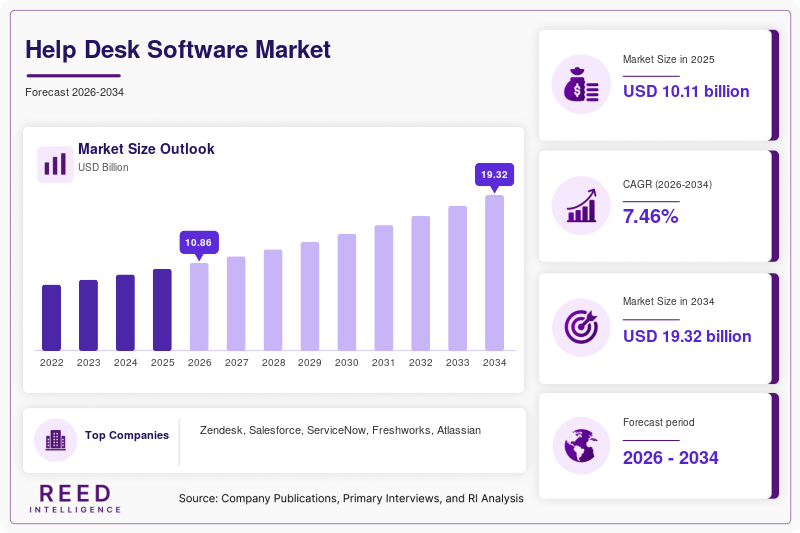
The global Help Desk Software Market size was valued at USD 10.11 billion in 2025 and is projected to grow from USD 10.86 billion in 2026 to USD 19.32 billion by 2034, registering a CAGR of 7.46% during the forecast period from 2026 to 2034.
The Help Desk Software Market is moving from traditional ticket-management systems toward AI-enabled service platforms that can classify requests, search knowledge bases, recommend responses, automate workflows and increasingly resolve cases without human intervention. Modern platforms combine ticketing, shared inboxes, knowledge management, self-service portals, reporting, workflow automation and omnichannel communication. describes the modern help desk as a combination of conversations, tickets, help-center content, workflows and AI, while connects customer cases with enterprise workflows and AI agents.
The commercial demand mechanism is closely linked to customer-service workload and pressure to improve resolution speed without expanding support headcount at the same rate. 's 2026 research found that 82% of surveyed senior leaders invested in AI for customer service in 2025 and 87% planned to invest in 2026; however, only 10% described their AI deployment as mature.
Vendors are consequently competing on automation depth rather than ticket storage alone. expanded advanced AI-agent access across its plans in 2026, Salesforce is positioning Agentforce around autonomous service, has introduced AI agents and specialists for customer and employee service, and Freshworks is expanding Freddy AI across customer-service workflows.
Help Desk Software Market Drivers
AI-Powered Ticket Resolution Is Changing the Economics of Help Desks
AI is changing help-desk software from a system that records support interactions into a system that can actively resolve them. 's AI platform provides agent assistance, intelligent triage, summaries and autonomous AI agents across messaging, email and web forms. 's customer-service platform similarly uses AI agents to execute multi-step workflows and handle routine cases.
The commercial mechanism is lower manual effort per support interaction. When an AI agent can identify intent, retrieve a relevant knowledge article, collect required information and execute an action, the human agent receives fewer repetitive tickets and can concentrate on exceptions.
Freshworks reports that Freddy AI combines customer-facing agents, agent copilots and insights, while its current platform claims AI agents can resolve up to 80% of queries across chat, messaging and email. These are vendor-reported capabilities rather than independent market measurements, but they demonstrate the direction of product development. Freshworks
This is also changing pricing models. and Salesforce are moving toward outcome-oriented AI-agent economics, where vendors increasingly link AI charges to successful resolutions rather than simply seats or software access.
Omnichannel Support Is Expanding the Role of Help Desk Platforms
Customer requests no longer arrive exclusively through email-based ticket queues. Service platforms increasingly combine email, chat, messaging, web forms, voice, social channels and self-service portals.
's Customer Service Management supports web, email, chat, telephone and social-media interactions, while Salesforce's Agentforce Service supports channels including SMS, WhatsApp, Messenger and voice.
reported in June 2026 that voice still represented approximately 40% of contact-center volume in its research, while 75% of surveyed contact-center leaders said legacy technology prevented true omnichannel service.
The commercial implication is that organizations increasingly prefer platforms capable of maintaining customer context across channels. This increases the addressable software footprint because a help desk becomes connected to contact-center, CRM, knowledge, workflow and analytics functions rather than remaining a standalone ticketing tool.
Enterprise Service Management Is Expanding Help Desk Software Beyond IT
Help-desk technology is increasingly being deployed outside traditional IT support. HR, finance, facilities, legal, procurement and customer-service teams can use service portals, workflows, knowledge bases and case management.
's Service Collection combines Jira Service Management, Customer Service Management, Assets and Rovo agents, while its enterprise service-management offering allows departments such as HR, marketing, legal, finance and facilities to create service portals.
is pursuing a similar cross-enterprise model, extending its AI platform across IT, security, HR, finance, legal, procurement and customer service.
This creates an expansion mechanism for vendors because an initial IT-service deployment can become the foundation for additional departmental workflows, increasing software coverage without requiring an entirely new platform.
Help Desk Software Market Restraints
AI Reliability, Knowledge Quality and Human Oversight Remain Constraints
AI-based help desks depend heavily on accurate knowledge bases, appropriate permissions, reliable integrations and clear escalation rules. 's documentation explicitly notes that AI answers work best when an organization has an up-to-date knowledge base, while its virtual agent can escalate unresolved issues to human agents.
's 2026 research also shows that AI adoption does not automatically produce mature deployment. Although 62% of surveyed teams reported improved customer-service metrics after implementing AI, only 10% reported mature deployment.
The market implication is that customers still require implementation, knowledge-management, governance and integration services. Vendors therefore need to prove resolution quality rather than simply increasing automation percentages.
Integration Complexity and Migration Costs Can Slow Adoption
Large enterprises often operate multiple CRM, ERP, contact-center, identity, collaboration and IT-service systems. Replacing an established help desk can therefore require significant workflow redesign, data migration and employee training.
's move from Jira Service Management customer-service functionality into Service Collection illustrates how vendors themselves are consolidating service capabilities across applications.
is also emphasizing connected enterprise data and workflow execution because AI agents need access to systems of record to complete actions rather than simply provide text responses.
For buyers, the challenge is balancing the cost of migration against the expected reduction in handling time, ticket volume and software fragmentation.
Help Desk Software Market Opportunities
Outcome-Based AI Service Models
Outcome-based pricing creates a new commercial model for help-desk software. announced outcome-based pricing for its autonomous service workforce, while Salesforce's Agentforce Help Agent emphasizes payment for successful resolutions.
This model can reduce the importance of traditional per-seat licensing and align vendor revenue more closely with actual service activity. It also allows companies with large customer-service volumes to deploy AI without necessarily adding equivalent numbers of human seats.
The opportunity is particularly relevant to high-volume industries such as retail, telecommunications, financial services and e-commerce.
AI-Powered Self-Service and Knowledge Management
Self-service is becoming a central software function rather than an auxiliary knowledge base. combines AI search, conversational chat and AI agents, while 's virtual service agent can retrieve information from connected knowledge bases, answer questions and execute controlled actions.
The commercial mechanism is ticket avoidance and faster resolution. Better knowledge management can also improve AI performance because agents have access to more accurate organizational information.
This creates opportunities for vendors that combine knowledge creation, content governance, AI retrieval and workflow execution in a single platform.
Industry-Specific and Specialized AI Agents
Generic AI agents are increasingly being replaced by specialized agents grounded in specific industries, workflows and business rules. launched specialized industry and custom AI agents in September 2026 that can work with company-specific knowledge, workflows and connected systems.
This creates room for verticalized help-desk software in areas such as healthcare, financial services, telecommunications, retail and technology. Industry specialization can improve workflow relevance and reduce the configuration burden for customers.
Segmental Analysis
By Component
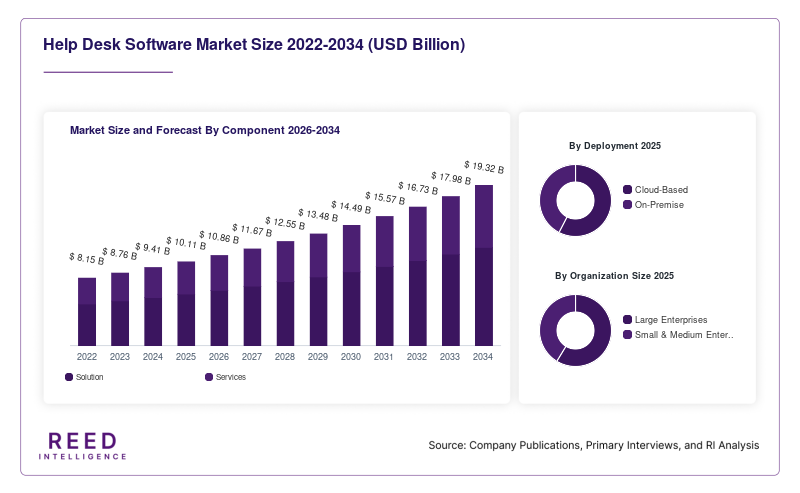
Solution represents approximately 78% of the global market in 2025, reflecting the central role of ticketing, case management, knowledge management, automation, analytics and AI capabilities in help-desk deployments.
Services account for approximately 22% and include implementation, integration, customization, training, migration and managed support.
Services are the fastest-growing component, with approximately 9.0% CAGR, as enterprises require integration and operational support for increasingly complex AI-enabled service environments. ServiceNow's expansion of agentic workflows and Atlassian's integration of service management, assets and AI agents illustrate why implementation requirements are expanding alongside software functionality.
By Deployment
Cloud-Based deployment represents approximately 83% of the market in 2025. Cloud deployment supports remote service teams, rapid feature releases, AI infrastructure and integration with CRM, collaboration and business applications.
On-Premise deployment accounts for approximately 17%, primarily where organizations maintain strict data, security or infrastructure requirements.
Cloud-Based deployment is also the fastest-growing category, with approximately 8.2% CAGR. The rapid introduction of AI capabilities is reinforcing this shift because cloud platforms can provide access to continuously updated models, automation and analytics without requiring customers to manage the underlying AI infrastructure.
By Organization Size
Large Enterprises account for approximately 61% of the market in 2025. Large organizations typically manage high ticket volumes, multiple support channels, complex SLAs and integrations across CRM, ERP, identity and collaboration systems.
SMEs represent approximately 39% and are the fastest-growing organization category, with approximately 9.1% CAGR.
Cloud deployment and AI automation lower some of the infrastructure and staffing requirements that previously made sophisticated help desks more difficult for smaller businesses to adopt. Freshworks, and HubSpot all position AI-powered service products toward scaling support without proportionally expanding service teams.
By Application
Customer Support represents approximately 38% of the market in 2025, making it the largest application. It covers external customer inquiries, complaints, product questions, account issues and service requests.
IT Service Desk accounts for approximately 29%, supported by incident management, employee IT support, asset-related workflows and change management.
Employee Service represents approximately 18%.
Enterprise Service Management accounts for approximately 15% but is the fastest-growing application, with approximately 9.4% CAGR. Atlassian's expansion into HR, finance, legal and facilities service portals and ServiceNow's cross-enterprise AI platform demonstrate the expansion mechanism.
By End User
IT & Telecommunications represents approximately 22% of the market in 2025, supported by high volumes of technical incidents, service requests and internal IT support.
BFSI accounts for approximately 17%, while Retail & E-Commerce represents 16%.
Healthcare accounts for approximately 13%, Manufacturing 11%, Government & Education 9%, and other industries 12%.
Retail & E-Commerce is the fastest-growing end-user segment, with approximately 9.2% CAGR, supported by high customer-interaction volumes, digital purchasing and the need for rapid support across chat, email, messaging and self-service.
's current Agentforce service platform specifically supports autonomous service across multiple channels, while Intercom continues to develop AI customer agents for commerce-related use cases.
Regional Analysis
North America Help Desk Software Market
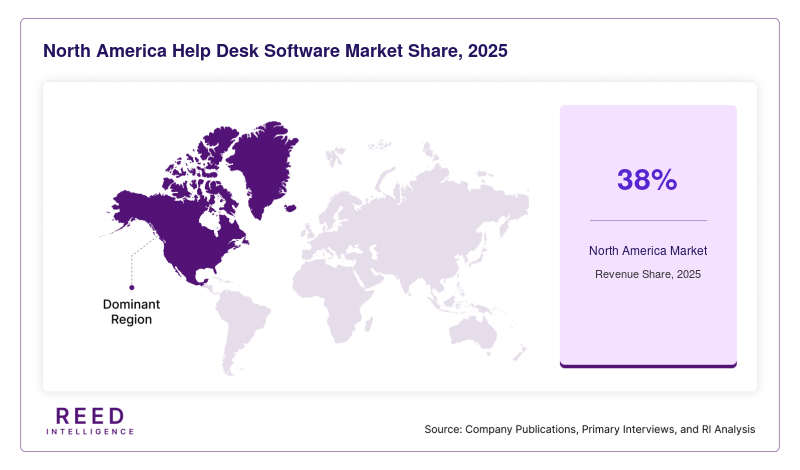
North America represents approximately 38% of the global Help Desk Software Market in 2025, supported by high enterprise software adoption, mature cloud infrastructure, large technology companies and established customer-service operations.
The region has a dense competitive ecosystem that includes ServiceNow, Freshworks, HubSpot, Intercom, and Atlassian. Their product strategies increasingly converge around AI agents, workflow automation, self-service and omnichannel service.
North American enterprises are also early adopters of outcome-oriented AI service models. 's 2026 strategy shifted toward autonomous service and outcome-based pricing, while introduced resolution-based Agentforce Help Agent pricing.
The region is projected to grow at approximately 6.8% CAGR through 2034. The principal demand mechanism is enterprise modernization: companies are consolidating ticketing, knowledge, contact-center and workflow capabilities into fewer AI-enabled platforms.
The counterbalance is market maturity and high competition among vendors, which can make customer acquisition expensive and increase pressure on software providers to demonstrate measurable ROI.
Europe Help Desk Software Market
Europe accounts for approximately 27% of the global market in 2025. Demand is supported by mature enterprise software adoption, strong cloud usage, multilingual customer-service requirements and extensive cross-border operations.
European companies increasingly need help-desk systems capable of supporting multiple languages and channels while maintaining data governance. , , ServiceNow, Atlassian and Intercom all provide multi-channel service capabilities, while expanded voice support across languages in September 2026.
European service teams are also adopting AI, but implementation tends to emphasize governance, knowledge quality and human escalation alongside automation. Intercom's 2026 research shows that AI adoption is widespread but mature deployment remains much less common, highlighting the implementation gap.
Europe is projected to grow at approximately 6.7% CAGR through 2034.
The main constraint is the complexity of operating across different languages, regulatory environments and enterprise technology stacks. These factors increase integration requirements but also create demand for sophisticated workflow and governance capabilities.
APAC Help Desk Software Market
APAC represents approximately 22% of the global market in 2025 and is the fastest-growing region, with approximately 10.1% CAGR.
The region combines rapidly expanding digital businesses, growing cloud adoption, large customer-service workforces and increasing enterprise use of AI automation.
India, China, Japan, South Korea, Singapore and Australia provide distinct demand centers. Global vendors are increasingly supporting multilingual AI, omnichannel communication and localized workflows to serve these markets.
Freshworks has particular relevance in APAC because of its Indian origins and international customer-service platform, while , , ServiceNow, Atlassian and Intercom continue expanding their AI-enabled service capabilities globally. Freshworks reported 16% year-over-year revenue growth for 2025 and identified AI-powered software as an important growth driver.
The region's growth mechanism is a combination of new cloud deployments and expansion within existing enterprises. AI can also help organizations handle large multilingual service volumes without increasing support staffing at the same rate.
The principal constraints include varying enterprise software maturity, price sensitivity among SMEs and differences in data-governance requirements across countries.
Middle East and Africa Help Desk Software Market
Middle East and Africa represents approximately 6% of the global market in 2025 and is projected to grow at approximately 8.7% CAGR.
Demand is supported by cloud migration, digital government initiatives, financial-services modernization, telecommunications growth and expansion of e-commerce.
Help-desk platforms are increasingly used for both customer support and employee service. The expansion of self-service is particularly relevant where organizations need to support large user populations without proportionally expanding physical service centers.
The region also provides an opportunity for multilingual AI because customer and employee interactions can involve Arabic, English and other languages. 's 2026 expansion of voice support across languages illustrates the broader vendor response to multilingual service requirements.
The main constraints are differences in cloud infrastructure, procurement practices and enterprise IT maturity across countries.
LATAM Help Desk Software Market
LATAM accounts for approximately 7% of the global market in 2025 and is expected to expand at approximately 8.5% CAGR.
Brazil and Mexico are important technology and enterprise-service markets, while e-commerce, financial technology and telecommunications create high volumes of digital customer interactions.
Cloud-based help desks are particularly relevant because they reduce the need for local infrastructure and allow distributed customer-service teams to access the same ticketing and knowledge systems.
Multilingual and omnichannel support is also important because enterprises increasingly serve customers through web, messaging, email and voice channels. and ServiceNow both emphasize multi-channel customer-service workflows, while Freshworks and are expanding AI-based automation.
LATAM's principal constraints include currency fluctuations, IT-budget limitations among smaller enterprises and uneven cloud infrastructure.
Competitive Landscape
The Help Desk Software Market is highly competitive and increasingly overlaps with customer-service management, IT service management, CRM, contact-center and enterprise workflow software. The competitive boundary is therefore moving beyond conventional ticketing.
Zendesk is positioning itself as an AI-first resolution platform. In March 2026, it reported more than 20,000 customers and USD 200 million in AI ARR for 2025. It completed its Forethought acquisition in March 2026 to strengthen self-improving AI agents, then expanded advanced AI-agent capabilities across its plans.
ServiceNow competes through enterprise workflow depth. Its Customer Service Management platform connects cases, knowledge, self-service and AI agents, while its 2026 Autonomous Workforce strategy expanded AI specialists across customer service, employee service and IT.
Salesforce uses its CRM data advantage to connect service cases, customer context and Agentforce AI agents. Its current Agentforce platform supports customer, employee and field-service use cases and positions autonomous resolution across multiple channels.
Key Market Players
- Zendesk
- Salesforce
- ServiceNow
- Freshworks
- Atlassian
- Intercom
- HubSpot
- Zoho
- Oracle
- Microsoft
- SAP
- Gladly
- Help Scout
- Gorgias
- Hiver
- Front
- HappyFox
- SolarWinds
Recent Market Developments
-
September 2026 – Zendesk launched Specialized AI Agents. The new Industry Agents and Custom Agents use company-specific knowledge, workflows and connected systems, with Zendesk stating that they can automate up to 80% of workflows. This shifts competition toward verticalized and customized autonomous service.
- May 2026 – ServiceNow expanded its Autonomous Workforce. New AI specialists were introduced for IT, CRM, employee service, security and risk, while the company's L1 IT Service Desk AI Specialist was made available.
Help Desk Software Market Segments
By Component
- Solution
- Services
By Deployment
- Cloud-Based
- On-Premise
By Organization Size
- Large Enterprises
- Small & Medium Enterprises
By Application
- Customer Support
- IT Service Desk
- Employee Service
- Enterprise Service Management
By End User
- IT & Telecommunications
- BFSI
- Retail & E-Commerce
- Healthcare
- Manufacturing
- Government & Education
- Other Industries
By Region
- North America
- Europe
- APAC
- Middle East and Africa
- LATAM