Hemostasis Valve Market Size, Share Demand Report By Type (Y-Connector Hemostasis Valve, Rotating Hemostasis Valve), By Material (Plastic-Based Valves, Silicone-Based Valves, Metal Component Valves), By End-use (Hospitals, Ambulatory Surgical Centers, Cardiac Catheterization Laboratories), By Application (Interventional Cardiology, Radiology, Neurology), By Region & Segment Forecasts, 2026–2034
USD 3950
Market Overview
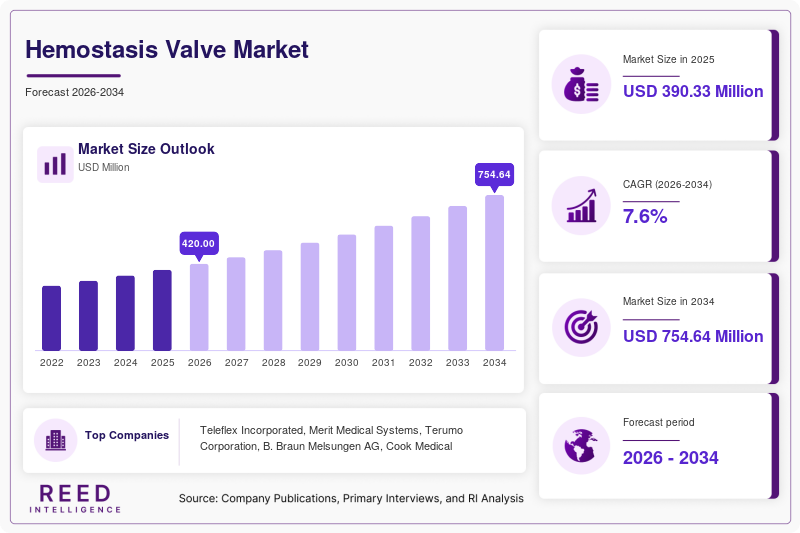
The Hemostasis Valve Market size is estimated at USD 420 million, and it is projected to reach USD 760 million by 2034, registering a CAGR of 7.6% during the forecast period (2026–2034).One of the key global factors supporting Hemostasis Valve Market growth is the increasing prevalence of cardiovascular and neurovascular diseases, which has significantly boosted the demand for catheter-based diagnostic and therapeutic procedures. Hemostasis valves play a critical role in preventing blood leakage during such interventions while ensuring smooth device exchange, thereby enhancing procedural safety and efficiency.
Another important contributor to Hemostasis Valve Market expansion is the rapid technological advancement in interventional cardiology devices, particularly in emerging economies where healthcare infrastructure is modernizing at a fast pace.
Key Highlights
- Dominant region (2025 share): North America – 38%
- Fastest-growing region CAGR (2026–2034): Asia Pacific – 8.9%
- Dominant subsegment (Type): Y-connector hemostasis valves – 44% share in 2025
- Fastest-growing subsegment (Type CAGR): Rotating hemostasis valves – 8.8% CAGR
- Dominant country (2024–2025 market value): United States – USD 140 million (2024), USD 150 million (2025)
The Hemostasis Valve Market continues to evolve with increased integration into advanced catheter systems, reinforcing its importance in modern minimally invasive procedures.
Market Trends
Shift Toward Rotational and Ergonomic Valve Designs
The Hemostasis Valve Market is increasingly witnessing a shift toward ergonomic and rotational valve systems that allow smoother device manipulation during complex interventional procedures. These designs reduce friction, improve control, and minimize blood loss, thereby improving procedural efficiency. Manufacturers are focusing on user-friendly designs compatible with next-generation catheters, which is positively influencing Hemostasis Valve Market trends globally.
Rising Integration with Advanced Imaging-Guided Procedures
Another significant trend shaping the Hemostasis Valve Market is its integration with imaging-guided interventional procedures such as fluoroscopy and intravascular ultrasound-assisted surgeries. These procedures require high-precision vascular access systems, and hemostasis valves are being optimized for compatibility with such technologies, enhancing procedural accuracy and safety.
Market Drivers
Increasing Volume of Minimally Invasive Procedures
The growing preference for minimally invasive surgeries is a key driver of the Hemostasis Valve Market. These procedures require precise vascular access and controlled hemostasis, leading to higher adoption of advanced valve systems. The rise in angioplasty, stent placement, and diagnostic catheterization is directly supporting market expansion.
Expansion of Cardiovascular Intervention Procedures
The increasing incidence of cardiovascular disorders worldwide is driving demand for interventional cardiology procedures. As these procedures heavily rely on catheter-based systems, the Hemostasis Valve Market is benefiting from consistent procedural growth across hospitals and specialized cardiac centers.
Market Restraint
High Product Cost and Pricing Pressure
One of the major restraints affecting the Hemostasis Valve Market is the relatively high cost of advanced valve systems. In cost-sensitive healthcare environments, particularly in developing regions, this limits widespread adoption. Additionally, pricing pressure from generic medical device manufacturers further challenges revenue expansion for premium product providers.
Market Opportunities
Expansion in Emerging Healthcare Infrastructure
The rapid development of healthcare infrastructure in emerging economies presents a strong opportunity for the Hemostasis Valve Market. Increasing investments in catheterization labs and surgical facilities are expected to create sustained demand for advanced vascular access devices.
Innovation in Single-Use and Disposable Valve Systems
The shift toward single-use medical devices is creating new opportunities in the Hemostasis Valve Market. Disposable valves reduce infection risks and improve procedural efficiency, making them highly attractive in high-volume surgical environments.
Segmental Analysis
By Type
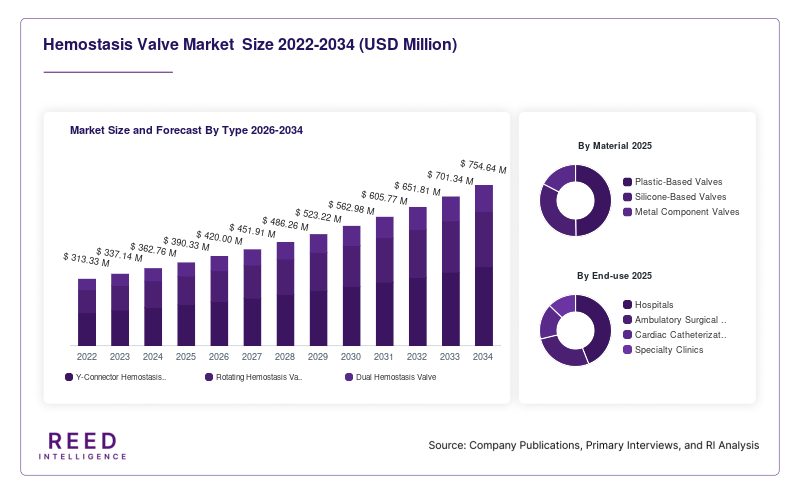
The Hemostasis Valve Market is segmented into Y-connector valves, rotating valves, and dual hemostasis valves. In 2025, Y-connector hemostasis valves dominated with 44% share, primarily due to their widespread use in standard catheterization procedures. However, rotating hemostasis valves are expected to grow at a CAGR of 8.8%, driven by their enhanced maneuverability during complex interventions requiring precise device control.
By Material
Based on material, the market includes plastic, silicone, and metal-based components. In 2025, plastic-based valves held 52% share, supported by cost efficiency and ease of manufacturing. Meanwhile, silicone-based valves are projected to grow at a CAGR of 8.5%, driven by improved flexibility, biocompatibility, and reduced risk of vascular trauma.
By End-use
Hospitals, ambulatory surgical centers (ASCs), cardiac catheterization laboratories, and specialty clinics form key end-users. Hospitals accounted for 48% share in 2025, due to high patient inflow and complex surgical procedures. However, ASCs are expected to expand at a CAGR of 9.0%, driven by cost-effective outpatient procedures and increasing preference for same-day surgeries.
By Application
The Hemostasis Valve Market is segmented into interventional cardiology, radiology, neurology, and peripheral vascular procedures. Interventional cardiology dominated with 46% share in 2025, supported by high global procedure volumes. On the other hand, neurology applications are expected to grow at a CAGR of 9.2%, driven by increasing adoption of neurovascular interventions and rising stroke-related treatments.
Regional Analysis
North America
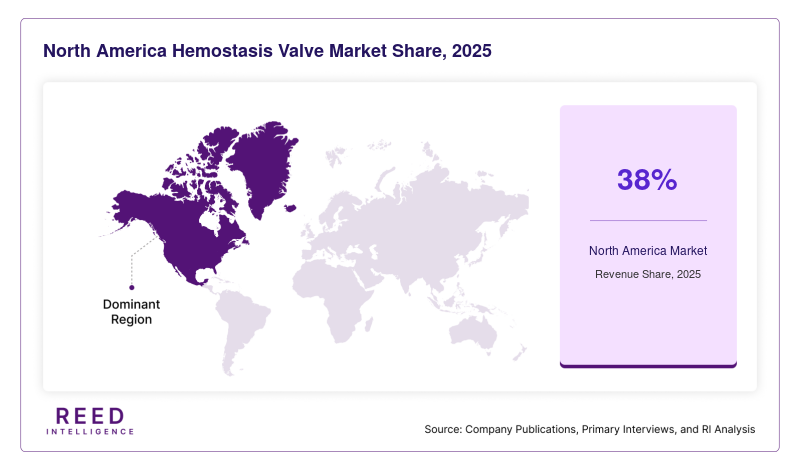
North America accounted for 38% of the global Hemostasis Valve Market share in 2025, driven by a strong presence of advanced healthcare systems and high procedural volumes in interventional cardiology. The region is projected to grow at a CAGR of 7.2% (2026–2034), supported by continuous technological upgrades and strong reimbursement frameworks. The United States remains the dominant country due to high adoption of advanced catheter-based interventions and early integration of innovative medical devices.
Europe
Europe held 27% share in 2025 of the Hemostasis Valve Market, with growth supported by rising cardiovascular disease prevalence and well-established surgical infrastructure. The region is expected to grow at a CAGR of 6.8%. Germany leads the regional market due to strong medical device manufacturing capabilities and high procedural efficiency in hospital systems.
Asia Pacific
Asia Pacific represented 23% share in 2025 and is projected to be the fastest-growing region with a CAGR of 8.9%. Growth is driven by expanding healthcare investments, increasing patient population, and rising adoption of minimally invasive procedures. China is the dominant country, supported by rapid hospital expansion and increasing interventional cardiology procedures.
Middle East & Africa
The Middle East & Africa accounted for 7% share in 2025 and is expected to grow at a CAGR of 8.1%. Growth is supported by healthcare modernization initiatives and increasing demand for advanced surgical procedures. The United Arab Emirates leads the region due to growing medical tourism and advanced hospital infrastructure.
Latin America
Latin America held 5% share in 2025 and is projected to grow at a CAGR of 7.4%. Brazil dominates the regional Hemostasis Valve Market due to expanding public healthcare investment and increasing adoption of interventional diagnostic procedures.
Competitive Landscape
The Hemostasis Valve Market is moderately consolidated, with several global and regional players competing on innovation, product performance, and pricing strategies. Key companies include Teleflex Incorporated, Merit Medical Systems, Terumo Corporation, B. Braun Melsungen AG, and Cook Medical. Among these, Teleflex Incorporated holds a leading position due to its strong distribution network and diversified interventional product portfolio.
The company has recently expanded its product line with next-generation hemostasis valve systems designed for improved pressure resistance and ergonomic handling. Merit Medical Systems continues to focus on innovation in single-use vascular access devices, strengthening its presence in hospital procurement channels. Terumo Corporation emphasizes precision-engineered catheter accessories, while B. Braun Melsungen AG focuses on integrated surgical solutions. Cook Medical maintains a strong foothold through its specialty interventional devices. Overall, competition in the Hemostasis Valve Market is driven by innovation, regulatory approvals, and expanding global healthcare demand.
Key Players List
- Teleflex Incorporated
- Merit Medical Systems
- Terumo Corporation
- B. Braun Melsungen AG
- Cook Medical
- Boston Scientific Corporation
- Cardinal Health Inc.
- Abbott Laboratories
- Medtronic plc
- Smiths Medical
- Edwards Lifesciences
- Argon Medical Devices
- Nipro Corporation
- Surmodics Inc.
- Guangdong Baihe Medical Technology
Recent Developments
- In 2025, leading manufacturers introduced enhanced rotational hemostasis valves designed to improve catheter control and reduce procedural complications.
- Several companies expanded production capacities in Asia Pacific to meet rising demand for cost-effective interventional devices.
- Strategic collaborations between medical device firms and hospital networks increased to improve supply chain efficiency and product accessibility.
- Regulatory approvals for advanced single-use valve systems accelerated in North America and Europe, supporting infection control initiatives.
- R&D investments increased in biocompatible materials, particularly silicone-based valve systems, to enhance durability and patient safety in the Hemostasis Valve Market.
Hemostasis Valve Market Segments
By Type
- Y-Connector Hemostasis Valve
- Rotating Hemostasis Valve
- Dual Hemostasis Valve
By Material
- Plastic-Based Valves
- Silicone-Based Valves
- Metal Component Valves
By End-use
- Hospitals
- Ambulatory Surgical Centers (ASCs)
- Cardiac Catheterization Laboratories
- Specialty Clinics
By Application
- Interventional Cardiology
- Radiology
- Neurology
- Peripheral Vascular Procedures
By Region
- North America
- Europe
- APAC
- Middle East and Africa
- LATAM